
On this page
Start here
Quick answer
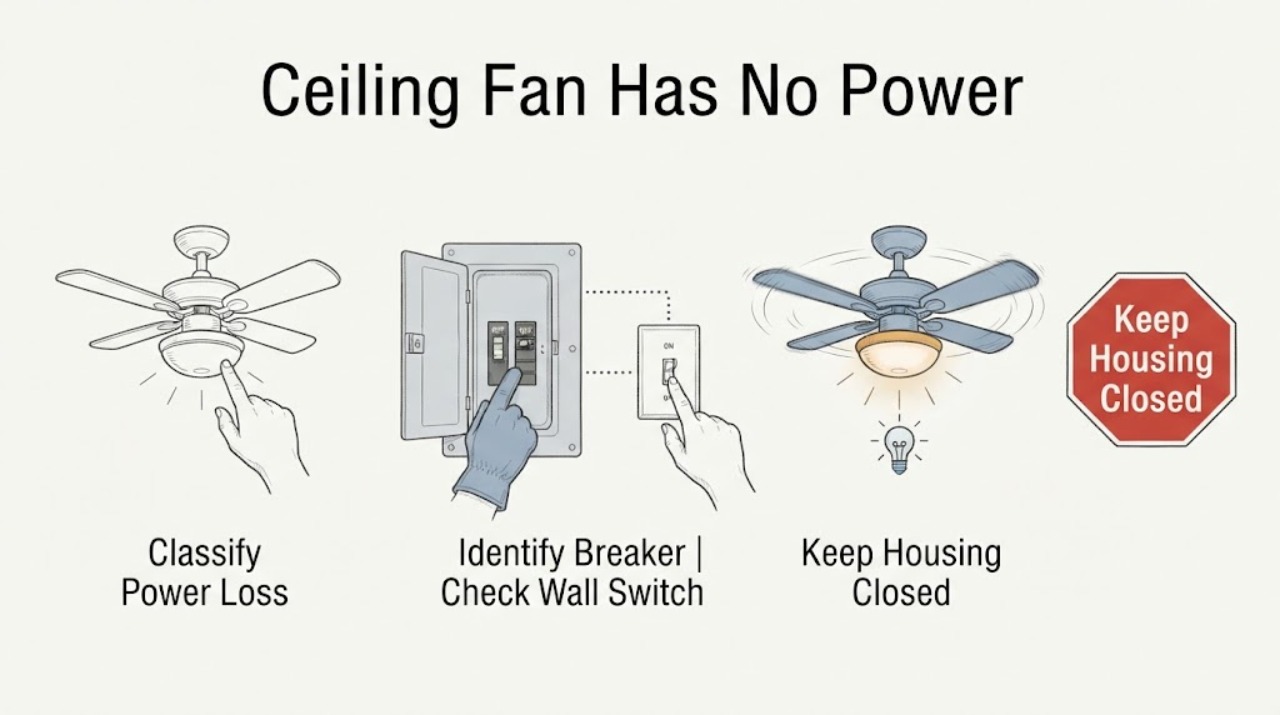
When a ceiling fan has no power, first determine whether the light and fan are both dead, then check the correct circuit breaker and the wall switch or remote control without opening the canopy. If the breaker trips again, the switch is hot or damaged, wires are exposed, the fan is loose, there is an arc or burning odor, or the fan is wet, leave the circuit off and call a qualified electrician. A wall switch being off is not proof that ceiling wiring is safe: OSHA requires exposed electrical parts to be de-energized and verified with appropriate test equipment before work. Do not remove the canopy, touch wiring, change connections, bypass a safety device, or climb to the fan while the circuit may be energized.
Before you begin
Safety first
- This guide permits only normal control use, a safe breaker-position observation, and visual checks from the floor. Do not open the canopy or switch box, touch wiring, test exposed parts, bypass an interlock, climb to an unstable fan, or re-energize a damaged circuit. A qualified person must de-energize and verify the circuit before electrical work.
Work through in order
Diagnostic checks
Use only checks that match the exact appliance or system and its official guide.
-
Check 1
From the floor and without touching the fan, note whether the fan motor, fan light, wall control, and any remote indicator respond when the normal controls are used once.
Expected result: Record whether both fan and light are dead, only the motor is dead, only the light is dead, the wall control has no response, or the fan starts and stops unexpectedly.
Next step: Continue only with the safe breaker and switch-position checks when there is no hazard; request electrical service for any odor, heat, exposed wire, or unpredictable operation.
Stop if: Stop immediately for sparks, an arc, burning odor, smoke, hot switch plate, water near the fan, exposed conductors, a loose fan, or a breaker that has already tripped repeatedly.
Why this matters
Why: Both functions being dead supports a supply, breaker, switch, or wiring branch. One function working points toward its separate control or fan component. Start-and-stop behavior or a sudden failure with heat or odor is a safety fault, not a normal control issue.
-
Check 2
From a dry, stable floor position, identify the breaker or fuse labeled for the ceiling fan or room and observe whether it is fully on, visibly tripped, or associated with other dead fixtures.
Expected result: Note whether the fan shares a circuit with room lighting or outlets, whether the breaker handle is between positions, and whether other fixtures lost power at the same time.
Next step: If there is no hazard, switch a tripped breaker fully off and then on once; if it trips again or will not reset, leave it off and call a qualified electrician.
Stop if: Do not remove the panel cover, replace a fuse with a different rating, reset repeatedly, touch wet equipment, or work at the panel if there is heat, smoke, arcing, or a burning smell.
Why this matters
Why: A tripped breaker or several dead fixtures suggests an upstream circuit event. A breaker that appears on but a fan that remains dead shifts attention to the switch, wiring, control, or fan assembly; the panel position alone does not prove de-energization.
-
Check 3
With the breaker status known and no hazard present, verify that the wall switch is in the intended on position and that any model-specific pull chain, remote, or receiver control has not disabled the fan.
Expected result: Record whether the switch feels loose, hot, cracked, or stuck; whether the remote or wall control responds; and whether the light and motor change independently.
Next step: Use only the normal control sequence in the exact fan manual; arrange service for a damaged control, a warm switch, an unknown receiver, or continued loss of power.
Stop if: Do not remove the switch plate, pull the fan chain forcefully, open a remote receiver, bypass a control, or touch the canopy or ceiling box.
Why this matters
Why: A loose, hot, cracked, or nonresponsive switch can interrupt power or indicate a failing connection. If controls respond normally but the fan is still dead, a ceiling connection, receiver, motor, or internal wiring fault needs professional diagnosis.
-
Check 4
From the floor and without a ladder, visually inspect the accessible fan, canopy, blades, wall control, and nearby ceiling for loose mounting, exposed wire, moisture, scorch marks, cracked parts, or an object striking the blades.
Expected result: Note sagging, a gap at the ceiling, blade separation, wobble, damaged insulation, discoloration, water staining, or anything that could fall or contact the fan.
Next step: Keep the circuit off and arrange qualified electrical or fan service; check the CPSC recall database using the model information only from a safe location if a product hazard is suspected.
Stop if: Do not steady the fan, tighten overhead hardware, remove a blade, climb, touch an exposed wire, or energize a wet or damaged fan.
Why this matters
Why: A mounting or blade hazard is independent of the no-power diagnosis and requires the area below the fan to remain clear. Moisture, exposed wire, scorch marks, or damaged insulation can make the circuit unsafe to re-energize.
-
Check 5
If any repair or wiring inspection would be needed, stop at the household control boundary and arrange a qualified electrician to disconnect, lock or tag where applicable, and verify the circuit with suitable test equipment.
Expected result: The qualified person should document which disconnect controls the fan, whether the fan can be restarted, whether exposed parts are actually de-energized, and whether unrelated or back-fed voltage is present.
Next step: Give the electrician the symptom map, breaker behavior, switch observations, model information, and any hazard history; do not open the canopy yourself.
Stop if: Stop all hands-on work when verification would require a meter on exposed parts, panel access, arc-flash exposure, a ladder, or work near an unstable fan.
Why this matters
Why: A switch position or breaker label is not enough when someone may contact wiring. OSHA's work-practice guidance requires de-energization and verification before work near exposed electrical parts, with only qualified persons working on energized equipment.
-
Check 6
Prepare a service record from the floor without removing the fan or canopy: note the model or serial marking if safely visible, control type, breaker behavior, switch condition, light-versus-motor symptom, and visible mounting condition.
Expected result: Record when the fan stopped, whether it had wobble or noise, whether the light or motor changed first, whether the breaker tripped, and whether smoke, heat, moisture, or an arc occurred.
Next step: Leave the fan off when the cause is not a simple safe control setting and request qualified electrical service; keep people clear if the fan is loose or damaged.
Stop if: Do not continue if the model marking is inside the canopy, access requires a ladder, the fan is unstable, or any electrical part is exposed.
Why this matters
Why: This record helps an electrician separate an upstream circuit fault from a wall control, ceiling connection, receiver, motor, or wiring issue and lets a safety professional check for a matching recall without energizing the fan.
Use your observations
Decision map
Find the observation that best matches what you see, then follow the next safe action.
-
PATH 01Next step
What you see
The fan motor and light are both dead, and other room fixtures are also without power.
Do this next
Check the correct breaker or fuse from a safe position. Reset once only when no hazard is present; a repeat trip or continued loss of power needs qualified electrical service.
-
PATH 02Next step
What you see
The light works but the fan motor does not, or the fan runs but the light does not.
Do this next
Use the normal control or remote sequence from the exact fan manual. If the control responds but one function remains dead, arrange fan or electrical service rather than opening the canopy.
-
PATH 03Next step
What you see
The wall switch is hot, cracked, loose, stuck, discolored, or produces a smell or sound.
Do this next
Leave the circuit off and request qualified electrical service; do not remove the switch plate or keep operating a suspect connection.
-
PATH 04Next step
What you see
The breaker trips again, a fuse opens again, or the panel or circuit produces heat, arc, smoke, or odor.
Do this next
Do not reset again. Keep clear of the hazard and arrange qualified electrical service; exposed parts must be de-energized and verified before work.
-
PATH 05Next step
What you see
The fan is loose, sagging, damaged, wet, wobbling, or has exposed wiring or a possible recall condition.
Do this next
Keep everyone out from underneath, leave the circuit off, and arrange qualified inspection. Do not support, climb to, or energize the fan.
-
PATH 06Next step
What you see
The breaker and normal controls appear correct but the ceiling fan remains without power.
Do this next
Treat the issue as a wiring, ceiling connection, receiver, motor, or control fault requiring a qualified electrician; do not infer a part or open the canopy.
Helpful context
Understand the symptom
Use the light and fan symptoms to narrow the fault
A ceiling fan can have separate controls for the motor and light. If the light works but the blades do not, the branch may be in the fan control, wall switch, remote receiver, motor circuit, or fan assembly. If both are dead, the circuit breaker, supply switch, wiring, or a connection upstream becomes more likely. These observations narrow the service request; they do not justify opening the ceiling canopy or testing exposed conductors.
A breaker trip is a stop signal, not a reset loop
A breaker may open because of a fault, overload, damaged wiring, or a component problem. Turn the fan control off and identify the labeled circuit only from a safe standing position. A single reset may be reasonable when there is no smell, heat, moisture, visible damage, or unusual sound, but a repeat trip means leave the circuit off and request electrical service. Do not substitute a larger breaker or keep cycling the handle.
Treat fan mounting and blade hazards separately from loss of power
A loose canopy, sagging fan, damaged blade, exposed wire, or unusual wobble can create both impact and electrical hazards. The Consumer Product Safety Commission maintains ceiling-fan recall information, including cases involving blade separation. If the fan is loose, has visible damage, or may be recalled, keep people out from underneath it and arrange qualified inspection rather than attempting to support or rewire it.
Only after diagnosis
Potential parts
- wall switch or fan control
Consider this category only after qualified diagnosis confirms that the switch or fan control is damaged or incompatible with the fan and circuit.
Confirm the fan's control type, wiring arrangement, load requirements, and local electrical requirements with the electrician before ordering. - ceiling fan receiver
Consider this category only after qualified diagnosis confirms a receiver fault in a fan that uses a remote or wireless control.
Confirm the exact fan model and receiver system; installation requires safe access and verified de-energization. - ceiling fan wiring or junction-box component
Consider this category only if a qualified electrician confirms damaged wiring or an unsuitable ceiling-box component as the source of the no-power or mounting fault.
Confirm the existing circuit, box rating, mounting method, conductor condition, and applicable code; do not select a component from the symptom alone.
When checks do not resolve it
Need a professional?
Call a qualified electrician when the fan remains dead after a safe breaker and normal-control check, when only one function works, when a switch is damaged or warm, when a breaker trips again, or when any canopy, ceiling-box, wiring, or motor access is required. Leave the circuit off and keep people clear for sparks, arcing, smoke, burning odor, moisture, exposed wires, a loose or falling fan, or an unstable mounting.
Safety scope: This guide permits only normal control use, a safe breaker-position observation, and visual checks from the floor. Do not open the canopy or switch box, touch wiring, test exposed parts, bypass an interlock, climb to an unstable fan, or re-energize a damaged circuit. A qualified person must de-energize and verify the circuit before electrical work.
Common questions
FAQ
Why is my ceiling fan not getting power?
Determine whether both the light and motor are dead, then check the correct breaker and normal wall or remote control from a safe position. If those checks pass, the fault may be in the switch, wiring, ceiling connection, receiver, or motor and needs qualified electrical diagnosis.
Can I use the wall switch to prove the ceiling fan wiring is safe?
No. A switch is a control device, not proof that exposed wiring is de-energized. Do not open the canopy or switch box; a qualified person must isolate and verify the circuit before electrical work.
What should I do if the ceiling-fan breaker keeps tripping?
Stop resetting it. Leave the circuit off and arrange qualified electrical service, especially if there is heat, smoke, an arc, a burning odor, moisture, or a damaged fan. Do not replace the breaker with a different rating.
Is a loose ceiling fan related to a no-power problem?
It may be a separate mounting or blade hazard, but both conditions require the fan to remain off. Keep people out from underneath it and arrange qualified inspection without climbing or touching the fan.
Read the exact guide
Official sources
- eTool: Lockout-Tagout - Hot Topics - Energy Control Program - Specific Procedures for Energy Control and Control Circuitry ProhibitionOccupational Safety and Health Administration · Supports identifying energy sources, isolating equipment, controlling stored energy, and verifying isolation before service.
- 1910.333 - Selection and use of work practicesOccupational Safety and Health Administration · Supports the no-opening, de-energize, verify, and qualified-person boundaries for ceiling-fan wiring and switch work.
- Ceiling FansUnited States Consumer Product Safety Commission · Supports stopping use and keeping people clear when a ceiling fan has a blade, mounting, or other recalled-product hazard.
Community feedback
Share a repair observation
Share a plain-text repair observation. Accepted observations are published automatically; this page may take a moment to update.