
On this page
Start here
Quick answer
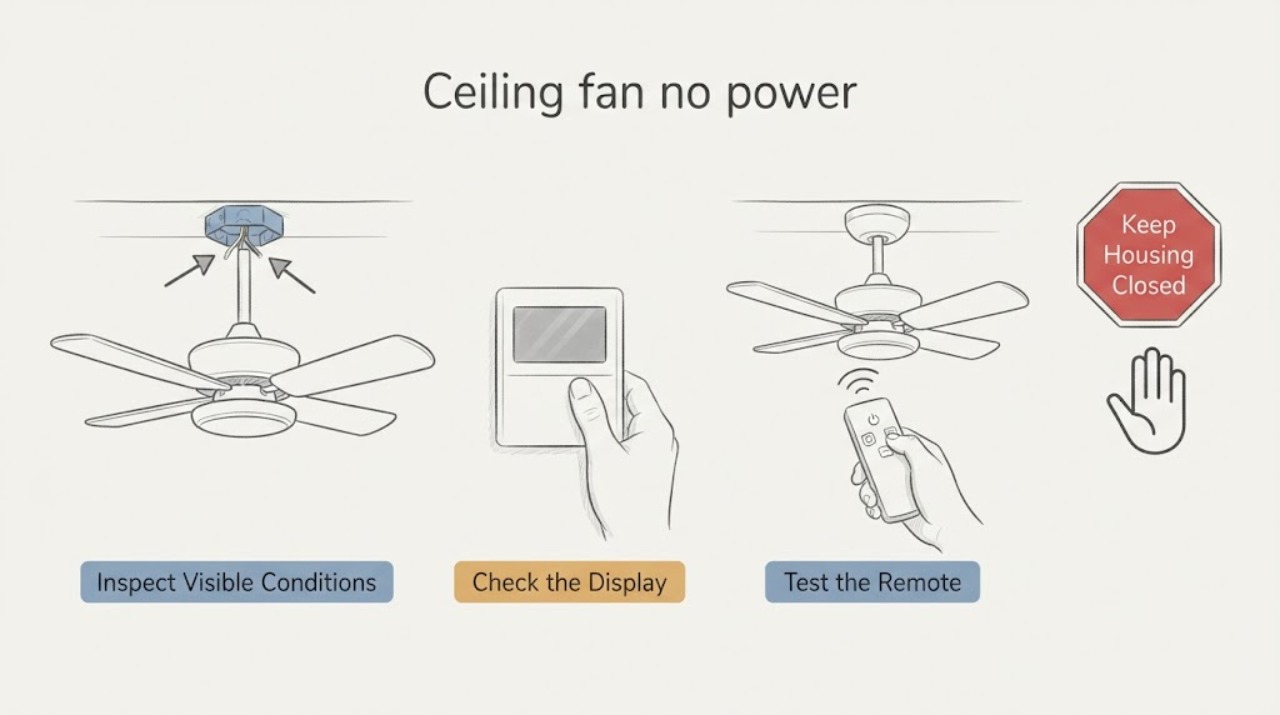
If a ceiling fan has no power, first confirm whether the failure is the fan, its wall switch or pull chain, its remote, or the room circuit. From the floor, try the known wall switch, pull chain, reverse switch, or remote control and see whether the fan light or another device on the same circuit works. Check the labeled breaker or fuse once and reset it only if it moves normally and there is no smell, heat, smoke, arcing, water, or visible damage. If the breaker trips again, the switch has no power, the fan has burn marks or a hot housing, or wiring is suspected, leave the fan off and call a licensed electrician. Do not remove the canopy, open a switch box, touch wiring, use a tester on live parts, bypass protection, or keep resetting the breaker.
Before you begin
Safety first
- This article supports floor-level observation, known control checks, and one safe protection check only. Do not remove covers, touch wiring, test live parts, bypass protection, or reach into an overhead fan.
Work through in order
Diagnostic checks
Use only checks that match the exact appliance or system and its official guide.
-
Check 1
From the floor, note whether the fan, its light, its remote indicator, and any nearby device on the same wall or room circuit respond; do not climb, remove parts, or reach toward the fan.
Expected result: Both fan and light are dead, the light works but the fan does not, the fan hums or clicks, the remote is unresponsive, or the nearby device is also without power.
Next step: Use the matching switch, remote, and breaker branch below; leave the fan off if there is heat, smell, smoke, arcing, water, or visible damage.
Stop if: Stop for a hot surface, burning smell, smoke, crackling, sparks, water at the ceiling or switch, damaged housing, or any need to reach the fan or wiring.
Why this matters
Why: Fan and light both dead suggests a switch, circuit, receiver, or supply issue. A working light narrows the issue toward the fan control or motor path. A nearby dead device suggests a broader circuit interruption rather than a fan-only fault.
-
Check 2
With both hands on the floor, turn the known wall switch on, pull the fan chain once if fitted, set the fan's reverse switch fully to one side only when the control is reachable without climbing, and press the remote's on control if the fan is remote-operated.
Expected result: The fan starts, the light responds but the blades do not, the chain has no normal click or the remote has no indicator, or none of the controls produces any response.
Next step: If the remote is the only problem, replace its battery or follow the exact pairing instructions. If the fan remains dead, check the room circuit once and then arrange electrical service.
Stop if: Do not climb on furniture, force a chain or switch, substitute a dimmer, open a remote receiver, or continue if the control is hot, damaged, wet, or crackling.
Why this matters
Why: A response from one control points to a control-state or remote issue. No response from all known controls keeps the circuit, switch, receiver, or wiring in scope; a chain or switch that feels broken should not be forced.
-
Check 3
For a remote-operated fan, install a fresh battery of the type specified by the remote manual, stand at the normal operating position, and use the fan's on control once; do not open the receiver or change internal settings.
Expected result: The remote indicator or fan responds, the light responds but the motor does not, the remote remains dead, or the fan responds intermittently.
Next step: Follow only the model manual for pairing or remote settings; if the receiver or fan still does not respond, keep the power off and ask a technician to assess the receiver and wiring.
Stop if: Do not remove the canopy, access the receiver, change wiring, or keep cycling the fan if it buzzes, heats, sparks, or smells burnt.
Why this matters
Why: A dead remote or intermittent response can be a battery, pairing, range, receiver, or fan-power issue. A light response with no motor response means the fan is not completely without power, so wiring is not proven by the symptom alone.
-
Check 4
From a dry position at the electrical panel, identify the fan or room breaker or fuse and check its visible state once; reset it only if it is clearly tripped and there is no hazard or unusual condition.
Expected result: The protection is open, resets and holds, will not reset, trips again when the fan is used, or no labeled protection clearly corresponds to the fan.
Next step: If one safe reset holds, make one normal fan-control check. If it trips again, will not reset, or the fan remains dead, leave the circuit off and call a licensed electrician.
Stop if: Do not repeatedly reset protection, replace a fuse with an unknown type, open the panel beyond normal control access, or touch a hot, wet, smoking, or arcing panel or switch.
Why this matters
Why: A single open breaker or fuse may explain no power, but a repeat trip indicates a fault or overload that should not be challenged. An unclear panel or failed reset requires professional identification.
-
Check 5
From the floor and without removing the canopy or switch cover, look for a loose-looking wall plate, cracked fan housing, water staining, burn mark, damaged cord or control, unusual wobble, or an obstruction that prevents the blades from moving freely.
Expected result: The exterior is normal, a visible part is damaged or hot, water has reached the ceiling or switch, the blades are obstructed, or the fan is mechanically loose or moving.
Next step: Leave the wall switch and breaker off for damage, water, heat, wobble, or wiring concerns and call an electrician; only report a clear external obstruction to the technician rather than reaching into the fan.
Stop if: Do not touch the canopy, switch box, blades, mounting hardware, wiring, or wet surface, and do not operate a fan with damaged housing, wobble, smoke, or burn marks.
Why this matters
Why: A normal exterior does not clear hidden wiring. Damage, water, heat, or a loose mounting condition makes continued operation unsafe; an obstruction can explain a stopped motor but must not be cleared near energized equipment.
-
Check 6
Give the electrician the fan model, control type, fan-and-light response, breaker result, room-circuit result, timing of the failure, and any smell, heat, noise, water, or visible damage; keep the fan isolated until assessed.
Expected result: The fan returns to normal after one safe control or breaker check, or it remains dead, trips protection, has a damaged control, or has a suspected wiring or ceiling-box fault.
Next step: Use the fan only if it operates normally without noise, heat, odor, wobble, or protection trips; otherwise leave it off and schedule an electrician to inspect the circuit and fan installation.
Stop if: Stop all user troubleshooting for suspected wiring, loose connections, repeated trips, hot parts, arcing, smoke, water, or any uncertainty about electrical safety.
Why this matters
Why: A one-time recovery points to a control state or circuit interruption but does not prove the wiring is sound. Persistent no power, repeat trips, or any wiring symptom needs professional electrical diagnosis.
Use your observations
Decision map
Find the observation that best matches what you see, then follow the next safe action.
-
PATH 01Safety boundary
What you see
The fan, light, and another device on the same room circuit are all dead, or the labeled breaker or fuse is open.
Do this next
Perform no more than one safe reset from the panel; if protection will not hold or the room remains without power, call a licensed electrician.
Why this path and its safety boundary
Why it matters: The interruption is likely upstream of the fan, but a repeat trip or failed reset can indicate a wiring or load fault.
Safety stop: Do not repeatedly reset protection or use the fan with smoke, smell, heat, water, arcing, or damaged equipment.
-
PATH 02Safety boundary
What you see
The room has power and the fan responds to a switch, chain, remote battery, or pairing action but not the expected control.
Do this next
Use only the model manual for the remote or control; leave receiver and wiring work to an electrician or qualified fan technician.
Why this path and its safety boundary
Why it matters: A control state, remote, receiver, incompatible control, or model-specific setting is more likely than a completely dead fan circuit.
Safety stop: Do not substitute a dimmer, open a receiver, force a chain, or continue if the control is hot, wet, damaged, or crackling.
-
PATH 03Safety boundary
What you see
The room and light have power but the fan motor has no response, or the fan hums or clicks without starting.
Do this next
Keep the fan off and provide the model and response pattern to a technician; do not reach into the fan or perform internal tests.
Why this path and its safety boundary
Why it matters: A fan control, receiver, motor, capacitor, or wiring harness may be involved; the symptom alone does not identify the failed component.
Safety stop: Stop for a hot housing, burning odor, smoke, arcing, unusual mechanical resistance, or repeated protection trip.
-
PATH 04Safety boundary
What you see
The breaker holds but the switch or fan has no power, a connection is suspected, or there is a visible burn mark, damaged conductor, water stain, or loose mounting condition.
Do this next
Leave the breaker and fan switch off and call a licensed electrician with the model and observations; do not open the canopy or switch box.
Why this path and its safety boundary
Why it matters: A supply, switch, ceiling-box, receiver, or fan wiring fault is possible and requires qualified electrical work.
Safety stop: Do not touch wiring, remove covers, test live parts, bypass protection, or restore power to see whether a suspected fault repeats.
-
PATH 05Safety boundary
What you see
There is smoke, an arc, burning odor, a hot switch or housing, water at electrical equipment, a repeated trip, or an exposed conductor.
Do this next
Move away, leave the circuit off only if it can be done without approaching the hazard, and arrange emergency electrical assessment or local emergency help as appropriate.
Why this path and its safety boundary
Why it matters: This is an immediate electrical or fire hazard, not a user troubleshooting branch.
Safety stop: Do not touch the fan, switch, panel, water, wiring, or damaged parts and do not re-energize the circuit.
Helpful context
Understand the symptom
No power is not the same as a bad motor
A completely inactive fan can lose power at the wall switch, remote receiver, branch circuit, or wiring before the motor is involved. If the light works but the blades do not, or if the fan hums without starting, the diagnostic path is different from a fan and light that are both dead. The component named wiring is a reason to stop at external observations and arrange professional inspection, not permission to open the ceiling canopy.
Use only controls you already know
From the floor, use the installed wall switch, pull chain, reverse switch, or remote in the way the fan manual describes. A remote may need a fresh battery or pairing, and a pull-chain fan may still be off at the chain even when the wall switch is on. Do not substitute a dimmer or speed control unless the exact fan manual says it is compatible.
Wiring work belongs to an electrician
A loose connection, damaged conductor, failed switch, receiver, or ceiling-box connection can leave a fan without power and can create shock or fire risk. If the accessible switch or breaker check does not restore normal operation, keep the fan off. An electrician can make the circuit safe and determine whether the fault is in the supply wiring, control, receiver, or fan assembly.
Safety boundary
Stop conditions
- Do not remove the canopy, switch cover, light kit, receiver, or junction-box cover as a user check.
- Do not touch wiring, use a voltage tester on live parts, bypass protection, or work on a circuit that may still be energized.
- Do not repeatedly reset a breaker or fuse, use an extension lead, or keep operating a fan that trips protection.
- Stop for smoke, sparks, crackling, burning odor, a hot switch or housing, water near electrical equipment, exposed conductors, or a damaged ceiling box.
- Do not climb or reach into a moving or overhead fan; let blades stop before any external observation and keep all checks at floor level.
- Treat suspected wiring, loose connections, or no power at the switch as an electrician service condition even if the fan has no visible damage.
Only after diagnosis
Potential parts
- fan remote or receiver
Consider this category only when the exact fan model and control symptoms support a remote or receiver fault after the room circuit and known controls are safe.
Confirm the exact fan model and manufacturer pairing requirements; do not open or replace a receiver in an energized fan. - wall switch or fan control
Consider this category only when an electrician confirms the switch or control is defective and the fan and circuit are otherwise suitable.
Confirm the wiring method, load and speed-control compatibility, and local installation requirements with a licensed electrician. - fan wiring harness or ceiling-box connection
Consider this category only after a licensed electrician identifies a damaged harness or connection on the exact fan and verifies the mounting and supply arrangement.
This is professional electrical work; confirm the exact model, listed parts, conductors, grounding, and ceiling-box support before any replacement.
When checks do not resolve it
Need a professional?
Call a licensed electrician when the fan and light remain dead after known switch, pull-chain, remote, and one safe breaker check; when the switch has no power; when wiring, a receiver, ceiling-box connection, or control is suspected; or when a breaker trips again. Stop immediately for smoke, arcing, burning odor, hot parts, water, exposed wiring, damaged mounting, or any uncertainty about electrical safety.
Safety scope: This article supports floor-level observation, known control checks, and one safe protection check only. Do not remove covers, touch wiring, test live parts, bypass protection, or reach into an overhead fan.
Common questions
FAQ
Why does my ceiling fan have no power?
The room circuit, wall switch, pull chain, remote or receiver, fan control, ceiling-box connection, or wiring may be involved. Start from the floor with known controls and one safe breaker check; do not assume the motor is bad.
What should I check before calling an electrician?
Check the known wall switch, pull chain, remote battery or pairing, and whether another device on the same circuit works. Check the labeled breaker or fuse once if there is no smell, heat, smoke, water, or damage. Leave wiring and internal fan checks to an electrician.
The light works but the ceiling fan does not. Is there still power?
Some power is reaching the fan assembly, but the motor control, receiver, capacitor, switch, or wiring harness may still be faulty. Do not open the fan; record the light-and-motor difference for a technician.
Should I reset the breaker more than once?
No. A single reset is reasonable only when the breaker is clearly tripped and there is no hazard. If it trips again, will not reset, or the fan remains dead, leave it off and call a licensed electrician.
Can I inspect the ceiling fan wiring myself?
Not as a routine user check. Suspected wiring requires a licensed electrician. Do not remove the canopy or switch cover, touch conductors, test live parts, bypass protection, or work near a wet, hot, smoking, or arcing fan.
Read the exact guide
Official sources
- Air Conditioner and Fan SafetyElectrical Safety Foundation International · Official electrical-safety organization guidance used for the professional service boundary around fan electrical work.
- My fan stopped working. What do I do?Hunter Fan Support Site and Help Center · Official Hunter guidance used as a manufacturer example for generic ceiling-fan checks; control and wiring details vary by brand and model.
- How to Fix a Ceiling Fan That Won't Turn On, Wobbles, or Makes NoiseHunter Fan Company · Official Hunter guide used as a general ceiling-fan example; always match any repair to the actual fan manual and use a licensed electrician for wiring.
Community feedback
Share a repair observation
Share a plain-text repair observation. Accepted observations are published automatically; this page may take a moment to update.