
On this page
Start here
Quick answer
If a ceiling fan has no power, first determine whether the room, wall switch, remote or pull chain, or the fan itself is the part that is unresponsive. From floor level, try the normal wall switch and the fan's normal pull-chain or remote control, and check whether the fan light or another room fixture still works. Check the circuit breaker once only if there is no water, burning smell, sparking, heat, or other hazard. If the breaker trips again, the fan has damaged or loose wiring, the ceiling box or fan is loose, or the next check requires a ladder, canopy removal, or live electrical testing, leave the circuit in a safe state and call a qualified electrician. Do not open the canopy or switch housing or touch internal wiring based on the symptom alone.
Before you begin
Safety first
- User checks are limited to normal controls, safe room-load observation, and one safe breaker check when no hazard is present. Do not open covers, access wiring, climb, perform live testing, bypass protection, or energize a wet, damaged, loose, or sagging fan.
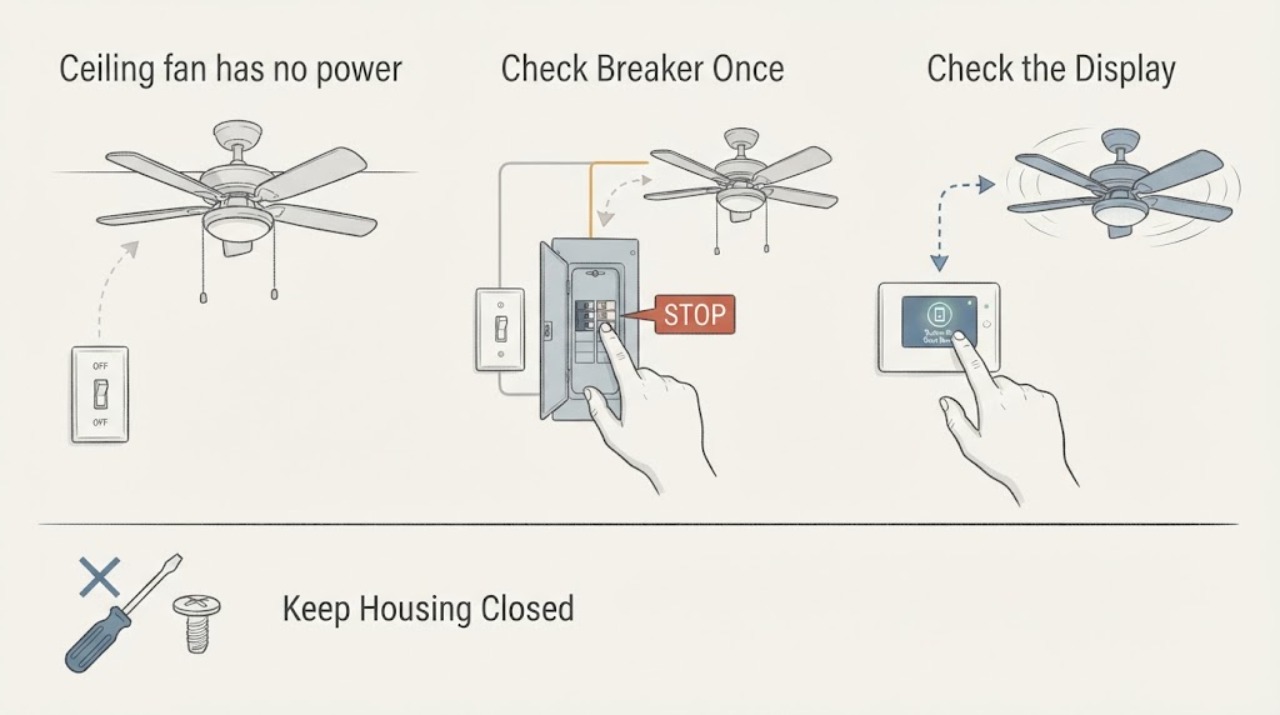
Work through in order
Diagnostic checks
Use only checks that match the exact appliance or system and its official guide.
-
Check 1
From floor level, operate the normal wall switch and the fan's normal pull chain or remote control once, then check whether the fan light and another nearby fixture or outlet respond without changing wiring.
Expected result: The room fixture is also dead, the fan light works but the blades do not, the fan and light are both dead, or the fan responds to one control but not another.
Next step: Record exactly which controls and loads respond and use that result to guide the breaker and electrician check; do not remove a cover or climb to inspect the fan.
Stop if: Stop for sparks, smoke, burning odor, heat, water near the fan or switch, a loose or sagging fan, unexpected movement, or any need to reach above floor level.
Why this matters
Why: A wider room outage points toward the circuit or switch supply; a working light with a non-running fan points toward the fan control or motor path; one working control separates a control-path issue from total loss of supply.
-
Check 2
At the electrical panel, look for the breaker serving the room and note whether it is fully on, visibly tripped, or unclear; if there is no hazard, reset a visibly tripped breaker once by moving it fully off and then on.
Expected result: The breaker was on, the breaker was tripped and the fan returns, the breaker trips again, or the correct breaker cannot be identified safely.
Next step: If it stays on, retest only the normal fan controls once; if it trips again or cannot be identified, leave it off and call a qualified electrician.
Stop if: Do not reset a breaker with water, smoke, heat, arcing, burning odor, damaged equipment, wet hands, or a panel that is unsafe to approach; never bypass or replace the breaker.
Why this matters
Why: A one-time return after a trip suggests the circuit had opened, but it does not identify why. A repeat trip or an unclear panel path requires electrical diagnosis rather than more resets.
-
Check 3
If the fan has a remote, check its battery and use only the model's normal pairing or on control from the floor; if it has a pull chain, confirm the chain is in its normal on position, and confirm a forward/reverse slider is fully to one side rather than centered.
Expected result: A fresh battery or normal pull-chain position restores operation, the remote does not pair or respond, the direction switch is centered, or no control produces any response.
Next step: Use the exact owner's manual for model-specific pairing; if the issue persists, stop at the controls and arrange service rather than opening the receiver or fan housing.
Stop if: Do not climb, remove the receiver, open the canopy, alter dip switches or wiring, or test exposed conductors as part of this check.
Why this matters
Why: A restored response makes the control setting or remote path the leading branch. No response after normal control checks leaves the supply, receiver, wiring, or fan electronics unresolved.
-
Check 4
From the floor, look at the fan's visible position and surrounding ceiling for sagging, a widening gap, water marks, loose-looking hardware, damaged housing, or signs that the fan has shifted; do not touch or steady it.
Expected result: The fan remains firmly positioned with no visible damage, or it is loose, tilted, water-affected, cracked, or otherwise changed from its normal mounting.
Next step: Keep people below and around the fan clear, leave the circuit off if practicable, and request a qualified electrician to assess support and wiring before any test.
Stop if: Stop immediately for a loose or falling fan, visible exposed conductors, water intrusion, cracking, unusual heat, smoke, or any need for a ladder.
Why this matters
Why: A stable appearance permits only the remaining low-risk control observations. A shifted, wet, or damaged fan may involve its support box, wiring, or falling-object risk and is not safe to energize.
-
Check 5
Record the fan's brand and model label only if it is readable from a safe position, the control type, whether the light works, breaker behavior, recent installation or water event, and the exact point where normal testing stopped.
Expected result: Identity and symptom history are complete, partially available, or unavailable without climbing or disassembly.
Next step: Provide the record and safe photographs to the electrician or manufacturer support; keep the fan off if the symptom is unresolved or any hazard was observed.
Stop if: Do not remove a rating label, disassemble the fan, access the ceiling box, or energize the circuit for a professional-style voltage test.
Why this matters
Why: A complete record helps the electrician use the correct wiring diagram and distinguish a supply fault from a fan-specific control issue; missing identity is not a reason to perform hazardous access.
Use your observations
Decision map
Find the observation that best matches what you see, then follow the next safe action.
-
PATH 01Next step
What you see
The nearby room fixture or outlet is also dead, or the correct breaker is tripped or cannot be safely identified.
Do this next
Treat the problem as a circuit or switch-supply issue. Check the breaker only once if safe; if power does not return or the breaker trips again, leave it off and call a qualified electrician.
-
PATH 02Next step
What you see
The fan light or one control responds, but the fan does not respond to the remote, pull chain, or normal speed/direction control.
Do this next
Follow only the model-specific normal control or pairing instructions from the owner's manual. If the fan remains unresponsive, request service for the control, receiver, wiring, or motor path without opening the housing.
-
PATH 03Next step
What you see
The breaker trips again, there is burning odor, heat, smoke, arcing, water, exposed wiring, or unexpected operation.
Do this next
Stop using the fan, keep people clear, leave the circuit off if it can be done safely, and obtain urgent qualified electrical assessment. Do not reset repeatedly or bypass protection.
-
PATH 04Next step
What you see
The fan is loose, tilted, water-affected, visibly damaged, or the next check requires a ladder, canopy removal, a meter, or access to internal connections.
Do this next
Do not energize or steady the fan. Keep the area clear and have a qualified electrician assess the mounting box, support, wiring, and fan before operation.
-
PATH 05Next step
What you see
The room has power, the breaker stays on, normal controls produce no response, and no visible cause is available from floor level.
Do this next
Stop the user checks and request electrician or manufacturer diagnosis. Provide the control type, model if safely visible, breaker result, light result, and symptom timeline; do not assume a replacement part.
Helpful context
Understand the symptom
Start by separating a dead room from a dead fan
A ceiling fan that does nothing can have a supply, wall-switch, remote-control, pull-chain, receiver, connection, or motor-control problem. The first useful observation is whether the light on the same fan responds and whether another fixture in the room has power. Hunter's general troubleshooting sequence starts with the power switch, pull chain or remote, reversing switch, and circuit breaker before moving toward connections. Those checks help route the problem; they do not prove which component has failed.
Stay at ordinary user access
Use only normal controls from the floor. Do not climb onto furniture, reach the fan, remove the canopy, open a switch housing, or use a meter on exposed conductors as a first check. Manufacturer guidance calls for power to be off before connection work, and unresolved electrical faults should be handled by a qualified electrician. A ceiling fan's support and electrical box also need to be appropriate for a moving fixture; a loose or sagging fan is a stop condition, not a reason to keep testing.
A breaker that trips again is a fault signal
A breaker reset can restore a tripped circuit, but it is not a repair. If it trips again, the fan or its circuit may have a fault or unsafe load. Leave it off and arrange electrical service. Do not repeatedly reset it, bypass protection, substitute a larger breaker, or open the fan to find the fault.
Safety boundary
Stop conditions
- Do not open the canopy, switch housing, receiver, or electrical box or touch internal conductors as a first user check.
- Do not use a ladder, climb on furniture, steady a loose fan, or perform live voltage testing.
- Do not reset a breaker repeatedly, bypass protection, substitute a larger breaker, or energize a wet or visibly damaged fan.
- Stop for smoke, burning odor, heat, arcing, exposed wiring, water, unexpected operation, a loose or sagging fan, or a blocked safe exit.
Only after diagnosis
Potential parts
- ceiling fan remote or receiver
Consider only after the exact model and control path are identified and a qualified diagnosis shows that the remote or receiver is the failed component rather than the supply or wiring.
Confirm the exact fan model, control system, voltage, pairing method, and manufacturer's fit information before ordering; no symptom-only compatibility claim is made.
When checks do not resolve it
Need a professional?
Call a qualified electrician when the room or fan remains without power after safe control and one-time breaker checks, when the breaker trips again, or when diagnosis requires canopy removal, internal wiring, a meter, a ladder, or inspection of the ceiling box. Request urgent service for smoke, burning odor, heat, arcing, exposed wiring, water, unexpected operation, or a loose or sagging fan. Provide the control type, model if safely visible, light result, breaker behavior, recent installation or water history, and the point where safe checks stopped.
Safety scope: User checks are limited to normal controls, safe room-load observation, and one safe breaker check when no hazard is present. Do not open covers, access wiring, climb, perform live testing, bypass protection, or energize a wet, damaged, loose, or sagging fan.
Common questions
FAQ
Why does my ceiling fan have no power when the room lights work?
A working room light narrows the issue but does not identify the failed part. Check the fan's normal wall switch, remote or pull chain, and direction control from the floor. If those controls do not restore operation, the fan control, receiver, wiring, or motor path needs qualified diagnosis.
Should I reset the breaker if my ceiling fan stopped working?
Only if there is no water, smoke, heat, burning odor, arcing, or other hazard and you can safely identify the circuit. Reset a visibly tripped breaker once. If it trips again or the fan remains dead, leave it off and call a qualified electrician rather than repeatedly resetting it.
Can I open the ceiling fan canopy to check the wires?
Not as a routine first check. Canopy and switch-housing work involves electrical connections and may require a ladder. Have a qualified electrician perform that inspection with the correct breaker off and power verified, following the fan's exact wiring diagram.
What if the fan light works but the blades do not?
That result points away from a total room outage and toward the fan control, receiver, motor, or related wiring, but it does not prove which one. Try only the normal control or pairing steps for the exact model; arrange service if the blades still do not start.
When is a ceiling fan with no power an urgent electrical call?
Call urgently for a repeated breaker trip, burning odor, heat, smoke, arcing, water, exposed wiring, unexpected movement, a loose or sagging fan, or any need to access internal wiring. Keep people clear and do not energize a visibly damaged fan.
Read the exact guide
Official sources
- TRoubleshooting GuideWestinghouse Lighting · A manufacturer manual example used to support the breaker, power-off, and qualified-electrician boundaries; exact model instructions may differ.
- My fan stopped working. What do I do?Hunter Fan · General control-routing reference only; the reader's fan brand, model, wiring, and local electrical requirements control.
- What is a ceiling fan rated electrical box?Hunter Fan · Used for the mounting and internal-connection safety boundary; it is not a model-independent diagnosis of this fan.
Community feedback
Share a repair observation
Share a plain-text repair observation. Accepted observations are published automatically; this page may take a moment to update.