
On this page
Start here
Quick answer
A burning smell near a circuit breaker or electrical panel is a stop-use warning, not a repair invitation. Leave the panel cover and breaker wiring closed, stop using the affected circuit, and arrange a licensed electrician to inspect it. Overheating can result from an overload, a loose or high-resistance connection, damaged wiring, or a failing breaker. If there is smoke, a visible arc or flame, rapidly increasing odor, or anyone is in immediate danger, leave the area and call emergency services; do not reset the breaker to see whether the smell returns.
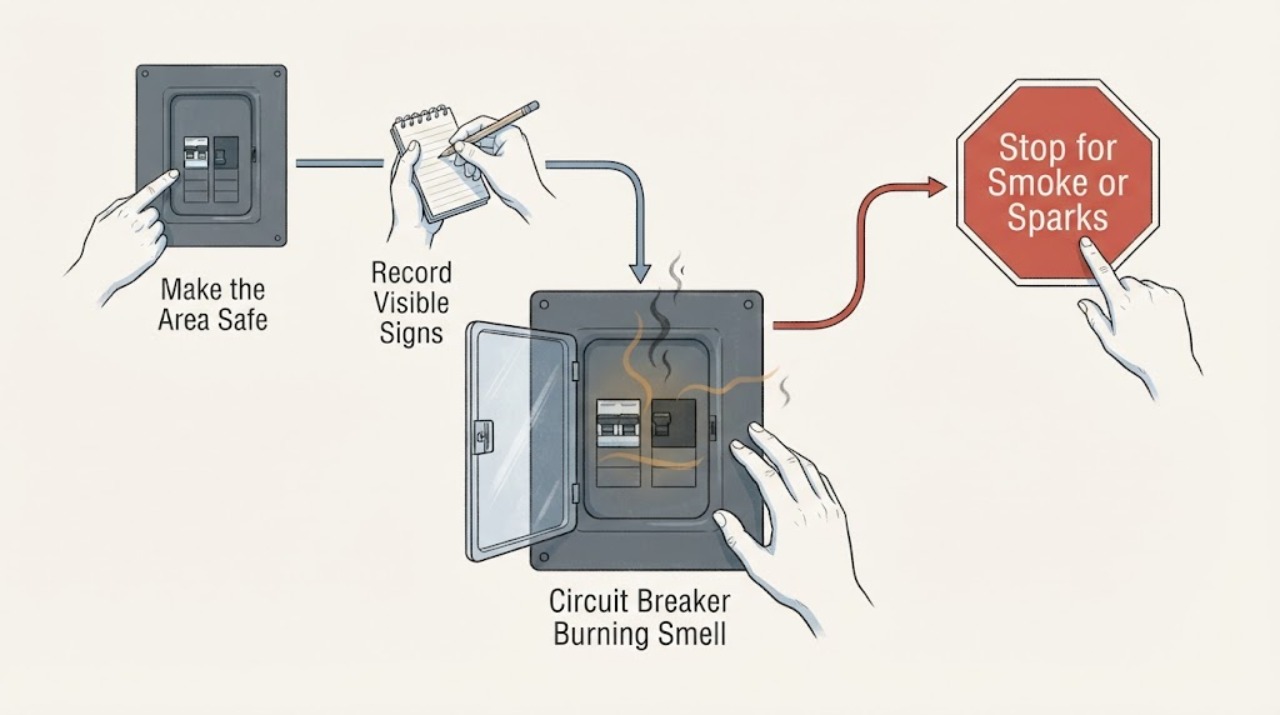
Work through in order
Diagnostic checks
Use only checks that match the exact appliance or system and its official guide.
-
Check 1
Stop using the circuit and any appliance that was operating when the smell appeared. Without touching the panel, breaker, switch, outlet, cord, or plug, move to a safe location and look only for smoke, flame, sparks, or a rapidly worsening odor.
Expected result: There is smoke, flame, visible arcing, a rapidly increasing burning odor, or immediate danger to people.
Next step: Leave the area, keep others out, and call emergency services. Do not use water on electrical equipment and do not return to reset the breaker until the hazard has been handled by responders.
Why this matters
Why: This is an active electrical emergency rather than a troubleshooting symptom. Continuing to watch it or re-energize the circuit can increase fire and shock risk.
-
Check 2
If there is no smoke or flame and you are already at a safe distance, note where the odor is strongest without leaning into or touching anything: the panel exterior, a nearby switch or receptacle, a cord or appliance, or an area that cannot be located.
Expected result: The odor is strongest at the panel or switch, at one appliance or receptacle, or cannot be localized; the area may also have buzzing, sizzling, warmth, or discoloration.
Next step: Keep the suspected circuit and equipment out of use and tell the electrician the location and accompanying signs. If any surface is hot, discolored, buzzing, sizzling, or sparking, do not touch it and treat the service as urgent.
Why this matters
Why: A panel or switch odor suggests a fixed electrical fault. A localized appliance or receptacle odor still needs evaluation because heat may have damaged the connection or cord. An unlocalized odor cannot be safely cleared by guessing which breaker to reset.
-
Check 3
From a safe location, record what changed immediately before the smell: a breaker trip, a large load starting, a new appliance being used, flickering lights, or a recent electrical installation. Do not turn the load back on to reproduce the odor.
Expected result: The odor followed a particular load or trip, appeared after installation, or occurred without an obvious load and persists with the circuit unused.
Next step: Give the timeline and affected circuit information to a licensed electrician. Do not reconnect the load, replace the breaker, or increase its rating while waiting.
Why this matters
Why: A load-related event can point the electrician toward overload, damaged equipment, or a short; a persistent odor with no load raises concern about a fixed connection or panel component. Neither pattern identifies a safe homeowner repair.
-
Check 4
Check whether the breaker has tripped only by reading the handle from a safe position; do not operate the handle or open the panel. If it has tripped, leave it in that state until the fault has been inspected.
Expected result: The breaker is tripped, will not stay on, or appears on while the burning smell remains.
Next step: Keep the affected circuit off and call a licensed electrician; seek emergency help for smoke, flame, arcing, or immediate danger.
Stop if: Do not treat an apparently on breaker as clearance. Keep the suspected load out of use and arrange inspection while the odor, heat, noise, or discoloration is present.
Why this matters
Why: A trip is a protective response, not proof that the downstream fault is gone. An odor while the breaker appears on can indicate overheating that has not reached the trip condition or a nearby component outside the breaker.
Use your observations
Decision map
Find the observation that best matches what you see, then follow the next safe action.
-
PATH 01Next step
What you see
Smoke, flame, visible arcing, or rapidly worsening odor is present
Do this next
Leave the area, keep people away, and call emergency services. Do not touch or re-energize the equipment.
-
PATH 02Next step
What you see
The odor is strongest at the panel, breaker, switch, or fixed wiring
Do this next
Keep the circuit and nearby equipment out of use and arrange urgent licensed-electrician inspection. Do not open the panel or tighten connections.
-
PATH 03Next step
What you see
The odor appeared after one appliance or load was used
Do this next
Leave that appliance and circuit unused and give the electrician the appliance and timing details; do not reconnect it to test the theory.
-
PATH 04Next step
What you see
The breaker tripped or will not remain on
Do this next
Do not repeatedly reset it or install a higher-rated breaker. Have the downstream equipment and circuit inspected by a qualified electrician before power is restored.
Helpful context
Understand the symptom
Why the smell matters
A breaker interrupts excessive current, but a breaker that has not tripped does not prove that every connection is safe. Schneider Electric identifies odor, discoloration, and softened or melted insulation as signs of overheating that need qualified inspection. A burning odor can come from the breaker, its connections, the panel bus, or a downstream load, so the smell alone cannot identify a part that a homeowner should replace.
What not to do
Do not remove the panel cover, tighten terminals, probe for voltage, pull out a breaker, bypass protection, substitute a higher-rated breaker, or keep resetting a tripped breaker. Those actions expose you to shock and arc-flash hazards and can hide the original fault. Keep people away from a hot, smoking, sparking, or discolored panel or switch.
Only after diagnosis
Potential parts
- circuit breaker
Consider a replacement only after a qualified electrician confirms that the breaker itself is damaged and the panel and downstream fault have been evaluated.
The panel manufacturer, series, rating, interrupting capability, and local requirements must be confirmed; a breaker is not a user-selected substitute for a higher rating.
When checks do not resolve it
Need a professional?
Use professional service immediately for burning odor, heat, discoloration, noise, smoke, arcing, a breaker trip, or an odor that persists after the load is stopped.
Common questions
FAQ
Is a burning smell from a circuit breaker an emergency?
It is at least an urgent stop-use warning. Leave the circuit and panel alone and arrange a licensed-electrician inspection. If there is smoke, flame, visible arcing, or immediate danger, leave and call emergency services.
Should I reset the breaker after I smell burning?
No. Do not repeatedly reset it or use a higher-rated breaker. A trip does not prove that the downstream fault is repaired, and a breaker that appears on does not prove that the odor source is safe.
Can I tighten the breaker terminal or replace the breaker myself?
Do not open the panel or work on its terminals. Loose or damaged connections and breaker replacement require qualified electrical personnel who can isolate the equipment and verify the surrounding fault.
What if the smell comes from one appliance instead of the panel?
Leave the appliance and its circuit unused and tell the electrician what was running when the smell began. A plug, receptacle, cord, or appliance can overheat even when the panel breaker has not tripped.
Read the exact guide
Official sources
- Guide to Home Wiring HazardsU.S. Consumer Product Safety Commission · Electrical panels, circuit breakers, odors, overheating, sparks, repeated trips, and unsafe electrical repairs
- PowerPact B-Frame Circuit Breakers and Automatic SwitchesSchneider Electric · Breaker trips, burn marks, electrical fault inspection, and restrictions on resetting equipment after a fault
- Home Wiring Safety TipsElectrical Safety Foundation International · Circuit breaker trips, arcing, sizzling, overheating, hot or discolored surfaces, odors, and shocks
- How do you determine why a thermal-magnetic breaker nuisance trips?Schneider Electric USA · Breaker trips, odor, discoloration, softened or melted insulation, loose or oxidized connections, and suspected breaker damage
- Electrical Safety DosElectrical Safety Foundation International · Burning smell, warm or discolored electrical equipment, buzzing, and other signs of a wiring problem
Community feedback
Share a repair observation
Share a plain-text repair observation. Accepted observations are published automatically; this page may take a moment to update.