
On this page
Start here
Quick answer
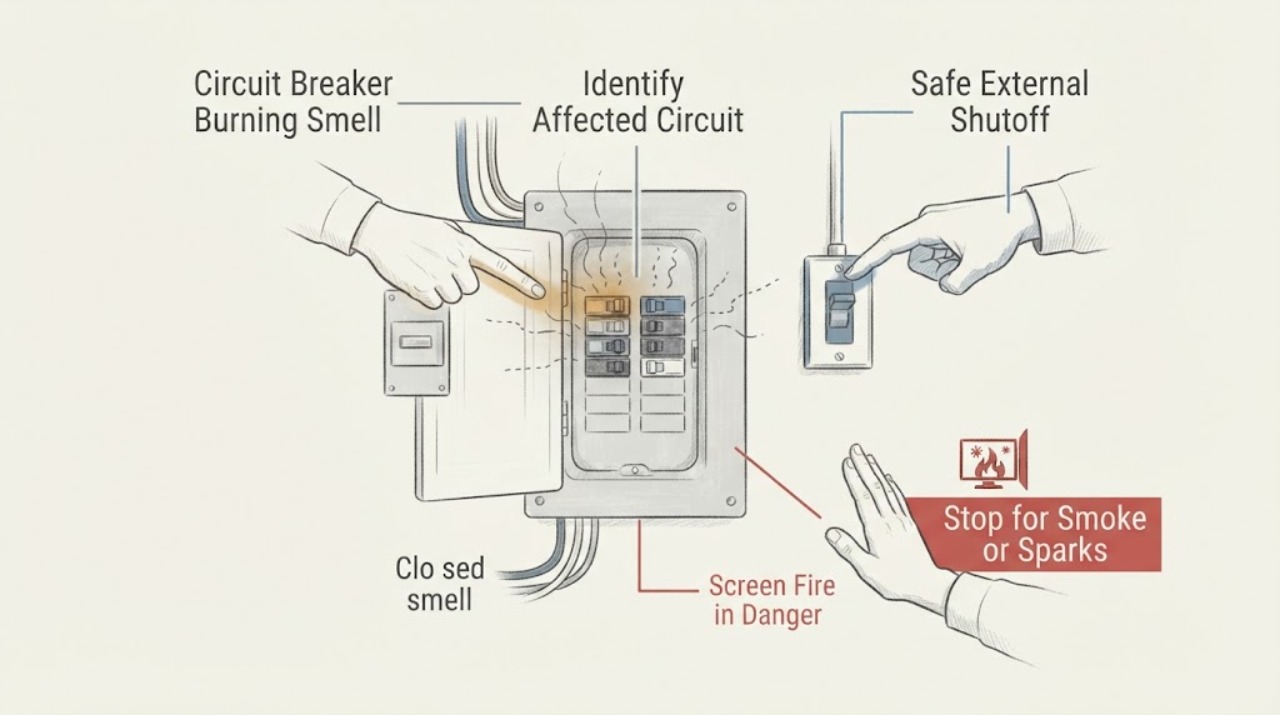
A burning smell at a circuit breaker is an electrical fire warning, not a normal breaker odor. From a safe position, note whether there is smoke, sizzling or crackling, visible arcing, a hot or discolored panel, a melted-plastic smell, or a circuit that will not stay on. If there is smoke, flame, active arcing, rapidly worsening heat, or danger to leave safely, evacuate and use the local fire-emergency route. If it is safe to do so without opening the panel or touching the equipment, switch off the affected circuit or main disconnect once, then keep clear. Do not reset the breaker repeatedly, remove the panel, touch wiring, use water, or perform energized electrical checks. Have a licensed electrician inspect the breaker, panel, wiring, and connected load before re-energizing.
Work through in order
Diagnostic checks
Use only checks that match the exact appliance or system and its official guide.
-
Check 1
From a safe distance and without touching the panel, look and listen for smoke, flame, visible arcing, sizzling or crackling, a rapidly spreading odor, a hot or discolored panel, or an alarm.
Expected result: There is active smoke or flame, visible arcing, rapidly worsening heat, or an exit may be unsafe; or there is only a residual smell with no active sign.
Next step: For fire, smoke, active arcing, or unsafe egress, evacuate and use the local fire-emergency route. Otherwise keep clear and continue only with external, unpowered observations.
Stop if: Do not open the panel, touch the breaker, use water, or remain nearby to watch an active electrical fault.
Why this matters
Why: Active fire or arc energy is an emergency and cannot be diagnosed safely by a resident. A residual smell still indicates that a fault may remain energized or may recur.
-
Check 2
From a dry safe position, record which labeled circuit or area lost power, what was running just before the smell, whether the breaker is visibly in a tripped or off position, and whether nearby outlets or lights are also affected.
Expected result: Only one appliance or branch is affected, several rooms or circuits are affected, the breaker trips immediately, or the label does not match the affected area.
Next step: Keep the suspected circuit off and record the load history. Escalate urgently for immediate re-tripping, multiple affected circuits, heat, odor, or uncertainty about the correct disconnect.
Stop if: Do not repeatedly operate the breaker, remove the dead-front, or assume a nearby outlet is safe because one light is off.
Why this matters
Why: The pattern helps an electrician separate a connected-load fault from a panel or supply problem, but a breaker position or label does not prove that all conductors are de-energized.
-
Check 3
If there is no active smoke, flame, water, exposed conductor, or heat blocking access, and the disconnect can be operated without touching damaged equipment, switch off the clearly identified affected circuit or main disconnect once; otherwise do not approach it.
Expected result: The circuit remains off, the breaker will not stay off, the main disconnect is unclear, or heat, moisture, smoke, or exposed parts make access unsafe.
Next step: Keep clear and arrange an urgent electrician inspection. Evacuate for worsening smoke, flame, or heat, and use the fire-emergency route.
Stop if: Do not force a handle, remove a cover, touch the panel surface if it is hot or wet, or attempt an internal shutoff.
Why this matters
Why: A safe shutoff can reduce ongoing energy, but a breaker that will not remain off or an inaccessible disconnect requires professional or emergency response. It does not prove the wiring is safe.
-
Check 4
From outside the enclosure, record only visible signs such as scorch marks, melted plastic, discoloration, a loose-looking cover, buzzing, soot, water entry, or a damaged nearby cord or appliance; do not touch, wipe, tighten, or remove anything.
Expected result: There are scorch or melt marks, soot, a hot cover, water, damaged insulation, buzzing, or no visible damage despite the smell.
Next step: Keep the circuit off and give the observations to a licensed electrician. Treat water near electrical equipment as an additional shock hazard and do not approach until safe.
Stop if: Do not touch wiring, remove the panel, scrape soot, tighten a terminal, or use a meter on the energized installation.
Why this matters
Why: Visible damage or heat supports an urgent electrical fault, while no visible damage does not rule out overheated wiring or a concealed connection.
-
Check 5
Without restoring the suspect circuit, list the appliances, heaters, cooking equipment, extension leads, and recently added loads that were operating or connected when the smell began; do not unplug a hot, damaged, wet, or arcing device.
Expected result: One device was operating, several high-load devices shared the circuit, a cord or plug was damaged, or the smell began with no identifiable load change.
Next step: Leave the suspected circuit and any damaged equipment out of service. Have the electrician inspect the branch, receptacles, breaker, and connected loads before any restart.
Stop if: Do not move heavy equipment, pull a damaged plug, use an extension lead as a substitute, or reconnect loads for comparison.
Why this matters
Why: The history can point the electrician toward an appliance fault, overload, damaged cord, connection, or panel-side problem. It cannot safely distinguish those causes without professional inspection.
-
Check 6
From a safe location, note whether the smell or sound changes while the circuit remains off, whether other circuits begin to smell or trip, and whether a smoke or heat alarm activates; do not restore power to provoke a repeat.
Expected result: The odor fades with the circuit off, persists or worsens, spreads to another area, or a second circuit trips or heats.
Next step: Keep clear and escalate urgently. Evacuate for smoke, flame, rapidly worsening odor, or unsafe heat; otherwise keep the affected circuits off for electrician assessment.
Stop if: Do not reset breakers one at a time, open doors or covers to chase the smell, or use a fan near suspected arcing.
Why this matters
Why: A fading odor does not clear the fault. Persistence, spread, or more than one affected circuit raises concern for a broader wiring, panel, supply, or fire condition.
-
Check 7
Prepare a safe record for the electrician: time of smell, exact location, circuit label, breaker behavior, equipment in use, sound, visible marks, alarm activity, water exposure, recent work, and any one-time shutoff; use a photograph only from a safe distance if no camera use would delay evacuation.
Expected result: The event is intermittent, tied to a particular load, followed work or remodeling, or has no clear trigger.
Next step: Leave the affected circuit off and provide the record. Request inspection of breaker connections, bus or panel condition, branch wiring, outlets, and connected equipment as applicable.
Stop if: Do not recreate the smell, remove evidence, tighten screws, or test a suspected connection yourself.
Why this matters
Why: Timing and load history help a professional inspect the correct branch without asking the occupant to reproduce a hazardous fault.
-
Check 8
Keep the circuit off and arrange a licensed electrician inspection before re-energizing any breaker associated with a burning smell; if a connected appliance is implicated, keep it out of service until the electrician clears both the appliance and circuit.
Expected result: A qualified professional finds and corrects a confirmed cause, finds no visible cause but needs further tracing, or the smell recurs before inspection.
Next step: Follow the electrician's written clearance and local code requirements. Escalate to fire or emergency services for smoke, flame, active arcing, or rapidly worsening heat.
Stop if: Do not re-energize for a trial, bypass the breaker, replace it with a different rating, or continue using the circuit because the odor stopped.
Why this matters
Why: Only professional inspection can determine whether the fault is the breaker, panel connection, wiring, receptacle, appliance, overload, or another upstream condition. Recurrence means the hazard remains active.
Use your observations
Decision map
Find the observation that best matches what you see, then follow the next safe action.
-
PATH 01Next step
What you see
There is smoke, flame, visible arcing, rapidly worsening heat, or an unsafe exit.
Do this next
Evacuate and use the local fire-emergency route. Do not approach the panel, use water, or remain inside to diagnose the source.
-
PATH 02Next step
What you see
There is no active fire, water, exposed conductor, or dangerous heat, and the clearly identified disconnect can be reached without touching damaged equipment.
Do this next
Switch off the affected circuit or main disconnect once from a dry safe position, then keep clear and arrange a licensed electrician inspection.
-
PATH 03Next step
What you see
The disconnect is unclear or access is blocked by heat, smoke, moisture, exposed parts, or a damaged enclosure.
Do this next
Do not approach. Leave if conditions worsen and use fire or emergency assistance; otherwise keep people away and arrange urgent electrical service.
-
PATH 04Next step
What you see
The breaker trips again, will not stay off, or more than one circuit is affected.
Do this next
Do not reset it again. Keep clear and arrange urgent electrician inspection, with fire-emergency escalation for smoke, flame, active arcing, or rapid heat.
-
PATH 05Next step
What you see
Scorch marks, melted plastic, soot, a hot panel, damaged cord, or water exposure is visible from a safe position.
Do this next
Keep the circuit off and do not touch or clean the damage. Have a licensed electrician inspect the panel, wiring, and connected equipment before any restart.
-
PATH 06Next step
What you see
The smell began while one appliance or several high-load devices were operating, with no active fire or unsafe shutoff access.
Do this next
Keep the circuit and any damaged device out of service. Do not unplug hot or damaged equipment; provide the load history to the electrician.
-
PATH 07Next step
What you see
The odor fades after one safe shutoff and no smoke, flame, arc, heat, or second affected circuit is present.
Do this next
Do not treat the circuit as cleared. Leave it off and arrange inspection because concealed thermal damage may remain.
-
PATH 08Next step
What you see
The smell persists, returns, has no identifiable load, or the panel and wiring cannot be safely assessed externally.
Do this next
Keep the affected circuit off and request urgent licensed electrical service. Escalate to fire or emergency services if smoke, flame, active arcing, or rapidly worsening heat appears.
Helpful context
Understand the symptom
Treat the smell as an active fault
A warm-dust smell after a long-idle circuit is different from a sharp burnt-plastic or scorched-insulation smell at the panel. The latter can mean an overheated connection, damaged conductor, failing breaker, overloaded circuit, or a fault in connected equipment. Smell cannot locate the failed part, so do not remove the dead-front or probe the panel.
Choose fire response before diagnosis
If smoke, flame, visible arc, or rapidly worsening heat is present, leave and use the local fire-emergency route. Do not pour water on an electrical fire or stay inside to find the source. If there is no active fire and the affected disconnect is clearly accessible without contact with heat, moisture, or exposed parts, one safe shutoff may reduce risk; it does not make the installation safe.
A tripped breaker is evidence, not an invitation to keep trying
A breaker may trip because of overload, short circuit, ground fault, heat, or a failing device. Repeatedly restoring it can re-energize a damaged connection. Leave the circuit off after a burning smell until a qualified electrician identifies the cause and checks the panel, wiring, outlets, and connected equipment.
Only after diagnosis
Potential parts
- circuit breaker
Consider only after a licensed electrician confirms that the breaker itself is damaged or unsuitable for the identified panel and circuit.
A breaker rating or form factor must match the panel, circuit design, and local requirements. Do not substitute a breaker or change its rating based only on smell. - panel connection or bus hardware
Consider only when professional inspection identifies thermal damage or a failed connection in the panel.
Panel internals are professional electrical work; the enclosure, manufacturer, configuration, and local code determine the permitted repair. - branch-circuit wiring or receptacle
Consider only after the electrician traces the smell to a branch conductor, terminal, receptacle, or connected load rather than the breaker.
The conductor type, circuit protection, enclosure, connected load, and jurisdiction must be assessed together. Do not order wiring from a symptom alone.
When checks do not resolve it
Need a professional?
Arrange urgent licensed electrical service for any burning smell at a circuit breaker, even if the odor fades after shutoff. Escalate to fire or emergency services for smoke, flame, visible arcing, rapidly worsening heat, an unsafe exit, or a breaker that will not remain off.
Have this ready
- Provide the panel location, circuit label, exact odor location, time and duration, breaker behavior, appliances or loads in use, visible scorch or melt marks, sounds, water exposure, recent electrical work, and whether a single safe shutoff was performed.
Common questions
FAQ
Is a burning smell from a circuit breaker normal?
No. A burning-plastic, scorched-insulation, or hot-panel smell is a warning of possible overheating, arcing, overload, or wiring damage. Keep clear, use a safe shutoff only if it is plainly accessible, and arrange licensed electrical inspection.
Should I reset a breaker that smells burnt?
Do not reset it repeatedly. If there is no smoke, flame, water, exposed part, or dangerous heat and the disconnect is safely accessible, one shutoff may reduce energy; leave the circuit off and have an electrician inspect it before re-energizing.
What if the burning smell stops after the breaker trips?
A fading smell does not prove the fault is gone. Concealed thermal damage or a failed connection may remain. Keep the circuit off, record what was operating, and request professional inspection.
Can I remove the electrical panel cover to find the smell?
No. Do not remove the panel or dead-front, touch wiring, tighten connections, or perform energized checks. A panel can contain hazardous energy even when one breaker is off; a licensed electrician should locate and repair the fault.
When is a breaker burning smell an emergency?
Treat smoke, flame, visible arcing, sizzling or crackling, rapidly worsening heat, a wet or melted panel, an unsafe exit, or a breaker that will not stay off as an emergency. Leave if needed and use the local fire-emergency route; do not use water on an electrical fire.
Read the exact guide
Official sources
- Cooking Fire Safety PictographsU.S. Fire Administration · General cooking-fire guidance; use the local emergency procedure for an active fire.
- Appliance and Electrical Fire SafetyU.S. Fire Administration · General fire-safety guidance for household electrical equipment, not a circuit-specific diagnosis.
- Electrical Safety Advice for Oven and Grills / Oven and Grills SafetyElectrical Safety First · General household electrical-safety guidance, not a diagnosis of a particular panel or circuit.
Community feedback
Share a repair observation
Share a plain-text repair observation. Accepted observations are published automatically; this page may take a moment to update.