
On this page
Start here
Quick answer
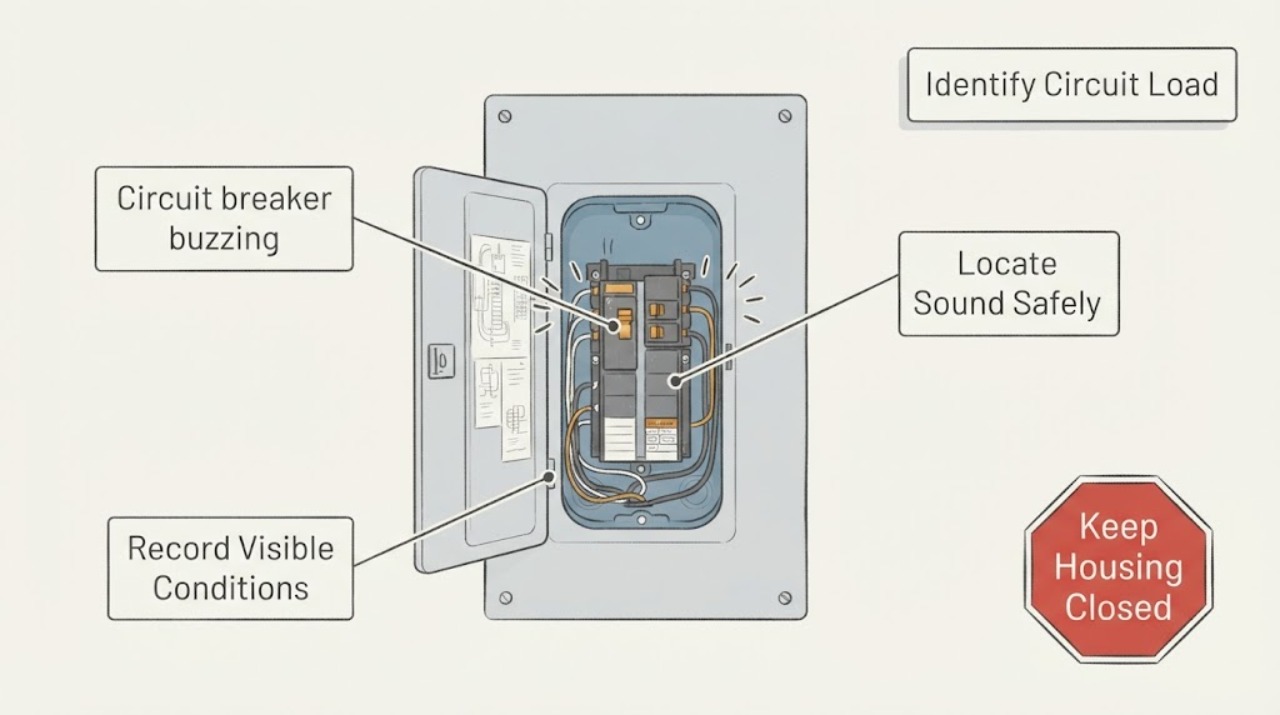
A circuit breaker that makes a new, loud, or persistent buzzing sound should be treated as an electrical warning until a qualified electrician identifies the cause. From a safe distance, determine whether the sound comes from one breaker, the panel door, a nearby switch, or an appliance on a particular circuit. Note flickering lights, a warm or discolored panel or switch, burning odor, smoke, arcing, or a breaker that trips. Do not remove the panel cover, tighten terminals, touch wiring, measure live voltage, spray water, or repeatedly reset the breaker. If there is heat, smell, smoke, visible arcing, a shock, or repeated tripping, move away, leave the circuit off only if that can be done without approaching the hazard, and contact a licensed electrician or local emergency service as appropriate. A faint model-specific operating hum can occur under load, but excessive or changing noise still requires professional assessment.
Before you begin
Safety first
- This article supports safe-distance observation and, only when there is no hazard, one normal protection-state observation or reset. Do not open enclosures, touch wiring, test live parts, bypass protection, use water, or deliberately reproduce the noise.
Work through in order
Diagnostic checks
Use only checks that match the exact appliance or system and its official guide.
-
Check 1
From a safe standing position, listen without touching the equipment and identify whether the buzzing is loudest at one breaker, the panel cover, a nearby wall switch, or a connected appliance; do not open the panel.
Expected result: The sound is localized to one breaker, changes when a known load runs, comes from a switch or receptacle instead, or cannot be localized safely.
Next step: Record the location, time, and load pattern from a safe distance and continue only with the symptom and hazard observations; arrange an electrician if the noise is persistent or new.
Stop if: Stop immediately for smoke, burning odor, sparks, crackling, heat, water, shock, or any need to touch or approach energized equipment.
Why this matters
Why: A load-dependent breaker sound can involve the breaker, its connections, or the circuit load. A sound at a switch or receptacle shifts the service point, while an uncertain location should not be chased by handling equipment.
-
Check 2
Without touching the panel or switch, observe whether lights flicker or dim, the breaker or wall plate looks discolored, the panel or switch feels warm only if it can be noticed without contact, or an odor is present.
Expected result: There is no visible or sensory warning sign, or there is flicker, discoloration, warmth, burning odor, smoke, an arc, or a shock or tingle.
Next step: For any warning sign, keep away and call a licensed electrician or local emergency service as appropriate; do not continue to operate the circuit to compare sounds.
Stop if: Do not touch a warm or discolored panel, switch, or receptacle, and do not approach smoke, arcing, exposed parts, or water near the electrical equipment.
Why this matters
Why: A quiet-looking panel does not prove safety, but any heat, odor, flicker, arcing, or shock raises the priority from diagnosis to immediate electrical isolation and professional inspection.
-
Check 3
Read the circuit label from outside the panel and list the appliances, lights, or receptacles that lost power or are operating when the buzzing occurs; do not unplug or switch a load in a hazardous area just to provoke the noise.
Expected result: The buzz follows one high-demand appliance, several devices share the circuit, the sound persists with normal loads, or the label does not match the affected area.
Next step: Stop using nonessential loads on the affected circuit and provide the circuit label and load pattern to the electrician; do not use extension cords or move a high-demand load to an unknown circuit.
Stop if: Stop for smell, heat, flicker, smoke, sparks, a trip, a damaged cord, water, or any need to reach behind furniture or open an electrical enclosure.
Why this matters
Why: A load-related change can point to overload, a device fault, a connection issue, or breaker behavior. A persistent sound with ordinary load or an unclear label requires an electrician to trace the circuit rather than a homeowner experiment.
-
Check 4
If there is no hazard and the panel can be reached normally, observe whether the affected breaker is clearly in a tripped or middle position; only one normal reset may be attempted if the panel instructions and local practice permit it, with loads off and no contact with internal parts.
Expected result: The breaker is not tripped, it resets and stays on without the buzzing returning, it will not reset, or it trips or buzzes again.
Next step: Leave the breaker off for a failed or repeat trip and arrange a licensed electrician; if a single reset appears to restore normal operation, still report the prior noise and monitor without deliberately recreating it.
Stop if: Do not reset again after a trip, remove the panel cover, replace a breaker or fuse, tighten a terminal, or operate a breaker that is hot, smoking, arcing, wet, or damaged.
Why this matters
Why: A breaker that is not tripped but buzzes can have a breaker, connection, or load issue. A repeat trip or returning buzz indicates an unresolved fault and should not be challenged by more resets.
-
Check 5
Write down when the sound starts and stops, whether it changes with a known load, whether the breaker feels mechanically normal from its handle only, and whether a recent installation, storm, moisture event, or electrical work preceded it; do not operate the panel to make a comparison.
Expected result: The sound is continuous, intermittent, synchronized with a load, present after recent work or moisture, or accompanied by flicker, odor, warmth, or a trip.
Next step: Keep the affected circuit unused when practical and give the timeline and warning signs to a licensed electrician; do not continue the appliance or circuit as a test.
Stop if: Stop for any heat, smoke, arcing, odor, flicker, shock, water, or sudden change in the sound.
Why this matters
Why: The timing helps an electrician distinguish a load or connection pattern from a persistent breaker or panel condition, but it cannot prove that a faint hum is harmless. Recent work or moisture raises the need for inspection.
-
Check 6
Give the electrician the panel and breaker label, sound location, load pattern, breaker position, warning signs, recent work or moisture history, and whether one safe reset changed anything; leave the enclosure unopened.
Expected result: The sound persists, returns, or is accompanied by a trip, or the circuit appears normal after one safe observation but the cause remains uncertain.
Next step: Keep the affected circuit off if it is safe to do so and schedule a licensed electrician to inspect the breaker, connections, wiring, load, and panel condition.
Stop if: Stop all user troubleshooting for suspected wiring, loose hardware, a hot or damaged panel, repeated trips, smoke, arcing, burning odor, water, or shock.
Why this matters
Why: A temporary quiet period does not certify the breaker, switch wiring, or connections. Buzzing tied to a circuit component remains a professional electrical inspection condition.
Use your observations
Decision map
Find the observation that best matches what you see, then follow the next safe action.
-
PATH 01Safety boundary
What you see
The noise is a faint, stable hum with no heat, odor, flicker, damage, or trips and appears only under a normal load.
Do this next
Record the breaker model and load pattern, avoid altering the panel, and ask an electrician to confirm it at the next suitable inspection or sooner if the sound changes.
Why this path and its safety boundary
Why it matters: Some breakers or electrical equipment can produce operating noise, but the absence of warning signs does not identify the model or certify the installation.
Safety stop: Stop using the circuit if the hum becomes louder, changes, or gains heat, odor, flicker, smoke, arcing, or trips.
-
PATH 02Safety boundary
What you see
The buzzing begins or grows when a particular appliance or group of loads runs.
Do this next
Stop using the nonessential load and arrange an electrician to assess the circuit and appliance; do not move the load to another unknown circuit or reproduce the buzz.
Why this path and its safety boundary
Why it matters: A load, overload, appliance fault, breaker connection, or circuit wiring issue is possible; the noise pattern does not identify which one.
Safety stop: Stop immediately for flicker, warmth, discoloration, burning odor, smoke, arcing, a trip, or a damaged appliance cord.
-
PATH 03Safety boundary
What you see
The breaker will not reset, trips again, or the buzzing returns after one safe reset.
Do this next
Leave the affected circuit off and call a licensed electrician for diagnosis; do not keep resetting or replace the breaker yourself.
Why this path and its safety boundary
Why it matters: An unresolved overload, short, arc, defective breaker, connection, or wiring fault may be present.
Safety stop: Do not approach a hot, smoking, arcing, wet, or damaged panel and do not operate other controls in the hazard area.
-
PATH 04Safety boundary
What you see
The sound is actually at a wall switch or receptacle, or the breaker is quiet but the circuit has flicker, heat, discoloration, odor, or a loose-feeling control.
Do this next
Stop operating the control, leave the circuit off if safe, and call a licensed electrician; do not remove the cover plate or touch wiring.
Why this path and its safety boundary
Why it matters: The component may be switch wiring or a connection rather than the breaker itself, and unusual electrical sounds need qualified inspection.
Safety stop: Stop for smoke, sparks, a shock, water, a hot plate, or any exposed conductor.
-
PATH 05Safety boundary
What you see
Buzzing is accompanied by smoke, arcing, burning odor, a hot panel or switch, visible damage, water, or a shock or tingle.
Do this next
Move people away, do not touch the equipment, and contact local emergency help or a licensed electrician from a safe location; isolate the circuit only if it can be done without approaching the hazard.
Why this path and its safety boundary
Why it matters: This is an immediate electrical or fire hazard, not a troubleshooting branch.
Safety stop: Do not use water, open the panel, operate switches near smoke or gas, re-energize the circuit, or return until the hazard is assessed.
Helpful context
Understand the symptom
A hum is not a diagnosis
Some equipment can produce a low operating hum under load, but the change that matters is excessive, new, intermittent, or load-related noise. Schneider Electric notes that loose hardware, wiring, mounting parts, or internal breaker components can affect noise. A homeowner cannot distinguish those causes safely by listening alone, so the task is to document the pattern and identify a safe service boundary.
Observe the panel without opening it
Stand clear of the panel and listen only from a normal safe position. Note the affected breaker label, whether the sound changes when a known appliance starts, and whether lights flicker or a switch plate becomes warm or discolored. Do not remove the dead-front or touch a breaker terminal: the panel can contain energized parts even when one breaker is off.
When buzzing becomes urgent
Buzzing accompanied by burning odor, smoke, arcing, heat, shock, flicker, or repeated trips is not a normal troubleshooting opportunity. Keep people away, avoid operating switches near smoke or arcing, and obtain qualified electrical help. If there is an active electrical fire, use the local emergency response route from a safe location; do not use water on energized equipment.
Safety boundary
Stop conditions
- Do not remove the panel cover, dead-front, breaker, switch plate, receptacle, or any enclosure as a user check.
- Do not touch wiring, tighten terminals, replace a breaker or fuse, measure live voltage, bypass protection, or work on a circuit that may still be energized.
- Do not repeatedly reset or re-energize a buzzing, tripping, hot, wet, smoking, or arcing circuit.
- Stop and move away for burning odor, smoke, sparks, visible arcing, a hot or discolored panel or switch, flickering, shock, water, or exposed conductors.
- Do not use water on an energized electrical fire; use the local emergency response route from a safe location.
- Treat suspected switch wiring, loose hardware, an unexplained breaker hum, or no power at a switch as a licensed electrician service condition.
Only after diagnosis
Potential parts
- circuit breaker
Consider this category only after a licensed electrician identifies a defective or incompatible breaker and confirms the panel and circuit requirements.
Breaker replacement is professional work; confirm the exact panel, breaker family, circuit requirements, and local code before any part is selected. - wall switch or switch connection
Consider this category only when the sound is localized to the switch or an electrician confirms a faulty switch or connection.
Confirm the wiring method, load and control compatibility, enclosure condition, and local installation requirements with a licensed electrician. - panel connection or wiring repair
Consider this category only when a qualified inspection identifies a loose, damaged, overheated, or improperly installed connection or conductor.
This is professional electrical work; do not choose a connector, conductor, or repair method from the sound alone.
When checks do not resolve it
Need a professional?
Call a licensed electrician for a new, loud, persistent, or load-related breaker buzz; buzzing at a switch or receptacle; unexplained flicker; a warm or discolored panel; a breaker that will not reset or trips again; or suspected switch wiring, loose hardware, or internal breaker trouble. For smoke, arcing, burning odor, shock, water near the panel, or an active electrical fire, move away and use the local emergency response route as appropriate.
Safety scope: This article supports safe-distance observation and, only when there is no hazard, one normal protection-state observation or reset. Do not open enclosures, touch wiring, test live parts, bypass protection, use water, or deliberately reproduce the noise.
Common questions
FAQ
Is a buzzing circuit breaker always dangerous?
Not every faint hum proves failure; some equipment can produce operating noise under load. A new, loud, changing, or persistent buzz, especially with heat, odor, flicker, arcing, or trips, should be inspected by a licensed electrician.
Can I tighten the buzzing breaker connection?
No. Do not remove the panel cover or touch breaker terminals and wiring. A qualified electrician must isolate the equipment and determine whether the cause is a connection, breaker, load, or wiring fault.
Should I keep resetting a buzzing breaker?
No. At most one normal reset is reasonable only when there is no hazard and the breaker is clearly tripped. If it trips again, the buzz returns, or the breaker will not reset, leave it off and call an electrician.
What does buzzing with flickering lights mean?
Buzzing combined with flicker can indicate an overload, connection, switch, breaker, or wiring issue. Stop operating nonessential loads, avoid reproducing the symptom, and arrange prompt electrical inspection.
What should I do if the breaker is hot or smells burnt?
Do not touch it or open the panel. Move away, keep people away, and use the local emergency response route or a licensed electrician from a safe location. Do not use water on energized equipment or re-energize the circuit.
Read the exact guide
Official sources
- A circuit breaker, panel, or switchboard is making a buzzing or humming noiseSchneider Electric USA · Official Schneider Electric breaker guidance used to distinguish possible operating hum from excessive or load-related noise; actual breaker model and installation must be assessed by a professional.
- Don't Overload Your HomeElectrical Safety Foundation International · Official electrical-safety organization guidance used for user-visible warning signs and escalation; it does not diagnose a particular panel or breaker.
- Switch to SafetyElectrical Safety Foundation International · Official ESFI safety handout used for buzzing, heat, flicker, odor, shock, and loose-switch escalation boundaries.
- What is a Circuit BreakerSchneider Electric United States · Official Schneider Electric educational guidance used for general breaker safety concepts; it does not identify the user's breaker model or authorize panel work.
Community feedback
Share a repair observation
Share a plain-text repair observation. Accepted observations are published automatically; this page may take a moment to update.