
On this page
Start here
Quick answer
Buzzing together with a burning-plastic smell at a hall bathroom light switch is an electrical stop condition, not a switch to keep testing. From a safe distance, note whether there is smoke, flame, visible arcing, heat, or water; identify whether the odor is strongest at the switch, outlet, cord, appliance, or service panel; and note which circuit appears affected. If there is smoke, flame, arcing, rapidly rising heat, or an odor that is getting stronger, leave and call emergency fire help from a safe location. If there is no immediate emergency and it is safe to reach without approaching heat or water, turn off the affected circuit or main supply using its normal control; otherwise wait for a licensed electrician. Do not reset the circuit, open a panel or switch, touch wiring, measure voltage, pull a hot plug, bypass protection, or use water on a possible energized fire.
Before you begin
Safety first
- A licensed electrician should inspect the switch, outlet, plug and cord, branch circuit, protective device, and panel as appropriate; an appliance professional may be needed if a connected appliance caused the event.
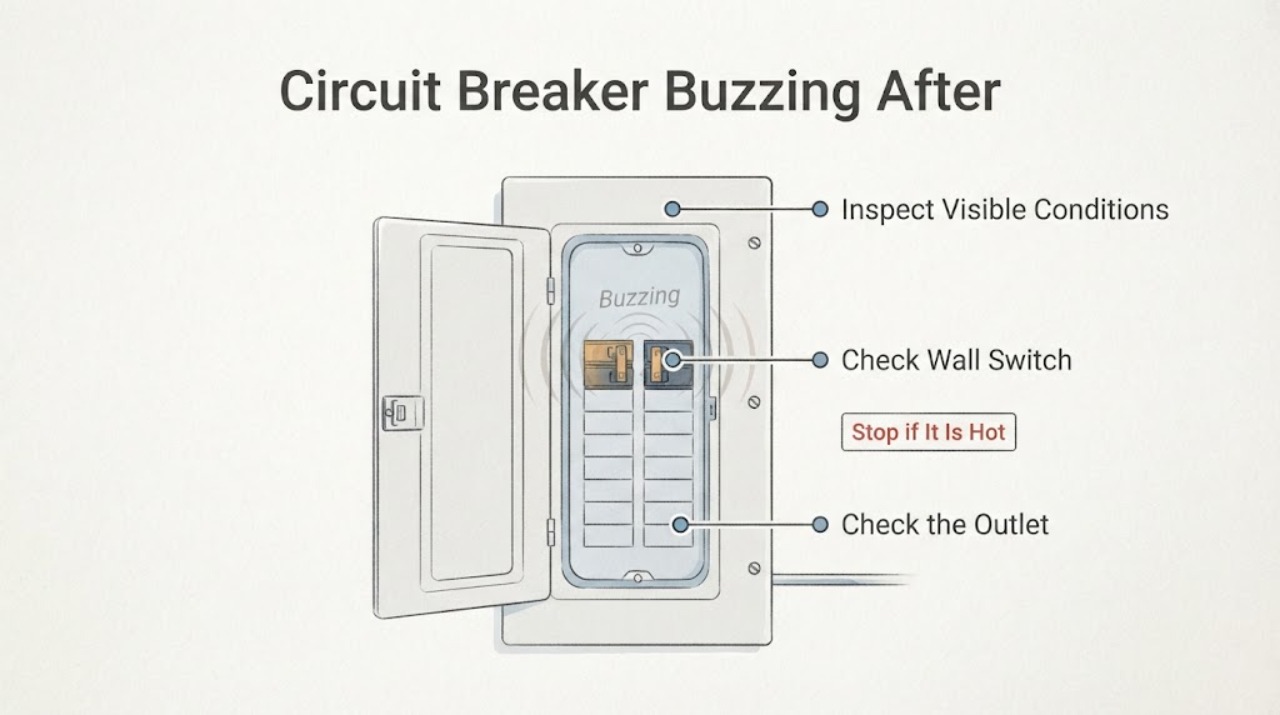
Work through in order
Diagnostic checks
Use only checks that match the exact appliance or system and its official guide.
-
Check 1
From a safe distance, look for smoke, flame, glowing material, visible arcing, rapidly rising heat, or an odor that is quickly getting stronger. Keep people away from the hall bathroom and do not approach the switch, outlet, panel, or load for a closer look.
Expected result: Smoke, flame, glowing material, visible arcing, or rapidly worsening heat is an emergency condition; a lingering burning-plastic smell or buzzing without visible smoke is still an electrical stop condition.
Next step: Leave and call emergency fire help from a safe location for smoke, flame, arcing, or rapidly rising heat. Do not use water and do not return to inspect until responders say it is safe.
Why this matters
Why: The severity and progression determine whether evacuation and emergency fire response take priority over an electrician visit.
-
Check 2
Without touching or operating anything, identify where the buzzing and odor seem strongest: the switch plate, a nearby outlet, a plug or cord, a light fitting, another connected load, or the service-panel area. Note whether the sound changes without anyone operating the switch.
Expected result: A smell or buzz at the switch differs from one at an outlet, cord, appliance, or panel; a sound that continues with the switch untouched raises the urgency.
Next step: Keep clear and report the suspected location and timing to a licensed electrician. Do not operate the light, test another load, touch the plate, or open a cover.
Why this matters
Why: Location and timing help a professional choose the inspection path but do not prove which connection or device is failing.
-
Check 3
From a safe position, note whether the breaker for the bathroom or hall appears tripped and whether lights or outlets in that area have lost power. If there is no smoke, water, heat, or arcing and the cutoff is safely accessible without approaching the hazard, turn off the affected circuit or main supply using its normal control; do not reset it.
Expected result: A circuit that has tripped or will not remain on, or a power loss limited to the hall bathroom, confirms that the event affected a protective device or branch circuit but does not identify the cause.
Next step: Leave the circuit off and arrange prompt electrical inspection. If the cutoff cannot be reached safely, keep away and wait for emergency responders or a licensed electrician.
Why this matters
Why: A protective trip may reflect the load, switch, outlet, branch wiring, or panel; repeated operation can re-energize a fault.
-
Check 4
From a distance and only with a clear, safe view, look for a discolored or warped switch plate, soot, melted plastic, a damaged cord, a loose-looking plug, or heat marks on the wall or trim. Do not touch any surface or pull any plug to check fit or temperature.
Expected result: Discoloration, melting, soot, damaged insulation, or a visibly hot-looking plate indicates a potential fire or shock hazard even if the breaker is currently on.
Next step: Keep the switch, outlet, light, appliance, and circuit unused. Do not tape, tighten, clean, replace, or cover the damaged area; give the visual description to the electrician or fire responders.
Why this matters
Why: NFPA and CPSC treat burning odors, warm or discolored outlets, sparks, and damaged cords as reasons to discontinue use and obtain qualified help.
-
Check 5
From a safe distance, note whether the bathroom is damp, the floor is wet, water has reached the wall or fitting, or combustibles are near the suspected electrical source. Do not use a wet cloth, water, metal object, or fan to investigate or clean the area.
Expected result: Water near the switch, outlet, cord, or panel increases shock risk; smoke, heat, or arcing near towels or other combustible material increases fire risk.
Next step: Keep people out of the wet or affected area. Leave and call emergency help for smoke, fire, or escalating heat; otherwise wait for qualified electrical service without attempting to dry or move equipment.
Why this matters
Why: Moisture can make an otherwise urgent electrical inspection unsafe to approach and can change the event to an emergency response.
-
Check 6
Without changing the load, record what was operating when the buzzing began: the bathroom light, exhaust fan, receptacle load, another appliance, or several devices. Note whether the smell began after a switch operation, a plug connection, a moisture event, or a breaker trip.
Expected result: A symptom tied to one switch or load differs from a symptom affecting several outlets or the panel; either pattern can involve equipment or fixed wiring.
Next step: Keep the suspected equipment and affected circuit unused and report the sequence to the electrician. Do not move loads, add an extension cord, or try another outlet.
Why this matters
Why: The event sequence helps a professional separate an appliance-side clue from a switch, outlet, branch-circuit, or panel condition without energizing another test.
-
Check 7
Prepare a distance-only incident record with the room, switch or outlet location, circuit status, power loss, odor and sound timing, smoke or sparks, visible damage, water proximity, and any safe-distance photographs. Do not open a panel or switch to add details.
Expected result: A record showing whether the problem is localized, recurring, or associated with a trip gives the electrician or emergency responder useful prioritization information.
Next step: Give the record to a licensed electrician or emergency responders and keep the circuit out of use until it is inspected and cleared.
Why this matters
Why: No ordinary observation can certify a bathroom circuit as safe after buzzing and a burning-plastic smell; inspection is required before reuse.
Use your observations
Decision map
Find the observation that best matches what you see, then follow the next safe action.
-
PATH 01Next step
What you see
Smoke, flame, glowing material, visible arcing, rapidly rising heat, or rapidly worsening odor is present.
Do this next
Evacuate, keep others away, and call emergency fire help from a safe location. Do not use water or return to operate the breaker.
Why this path and its safety boundary
Why it matters: Treat the event as an electrical fire emergency, not a switch diagnosis.
-
PATH 02Next step
What you see
There is buzzing or a burning-plastic odor without active smoke or flame, and the source appears near the bathroom switch or outlet.
Do this next
Arrange prompt inspection by a licensed electrician; use emergency help if smoke, heat, or arcing starts.
Why this path and its safety boundary
Why it matters: Discontinue use of the switch, outlet, connected load, and affected circuit without touching them.
-
PATH 03Next step
What you see
The breaker has tripped, will not remain on, or trips when the bathroom switch or load is used.
Do this next
Leave the circuit out of use and have an electrician determine whether the cause is the switch, outlet, connected load, branch wiring, or panel.
Why this path and its safety boundary
Why it matters: Do not reset it again, test another load, or install a higher-rated protective device.
-
PATH 04Next step
What you see
The bathroom or electrical source is wet, there is standing water, or the suspected area cannot be approached safely.
Do this next
Keep people away and use emergency response for smoke or fire; otherwise wait for qualified electrical service from a safe location.
Why this path and its safety boundary
Why it matters: Do not approach, clean, move, unplug, or cover the electrical equipment.
-
PATH 05Next step
What you see
The buzzing and smell stop before help arrives and no damage is visible.
Do this next
Preserve the incident record, keep the affected circuit unused, and arrange inspection before restoring normal use.
Why this path and its safety boundary
Why it matters: The absence of current symptoms does not clear the switch, outlet, circuit, or panel.
Helpful context
Understand the symptom
The light switch is only a visible clue. A buzzing sound can travel through a wall, and a burning-plastic odor may originate at the switch, an outlet, a junction, a connected load, a branch circuit, or the service panel. Do not try to prove the source by operating the light or plugging in another device. The safe objective is to stop exposure, observe from a distance, and give a professional a precise event record.
Bathroom moisture makes approach more hazardous. Do not touch a faceplate, plug, cord, breaker, wall, or wet surface to judge temperature. Do not remove a cover, search for a loose wire, measure voltage, or use water around an electrical smell or possible fire.
Safety boundary
Stop conditions
- Stop and evacuate for smoke, flame, glowing material, visible arcing, rapidly rising heat, or a rapidly worsening burning odor; call emergency fire help from a safe location.
- Stop using the bathroom switch, outlet, light, connected load, and circuit for any burning-plastic smell, buzzing, warmth, discoloration, soot, melting, or sparks.
- Do not reset a breaker repeatedly, fit a higher-rated protective device, bypass protection, or restore power to reproduce the symptom.
- Do not open the switch, outlet, panel, or faceplate; touch wiring, a hot plate, cord, plug, wall, or breaker; or measure voltage.
- Do not pull out a hot plug, move energized equipment, add an extension cord, or use water on a possible energized electrical fire.
- Stop and keep clear if water, a wet floor, combustible material, or another person is at risk near the suspected electrical source.
Only after diagnosis
Potential parts
- light switch or receptacle outlet
Consider only if an electrician confirms the switch or outlet is damaged, loose, or overheated.
The electrician must select a code-compliant device for the wiring, protection, moisture location, and load; do not select or install it from the symptom alone. - circuit breaker or protective device
Consider only after inspection identifies a failed or unsuitable protective device and rules out the switch, outlet, load, and branch wiring.
Never substitute a higher-rated device or bypass protection; rating and fit must be determined by a qualified electrician. - branch-circuit wiring or appliance cord
Consider only when inspection identifies damaged insulation, a loose connection, moisture damage, or a connected-load cord fault.
Wiring and cord work requires qualified installation and correct ratings; buzzing and odor do not identify a repair part.
When checks do not resolve it
Need a professional?
Any buzzing with burning odor, heat, discoloration, smoke, spark, trip, or unexplained power loss; emergency response for active smoke, flame, arcing, or rapidly rising heat.
Safety scope: A licensed electrician should inspect the switch, outlet, plug and cord, branch circuit, protective device, and panel as appropriate; an appliance professional may be needed if a connected appliance caused the event.
Have this ready
- Hall bathroom switch or outlet location, affected circuit status, light or load involved, odor and buzzing timing, smoke or sparks, visible damage, water proximity, and safe-distance photographs.
Common questions
FAQ
Is buzzing from a bathroom light switch dangerous?
Buzzing together with a burning-plastic smell, warmth, discoloration, sparks, or a trip can indicate an electrical hazard. Stop using the switch and affected circuit, keep clear of moisture, and arrange a licensed electrician. Evacuate and call emergency help for smoke, flame, arcing, or rapidly rising heat.
Should I flip the breaker when a bathroom switch smells like burning plastic?
Only if there is no smoke, water, heat, or arcing and the cutoff is safely accessible without approaching the hazard; use its normal control and do not reset it. If access is unsafe, keep away and wait for emergency responders or a licensed electrician.
Can I remove the switch plate to see what is buzzing?
No. Do not open the switch, outlet, faceplate, or service panel, touch wiring, or measure voltage. A licensed electrician must inspect it, especially in a damp bathroom environment.
What if the buzzing and odor stop?
A stopped symptom does not clear the switch or circuit. Record the timing and location, keep the affected circuit unused, and arrange inspection before restoring normal use.
What should I tell the electrician?
Provide the hall bathroom location, switch or outlet involved, circuit and power status, light or load operating, sound and odor timing, smoke or sparks, visible discoloration or melting, nearby water, and any photographs taken from a safe distance.
Read the exact guide
Official sources
- Electrical Safety: ChecklistNational Fire Protection Association · Residential electrical warning signs and qualified-electrician escalation guidance
- CPSC Guide to Home Wiring HazardsU.S. Consumer Product Safety Commission · Home wiring, receptacle, switch, cord, plug, breaker, overheating, odor, arcing, and qualified-electrician safety guidance
Community feedback
Share a repair observation
Share a plain-text repair observation. Accepted observations are published automatically; this page may take a moment to update.