
On this page
Start here
Quick answer
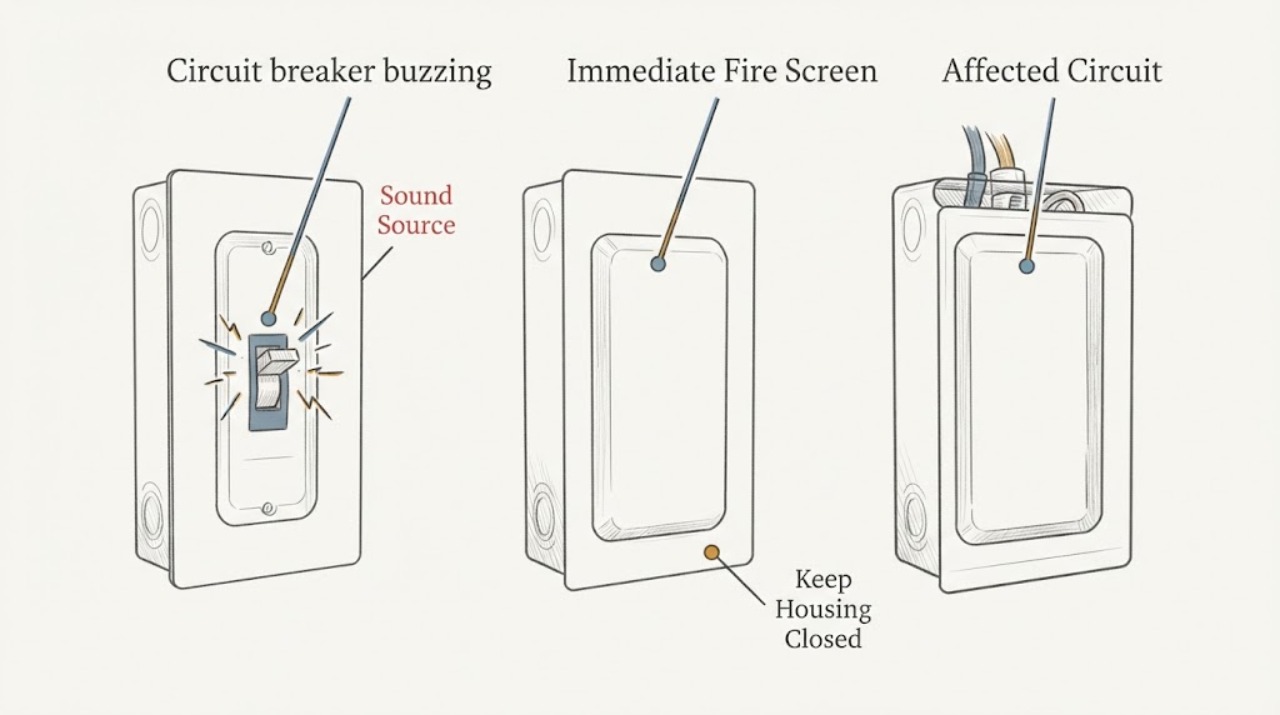
A faint, steady sound from some energized breakers can be normal for a particular device, but a new, loud, changing, or continuous buzz should be treated as an electrical-service issue. From outside the panel, note the exact sound source, affected circuit, load changes, flickering, trip behavior, heat, discoloration, odor, smoke, or arcing. Do not open the panel, touch the breaker or wiring, test voltage, use water, repeatedly reclose the breaker, or bypass protection. If there is burning odor, smoke, visible arc, a hot panel or switch, or a repeated trip, leave the area as appropriate and contact emergency services or a licensed electrician.
Work through in order
Diagnostic checks
Use only checks that match the exact appliance or system and its official guide.
-
Check 1
From outside the panel and from a safe position, look and listen without touching the breaker, panel, switch, receptacle, or wiring.
Expected result: Record smoke, visible arc or spark, burning or hot-plastic odor, a hot or discolored panel or switch, melted parts, crackling, water, a loud or changing buzz, or a breaker that has tripped.
Next step: Stop using the affected circuit. If safe without approaching damage, leave the area, contact emergency services for active smoke or fire, and arrange a licensed electrician. Do not operate the panel or use water on an energized electrical fire.
Stop if: Do not touch, open, reset, reclose, spray, or test the panel or switch after any hazard sign.
Why this matters
Why: These are potential fire, shock, arc, or water-exposure signs; they take priority over identifying whether the sound is normal.
-
Check 2
Without opening anything, identify whether the buzz appears to come from the breaker face, the panel enclosure, a nearby wall switch, a receptacle, or another device, and note whether it is steady, pulsing, crackling, or changing.
Expected result: A sound localized to the panel or breaker suggests panel or protective-device service; a sound at a switch or receptacle suggests a device or branch wiring issue; a sound that follows one load suggests an electrician should assess that circuit and load.
Next step: Keep the circuit in its current safe state and record the sound for a licensed electrician. Do not remove a cover to confirm the source.
Stop if: Stop observing and leave the area for smoke, burning odor, visible arc, heat, water, or a rapidly worsening sound.
Why this matters
Why: Schneider Electric notes that equipment resonance, loose hardware, wiring, load conditions, and internal breaker components can affect noise. Location and pattern narrow the report but do not prove the cause.
-
Check 3
From normal user controls only, note which lights, outlets, or appliances lose power or make the sound, and read the external breaker label without opening the panel.
Expected result: A whole branch affected by the same breaker, a single load that changes the buzz, or unrelated circuits showing symptoms provides a circuit pattern. No visible load relationship does not rule out an internal breaker or wiring fault.
Next step: Stop using the affected or suspect loads and give the electrician the breaker label and pattern. Do not unplug equipment from a wet or hot receptacle or move a load to another circuit as a test.
Stop if: Stop for water, heat, smoke, odor, arcing, exposed conductors, or any need to touch a damaged device.
Why this matters
Why: A breaker carries current for a circuit, so the connected load and branch wiring matter; the label and symptom pattern are service information, not permission to inspect live parts.
-
Check 4
If there are no warning signs and it can be done without approaching the panel, note whether the buzz starts or changes when one ordinary load is switched off at its normal, dry, undamaged control; do not create a test load or repeatedly toggle it.
Expected result: A sound that follows one load gives the electrician a reproducible circuit clue. A sound that remains with normal loads off points more toward the panel, breaker, branch wiring, or another energized circuit.
Next step: Leave the suspect load off and report the timing and result to a licensed electrician. Do not switch a device with a hot, wet, damaged, sparking, or burning control.
Stop if: Do not repeat the cycle, add an appliance, reconnect a suspect load, or operate a control after smoke, odor, heat, arcing, or a trip.
Why this matters
Why: Noise can be load-dependent, but changing a load does not prove that the load or breaker is safe. A new or excessive buzz remains a service issue even if it stops temporarily.
-
Check 5
From a safe distance, observe nearby lights and switches while the buzz is present; note flickering, dimming, brightening, a loose or leaning switch, or a change when other normal loads operate.
Expected result: Flicker, unexplained brightness changes, a loose or hot switch, or buzzing that tracks another load raises concern about a wiring, connection, overload, or device fault. A stable light does not make the buzz safe.
Next step: Stop using the affected controls or circuit and tell the electrician exactly which lights and loads changed. Do not open a switch box or use a meter.
Stop if: Stop immediately for smoke, smell, heat, sparks, shock, damaged insulation, or repeated protection operation.
Why this matters
Why: ESFI identifies flicker, hot or discolored plates, buzzing, loose switches, and frequent trips as wiring or overload warning signs that warrant qualified inspection.
-
Check 6
Without touching the panel interior, record whether the breaker is visibly on, off, in a middle or tripped position, or repeatedly operating; do not force the handle or reclose it as an experiment.
Expected result: A tripped or repeatedly operating breaker indicates a protective response that may involve overload, short, ground or arc fault, or equipment damage. A breaker that stays on while buzzing still requires assessment if the sound is new, excessive, or accompanied by other symptoms.
Next step: Leave a suspect or repeatedly tripping circuit off and arrange licensed electrical service. Follow emergency guidance for smoke, fire, or an escalating electrical event.
Stop if: Do not repeatedly reclose, tape, wedge, bypass, or replace the breaker yourself.
Why this matters
Why: Protection operation is information about the circuit, not a confirmation that the breaker is defective or safe to reset.
-
Check 7
From a safe position, check only whether water, condensation, construction dust, visible damage, a recent alteration, or an unusual environment is near the panel or switch; do not wipe, spray, or remove anything.
Expected result: Water, visible corrosion, damaged covers, recent wiring work, dust intrusion, or physical impact can change the risk of a buzzing connection. A dry intact exterior does not clear an internal fault.
Next step: Keep clear and arrange electrical service; if water is actively entering, address the source only without approaching energized equipment and use emergency help when needed.
Stop if: Do not touch wet equipment, use water to cool or extinguish it, remove a cover, or re-energize after water exposure.
Why this matters
Why: Moisture and damaged enclosures can create shock, tracking, or fire risk, while recent work is important context for the electrician.
-
Check 8
Treat the breaker, switch, panel, connections, bus, and branch wiring as professional inspection points; do not remove a dead-front cover, loosen a terminal, or touch the conductor area. Leave electrical testing to a licensed electrician.
Expected result: An electrician may find loose hardware, an improper connection, a failing breaker, overload, compatible-equipment issue, or internal fault. The homeowner cannot distinguish these safely by sight or sound from outside.
Next step: Leave the affected circuit in a safe state and provide the recorded sound and load pattern to a licensed electrician.
Stop if: Do not open the panel or switch box, touch connections, perform electrical testing, bridge protection, or make a wiring change.
Why this matters
Why: Schneider Electric's operational-noise guidance and ESFI's warning-sign guidance both place unusual electrical noise and related symptoms within qualified inspection, not DIY live work.
-
Check 9
Record when the buzzing began, whether any breaker, switch, receptacle, fan, appliance, renovation, storm, water event, or load change preceded it, and whether the sound is constant or intermittent.
Expected result: A new sound after electrical work or a load change, a buzz that follows one circuit, or a buzz that occurs without an obvious load provides different service clues; an intermittent sound remains unresolved even when it stops.
Next step: Keep suspect equipment off and arrange an electrician, giving the exact timeline and affected circuit. Do not recreate the event intentionally.
Stop if: Stop for any heat, odor, smoke, arcing, shock, water, damaged insulation, or repeated trip.
Why this matters
Why: Noise is a symptom with multiple possible causes, including load conditions, wiring, resonance, or internal breaker components. History can shorten safe professional diagnosis.
-
Check 10
Prepare the electrician handoff with the sound source and pattern, panel or breaker label, affected circuit and loads, light behavior, breaker state, heat or odor, visible damage, water, recent work, and any emergency action already taken.
Expected result: A complete record distinguishes a possibly normal model-specific hum from excessive noise, load-related behavior, branch wiring, switch, or protective-device symptoms without exposing the homeowner to live equipment.
Next step: Keep the affected circuit and suspect loads off until a licensed electrician declares the installation safe. Use emergency services for active smoke, fire, or escalating arcing.
Stop if: Do not reset, open, probe, bypass, replace, or tighten any panel or switch component yourself.
Why this matters
Why: The final diagnosis may require de-energized inspection and electrical testing of the breaker, connections, switch, branch conductors, and loads.
Use your observations
Decision map
Find the observation that best matches what you see, then follow the next safe action.
-
PATH 01Safety boundary
What you see
Smoke, visible arc or spark, active burning, rapidly escalating crackling, or fire is present.
Do this next
Leave the area, keep others away, contact emergency services from a safe location, and do not use water on energized equipment.
Why this path and its safety boundary
Why it matters: This is an immediate electrical-fire and shock emergency.
Safety stop: Do not approach, touch, open, reset, or re-energize the panel or circuit.
-
PATH 02Safety boundary
What you see
The panel, breaker, switch, or cover is hot, discolored, melted, smells of burning, shows damaged insulation, or feels loose.
Do this next
Stop using the affected circuit and arrange licensed electrical inspection; isolate only from a safe dry position if directed and possible.
Why this path and its safety boundary
Why it matters: Heat or damage can indicate a connection, overload, arcing, or component fault.
Safety stop: Do not touch the equipment, remove covers, reclose, or attempt tightening.
-
PATH 03Safety boundary
What you see
The breaker trips again, will not stay on, or fuses operate when the circuit or a load is used.
Do this next
Leave the circuit off and arrange a licensed electrician to diagnose it.
Why this path and its safety boundary
Why it matters: Protection is responding to a possible overload, short, ground or arc fault, wiring problem, or damaged equipment.
Safety stop: Do not repeatedly reclose, oversize, tape, bypass, or substitute the protective device.
-
PATH 04Safety boundary
What you see
Water, condensation, flooding, or active moisture is near the panel, breaker, switch, receptacle, or wiring.
Do this next
Keep clear, address the water source without approaching energized equipment, and arrange electrical inspection; use emergency assistance for an active event.
Why this path and its safety boundary
Why it matters: The equipment may present shock, tracking, or fire risk.
Safety stop: Do not touch, wipe, spray, cool with water, reset, or re-energize wet equipment.
-
PATH 05Safety boundary
What you see
The buzz changes with one normal load but no heat, odor, flicker, smoke, arc, or trip is observed.
Do this next
Leave the suspect load off and give the electrician the timing and load identity; do not add or swap loads as a test.
Why this path and its safety boundary
Why it matters: The load, branch wiring, breaker, or equipment resonance may be involved; a temporary quiet period does not prove safety.
Safety stop: Stop immediately if any warning sign appears.
-
PATH 06Safety boundary
What you see
The sound is localized to a wall switch or control, especially with flicker, dimming, warmth, odor, looseness, or a trip when operated.
Do this next
Stop operating that control and arrange a licensed electrician; leave the circuit off when safe to do so.
Why this path and its safety boundary
Why it matters: The switch, connected control, device, or branch wiring needs qualified inspection.
Safety stop: Do not remove the faceplate, touch terminals, spray cleaner, or bypass the switch.
-
PATH 07Safety boundary
What you see
The sound is localized to a breaker or panel and is new, excessive, intermittent, or unexplained by a known normal operating hum.
Do this next
Keep the affected circuit and suspect loads off and arrange licensed electrical service.
Why this path and its safety boundary
Why it matters: The breaker, enclosure, connection, bus, wiring, or current-carrying load requires professional assessment.
Safety stop: Do not remove the panel cover, tighten hardware, perform electrical testing, or replace the breaker yourself.
-
PATH 08Safety boundary
What you see
A faint steady sound is present with no heat, odor, flicker, damage, water, smoke, arcing, or protection operation.
Do this next
Record the model, circuit, load, and sound and ask an electrician to assess it if it is new, worsening, or uncertain; avoid opening the panel.
Why this path and its safety boundary
Why it matters: Some breakers can produce operational hum under load, but sound alone does not establish that this installation is normal.
Safety stop: Escalate immediately if any warning sign appears or the sound changes.
-
PATH 09Safety boundary
What you see
Buzzing began after renovation, a new load, storm, water event, breaker change, or other electrical work.
Do this next
Keep the affected circuit off and provide the timeline and work details to a licensed electrician.
Why this path and its safety boundary
Why it matters: A changed connection, load, compatibility, or installation condition deserves focused professional inspection.
Safety stop: Do not recreate the condition or inspect the work yourself.
-
PATH 10Safety boundary
What you see
The buzz persists, source is uncertain, the circuit behavior is abnormal, or safe external observations do not explain it.
Do this next
Arrange a licensed electrician and provide the complete observation record.
Why this path and its safety boundary
Why it matters: The cause cannot be determined safely without de-energized inspection and qualified electrical testing.
Safety stop: Do not open, measure, bypass, replace, or re-energize the equipment to pursue a diagnosis.
Helpful context
Understand the symptom
Buzzing is a symptom, not a diagnosis
A breaker or panel can make an operational hum under some loads, but a new, excessive, intermittent, or changing buzz can also be associated with loose hardware, wiring, load conditions, resonance, or an internal component. The sound alone cannot identify whether the breaker, the connected circuit, or a nearby switch is responsible. Do not remove the dead-front cover or attempt to tighten anything.
Use the sound and circuit behavior to help the electrician
From a safe position, note whether the sound changes when a particular known load is turned off at its normal control, whether lights flicker or dim, whether the breaker feels warm from outside without touching it, and whether the breaker trips. These observations can identify a timing and affected circuit, but they do not authorize a live test or repeated load switching.
Do not normalize heat, odor, or arcing
Electrical safety guidance treats a hot or discolored switch plate, burning smell, crackling or buzzing, smoke, visible sparks, damaged insulation, and unexplained breaker operation as warning signs. A steady low hum without any other symptom may be normal for some equipment, but the safe response to a change in sound or any warning sign is inspection—not a louder test.
Leave protection devices doing their job
A breaker can interrupt current when a circuit is overloaded or has a fault. Reclosing it over and over can re-energize a damaged circuit and create more heat or arcing. If it has tripped, leave it in the safe state unless a qualified professional directs a controlled action; never bridge, tape, oversize, or bypass the protective device.
A safe handoff includes the exact pattern
Give the electrician the panel location, breaker label, sound description, when it began, whether the sound is from the breaker, panel, or switch, which normal loads were operating, flicker or heat observations, trip history, recent electrical work, and any water or damage. This is more useful than opening the panel or guessing that the breaker itself needs replacement.
Safety boundary
Stop conditions
- Stop immediately for smoke, active fire, visible arcing or sparks, burning odor, a hot or discolored panel or switch, melted parts, water exposure, shock, or a repeated breaker or fuse operation.
- Do not use water on an energized electrical fire or wet electrical equipment; leave the area and obtain emergency help when appropriate.
- Do not open the panel or switch box, remove a dead-front cover, touch wiring or terminals, perform electrical testing, tighten connections, replace a breaker, or bypass protection.
- Do not repeatedly reclose a buzzing or tripping breaker, add or swap loads as a test, or re-energize a circuit after damage or water exposure.
- Do not infer that the breaker is defective or safe solely because the buzz is faint, intermittent, or temporarily stops.
Only after diagnosis
Potential parts
- circuit breaker
Consider this only after a licensed electrician identifies the breaker as failed or incompatible and confirms the panel and circuit requirements.
Breakers are panel-, circuit-, rating-, and protection-type specific; never substitute or oversize one based on a buzzing sound. - wall switch or control
This is relevant only when the buzzing is localized to a switch or control and an electrician confirms that device is defective or incompatible.
Switch and control compatibility depends on load, circuit, enclosure, and installation requirements; a qualified electrician should select it. - panel connection or terminal hardware
This is a service-only possibility when de-energized inspection identifies a loose, damaged, or corroded connection or hardware associated with the noise.
Panel hardware and torque requirements are manufacturer- and installation-specific; do not source or tighten it from the symptom alone. - branch-circuit wiring or device connection
Consider this only when an electrician traces the buzz to damaged, overloaded, improperly connected, or otherwise unsuitable branch wiring or a connected device.
Conductor, protection, routing, and repair choices must follow local requirements and the existing installation; this is not a homeowner replacement decision.
When checks do not resolve it
Need a professional?
Arrange a licensed electrician for any new, loud, changing, persistent, or unexplained breaker buzz; for buzzing at a switch or panel; for flicker, heat, odor, discoloration, looseness, water, or repeated trips; and immediately for smoke, fire, arcing, or an escalating electrical event.
Common questions
FAQ
Is a buzzing circuit breaker always dangerous?
Not always. Some breakers can produce a faint operational hum under load, but a new, loud, changing, or unexplained buzz should be assessed by a licensed electrician. Heat, odor, flicker, discoloration, smoke, arcing, or repeated trips make it an immediate stop-use condition.
What should I do if a breaker buzzes and trips?
Leave the affected circuit off and arrange licensed electrical service. Do not repeatedly reclose, oversize, tape, or bypass the breaker; the trip can reflect an overload, short, ground or arc fault, wiring issue, or damaged load.
Can I tighten a buzzing breaker connection?
No. Do not open the panel, remove the dead-front cover, touch terminals, or tighten connections. The panel can contain energized parts even when a control appears off. Have a licensed electrician isolate and inspect it.
Why does the buzzing change when an appliance turns on?
The sound may be load-related, or it may reflect a branch wiring, connection, breaker, or resonance issue. Note the affected load from a safe distance, leave a suspect load off, and provide the pattern to an electrician rather than adding loads as a test.
When should I call emergency services for a buzzing breaker?
Leave immediately and contact emergency services from a safe location for smoke, active fire, visible arcing or sparks, rapidly escalating crackling, or an electrical event you cannot safely isolate. Do not use water on energized electrical equipment.
Read the exact guide
Official sources
- A circuit breaker, panel, or switchboard is making a buzzing or humming noiseSchneider Electric USA · Schneider Electric and Square D circuit-breaker equipment; use as general noise context and defer to the installed equipment documentation
- Switch to SafetyElectrical Safety Foundation International · Residential electrical switches and control points; safety warning guidance
- Extension leads, cable reels and block adaptorsElectrical Safety First · General household electrical safety; use for stop-use boundaries rather than equipment-specific repair
Community feedback
Share a repair observation
Share a plain-text repair observation. Accepted observations are published automatically; this page may take a moment to update.