
On this page
Start here
Quick answer
A circuit breaker that produces a continuous buzz, hum, sizzle, or crackle is not a homeowner repair project. From a safe distance, note whether the sound is at the breaker panel, a switch or outlet, or an appliance; whether it changes when a known load starts; and whether there is heat, discoloration, burning odor, flickering, smoke, arcing, or a trip. Do not remove the panel cover, touch wiring, chase the circuit, measure voltage, repeatedly reset the breaker, bypass protection, or use water on an electrical fire. If the panel or breaker is hot, smoking, sparking, or smells burned, leave the area and contact emergency help as appropriate. Otherwise keep clear, avoid the affected circuit, and arrange a licensed electrician to inspect the wiring and breaker.
Before you begin
Safety first
- Keep the affected circuit and equipment unused for active buzzing, smoke, fire, arcing, hot or damaged components, repeated trips, water exposure, or shock. Do not open the panel, make live measurements, bypass protection, or reset repeatedly until qualified service clears it.
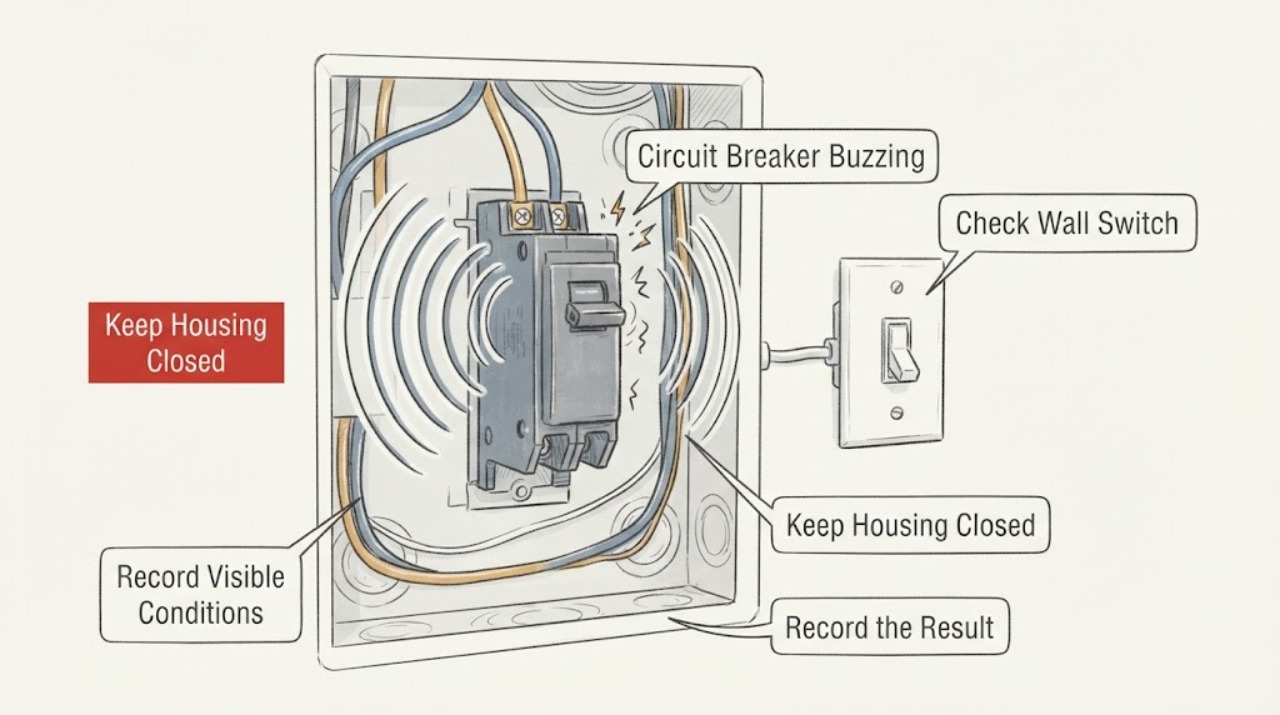
Work through in order
Diagnostic checks
Use only checks that match the exact appliance or system and its official guide.
-
Check 1
From a safe distance, locate the sound without touching the panel or nearby equipment. Note whether it is a steady buzz, hum, sizzle, or crackle and whether it comes from a breaker, the panel interior, a switch, an outlet, or a connected appliance.
Expected result: The sound is continuous or worsening, or it is accompanied by smoke, flame, visible arc, burning odor, heat, discoloration, flickering, or a shock or tingle.
Next step: Keep away from the equipment and affected area. If there is active smoke, flame, arcing, or rapidly worsening heat or odor, leave and contact emergency services. Otherwise avoid the area and arrange a licensed electrician.
Stop if: Do not touch the breaker, remove a cover, open the panel, chase wiring, or pour water on electrical equipment.
Why this matters
Why: These are warning signs of an electrical fault or fire hazard, not a normal breaker operating sound.
-
Check 2
From a safe position, note whether the buzz changes when a known appliance or lighting load starts or stops, without deliberately adding a load or operating equipment near a hazard. Record any associated dimming, flickering, or device shutdown.
Expected result: The sound begins or becomes louder with one load, occurs across several loads, or is present even when normal loads are off.
Next step: Stop using the suspected load and keep the circuit in its current safe state. Do not unplug or reconnect equipment at a hot, wet, smoking, or sparking outlet; give the timing to the electrician.
Why this matters
Why: A load-related change can help the electrician identify the affected branch; a sound independent of visible loads may involve the breaker, panel, or fixed wiring.
-
Check 3
Look only at visible exterior surfaces from a safe distance: the panel door, breaker handles, surrounding wall, switch plates, and outlets. Do not open the panel or touch any surface that is hot, wet, damaged, or discolored.
Expected result: A breaker handle or panel area is hot or discolored, an odor of overheated insulation is present, moisture is nearby, or no exterior warning is visible.
Next step: Keep clear and contact a licensed electrician. If the area is wet, do not approach the panel to isolate power; if smoke or fire is present, leave and obtain emergency help.
Stop if: Do not touch the panel, remove covers, dry energized equipment, or make an electrical measurement.
Why this matters
Why: Heat, odor, water, or discoloration indicates a potentially unsafe connection or wiring condition even if the breaker has not tripped; a normal exterior does not clear the panel.
-
Check 4
If the breaker has tripped and the panel is cool, dry, quiet, and free of odor, smoke, and sparks, note its position without repeatedly resetting it. Do not force the handle, substitute a fuse or breaker, or turn it back on to reproduce the buzz.
Expected result: The breaker is tripped and remains off, it trips again after one normal reset, it will not stay set, or it is on while buzzing continues.
Next step: If it trips again or the buzz continues, leave it off and call a licensed electrician. Do not use a larger-rated protective device or bypass the protection.
Stop if: Do not repeatedly reclose the breaker or open the panel to find the cause.
Why this matters
Why: A trip or persistent buzz may reflect an overload, arc fault, loose connection, defective breaker, or downstream wiring/load problem that needs diagnosis.
-
Check 5
Record nearby symptoms without touching wiring: dimming or flickering lights, outlets or switches that feel warm, appliance shutdowns, unusual smells, recent electrical work, water intrusion, or a new high-load appliance on the affected circuit.
Expected result: One or more of these symptoms occurs with the buzz, or the circuit has had recent renovation, water exposure, or added load.
Next step: Avoid the affected loads and arrange licensed electrician service. Tell the electrician the exact timing, location, recent work, and all visible warning signs.
Why this matters
Why: The combination strengthens the need for a whole-circuit and panel inspection; it does not identify a safe DIY adjustment.
-
Check 6
If the buzz is at a connected appliance or outlet rather than the breaker panel, stop using that load and record its name, operating state, and whether the sound stops when the appliance is safely turned off from its normal control. Do not unplug a hot, wet, smoking, or arcing device.
Expected result: The appliance or outlet is the apparent source, the buzz continues after the load is off, or the location cannot be distinguished safely.
Next step: Keep the suspected load out of service and request electrician inspection, with appliance service as needed. Do not move the fault to another outlet or extension cord.
Why this matters
Why: A connected device, receptacle, branch wiring, or upstream breaker may be involved; location uncertainty is not a reason to open the circuit.
-
Check 7
Prepare a professional handoff with the panel or breaker label, exact location, sound description, start time, load changes, trip history, flicker, odor, heat, smoke, water, and any shock. Do not try to reproduce the condition for the technician.
Expected result: The buzzing persists, recurs, or was associated with any spark, heat, smell, smoke, water, flicker, or trip.
Next step: Leave the affected circuit or equipment unused as directed by the electrician and arrange licensed electrical service. If there is active fire, smoke, or arcing, use emergency services first.
Stop if: Do not remove panel covers, trace wiring, bypass the breaker, or energize the circuit for another observation.
Why this matters
Why: A persistent or recurring buzzing circuit needs qualified diagnosis of the breaker, fixed wiring, connections, and affected loads.
Use your observations
Decision map
Find the observation that best matches what you see, then follow the next safe action.
-
PATH 01Next step
What you see
Buzzing is continuous or worsening, or the panel/breaker has heat, discoloration, burning odor, smoke, spark, arc, or a shock/tingle.
Do this next
Keep clear, leave if smoke or fire is active, contact emergency services as appropriate, and arrange licensed electrician inspection. Do not touch the panel or repeat a reset.
Why this path and its safety boundary
Why it matters: Treat the condition as an urgent electrical hazard.
-
PATH 02Next step
What you see
The breaker buzz changes when a known appliance or lighting load starts, or one connected device is the apparent source.
Do this next
Stop using the suspected load, do not move it to another outlet, and give the electrician the load timing and symptoms.
Why this path and its safety boundary
Why it matters: The load or its branch may be contributing, but the breaker, receptacle, and fixed wiring still require professional evaluation.
-
PATH 03Next step
What you see
The breaker has tripped and the panel is cool, dry, and free of warning signs.
Do this next
Do not repeatedly reset it. If one normal reset is attempted from a safe position and it trips again or buzzing returns, leave it off and call an electrician.
Why this path and its safety boundary
Why it matters: An overload or fault may have interrupted the circuit, but a trip is not proof that the wiring is safe.
-
PATH 04Next step
What you see
The panel or surrounding area is wet, or the breaker cannot be approached without standing in water or entering a hazard zone.
Do this next
Do not approach or touch it. Leave the area and obtain qualified or emergency help; do not try to dry or isolate energized equipment yourself.
Why this path and its safety boundary
Why it matters: The installation may present an immediate shock risk.
-
PATH 05Next step
What you see
The sound is faint or intermittent, with no heat, odor, flicker, spark, smoke, trip, or other warning sign, but its source is uncertain.
Do this next
Avoid manipulating the panel and arrange an electrician assessment if the sound recurs; record when it occurs and which loads are operating.
Why this path and its safety boundary
Why it matters: A benign mechanical or normal device sound cannot be confirmed from a distance, and a breaker or wiring issue remains possible.
-
PATH 06Next step
What you see
The buzz stops but the circuit has repeated trips, flickering, hot or discolored plates, burning odor, prior water damage, or recent wiring work.
Do this next
Keep affected loads off and request licensed electrician inspection before normal use resumes.
Why this path and its safety boundary
Why it matters: The absence of sound does not clear a circuit with other electrical warning signs.
Helpful context
Understand the symptom
A continuous buzz is a stop-and-escalate symptom
A brief mechanical or relay sound during normal switching is not the same as a circuit breaker that continuously buzzes, sizzles, or crackles. You cannot determine from the sound alone whether the cause is the breaker, a loose connection, an overloaded circuit, an arc fault, or a connected load. Keep your distance and arrange licensed electrical inspection.
Observe only what is visible from a safe distance
Record the sound's location, duration, whether it changes with a known appliance, and any flickering, odor, heat, discoloration, smoke, or spark. Do not remove a dead-front or panel cover, touch the breaker or wiring, trace conductors, or make electrical measurements. The wiring component is a service clue, not an invitation to open the panel.
Do not repeatedly reclose a buzzing breaker
A breaker trip can be a response to an overload or fault, and a breaker that buzzes without tripping can still indicate a problem. One normal action to avoid the affected circuit may be appropriate only if the control is clearly accessible and there is no heat, smoke, water, or arc; repeated resets or a larger replacement can increase risk.
Know when to leave
Smoke, flame, visible arcing, a strong burning-insulation odor, a hot panel, rapidly worsening sound, or a shock changes this from an electrical service call to an emergency. Leave without touching the equipment if the hazard is active, keep others away, and contact local emergency help. Never throw water onto energized electrical equipment.
Safety boundary
Stop conditions
- Stop immediately for persistent buzzing, sizzling, crackling, visible sparks or arcs, smoke, burning odor, hot or discolored panel parts, flickering, a shock or tingle, or repeated breaker trips.
- Do not remove a breaker-panel cover, touch wiring, trace the circuit, make electrical measurements, bypass protection, install a larger breaker, or repeatedly reclose the breaker.
- Do not approach or touch wet electrical equipment or stand in water to reach the panel. Keep clear and obtain qualified help; never use water on an electrical fire.
- If smoke, flame, active arcing, or rapidly worsening heat or odor is present, leave the area and contact emergency services. Do not re-energize the circuit until it has been inspected.
Only after diagnosis
Potential parts
- circuit breaker
Consider replacement only after a licensed electrician confirms the breaker itself is defective or unsuitable after checking the circuit and connections.
The breaker type, rating, panel listing, and local code must be verified by a qualified electrician; never substitute a larger rating. - switch, receptacle, or terminal connection
Relevant only when professional inspection identifies a damaged or loose connection at the affected switch, receptacle, or terminal.
Do not open the box or select a replacement from sound alone; the electrician must confirm the device and circuit requirements. - branch wiring or protective device
Consider only when the electrician finds damaged fixed wiring, an arc-fault condition, grounding issue, or another circuit-level defect.
Wiring and protective-device changes require licensed work and local-code compliance; do not bypass protection.
When checks do not resolve it
Need a professional?
Call a licensed electrician for any continuous or recurring circuit-breaker buzz, sizzle, or crackle; a breaker that trips again or will not stay set; hot or discolored panel parts; burning odor, flicker, spark, smoke, shock, water exposure, or an uncertain source.
Safety scope: Keep the affected circuit and equipment unused for active buzzing, smoke, fire, arcing, hot or damaged components, repeated trips, water exposure, or shock. Do not open the panel, make live measurements, bypass protection, or reset repeatedly until qualified service clears it.
Common questions
FAQ
Is a buzzing circuit breaker dangerous?
A continuous buzz, hum, sizzle, or crackle is not something to investigate by opening the panel. Treat it as a possible electrical fault, especially with heat, discoloration, burning odor, flickering, smoke, sparks, or a trip. Keep clear and call a licensed electrician.
Can I reset a buzzing breaker?
Do not repeatedly reset it. At most, one normal reset may be considered only when the panel is cool, dry, quiet, and free of odor, smoke, and sparks; if buzzing returns or the breaker trips again, leave it off and call an electrician. Do not install a larger breaker or bypass protection.
What should I do if the breaker panel is hot or smells burnt?
Do not touch or open it. Keep away and arrange urgent licensed electrician service. If there is smoke, flame, active arcing, or rapidly worsening heat or odor, leave and contact emergency services. Do not re-energize it until it has been inspected.
Why does the circuit breaker buzz when an appliance starts?
A change with a particular load helps the electrician identify the affected branch, but it does not prove the appliance is the only cause. Stop using the load, do not move it to another outlet or extension cord, and provide the timing and symptoms to the electrician.
Can I open the breaker panel to find a loose wire?
No. Do not remove the panel cover, touch wiring, chase the circuit, or make electrical measurements. The wiring component is a professional-service clue. Keep the affected circuit unused and have a licensed electrician inspect it.
Read the exact guide
Official sources
- CPSC, ESFI Warn Consumers About Electrical Hazards In The HomeU.S. Consumer Product Safety Commission and Electrical Safety Foundation International · General safety guidance, not a diagnosis of a particular breaker or wiring installation.
- Home Electrical Safety ChecklistU.S. Consumer Product Safety Commission · General household electrical safety resource; follow local emergency and licensed electrician guidance.
- Home Wiring HazardsU.S. Consumer Product Safety Commission · General household electrical safety guidance; local code and licensed electrician advice control any repair.
Community feedback
Share a repair observation
Share a plain-text repair observation. Accepted observations are published automatically; this page may take a moment to update.