
On this page
Start here
Quick answer
A circuit breaker that buzzes when there is a load on it should be treated as an electrical warning, not as a reason to add or repeat a load test. A brief sound already observed with one appliance is different from buzzing that continues with several known loads, but neither pattern can identify a safe household repair. From a safe, dry position, record what was already operating, whether lights flickered, and whether the panel or switch looks hot or discolored. Stop using the affected circuit. If the buzzing is loud, persistent, or accompanied by burning odor, smoke, sparks, sizzling, heat, shock, or repeated tripping, leave the area and contact emergency services. Otherwise, isolate the circuit only if its disconnect is safely reachable without touching damaged equipment, then have a licensed electrician inspect it before power is restored.
Before you begin
Safety first
- Do not open or touch the panel, reset repeatedly, add a load, test live wiring, pull a hot or wet plug, bypass protection, or restore power before inspection.
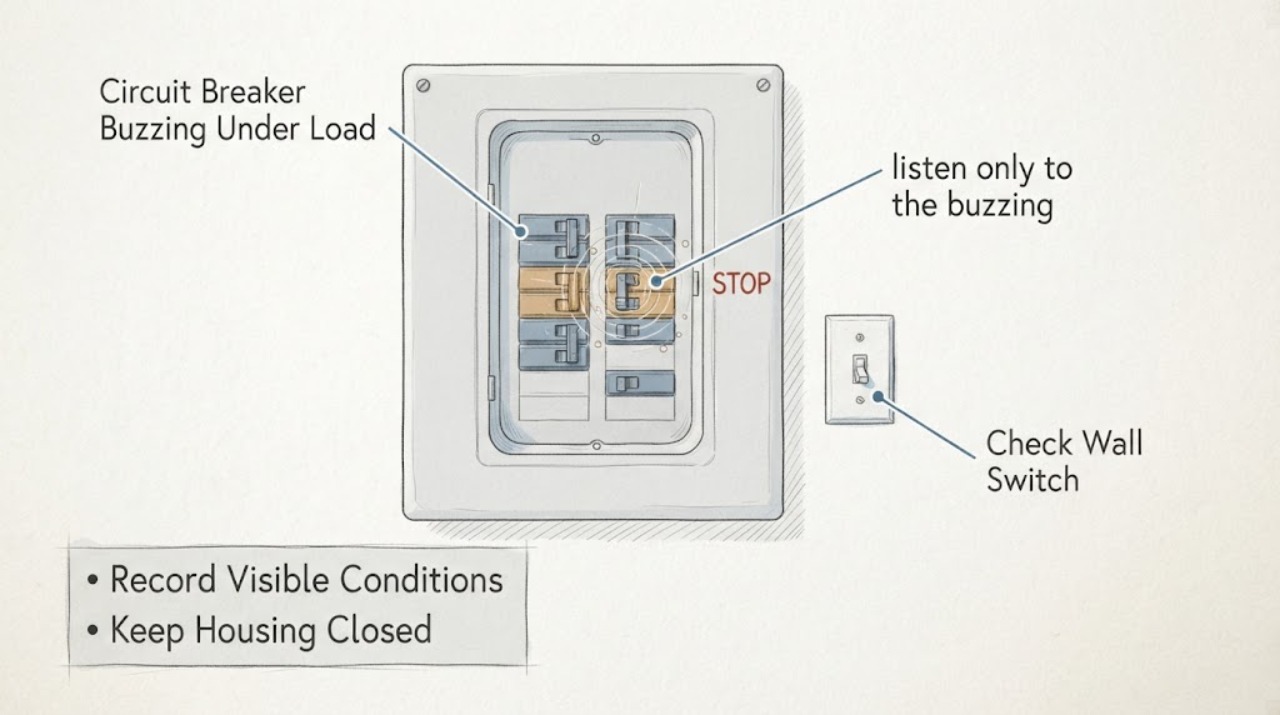
Work through in order
Diagnostic checks
Use only checks that match the exact appliance or system and its official guide.
-
Check 1
From a safe distance, listen only to the buzzing that has already occurred and note whether it was a brief event or is still continuous, without turning on another device or touching the panel.
Expected result: The buzz is continuous, harsh, growing louder, accompanied by sizzling, or present even after the known load has stopped; or it was brief and has not returned.
Next step: For a continuing or worsening sound, stop using the circuit and escalate to emergency or licensed electrical help. For a brief event, leave the circuit unused and arrange an electrician inspection rather than repeating the load.
Why this matters
Why: A continuing or worsening sound is a possible active connection, overload, or arcing warning. A brief event is still service evidence and is not permission to reproduce it.
-
Check 2
Look from a distance for smoke, flame, sparks, an arc, a hot or discolored panel or switch, flickering or dimming lights, a burning odor, or a breaker that has tripped again.
Expected result: Any of those signs is present, or the only symptom is a buzz that appeared when the previously operating load was on.
Next step: If there is smoke, flame, sparks, arcing, sizzling, rapidly increasing heat, or a worsening odor, evacuate and call emergency services. Otherwise keep the affected circuit out of use and call a licensed electrician.
Why this matters
Why: The added signs indicate a higher-risk electrical fault. A load-linked buzz without visible damage still needs inspection because hidden wiring or connection heating cannot be cleared visually.
-
Check 3
Record the loads that were already operating when the buzzing began, such as one appliance, a known group of appliances, or a permanently connected load, without switching them back on for comparison.
Expected result: The sound was associated with one previously active device, several devices already on the branch, or no identifiable load.
Next step: Keep the suspected device and circuit off. Give the electrician the load list and timing; do not move the device to another outlet, use an extension cord, or add a load to see whether the buzz changes.
Why this matters
Why: One-device timing can point to that appliance, its cord, outlet, or branch connection. Several-load timing can indicate circuit demand or a shared connection. No identifiable load raises concern about the breaker or wiring itself; none of these observations proves the failed part.
-
Check 4
Check visually from a safe position whether the affected area is dry and whether the circuit disconnect can be reached without entering water, touching a hot surface, approaching smoke, or crossing an obstructed exit.
Expected result: The panel or path is wet, standing water is present, equipment is damaged or hot, or the disconnect is dry and safely reachable.
Next step: Do not enter standing water or touch wet equipment. If the disconnect is safely reachable, isolate the affected circuit once and leave it off; otherwise wait for emergency personnel or a licensed electrician to isolate it.
Why this matters
Why: Water and damaged electrical equipment create shock and fire risk. A dry, clear route may allow isolation, but it does not make the panel safe to open or inspect.
-
Check 5
Without removing the cover or touching the breaker, note the handle position and whether the buzzing circuit has caused a loss of power, repeated trip, flicker, or change in brightness when the already-recorded load operated.
Expected result: The breaker is tripped or repeatedly trips, lights flicker or dim, brightness changes with the known load, or the handle appears normal while buzzing was heard.
Next step: Do not reset the breaker, replace it, install a higher rating, or open the panel. Keep the circuit off and provide the electrician the exact handle and lighting behavior.
Why this matters
Why: Protective operation or light changes help define the service call, but a normal handle does not clear a buzzing breaker or connection.
-
Check 6
Inspect only the accessible exterior of the known load's cord, plug, appliance, outlet, or switch from a non-contact distance, and record visible cracking, melting, discoloration, looseness, or an odor without moving it.
Expected result: A cord, plug, outlet, or switch shows damage or heat signs, or no external damage is visible.
Next step: Stop using the affected equipment and leave a hot, damaged, or wet plug in place. Have the electrician inspect the device and branch circuit; do not remove a faceplate or pull a plug under unsafe conditions.
Why this matters
Why: The fault may be downstream of the breaker; no visible damage cannot exclude overheating inside a connection or appliance.
-
Check 7
After safe isolation, confirm only from a distance that the buzzing, heat, smoke, and odor are not increasing; do not re-energize the circuit to verify the result.
Expected result: The warning continues or worsens after isolation, or it stops but the cause has not been inspected.
Next step: Leave the area and contact emergency services for smoke, flame, sparks, arcing, or worsening heat or odor. Otherwise keep power off and schedule a licensed electrical inspection before reuse.
Why this matters
Why: A persistent warning may involve equipment upstream of the branch disconnect or an active fire condition. A quiet circuit is not professional clearance.
Use your observations
Decision map
Find the observation that best matches what you see, then follow the next safe action.
-
PATH 01Next step
What you see
Buzzing is continuous, harsh, worsening, or accompanied by smoke, flame, sparks, arcing, sizzling, heat, burning odor, or repeated tripping.
Do this next
Evacuate or leave the danger area, call emergency services, and do not touch, reset, open, or use the electrical equipment.
-
PATH 02Next step
What you see
The circuit or panel is wet, standing water blocks access, or damaged equipment must be crossed to reach the disconnect.
Do this next
Do not enter the water or approach the equipment. Have emergency personnel or a licensed electrician isolate power from a safe location.
-
PATH 03Next step
What you see
The buzz was already observed only when one known appliance or switch was operating, with no visible smoke, heat, odor, flicker, or trip.
Do this next
Do not operate that load again. Keep the circuit out of use and have the appliance, outlet, switch, and branch circuit inspected.
-
PATH 04Next step
What you see
The buzz was already observed while several known loads were operating, with no additional emergency sign.
Do this next
Do not reproduce the condition. Keep the circuit isolated and have an electrician assess the branch demand, protective device, connections, and wiring.
-
PATH 05Next step
What you see
The sound stopped when the previously active load stopped, but the circuit has not been inspected.
Do this next
Treat the event as unresolved service evidence; do not restore the load until a licensed electrician clears the circuit.
Helpful context
Understand the symptom
The load relationship is useful evidence, not a test to repeat
A sound that began when a particular appliance started, or that was already heard with several loads running, helps an electrician identify the affected branch. It does not prove that the breaker is simply overloaded, and it does not make it safe to turn loads back on. A breaker, terminal, bus connection, branch conductor, receptacle, switch, or connected appliance may be involved.
Separate a brief known event from a continuing warning
Record whether the sound stopped when the already-active load was removed by normal control, whether it continued with the circuit idle, and whether any heat, odor, flicker, discoloration, or trip occurred. Do not create a new load or cycle the breaker to compare sounds. A persistent or worsening buzz is an escalation even when the circuit still appears to work.
The panel cover stays closed
Circuit breakers interrupt overcurrent, but the visible handle does not reveal the condition of internal contacts or terminations. The CPSC guide is a hazard-identification resource rather than a repair manual and directs qualified help for wiring defects. Keep the affected circuit isolated until a licensed electrician checks it.
Safety boundary
Stop conditions
- Stop immediately and evacuate for smoke, flame, sparks, arcing, sizzling, rapidly increasing heat, a worsening burning odor, or repeated breaker trips.
- Never turn on additional loads to test the circuit, repeat a prior load, repeatedly reset the breaker, or replace it with a higher-rated device.
- Never open the panel or switch box, remove a faceplate, touch wiring, measure voltage or current, bypass protection, or pull a hot, damaged, or wet plug.
- Do not enter standing water or use water on an electrical fire. Keep the affected circuit off until a licensed electrician or emergency personnel clears it.
When checks do not resolve it
Need a professional?
Call emergency services immediately for flame, smoke, sparks, arcing, sizzling, rapidly increasing heat, or a strong or worsening odor. For a circuit breaker that buzzed under a previously observed load without visible fire, stop using the affected circuit and call a licensed electrician. Provide the circuit label, the load or loads already operating, when the sound began, whether it stopped, and any flicker, heat, odor, damage, or trip.
Safety scope: Do not open or touch the panel, reset repeatedly, add a load, test live wiring, pull a hot or wet plug, bypass protection, or restore power before inspection.
Have this ready
- circuit label and affected area
- known load already operating when buzzing began
- whether one device or several devices were involved
- brief or continuous sound
- flicker or brightness change
- visible heat, discoloration, smoke, odor, sparks, or trip
- whether water or structural damage is present
Common questions
FAQ
Why does a circuit breaker buzz only when a load is running?
The timing can help an electrician distinguish one appliance or branch from several already operating loads, but it does not prove the cause or make a repeat test safe. Stop using the affected circuit and arrange inspection, especially if the sound persists or any heat, odor, flicker, sparks, or trip occurs.
Should I turn on another appliance to see whether the buzzing gets louder?
No. Do not add or repeat a load, cycle the breaker, or move the appliance to another outlet. Record what was already running and give that information to a licensed electrician.
When does buzzing require emergency help?
Leave the area and call emergency services for smoke, flame, sparks, arcing, sizzling, rapidly increasing heat, or a worsening burning odor. A quieter load-linked buzz still requires the circuit to remain out of use and a licensed electrical inspection.
Read the exact guide
Official sources
- CERT Basic TrainingFederal Emergency Management Agency / Ready.gov · Electrical emergency utility isolation and standing-water safety
- Electrical Fire SafetyCommonwealth of Massachusetts · Government fire-department escalation for electrical arcs, sparks, sizzling, and burning odors
- CPSC Guide to Home Wiring HazardsU.S. Consumer Product Safety Commission · Circuit breaker, electrical panel, switch, wiring hazard signs and professional repair boundary
- Appliance and Electrical Fire SafetyU.S. Fire Administration · Appliance load, outlet, cord, extension-cord, and electrical fire prevention safety
- Switch to SafetyElectrical Safety Foundation International · Electrical switch and circuit warning signs including buzzing, odor, heat, discoloration, flicker, and trips
- Don’t Overload Your HomeElectrical Safety Foundation International · Electrical overload warning signs and safe interpretation of buzzing when there is a load on it
- Electrical Safety: ChecklistNational Fire Protection Association · Residential electrical warning signs and qualified electrician escalation
- What to Do to Protect Yourself From Electrical HazardsCenters for Disease Control and Prevention · Electrical hazard response around water, burning odors, sparks, power isolation, and qualified inspection
Community feedback
Share a repair observation
Share a plain-text repair observation. Accepted observations are published automatically; this page may take a moment to update.