
On this page
Start here
Quick answer
An unusual buzzing or sizzling sound from a circuit breaker, panel, outlet, or nearby electrical device should be treated as a warning sign, not a noise to test by opening the panel. From a safe, dry position, identify where the sound comes from, whether it changes with a known load, and whether you can see flickering, discoloration, smoke, sparks, moisture, or signs of heat without touching anything. Stop using nonessential equipment from its normal controls if that is safe, do not reset the breaker repeatedly, and do not remove the service-panel cover. Arrange qualified electrician assessment; leave the area and seek urgent help for smoke, sparks, burning odor, hot or discolored parts, arcing, or an active fire.
Before you begin
Safety first
- This article covers listening, ground-level visual observation, safe load documentation, and normal-control shutdown of clearly safe nonessential devices only. Do not access energized parts, remove covers, reset or replace protection, or perform electrical tests.
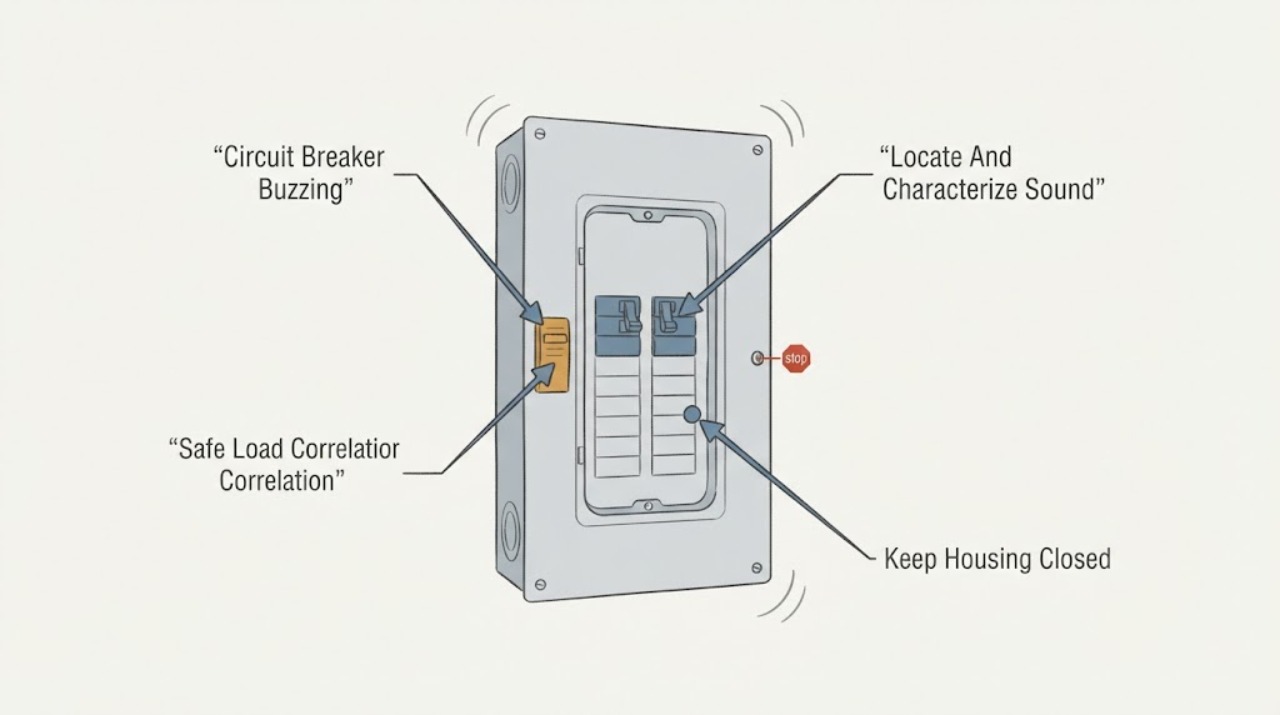
Work through in order
Diagnostic checks
Use only checks that match the exact appliance or system and its official guide.
-
Check 1
From a safe, dry position, listen without touching the panel or electrical equipment and identify whether the sound seems to come from the breaker area, the panel door or wall, a nearby outlet or switch, or a connected appliance. Note whether it is continuous, intermittent, or synchronized with a load starting or stopping.
Expected result: Record a steady hum, intermittent buzz or sizzle, crackling, sound only when one appliance runs, sound that continues with appliances off, or a source that cannot be located safely.
Next step: Keep the area untouched, document the sound and timing, and use the matching branch to decide whether to stop nearby equipment and request prompt or urgent qualified help.
Stop if: Stop immediately for sparks, smoke, burning odor, hot surfaces, visible arcing, loud popping, electrical shock, water, or any need to approach an exposed or damaged part.
Why this matters
Why: Location and timing can separate a panel-area warning from a device or load-related symptom, but none of these observations proves the failed component or makes contact with the panel safe.
-
Check 2
Without opening the panel or touching the cover, inspect the visible exterior, nearby wall, receptacles, switches, and appliance cords from ordinary standing distance for discoloration, melted material, scorch marks, smoke, moisture, flickering lights, or an odor of overheated insulation.
Expected result: Record no visible change versus warm-looking or discolored parts, melted plastic, scorch marks, smoke, moisture, flickering, or a hot-insulation odor.
Next step: Keep clear and arrange urgent qualified electrical assessment when any warning sign is present; do not wipe, tighten, cover, or remove the affected part.
Stop if: Do not touch a warm, wet, discolored, melted, smoking, or sparking component, and do not remove the panel cover to improve the view.
Why this matters
Why: Heat, discoloration, smoke, moisture, flickering, or an overheated-plastic odor raises the urgency and may indicate an electrical hazard beyond a noisy breaker. A clean exterior does not clear energized parts inside.
-
Check 3
Make a simple list of appliances, lights, heaters, tools, or other known loads that were operating when the buzzing began. From their normal controls, stop or unplug only a clearly safe, accessible, nonessential device; do not handle damaged equipment, wet plugs, heating elements, or anything that requires reaching behind the panel.
Expected result: Record whether the sound stops, changes, or continues after a known load is safely turned off, and whether lights dim, flicker, or another device trips at the same time.
Next step: Leave the correlated device out of use when safe, do not add loads or extension cords, and provide the load list and timing to a qualified electrician.
Stop if: Do not reset the breaker to repeat the test, operate a suspect appliance, unplug a hot or damaged cord, or touch any wet or energized equipment.
Why this matters
Why: A repeatable load correlation gives the electrician useful evidence about the affected branch or appliance, while a sound that continues with ordinary loads off keeps the panel, wiring, or breaker area in focus. Neither result identifies a part.
-
Check 4
From outside the closed panel, note whether the affected circuit appears on, off, or in an intermediate position without touching the handle or opening the cover; record any recent trips, outages, renovation, new high-load appliance, or repeated buzzing episodes.
Expected result: Record a stable visible position, an apparent trip or intermediate position, frequent trips, a recent added load, or no reliable state information.
Next step: Keep the circuit and area in the safest observed state and give the electrician the breaker label, timing, load history, and whether anyone reset it previously; do not manipulate the breaker.
Stop if: Do not touch a buzzing breaker, force a handle, replace a fuse or breaker, remove the dead front or cover, or investigate inside the panel.
Why this matters
Why: Frequent trips or a changed breaker state can signal overload, a malfunctioning product, or another electrical problem, but the state cannot be safely interpreted as permission to reset or replace anything.
-
Check 5
Keep people and pets away from the panel and nearby suspect equipment, preserve a clear exit, and document the sound source, visible signs, load correlation, breaker history, and any affected rooms from a safe position. Do not place combustible items against the panel or cover the sound with insulation.
Expected result: Confirm that the panel area is dry and unobstructed, no one needs to touch it to pass, and the warning signs are stable, worsening, or absent while qualified help is arranged.
Next step: Arrange qualified electrician assessment and provide the record; leave the affected equipment or circuit unused when safe until the cause is evaluated.
Stop if: Do not block, tape over, spray, cool with water, open, cover, or otherwise alter the panel or suspect equipment.
Why this matters
Why: A controlled area prevents accidental contact while preserving evidence for service. Worsening sound, heat, odor, smoke, or flickering changes the response from prompt scheduling to urgent electrical or emergency assistance.
Use your observations
Decision map
Find the observation that best matches what you see, then follow the next safe action.
-
PATH 01Next step
What you see
Smoke, sparks, visible arcing, burning odor, hot or discolored parts, melted material, water, shock, loud popping, or an active fire is present.
Do this next
Leave the area, keep people away, and use appropriate emergency or utility assistance. Disconnect power only from a safe, dry, normal disconnect location if qualified emergency guidance directs it; do not approach a gas, fire, wet, or sparking condition.
Why this path and its safety boundary
Why it matters: The buzzing is accompanied by an immediate fire, shock, heat, or water hazard and is not a user-diagnosis condition.
-
PATH 02Next step
What you see
The sound changes or stops when one clearly safe, accessible, nonessential appliance is turned off from its normal control, with no heat, odor, sparks, or visible damage.
Do this next
Leave the correlated device out of use when safe, do not reset the breaker to repeat the test, and arrange qualified electrician or appliance assessment as appropriate.
Why this path and its safety boundary
Why it matters: The appliance or its circuit load becomes a focused service question, but the load correlation does not prove an appliance or breaker fault.
-
PATH 03Next step
What you see
Buzzing continues with known nonessential loads off, comes from the panel or breaker area, or is accompanied by frequent trips, dimming, or flickering.
Do this next
Keep clear, do not open or reset the panel, and request prompt qualified electrician inspection with the sound and breaker history documented.
Why this path and its safety boundary
Why it matters: A panel, breaker, branch-circuit, supply, or hidden connection issue remains possible and cannot be resolved by sound or exterior appearance.
-
PATH 04Next step
What you see
The sound source cannot be located safely, or the panel and connected equipment cannot be observed without access to a tight, wet, elevated, dark, or otherwise unsafe area.
Do this next
Do not continue searching. Keep people away from the suspected area and arrange qualified electrical assessment, reporting where and when the sound was noticed.
Why this path and its safety boundary
Why it matters: Uncertainty about source or access is itself a reason to stop; a hidden energized fault cannot be ruled out.
-
PATH 05Next step
What you see
The sound is not currently present and no warning signs, trips, flickering, odor, heat, or visible damage were observed.
Do this next
Keep a safe event log and arrange non-emergency electrician assessment if the sound recurs, especially after a specific load starts or stops; never reproduce it by resetting or loading the circuit.
Why this path and its safety boundary
Why it matters: The immediate hazard is not established, but an intermittent electrical sound remains unresolved and should not be dismissed if it returns.
Helpful context
Understand the symptom
Treat unusual buzzing as a warning signal
A sound described as buzz, sizzle, crackle, or hum may come from the breaker, the panel enclosure, a connected device, or wiring elsewhere on the circuit. The sound does not identify a loose connection, overload, arcing condition, or failed breaker by itself. Its timing and accompanying signs determine urgency, while a qualified electrician determines the cause.
The safe inspection boundary is outside the panel
Look and listen only from a stable, dry position. The external door, surrounding wall, nearby receptacles, and connected appliances can provide context without exposing energized parts. CPSC specifically says not to remove the service-panel cover; do not use a screwdriver, probe, phone flash through a gap, or improvised tester to look inside.
Load correlation is evidence, not a repair test
If the sound changes when a known appliance starts, stops, or heats, record that correlation and leave the questionable equipment out of use when safe. A load-related change can help an electrician prioritize the circuit, but it does not make repeated breaker resets, panel adjustments, or appliance disassembly safe for a homeowner.
Safety boundary
Stop conditions
- Do not remove the service-panel cover, dead front, or any enclosure; do not probe gaps, touch terminals, tighten connections, or perform live testing.
- Do not reset a buzzing or repeatedly tripping breaker to reproduce the sound, replace a breaker or fuse, install a higher-rated device, or bypass a protective device.
- Stop for smoke, sparks, visible arcing, burning odor, hot or discolored parts, melted material, water, electrical shock, loud popping, or active fire; keep clear and obtain appropriate qualified or emergency help.
- Do not handle wet, hot, damaged, sparking, or suspect cords, plugs, outlets, appliances, or panel components.
When checks do not resolve it
Need a professional?
Arrange qualified electrician assessment for any unusual or recurring buzzing from a circuit breaker, panel, outlet, switch, or wiring, especially when the sound continues with loads off, changes with a known load, or occurs with trips, dimming, flickering, odor, heat, or discoloration. Leave the area and seek urgent emergency or utility assistance for smoke, sparks, arcing, burning odor, active fire, water, shock, or hot or melted electrical parts. Do not open the panel or reset the breaker as a test.
Safety scope: This article covers listening, ground-level visual observation, safe load documentation, and normal-control shutdown of clearly safe nonessential devices only. Do not access energized parts, remove covers, reset or replace protection, or perform electrical tests.
Common questions
FAQ
Is a buzzing circuit breaker normal?
Treat an unusual or recurring buzz, sizzle, or crackle as a warning sign. Do not diagnose it by opening the panel; document the sound and arrange qualified electrician assessment, especially if heat, odor, flickering, sparks, or trips occur.
Can I open the panel to see which breaker is buzzing?
No. CPSC specifically says not to remove the service-panel cover. Look and listen only from a safe position and have a qualified electrician inspect the equipment.
Should I reset a buzzing breaker?
Do not repeatedly reset it or use a reset to reproduce the sound. Record whether it has tripped, keep suspect loads out of use when safe, and arrange qualified electrical assessment.
When does buzzing require urgent help?
Leave the area and seek appropriate urgent emergency or utility assistance for smoke, sparks, visible arcing, burning odor, hot or melted parts, water, shock, loud popping, or active fire. Do not touch the panel or suspect equipment.
Read the exact guide
Official sources
- CPSC Guide to Home Wiring HazardsU.S. Consumer Product Safety Commission · Official CPSC home-wiring safety guide used for the no-panel-access boundary and safe recognition of buzzing, heat, odors, flickering, sparks, and trips; local electrical requirements and qualified professionals control.
- Commission Closes Investigation Of FPE Circuit Breakers And Provides Safety Information For ConsumersU.S. Consumer Product Safety Commission · Official CPSC general circuit-breaker safety information used for load history, repeated-trip caution, and professional inspection boundaries; it does not identify or condemn a particular breaker model.
- Electrical Safety Month PosterU.S. Consumer Product Safety Commission · Official CPSC consumer safety poster used for recognizing buzzing as an electrical warning sign; it does not diagnose a particular breaker or authorize panel access.
Community feedback
Share a repair observation
Share a plain-text repair observation. Accepted observations are published automatically; this page may take a moment to update.