
On this page
Start here
Quick answer
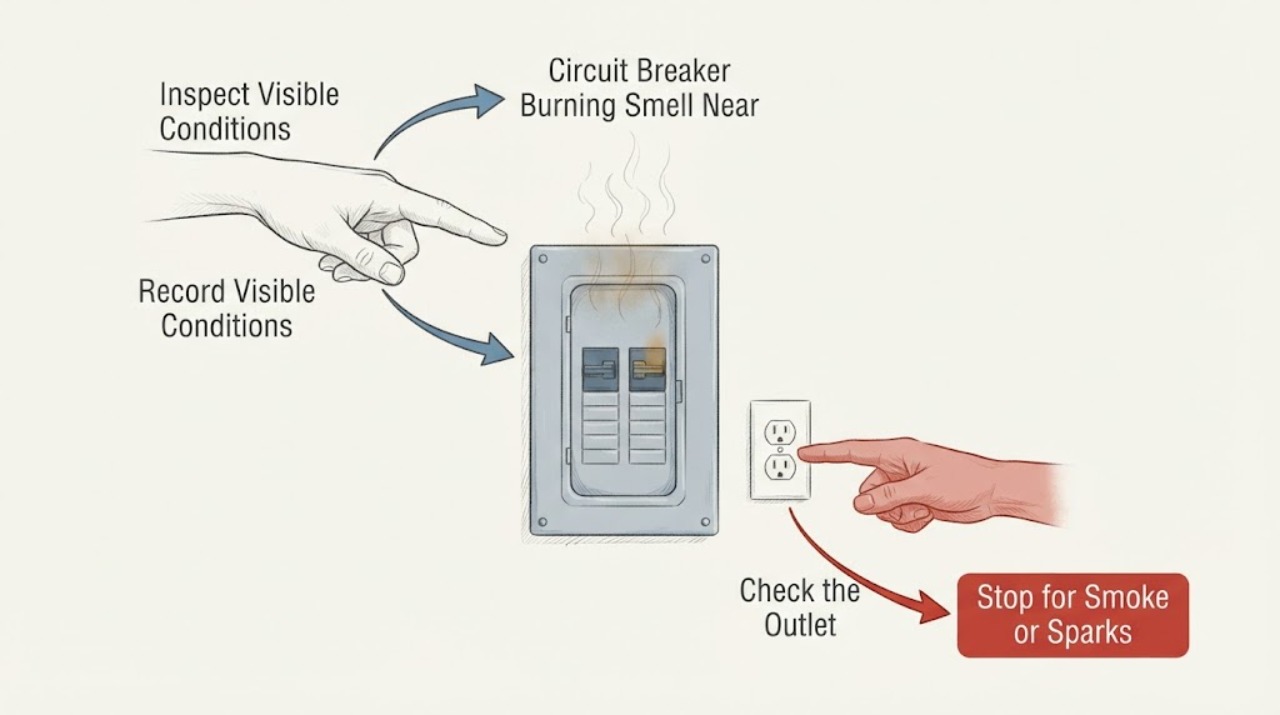
A burning smell near a circuit breaker, outlet, plug, or wall plate is not a normal troubleshooting symptom. From a safe distance, note whether there is smoke or flame, where the odor is strongest, which circuit appears affected, and whether the breaker has tripped. Do not reset the breaker, open a panel or outlet, pull out a hot plug, measure voltage, search for a loose wire, bypass protection, or use water on an energized fire. Evacuate for smoke, flame, rapid heat, arcing, or an odor that is getting stronger; call emergency fire help from a safe location when needed, and have a licensed electrician inspect the circuit before it is used again.
Before you begin
Safety first
- A licensed electrician should inspect the outlet, plug and cord, branch circuit, protective device, and panel as appropriate; an appliance professional may be needed if the appliance caused the event.
Work through in order
Diagnostic checks
Use only checks that match the exact appliance or system and its official guide.
-
Check 1
From a safe distance, look for smoke, flame, glowing material, visible arcing, a rapidly spreading odor, or people at risk. Do not approach the panel, outlet, plug, cord, or appliance to get a closer view.
Expected result: Active smoke, flame, glowing material, visible arcing, or rapidly worsening heat is an emergency condition; a lingering odor without visible smoke is still an electrical stop condition.
Next step: Leave the area and call emergency fire help from a safe location for smoke, flame, rapid heat, or arcing. Do not use water and do not return to inspect until responders say it is safe.
Why this matters
Why: The presence and speed of the hazard determine whether immediate evacuation and emergency fire response are needed before any electrician is contacted.
-
Check 2
Without touching or moving anything, identify where the odor seems strongest: the breaker or service-panel area, a wall outlet or faceplate, the plug or cord, or the connected appliance. Record whether the smell is burning, rubbery, or accompanied by crackling or buzzing.
Expected result: A smell at an outlet or appliance connection points to a different inspection path than an odor at the service panel; crackling, buzzing, or sparks raise the urgency.
Next step: Keep clear of the suspected source and tell the electrician the location, odor description, and any sound. Do not pull a hot plug, touch a warm plate, or remove an outlet or panel cover.
Why this matters
Why: Location is a dispatch clue, not a diagnosis. The visible source can be downstream from the actual loose, damaged, or overheated connection.
-
Check 3
From a safe position, note whether the affected circuit's breaker appears tripped and whether lights or outlets in the same area have lost power. Do not reset it, open the panel, substitute a fuse or breaker, or operate the suspected outlet to see whether the symptom returns.
Expected result: A breaker that trips when a particular outlet or appliance is used, or that will not remain on, indicates that the circuit needs qualified inspection; repeated trips are not a test to repeat.
Next step: Leave the affected circuit out of use and arrange a licensed electrician. Escalate to emergency help for smoke, flame, arcing, or rapidly rising heat.
Why this matters
Why: Protective operation can reflect overload, a fault in the appliance, or a wiring or outlet problem, and a visual status cannot distinguish them safely.
-
Check 4
From a distance and only if visibility is safe, look for a discolored wall plate, melted plastic, soot, a loose-looking plug, damaged cord insulation, or heat marks around the outlet and nearby wall. Do not touch the plate, cord, plug, or wall to check temperature or fit.
Expected result: Discoloration, melting, soot, damaged insulation, or an outlet that appears hot is evidence of a potential fire or shock hazard even if the breaker is currently on.
Next step: Keep people away and leave the outlet and appliance unused. Do not tape, tighten, replace, clean, or cover the damaged area; provide the visual description to the electrician or fire responders.
Why this matters
Why: CPSC and NFPA treat hot, warm, discolored, sparking, or odor-producing electrical equipment as a reason to discontinue use and obtain qualified help.
-
Check 5
From a safe distance, note what was operating when the odor began, whether other high-load appliances were on the same circuit, and whether the smell began after a plug, switch, or appliance was used. Do not move loads, add an extension cord, or plug the appliance into another outlet.
Expected result: A symptom tied to one appliance or outlet differs from odor and tripping across several outlets; either pattern can involve equipment or branch wiring and needs inspection.
Next step: Keep all suspected equipment and the affected circuit out of use. Report the appliance, outlet, circuit behavior, and event sequence to a licensed electrician.
Why this matters
Why: The event sequence helps a professional separate an appliance-side fault from an outlet or circuit condition without energizing another test setup.
-
Check 6
From a safe location, check whether water, a wet floor, combustible materials, or smoke is near the suspected electrical area. Do not use water, wet hands, a damp cloth, or a metal object around energized equipment.
Expected result: Water near an electrical source increases shock risk; combustible material near heat, smoke, or arcing increases fire risk.
Next step: Leave the area for active smoke, fire, or escalating heat and call emergency responders from safety. Do not attempt to dry, cover, move, or clean energized equipment.
Why this matters
Why: The environment can change this from an urgent electrician call to an emergency evacuation and fire response, and it makes approach unsafe.
-
Check 7
Prepare a distance-only incident record: the room and outlet location, appliance or load involved, breaker status, power loss, odor timing, sounds, smoke or sparks, visible discoloration, and whether anyone was exposed to shock. Do not perform voltage tests or open the panel to add details.
Expected result: A complete record of the first symptom and its progression helps the electrician or emergency responder prioritize the appliance, outlet, branch circuit, or panel inspection.
Next step: Give the record and photographs taken only from a safe distance to a licensed electrician or emergency responders. Keep the affected circuit and equipment unused until cleared.
Why this matters
Why: No ordinary-user observation can certify that a circuit is safe after a burning smell; inspection is required before reuse.
Use your observations
Decision map
Find the observation that best matches what you see, then follow the next safe action.
-
PATH 01Next step
What you see
Smoke, flame, glowing material, visible arcing, rapidly rising heat, or an odor that is quickly getting stronger is present.
Do this next
Evacuate, keep others away, and call emergency fire help from a safe location. Do not use water or re-enter to operate a breaker.
Why this path and its safety boundary
Why it matters: Treat it as an electrical fire emergency rather than a diagnostic project.
-
PATH 02Next step
What you see
There is a burning odor, warm or discolored outlet, damaged cord, soot, melting, buzzing, or sparks but no active fire.
Do this next
Arrange prompt inspection by a licensed electrician; use emergency help if smoke, heat, or arcing begins.
Why this path and its safety boundary
Why it matters: Discontinue use of the outlet, appliance, and suspected circuit without touching them.
-
PATH 03Next step
What you see
The breaker trips repeatedly or trips when one outlet, appliance, or switch is used.
Do this next
Leave the circuit out of use and have a qualified electrician determine whether the cause is the load, outlet, branch wiring, or panel.
Why this path and its safety boundary
Why it matters: Do not reset it again or install a higher-rated protective device.
-
PATH 04Next step
What you see
The suspected source is near water, a wet floor, combustible materials, or an area that cannot be approached safely.
Do this next
Keep people away and use emergency response for smoke or fire; otherwise wait for qualified electrical service from a safe location.
Why this path and its safety boundary
Why it matters: Do not approach, clean, move, unplug, or cover the equipment.
-
PATH 05Next step
What you see
The odor has stopped and there is no visible damage or smoke.
Do this next
Preserve the incident details and arrange an electrician inspection before restoring normal use.
Why this path and its safety boundary
Why it matters: The absence of current symptoms does not clear the circuit or outlet for reuse.
Helpful context
Understand the symptom
Do not assume the smell is coming from the breaker itself. Heat can be at the wall outlet, plug, appliance cord, branch wiring, or the service panel, and odor can travel. The safe goal is not to find the failed wire; it is to recognize the severity, keep people away, and give an electrician or fire responders useful information without approaching energized equipment.
The observations below are visual and distance-based. A breaker that trips is doing its protective job, but a trip does not prove the circuit is safe to restore. Do not repeatedly reset it, substitute a higher-rated protective device, remove a cover, or investigate behind an outlet faceplate.
Safety boundary
Stop conditions
- Stop and evacuate for smoke, flame, glowing material, visible arcing, rapidly rising heat, or a rapidly worsening odor; call emergency fire help from a safe location.
- Stop using the affected outlet, appliance, cord, circuit, and panel area for any burning smell, warm or discolored plate, soot, melting, buzzing, or sparks.
- Do not reset a tripped breaker repeatedly, fit a higher-rated protective device, bypass protection, or restore power to reproduce the symptom.
- Do not open a service panel or outlet, remove a faceplate, search for a loose wire, measure voltage, or touch a hot plug, cord, outlet, breaker, or wall.
- Do not pull out a hot plug, move energized equipment, use an extension cord for a suspected load, or use water on a possible energized electrical fire.
- Stop and keep clear if water, a wet floor, combustible material, or another person is at risk near the suspected electrical source.
Only after diagnosis
Potential parts
- receptacle outlet or faceplate
Consider only if an electrician confirms the outlet or its connection is damaged or overheated.
The electrician must select a code-compliant replacement for the wiring, load, protection, and installation context; do not select or install it from the smell alone. - circuit breaker or protective device
Consider only after an electrician identifies a failed or unsuitable protective device and rules out the load, outlet, and branch wiring.
Never substitute a higher-rated device or bypass protection; rating and fit must be determined by a qualified electrician. - branch-circuit wiring or appliance cord
Consider only when inspection identifies damaged insulation, a loose connection, or an appliance-side cord fault.
Wiring and cord work requires qualified installation and correct ratings; the odor does not identify a repair part.
When checks do not resolve it
Need a professional?
Any burning smell, heat, discoloration, smoke, spark, trip, or unexplained electrical odor; emergency response for active smoke, flame, arcing, or rapidly rising heat.
Safety scope: A licensed electrician should inspect the outlet, plug and cord, branch circuit, protective device, and panel as appropriate; an appliance professional may be needed if the appliance caused the event.
Have this ready
- Room and outlet location, appliance or load involved, breaker status, power loss, odor timing, sounds, smoke or sparks, visible damage, water proximity, and any safe-distance photographs.
Common questions
FAQ
Is a burning smell from a circuit breaker or outlet dangerous?
Yes. A burning or rubbery smell, warm or discolored outlet, buzzing, sparks, smoke, or repeated tripping can signal overheating, arcing, or a fire hazard. Keep clear, do not reuse the circuit, and arrange qualified electrical inspection; evacuate and call emergency help for smoke or fire.
Should I reset the breaker if I smell burning?
No. Do not reset it to see whether the smell returns, install a higher-rated device, or bypass protection. Leave the affected circuit out of use and have a licensed electrician inspect it.
Can I unplug an appliance with a hot plug or burning smell?
Do not touch or pull a hot, smoking, sparking, or damaged plug. Move away and use emergency response for smoke, flame, arcing, or rapidly rising heat. A qualified professional can make the area safe and determine whether the appliance, cord, or outlet is involved.
What if the burning odor has stopped?
A stopped odor does not prove the outlet, circuit, or panel is safe. Record where and when it occurred, keep the suspected equipment and circuit unused, and arrange inspection before restoring normal use.
What should I tell the electrician?
Provide the room and outlet location, appliance or load involved, breaker status, power loss, odor timing, buzzing or crackling, smoke or sparks, visible discoloration or melting, water nearby, and any photographs taken from a safe distance.
Read the exact guide
Official sources
- CPSC Guide to Home Wiring HazardsU.S. Consumer Product Safety Commission · Home wiring, receptacle, cord, plug, breaker, overheating, odor, arcing, and qualified-electrician safety guidance
- Electrical Safety: ChecklistNational Fire Protection Association · Residential electrical warning signs and qualified-electrician escalation guidance
Community feedback
Share a repair observation
Share a plain-text repair observation. Accepted observations are published automatically; this page may take a moment to update.