
On this page
Start here
Quick answer
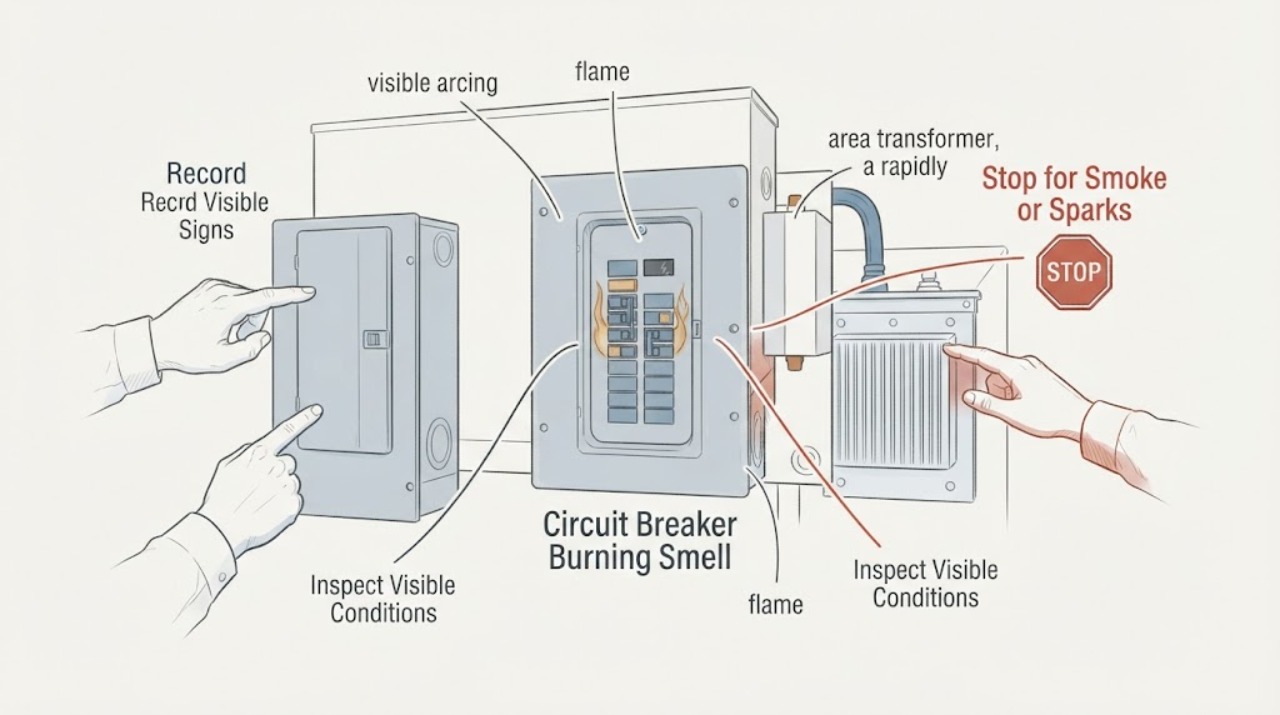
Treat a burning smell near a circuit breaker as an electrical fire hazard. Do not reset the breaker, open the panel, touch wiring or a transformer, or use water. From a safe distance, note smoke, flame, arcing, sizzling, a hot or discolored cover, flickering, and whether the smell is at the indoor panel, a nearby low-voltage device, or utility equipment. Leave and call the fire department for smoke, flame, active arcing, or a rapidly worsening odor. If there is no active fire, leave the affected circuit off if it is already off and call a licensed electrician; call the utility when the suspected source is service equipment or the meter side. A transformer may belong to a doorbell, HVAC control, or electrical distribution system, and only a qualified professional should identify or access it.
Work through in order
Diagnostic checks
Use only checks that match the exact appliance or system and its official guide.
-
Check 1
If there is smoke, flame, visible arcing, a rapidly worsening burning smell, or a panel or transformer area that is hot, alert everyone, leave by a safe route, and call the fire department from outside or another safe location. Do not use water on the electrical hazard.
Expected result: The presence of smoke, flame, bright flashes, popping, or a strong expanding odor means this is an active fire or imminent-fire situation rather than a routine breaker trip.
Next step: Stay out until emergency responders say it is safe. Do not re-enter to retrieve items, reset power, or investigate the transformer.
Why this matters
Why: People and fire response take priority over identifying whether the source is a breaker, transformer, wiring, or another device. Smoke can spread before flames are obvious.
-
Check 2
From a safe distance, note whether the odor appears to come from the indoor panel, a wall or ceiling device, a doorbell or HVAC control area, an exterior meter or service area, or a utility transformer. Do not open a cover, move an object, or step toward an arcing or buzzing device.
Expected result: A visible indoor breaker panel, a small nearby control transformer, and exterior service equipment are different locations. The source may also be uncertain because odor travels through walls and conduits.
Next step: Use the fire department for smoke or fire, the utility for suspected meter-side or service equipment, and a licensed electrician for an indoor panel or branch-circuit concern. If the location is uncertain, do not approach; report the uncertainty.
Why this matters
Why: Location determines who should respond, but a visual guess cannot prove the component. A transformer label or enclosure should be read only if already visible without approaching danger.
-
Check 3
Without touching the panel or equipment, observe from the room entrance whether there is a darkened or melted-looking cover, a warm-looking wall plate, flickering or dimming lights, unusual sizzling or buzzing, or a breaker handle already in an off or middle position.
Expected result: Discoloration, heat signs, unusual sound, flickering, and a recent trip are separate warning observations; absence of a visible mark does not make a burning odor safe.
Next step: Leave the affected circuit alone and arrange an electrician. If smoke, flame, active arcing, or a rapidly worsening smell appears, leave and call the fire department instead.
Why this matters
Why: These signs are consistent with an electrical overload, arcing, loose connection, damaged device, or another fault that requires professional assessment. A breaker position alone does not reveal what failed.
-
Check 4
If the breaker is already off, leave it off. If it is still on and the odor is present, do not reach into the panel or try to identify a transformer by touch; only a qualified person should decide how the supply is isolated.
Expected result: The odor may fade when a circuit is de-energized, persist because heat or damage remains, or continue because the source is elsewhere. No change is not evidence that re-energizing is safe.
Next step: Tell the electrician which handle was off and whether the odor changed, without operating the handle yourself. For suspected service equipment, contact the utility or emergency responders as directed.
Why this matters
Why: A protective device may interrupt current without removing heat, a damaged connection, or a fault on another feed. Repeated resets can increase fire or shock risk.
-
Check 5
Record what was running when the smell began and whether there were recent trips, flickering, dimming, warm receptacles, sizzling, or a new appliance or control installation. Do not reconnect equipment, use an extension cord, or move a suspect load to another outlet.
Expected result: A smell linked to one appliance or branch, a smell present with no load, or a smell that coincides with a new transformer or HVAC or doorbell installation gives the professional a different starting point.
Next step: Keep the suspect equipment out of service and give the timeline to a licensed electrician. If an appliance cord or plug is hot, damaged, or discolored, keep clear and do not handle it while energized.
Why this matters
Why: A recurring trip or odor can indicate an appliance fault, overloaded circuit, wiring issue, or component problem; the observation does not identify the transformer or authorize a user repair.
-
Check 6
If the suspected transformer is near a doorbell, HVAC control, security system, or other low-voltage accessory, observe only from a normal standing position whether its enclosure is smoking, melted, buzzing, or unusually hot-looking. Do not remove its cover or disconnect low-voltage wiring.
Expected result: A small control enclosure may be associated with a specific accessory, while a panel or exterior service enclosure may be part of the building supply. The same odor can also originate in nearby wiring.
Next step: Keep the accessory out of use if that can be done without approaching the device. Call an electrician; use utility or fire response if the source is service equipment, smoke, flame, or active arcing.
Why this matters
Why: A low-voltage label or accessory association does not make the transformer safe to open. A professional must trace the circuit and determine whether the transformer, its supply, or the building equipment is involved.
-
Check 7
If the odor is at the meter, exterior service equipment, overhead or underground supply, or a utility transformer, stay away and report the location from a safe place. Never touch the enclosure, fallen conductors, nearby metal, or surrounding wet ground.
Expected result: Flickering throughout the building, a loud arc, damaged service hardware, an outdoor smell, or a downed line suggests a utility or emergency boundary rather than a resident circuit check.
Next step: Keep people and pets away, leave for smoke or fire, and contact the utility or emergency services. Do not approach to read a label or take a close photograph.
Why this matters
Why: Service equipment can remain energized even when an indoor breaker is off. The utility or fire department has the authority and equipment to secure that part of the system.
-
Check 8
Prepare a handoff note with the exact location, first time noticed, odor description, smoke or flame, sound, visible heat or discoloration, breaker position, recent trips or flicker, equipment running, and whether the source may be a doorbell, HVAC control, panel, or service device.
Expected result: A clear timeline and safe-distance description lets the responding professional choose the right isolation and inspection plan without relying on a resident to repeat a dangerous condition.
Next step: Do not restore power or resume use until the fire department, utility, or licensed electrician gives the appropriate all-clear for the affected equipment.
Why this matters
Why: The component label transformer remains a professional service clue, not a diagnosis. The evidence is sufficient to escalate even when the source cannot be identified visually.
Use your observations
Decision map
Find the observation that best matches what you see, then follow the next safe action.
-
PATH 01Next step
What you see
Smoke, flame, visible arcing, or a rapidly worsening odor is present
Do this next
Leave immediately, alert others, call the fire department from outside, and do not touch the breaker, transformer, panel, or wiring. Never use water on an electrical fire.
-
PATH 02Next step
What you see
There is a burning smell but no visible smoke or flame
Do this next
Stay at a safe distance, leave any affected breaker off if it is already off, do not reset or open the panel, and arrange licensed electrician assessment. Treat heat, discoloration, buzzing, or flicker as urgent warning signs.
-
PATH 03Next step
What you see
The panel, breaker face, or nearby wall plate appears hot or discolored, or it buzzes or sizzles
Do this next
Do not touch or remove the cover. Keep clear and call a licensed electrician; escalate to the fire department if smoke, flame, or active arcing appears.
-
PATH 04Next step
What you see
A small transformer may belong to a doorbell, HVAC control, or another low-voltage accessory
Do this next
Do not disconnect or open it. Report the accessory and safe-distance observations to an electrician, who can identify the transformer and its supply circuit.
-
PATH 05Next step
What you see
The suspected source is the meter side, exterior service equipment, a utility transformer, or a damaged supply line
Do this next
Stay away and contact the utility or emergency responders. Do not rely on an indoor breaker to make service equipment safe.
-
PATH 06Next step
What you see
The breaker has tripped repeatedly or the odor returns when equipment is used
Do this next
Stop using the associated equipment and do not reset again. Have a licensed electrician diagnose the branch circuit, load, device, and protective equipment.
-
PATH 07Next step
What you see
Water, flooding, or a wet panel or transformer is involved
Do this next
Do not touch the equipment or stand in water. Leave the area if unsafe, and use emergency and qualified electrical response to evaluate the system before power is restored.
Helpful context
Understand the symptom
This is an emergency boundary, not a repair tutorial
A burning or rubbery odor around a breaker can come from an overheated connection, a damaged device, a branch-circuit fault, or equipment nearby. You cannot safely identify the source by removing the panel cover or touching the breaker. The U.S. Consumer Product Safety Commission lists odor, unusual sound, overheating, discoloration, and arcing among home wiring warning signs and says panel-cover work belongs to a qualified electrician.
The word transformer does not identify one safe location. A small transformer may serve a doorbell or HVAC control; a larger unit may be associated with service or distribution equipment. From the floor or a doorway, observe only what is already visible. Do not approach an outdoor service transformer, meter-side equipment, an open panel, a hot cover, or a device that is buzzing or sparking.
What you can safely record
Once people are safe and the immediate hazard has been reported, record the location, odor strength, visible smoke or flame, sounds, breaker position, recent trips, flickering, and what equipment was operating. This gives the fire department, utility, or electrician useful information without turning the resident into the inspector.
Never use a reset as a diagnostic experiment
A breaker opens to interrupt current when a circuit condition becomes unsafe, but an odor means the situation needs assessment. Do not repeatedly move a breaker, substitute a higher-rated protective device, bypass protection, or energize the circuit to see whether the smell returns.
Safety boundary
Stop conditions
- Stop and leave immediately for smoke, flame, visible arcing, an explosion-like sound, or a rapidly worsening odor; call the fire department from outside.
- Never reset the breaker repeatedly, bypass protection, substitute a higher-rated device, open the panel, remove a transformer cover, or touch wiring.
- Never measure voltage, probe current, or test a live circuit as a resident. Do not use water on a suspected electrical fire.
- Stay away from service equipment, fallen conductors, wet ground, a hot or discolored panel, and equipment that is buzzing or sizzling.
- Do not restore power or reuse an affected device until the appropriate fire, utility, or licensed electrical professional has assessed it.
When checks do not resolve it
Need a professional?
Call the fire department immediately for smoke, flame, active arcing, or a rapidly worsening burning odor. Call the utility for suspected meter-side, service, exterior transformer, or supply-line danger. Call a licensed electrician for an indoor panel, breaker, branch circuit, doorbell or HVAC transformer, warm or discolored device, repeated trips, flicker, or burning odor without visible fire.
Common questions
FAQ
Is a burning smell from a circuit breaker dangerous?
Yes. A burning or rubbery odor, warm or discolored electrical equipment, sizzling, sparks, or repeated trips are warning signs that call for professional electrical assessment. Smoke, flame, or arcing requires leaving and calling the fire department.
Should I reset the breaker to see whether the smell returns?
No. Leave an already-off breaker alone and do not repeatedly reset any breaker when there is an odor, heat, discoloration, sound, or trip history. A licensed electrician should determine the fault.
Could the transformer be for a doorbell or HVAC system?
It could, but the label is not a safe diagnosis. A small control transformer, its supply, nearby wiring, or service equipment can produce similar warning signs. Do not open or disconnect it; have an electrician identify it.
Can I open the electrical panel to find the hot breaker?
No. CPSC guidance says panel-cover work belongs to a qualified electrician. Observe only from a safe distance and report smoke, sound, heat, discoloration, and breaker position.
Who should I call if the smell is outside near the transformer?
Stay away from exterior service equipment and call the utility; call the fire department for smoke, flame, or active arcing. Do not assume an indoor breaker makes utility equipment safe.
Read the exact guide
Official sources
- Learn About FireU.S. Fire Administration · smoke danger, immediate evacuation, and staying out during a home fire
- Electrical Safety: ChecklistNational Fire Protection Association · electrical warning signs including burning smell, warm or discolored outlets, sparks, and repeated breaker trips
- Appliance and Electrical Fire SafetyU.S. Fire Administration · appliance and electrical fire prevention, damaged cords, direct wall connection, and avoiding extension cords
- CPSC Guide to Home Wiring HazardsU.S. Consumer Product Safety Commission · home wiring, electrical panels, circuit-breaker warning signs, service equipment, odors, overheating, arcing, and qualified-electrician boundaries
- Choosing and Using Fire ExtinguishersU.S. Fire Administration · electrical fire extinguisher classes, escape-route conditions, and leaving when extinguisher use is uncertain
- Don’t Overload Your HomeElectrical Safety Foundation International · electrical overload warning signs, burning odor, sizzling or buzzing, warm or discolored plates, and electrician escalation
- Water-Damaged Electrical EquipmentElectrical Safety Foundation International · wet electrical equipment, shock and fire risk, qualified electrical evaluation, and power-return boundary
Community feedback
Share a repair observation
Share a plain-text repair observation. Accepted observations are published automatically; this page may take a moment to update.