
On this page
Start here
Quick answer
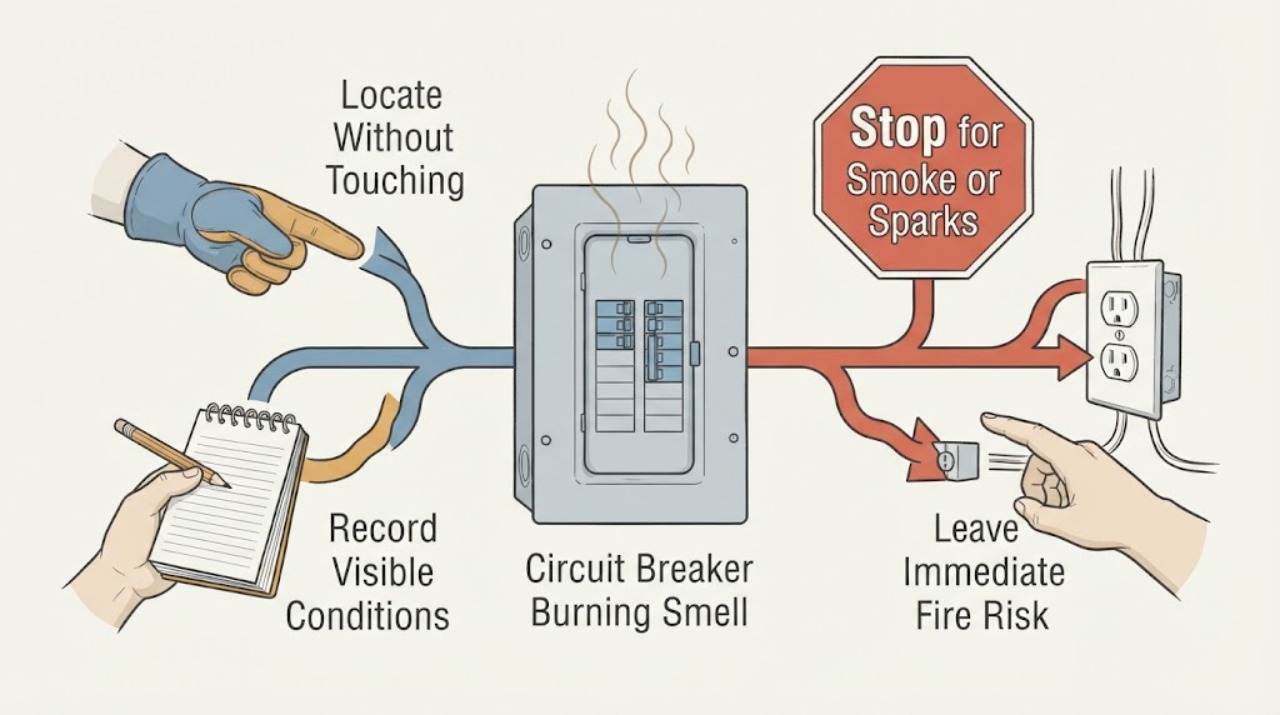
A burning smell near a circuit breaker, outlet, wall plate, or wiring is an electrical warning, not a breaker-reset problem. Stop using the affected circuit and keep away from a hot panel, outlet, plug, buzzing, crackling, visible arc, smoke, or discoloration. If there is smoke, flame, an expanding hot area, or an immediate fire risk, leave and call emergency services; do not use water on energized equipment. If there is no immediate fire and the panel is cool, dry, and safely reachable without touching the hot equipment, a qualified person may be able to isolate the affected circuit from a safe position, but do not repeatedly reset it. Do not touch or remove the breaker or outlet, unplug a hot plug, open a panel, or look for loose wiring. Have a licensed electrician inspect the circuit, breaker, receptacle, connections, and affected appliance before power is restored.
Before you begin
Safety first
- The reader-level scope is stopping use and observing from a safe position. A licensed electrician must isolate, open, test, repair, or replace the breaker, outlet, wiring, connections, and affected equipment. Do not touch hot equipment, open the panel, or restore power for a test.
Work through in order
Diagnostic checks
Use only checks that match the exact appliance or system and its official guide.
-
Check 1
Stop using the appliance, outlet, room circuit, or panel associated with the odor. From a safe position, look only for smoke, flame, visible arcing, rapidly spreading heat, or an alarm; if any is present, leave, warn others, and call emergency services from outside or another safe location.
Expected result: There is no smoke or flame and the odor is stable, or smoke, flame, arcing, or rapidly increasing heat is present.
Next step: For an immediate fire risk, do not re-enter or use water on energized equipment. For a stable odor, keep people away and continue only with distance-based documentation for an electrician.
Stop if: Do not touch hot equipment, throw water on electrical equipment, operate a switch near smoke or an arc, or remain in an unsafe area to find the source.
Why this matters
Why: An active fire or arc is an emergency, not a breaker troubleshooting task. A stable odor without visible fire still indicates a potentially overheated connection that must remain out of service.
-
Check 2
From a dry, stable position and without touching anything, identify whether the strongest odor or sound is at the breaker panel, a wall plate or outlet, an appliance plug or cord, or a wall or ceiling area; note buzzing, sizzling, discoloration, smoke, and which circuit or rooms are affected.
Expected result: The odor is localized to the panel, outlet or wall plate, plug or cord, hidden wall area, or cannot be localized safely.
Next step: Photograph only from a safe distance and give the location, sound, heat, discoloration, and affected circuit information to a licensed electrician. Keep the suspected outlet and connected appliance out of use.
Stop if: Do not remove a faceplate, open the panel, pull a plug from a hot outlet, move the appliance, or reach into a wall or cabinet to chase the odor.
Why this matters
Why: Location is a handoff clue, not proof of the failed component. CPSC guidance treats a hot outlet or plate, breaker trips, arcing, and damaged cords as potential fire or shock hazards requiring qualified inspection.
-
Check 3
From a safe position, record whether the breaker is On, Off, or in a tripped-looking position, whether it has tripped before, and which outlets, lights, or appliances are without power; do not move the handle or attempt a reset while odor, heat, smoke, or damage is present.
Expected result: The breaker has tripped once, trips repeatedly, remains on with a burning smell, or its position and affected circuit are unclear.
Next step: Give the electrician the circuit behavior, affected rooms, connected loads, and timing. Leave the circuit isolated if it has already been safely switched off and do not restore it until inspected.
Stop if: Do not repeatedly reset the breaker, substitute a higher-rated breaker or fuse, hold the breaker on, or work inside the panel.
Why this matters
Why: A breaker trip can reflect overload or a fault, but an energized circuit with heat or odor can still be unsafe. A recurring trip or a breaker that will not hold is a service symptom, not permission to fit a larger breaker or keep resetting it.
-
Check 4
Only from a cool, dry, safe distance, note visible browning, melting, soot, a loose-looking cover, damaged cord insulation, a hot plug, a warm wall plate, or an outlet that buzzes or crackles; do not touch the surface to measure heat or expose the wiring.
Expected result: The exterior is normal, or discoloration, melting, heat, buzzing, crackling, damaged insulation, or an arc is visible.
Next step: Record the condition without handling it and request licensed electrician inspection. If smoke, flame, or an active arc appears, return to the emergency branch and leave the area.
Stop if: Do not remove covers, tighten terminals, pull conductors, bend plug blades, unplug a hot plug, or perform live testing.
Why this matters
Why: A normal-looking exterior does not clear hidden wiring. Any heat, discoloration, sound, arc, or damaged insulation increases the likelihood of an unsafe connection or device and requires the circuit to remain out of use.
-
Check 5
Prepare a handoff record with the odor description and timing, exact location, smoke or arc observation, heat or discoloration, breaker position and trip history, affected rooms, appliances connected, recent installation or load change, and safe photos taken from outside the hazard area.
Expected result: The issue is isolated to a breaker, outlet or wiring area, connected appliance, or hidden area, and the circuit is safely left out of use or cannot be isolated without approaching heat or damage.
Next step: Give the record to a licensed electrician and keep the affected circuit and equipment out of service until the electrician confirms the repair and safe return to power.
Stop if: Do not use extension cords or another outlet as a workaround, restore power for a test, open the service panel, or order a replacement breaker from the symptom alone.
Why this matters
Why: A clear record helps the electrician trace the branch circuit and distinguish an outlet, breaker, wiring, appliance, or connection fault. Inability to isolate safely increases urgency and is not a reason to approach the equipment.
Use your observations
Decision map
Find the observation that best matches what you see, then follow the next safe action.
-
PATH 01Next step
What you see
Smoke, flame, visible arcing, rapidly increasing heat, or an alarm is present.
Do this next
Leave immediately, warn others, call emergency services from a safe location, and do not use water or re-enter to operate the breaker unless directed by emergency personnel.
-
PATH 02Next step
What you see
The odor, warmth, discoloration, buzzing, crackling, or damage is localized to an outlet, wall plate, plug, cord, or nearby wiring.
Do this next
Discontinue use, keep the circuit and connected equipment out of service, and arrange licensed electrician inspection. Do not unplug a hot or damaged plug by hand.
-
PATH 03Next step
What you see
The breaker trips or will not hold, but there is no visible smoke or flame and the panel is cool and dry.
Do this next
Do not repeatedly reset it or install a larger protective device. Record the affected circuit and connected loads and ask a licensed electrician to diagnose the fault.
-
PATH 04Next step
What you see
The strongest odor is at the breaker panel or a wall or ceiling area, or the source cannot be reached without opening equipment or a surface.
Do this next
Keep away, do not open the panel or wall, and request prompt licensed electrical inspection; use emergency help for smoke, flame, arcing, or rapidly increasing heat.
-
PATH 05Next step
What you see
The odor has stopped and no heat, smoke, arc, or discoloration is visible, but the prior source and circuit are uncertain.
Do this next
Do not assume the problem cleared. Keep the suspected circuit and equipment out of use, document the event, and arrange an electrician inspection before restoring normal use.
Helpful context
Understand the symptom
Treat the smell as an active electrical warning
A burning or hot-insulation smell can come from the breaker enclosure, an outlet, a plug, a wall cavity, or wiring upstream of the place where the odor is noticed. A breaker may trip, or it may remain on while a connection overheats. Because the odor source can be hidden, do not assume that changing the breaker rating or resetting the handle fixes the cause.
A cool visual check is the limit for an occupant
From a safe position, record where the odor is strongest, whether there is smoke, sound, heat, discoloration, or an arc, and which rooms or appliances lost power. Do not touch a hot cover, outlet, plug, or wiring, and do not remove a panel to inspect the connection. A licensed electrician must determine whether the fault is in the breaker, outlet, branch wiring, appliance cord, or another connection.
Do not keep restoring a circuit that shows heat or odor
Frequent trips, visible arcing, a warm or discolored plate, sizzling, buzzing, or a burning smell can indicate overload, a loose or damaged connection, or a failing device. Removing loads or switching off a circuit is not a repair and does not prove the circuit is safe. Keep the affected equipment out of use until the cause has been inspected and corrected.
Emergency and electrician boundaries are different
Smoke, flame, rapid heating, or an expanding burning odor requires people to leave and emergency help. If the immediate fire risk has passed but the circuit or outlet smells burned, remains hot, trips, or shows damage, schedule licensed electrical service promptly. Do not use water, open energized equipment, or perform a voltage test as a homeowner diagnostic.
Safety boundary
Stop conditions
- Stop and leave for smoke, flame, visible arcing, rapidly increasing heat, or an active electrical fire; call emergency services from a safe location and never use water on energized equipment.
- Do not touch a hot panel, outlet, plug, cord, wiring, or breaker; do not unplug a hot or damaged plug or operate a breaker from a wet or unsafe position.
- Do not repeatedly reset the circuit breaker, install a higher-rated protective device, open a panel or wall, tighten terminals, look for loose wires, or perform live electrical testing.
- Do not use an extension cord or another outlet as a workaround, and do not restore power until a licensed electrician has inspected the suspected circuit and affected equipment.
Only after diagnosis
Potential parts
- circuit breaker
Consider only after a licensed electrician confirms the breaker itself is damaged or incompatible with the panel; the smell does not identify it as the failed component.
Breaker type, rating, panel listing, and installation must be verified by a qualified electrician; never substitute a higher rating. - receptacle outlet or wiring connection
Consider only when inspection traces the odor or heat to an outlet, wall plate, or wiring connection rather than the breaker or appliance.
The correct device and wiring method depend on the circuit, enclosure, local requirements, and electrician's inspection.
When checks do not resolve it
Need a professional?
Call emergency services immediately for smoke, flame, visible arcing, rapidly increasing heat, or an active electrical fire. Request prompt licensed electrician service for any burning smell near a breaker, outlet, wall plate, plug, cord, or wiring, even if the smell stops or the breaker remains on. Repeated trips, a hot or discolored plate, buzzing, crackling, damaged insulation, or an uncertain source are not safe for continued use.
Safety scope: The reader-level scope is stopping use and observing from a safe position. A licensed electrician must isolate, open, test, repair, or replace the breaker, outlet, wiring, connections, and affected equipment. Do not touch hot equipment, open the panel, or restore power for a test.
Have this ready
- Provide the odor timing and location, smoke or arc observations, heat or discoloration, breaker position and trip history, affected rooms and appliances, recent load or installation change, whether water is present, and safe photos from outside the hazard area.
Common questions
FAQ
Is a burning smell from a circuit breaker ever normal?
No. Burning odor, warmth, discoloration, buzzing, crackling, sparks, or repeated trips are electrical warning signs. Stop using the affected circuit and arrange licensed electrician inspection; smoke, flame, visible arcing, or rapidly increasing heat requires leaving and calling emergency services.
Should I reset the breaker to see whether the smell returns?
No. Repeated resetting can re-energize a fault. Keep the affected circuit out of use, do not install a larger breaker, and have a licensed electrician determine whether the issue is the breaker, outlet, wiring, appliance, or connection.
Can I unplug the appliance if the plug feels hot?
Do not touch or pull a hot, melted, smoking, arcing, or damaged plug. Move away and obtain qualified electrical help; use emergency services for smoke or fire. A cool, undamaged plug should still remain out of use when the circuit smells burned until it is inspected.
Can I open the electrical panel to find the burned wire?
No. Do not open the panel, remove a faceplate, look for loose wires, or perform live testing. The safe reader task is distance-based observation and documentation; panel, outlet, and wiring inspection belongs to a licensed electrician.
Read the exact guide
Official sources
- Don’t Overload Your HomeElectrical Safety Foundation International · ESFI lists burning odor, warm or discolored wall plates, cracking or buzzing receptacles, frequent breaker trips, and shocks as overload or wiring warning signs; it recommends qualified electrical inspection.
- CPSC Guide to Home Wiring HazardsU.S. Consumer Product Safety Commission · CPSC identifies hot faceplates and receptacles as potential fire hazards, directs consumers to discontinue use and obtain qualified electrician help, and warns against higher-rated breakers, unsafe outlet work, and damaged cords.
Community feedback
Share a repair observation
Share a plain-text repair observation. Accepted observations are published automatically; this page may take a moment to update.