
On this page
Start here
Quick answer
A doorbell buzz can come from the chime, the button being held or sticking, a transformer or power mismatch, a chime connector or wire arrangement, or a fault in the low-voltage wiring. First listen from a safe position and record whether the sound is at the chime, button, or transformer, whether it starts only during a press, and whether the doorbell is wired or battery-powered. Do not remove a chime or transformer cover, touch wiring, measure voltage, or keep pressing the button to reproduce the sound. If there is heat, burning odor, smoke, arcing, a damaged enclosure, a breaker trip, or uncertainty about the transformer or mains connection, stop using the doorbell and have a licensed electrician inspect it.
Before you begin
Safety first
- This article supports listening and exterior observation only. Chime, button, transformer, wiring, panel, and voltage work belongs to a licensed electrician or exact product professional with safe isolation procedures.
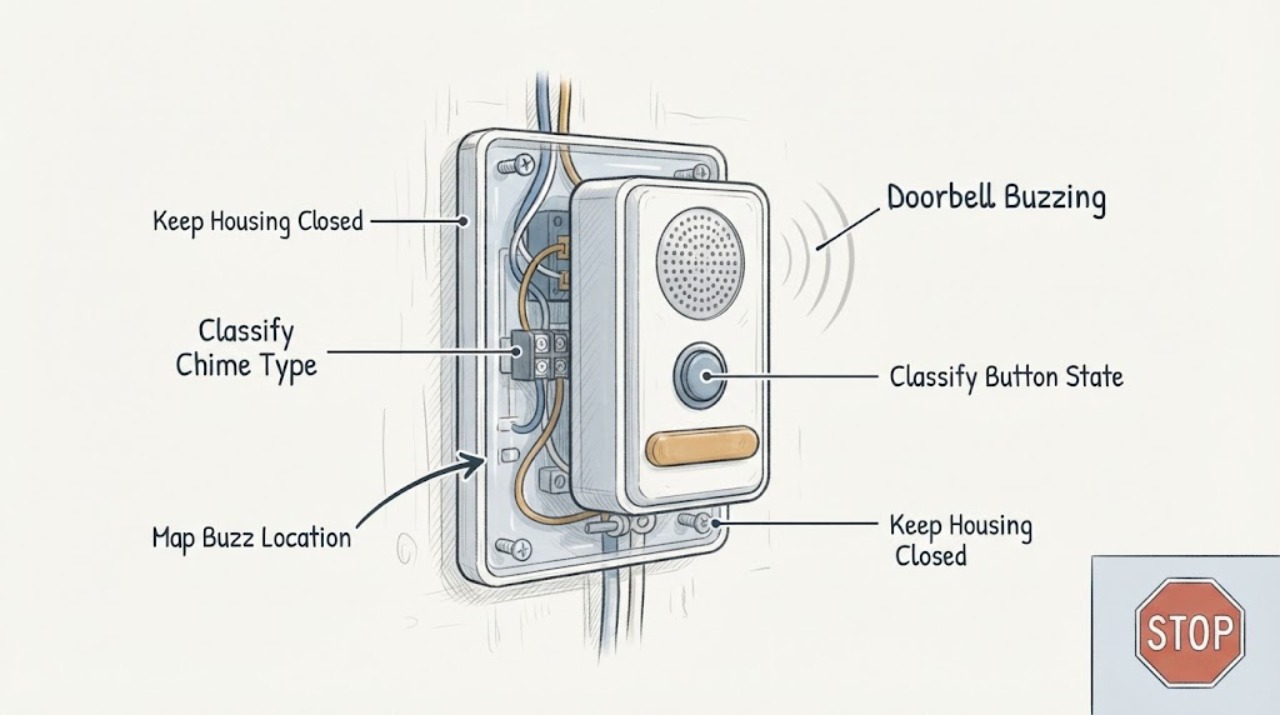
Work through in order
Diagnostic checks
Use only checks that match the exact appliance or system and its official guide.
-
Check 1
From a dry, safe position, listen at the chime area, exterior button, and any already-visible transformer location without touching, opening, or leaning on the equipment.
Expected result: Record whether the buzz is continuous or intermittent, its loudest location, whether it begins when the button is pressed, and whether the chime makes a normal ring as well.
Next step: Keep the system unused if the sound is continuous or abnormal and give the location and timing to a licensed electrician or the exact product professional.
Stop if: Stop for heat, smoke, burning odor, arcing, exposed conductors, water, shock, or a damaged enclosure; do not move closer to improve the diagnosis.
Why this matters
Why: A sound localized to the chime points toward its mechanism, connector, or load; a button-area sound points toward a stuck or damaged button; a transformer-area sound points toward its load, installation, or power condition. Location alone does not identify a safe repair.
-
Check 2
Observe the exterior button without repeatedly pressing it and note whether its face is stuck, physically damaged, wet, obstructed, or visibly held in an abnormal position.
Expected result: Record whether the buzz occurs only while the button is being pressed, continues after release, starts without anyone near the button, or is accompanied by a weak, continuous, or absent chime.
Next step: Leave a suspect button untouched and arrange product-specific or licensed electrical service; do not pry the button, remove its plate, or expose its terminals.
Stop if: Do not touch a wet, cracked, loose, hot, sparking, or damaged button or any visible wire; stop if the exterior enclosure is unsafe.
Why this matters
Why: A buzz that follows a held or stuck button supports a button or control-path problem. A buzz that continues when the button is untouched points farther downstream or toward the chime, transformer, connector, or wiring.
-
Check 3
Listen to the chime from outside its enclosure and record whether it is a mechanical ding-dong with moving parts, an electronic melody or speaker, or a smart-device notification; do not remove the chime cover.
Expected result: Record whether the buzz is mechanical vibration, an electronic hum, a continuous ring, or an unexpected chime, and whether it appeared after a doorbell or connector change.
Next step: Record the chime brand and model only if printed on the exterior, then use the exact manual or ask a qualified professional to inspect the connector and wiring with power safely isolated.
Stop if: Do not open the enclosure, touch moving parts or wiring, insert tools, or continue if the chime is hot, wet, cracked, discolored, or smells burned.
Why this matters
Why: Mechanical and electronic chimes can respond differently to the same system load. A connector or wiring arrangement that is correct for one doorbell model may be wrong for another; a continuous sound after an installation change needs compatibility review.
-
Check 4
Review the installation history and exterior labels without opening anything: note whether the doorbell is wired or battery-powered, whether a smart doorbell, chime connector, transformer, or button was recently changed, and whether the buzzing started afterward.
Expected result: Record the product names and model markings that are already visible, the old and new arrangement, and whether the sound began immediately after the change or after normal operation.
Next step: Provide the installation history and exterior markings to the installer, product support, or licensed electrician and request an exact compatibility and wiring review.
Stop if: Do not remove the doorbell, chime, transformer, or cover to read hidden labels; do not touch wiring or attempt a replacement from a generic voltage claim.
Why this matters
Why: A new buzz after an installation or device change raises a compatibility, connector, loading, or assembly question. The timing does not prove which person or part caused it, and model-specific voltage or power requirements must not be generalized.
-
Check 5
From a safe distance, observe whether the buzzing is accompanied by a breaker trip, flickering, a hot wall area, discoloration, smoke, burning odor, sparks, or water near the chime or transformer; do not operate the breaker or any device to reproduce it.
Expected result: Record only warning signs that are visible or audible without approaching, and note whether power loss affects only the doorbell or other circuits as well.
Next step: Stop using the doorbell and contact a licensed electrician; evacuate and contact emergency responders for smoke, fire, or active arcing.
Stop if: Do not touch, unplug, open, spray, reset, or move the buzzing equipment; do not use water on an electrical fire.
Why this matters
Why: Heat, odor, smoke, arcing, water, or a wider power problem can indicate an electrical fault beyond a harmless acoustic hum. A transformer that is overloaded or incorrectly connected may require immediate professional isolation.
-
Check 6
Prepare a service handoff with the sound location, timing, chime type, button behavior, product markings, installation history, and warning signs, without returning to the equipment for a photograph or measurement.
Expected result: Record whether the doorbell is currently unused, whether the buzz stopped after people moved away or after a qualified person isolated it, and whether any other circuit or appliance is affected.
Next step: Give the record to a licensed electrician or exact product installer and leave the system untouched until it has been inspected and declared safe.
Stop if: Do not resume repeated ringing, open covers, measure voltage, or handle the system because the buzz temporarily stopped.
Why this matters
Why: A concise symptom record lets a professional distinguish a button, chime, transformer, connector, wiring, or upstream supply issue while preserving a safe boundary. Stopping the sound does not prove the fault is gone.
Use your observations
Decision map
Find the observation that best matches what you see, then follow the next safe action.
-
PATH 01Safety boundary
What you see
The buzz begins with a button press or continues after release, and the button appears stuck, wet, or damaged.
Do this next
Stop pressing the button, keep the doorbell unused, and request product-specific or licensed electrical service for the button and low-voltage circuit.
Why this path and its safety boundary
Why it matters: A button or control-path problem is plausible, but a continuous engaged circuit can also stress the chime or transformer.
Safety stop: Do not pry, remove, or touch the button plate or terminals, especially if wet, hot, damaged, or sparking.
-
PATH 02Safety boundary
What you see
The sound is localized to the chime, occurs while the button is untouched, or began after a chime or smart-doorbell change.
Do this next
Leave the chime unused and provide its exterior model, doorbell model, and installation history to the installer or qualified electrician.
Why this path and its safety boundary
Why it matters: The chime mechanism, connector, load, or compatibility may be involved; the correct connector and arrangement are model-specific.
Safety stop: Do not remove the cover, touch moving parts or wires, or copy a connector arrangement from another model.
-
PATH 03Safety boundary
What you see
The loudest sound is at the transformer or electrical enclosure, or the transformer is hot, discolored, wet, or associated with an outage.
Do this next
Stay away, stop using the doorbell, and contact a licensed electrician; use emergency responders for smoke, sparks, or fire.
Why this path and its safety boundary
Why it matters: The transformer or its mains-side or low-voltage load may have a fault or mismatch; the location can involve household electrical power even when doorbell wires are thin.
Safety stop: Do not open the transformer enclosure, remove a cover, touch wiring, reset a breaker, or attempt a replacement.
-
PATH 04Safety boundary
What you see
The buzz began immediately after a doorbell, chime connector, transformer, or wiring change.
Do this next
Ask the installer or licensed electrician to review the exact models and wiring with safe isolation and to restore the manufacturer-specified arrangement.
Why this path and its safety boundary
Why it matters: An installation, compatibility, connector, or loading issue is possible, but timing alone does not establish causation or a specific wire fault.
Safety stop: Do not undo the installation, touch bare conductors, or measure voltage yourself.
-
PATH 05Safety boundary
What you see
Buzzing is accompanied by smoke, burning odor, arcing, heat, shock, water, a hot or discolored enclosure, or a breaker trip.
Do this next
Move away, keep others away, call emergency responders for fire, smoke, arcing, or injury, and notify the utility or licensed electrician from a safe location.
Why this path and its safety boundary
Why it matters: This is an electrical safety hazard rather than a routine chime adjustment; the system may remain energized.
Safety stop: Do not approach, touch, unplug, spray, open, reset, or attempt to extinguish electrical equipment with water.
Helpful context
Understand the symptom
Locate the sound without opening the system
A doorbell circuit normally has a button, a chime, a transformer, and low-voltage conductors, but their layout varies. Listen from a dry, safe position and identify whether the buzz is inside the chime, at the exterior button, near a transformer, or only audible through a smart-doorbell speaker. A steady buzz with the button untouched is different from a brief sound during a ring, and a buzz that began after a replacement or rewiring deserves an installation and compatibility review.
The chime, button, and transformer have different clues
A mechanical chime can buzz if its actuator is held, a wire or connector interferes with moving parts, or the system is receiving an unsuitable load. A button can stick or remain electrically engaged. A transformer can hum or overheat when overloaded, failing, incorrectly matched, or connected to a damaged circuit. These are conditional clues, not a license to remove a cover or make a voltage measurement. The exact doorbell and chime model must be identified before a connector or transformer is selected.
Keep low-voltage wiring separate from mains safety
Many wired doorbells use a small transformer, but the transformer is connected to the home's electrical supply. A person may see only thin doorbell wires at the button and still encounter a dangerous mains connection at the transformer or enclosure. Do not assume that low-voltage-looking wires make every part safe to touch. If the transformer location is near a breaker or fuse box, inside a utility area, wet, hot, damaged, or inaccessible, leave it for a licensed electrician.
Use the installation history as evidence, not as a repair instruction
Record whether the buzzing began after a smart doorbell, chime connector, transformer, button, or wiring change, and whether the old system had the same symptom. Manufacturer guidance shows that incompatible power requirements or a missing or incorrect chime connector can produce buzzing or unexpected chimes on particular systems. Because this topic has no brand or model, use those facts to request an exact compatibility check rather than copying a model-specific wiring diagram.
Safety boundary
Stop conditions
- Do not open a chime, button, transformer, breaker, or electrical enclosure; do not touch wiring, terminals, moving parts, or bare conductors.
- Do not measure voltage, use a test probe, repeatedly press the button, bypass a chime connector, or install a generic transformer or replacement from a symptom alone.
- Stop using the doorbell for continuous buzzing, unexpected ringing, a stuck button, a hot transformer, an outage, or a damaged or wet enclosure.
- Stop immediately for smoke, burning odor, sparks, arcing, crackling, heat, discoloration, shock, exposed conductors, or water near electrical equipment.
- Do not use water on an electrical fire; evacuate and contact emergency responders from a safe location.
Only after diagnosis
Potential parts
- compatible doorbell chime connector
Consider this category only when the exact doorbell and chime documentation identifies a required connector and a professional confirms the current arrangement is missing or incorrect.
Connector fit and wiring are model-specific; do not substitute, bypass, or reposition one while energized. - compatible doorbell transformer
Consider this category only after a licensed electrician or exact product professional confirms the installed doorbell and chime power requirements and the transformer is defective or inadequate.
Match the exact voltage, power, enclosure, wiring, and local requirements; installation and any mains connection require qualified service. - compatible doorbell button
Consider this category only when the button is confirmed as stuck or damaged and the exact system wiring and environmental rating are identified.
Confirm the system type and product instructions; do not remove or wire a button as a live troubleshooting experiment.
When checks do not resolve it
Need a professional?
Arrange licensed electrician service when the buzz is continuous, the source is near a transformer or electrical enclosure, the system was recently changed, the chime connector or transformer is unknown, or the sound persists with the button untouched. Use the exact product installer or manufacturer support for model-specific chime compatibility. Treat heat, burning odor, smoke, arcing, shock, water, or a breaker trip as an urgent electrical or emergency matter and do not approach the equipment.
Safety scope: This article supports listening and exterior observation only. Chime, button, transformer, wiring, panel, and voltage work belongs to a licensed electrician or exact product professional with safe isolation procedures.
Common questions
FAQ
Why does my doorbell chime buzz continuously?
Possible causes include a stuck button, a chime or connector arrangement, a transformer load or compatibility problem, or wiring damage. Listen from a safe position, stop pressing the button, and arrange exact product or licensed electrical service rather than opening the chime.
Is a doorbell transformer hum always normal?
A sound alone cannot establish that it is safe. A transformer-area buzz that is new, loud, continuous, hot, discolored, wet, or accompanied by an outage or odor should be left unused and inspected by a licensed electrician.
Can a smart doorbell cause a mechanical chime to buzz?
On some model-specific systems, an incorrect or missing chime connector or unsuitable power arrangement can cause buzzing or unexpected chimes. Do not copy another system's wiring; identify the exact doorbell and chime and have the arrangement checked.
Can I open the chime cover to check the wires?
Not as a generic troubleshooting step. A wired doorbell system includes a transformer and may connect to household electrical power. Do not open the chime or transformer, touch wiring, or measure voltage unless the work is performed by a qualified professional with safe isolation.
When is doorbell buzzing an emergency?
Treat smoke, burning odor, sparks, arcing, crackling, heat, discoloration, shock, water, exposed conductors, or a breaker trip as an electrical emergency. Move away, keep others away, and contact emergency responders or a licensed electrician from a safe location.
Read the exact guide
Official sources
- Get professional help to upgrade the doorbell system transformerGoogle Home and Nest Help · Google Nest wired doorbell systems only; the exact transformer's requirements vary by doorbell and chime.
- Electrical - Electric-Arc Flash HazardsOccupational Safety and Health Administration · OSHA electrical-work safety information; homeowners should keep away and use emergency or licensed professional response.
- Check Google Nest doorbell compatibilityGoogle Home and Nest Help · Google Nest doorbell systems only; used here to illustrate why doorbell connector and transformer requirements cannot be generalized.
- Basic Electricity SafetyOccupational Safety and Health Administration · OSHA electrical-safety training material; it does not replace incident-specific emergency response.
- Troubleshoot Nest doorbell chime issuesGoogle Home and Nest Help · Google Nest doorbell systems only; referenced for the distinction between chime types and the need for exact product instructions.
- Electrical SafetyOccupational Safety and Health Administration · General electrical-safety guidance; local emergency response and licensed electricians control the actual installation.
Community feedback
Share a repair observation
Share a plain-text repair observation. Accepted observations are published automatically; this page may take a moment to update.