
On this page
Start here
Quick answer
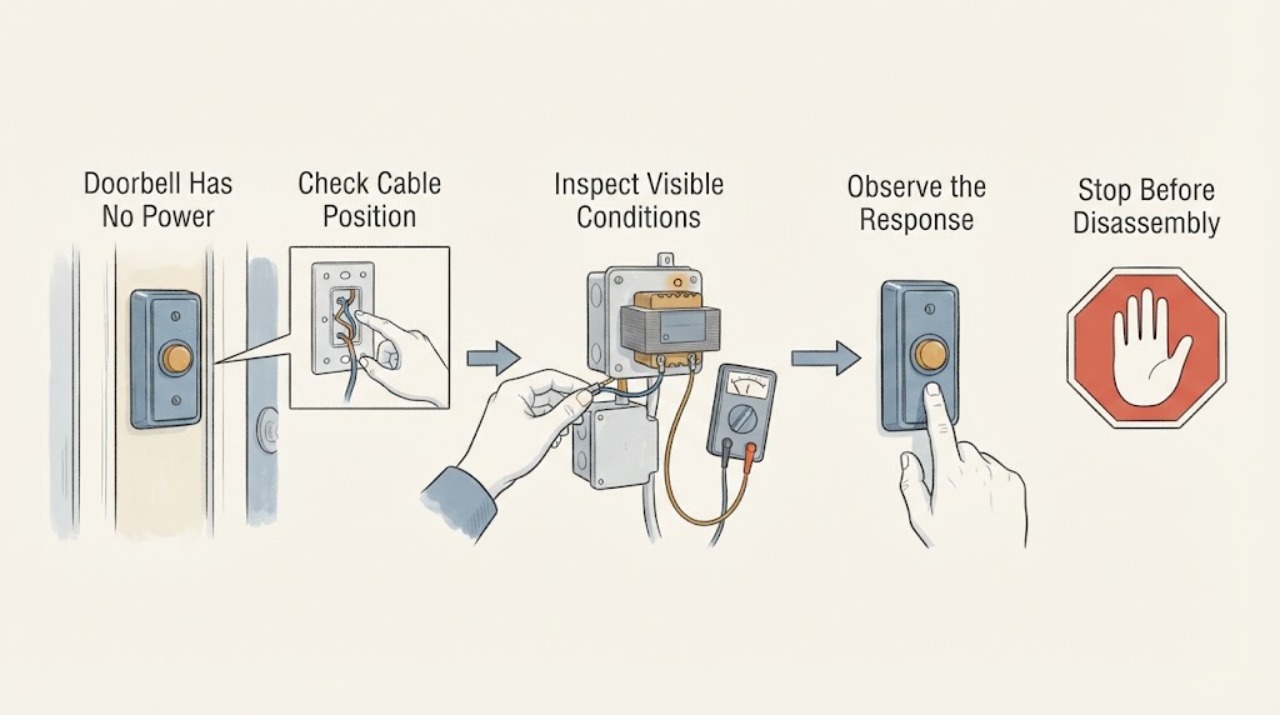
First establish whether the doorbell is a wired system or a battery device and what actually stopped: the button, indoor chime, indicator, or every doorbell function. For a wired system, check the supplying breaker from outside the panel and look for an upstream GFCI with TEST and RESET buttons. From a dry, safe position, inspect only the outside of the transformer, chime, button, and visible wiring for damage, heat, moisture, or odor. Do not remove the panel or transformer cover, touch wiring, measure live voltage, or bypass protection. If the breaker or GFCI will not hold, the transformer is hot, or no power returns after safe external checks, leave the system off and call a qualified electrician.
Work through in order
Diagnostic checks
Use only checks that match the exact appliance or system and its official guide.
-
Check 1
From a safe position, identify whether the doorbell is wired to an indoor chime and transformer or is a battery or wireless model. Press the button once only if the outside surface and your hands are dry and intact, then note whether the button indicator, video or status function, and indoor chime respond. Do not remove a cover or hold the button down.
Expected result: Only the chime is silent; the button or indicator is also dead; every function is dead; or the model is battery or wireless.
Next step: Record the exact symptoms and system type. Continue to the breaker and GFCI checks only for a wired system and only when the area is dry and free of warning signs.
Why this matters
Why: A silent chime with a live doorbell can be a chime setting or chime-circuit issue. A dead wired indicator and chime point toward the supply, transformer, wiring, or a protective device. A battery or wireless unit may not use the household transformer path at all.
-
Check 2
Look at the breaker panel from outside its enclosure and identify the breaker or fuse that supplies the doorbell or nearby chime outlet, if it is known. Note whether it is fully on, fully off, or in a middle position, and whether nearby lights or outlets also lost power. Do not open the panel, touch other parts, or change a protective-device rating.
Expected result: The supplying breaker is tripped; it appears on while the doorbell is dead; several nearby loads are dead; or the main device is affected.
Next step: If the area is dry, no warning sign is present, and an obvious portable load caused the trip, one normal enclosed reset may be considered. If it trips again or will not hold, leave it off and arrange electrical service.
Why this matters
Why: A tripped branch device can remove power from the transformer or chime. An apparently on breaker with no doorbell response can indicate an upstream GFCI, failed breaker, transformer, wiring fault, or a separate doorbell circuit. A wider outage needs branch or service diagnosis.
-
Check 3
Look for accessible GFCI outlets with TEST and RESET buttons in the same room and nearby wet-use areas. With dry hands and an intact device, press RESET once. Do not test or reset a wet, hot, damaged, or sparking device, and do not remove its cover.
Expected result: The GFCI reset restores the doorbell or its supplying outlet; the reset will not stay in; it trips again; or no GFCI is visible.
Next step: If reset fails or trips again, leave the protected circuit off and call an electrician. Do not bypass the GFCI or install a replacement outlet as a test.
Why this matters
Why: A GFCI receptacle can protect its own outlet and other outlets farther along the same branch, so a remote protective device can make a doorbell transformer or chime appear dead. A non-resetting or repeat-tripping device can indicate leakage, moisture, a damaged load, or wiring trouble.
-
Check 4
Inspect only the outside of the transformer, chime, button, and visible low-voltage cable for a missing cover, loose-looking enclosure, cut or crushed insulation, water entry, heat damage, or a burning odor. Do not touch the transformer, pull a cable, disconnect a terminal, or open an electrical box.
Expected result: The visible equipment is cool and intact, or there is heat, discoloration, melting, damage, moisture, odor, or an exposed conductor.
Next step: For any warning sign, leave the circuit off from a safe enclosed control and arrange prompt electrical service. If the equipment is inaccessible or its supply is unknown, do not search behind walls or inside the panel.
Why this matters
Why: An intact exterior does not prove that the transformer or low-voltage circuit is working. Heat, odor, moisture, damaged insulation, or an exposed conductor can indicate an unsafe fault and should not be tested by reconnecting the doorbell.
-
Check 5
With the doorbell circuit off and the area dry, list what happened immediately before the outage: a storm, power interruption, new smart-doorbell installation, button replacement, chime work, or a device becoming wet. Note whether the indoor chime, transformer area, or button changed at the same time. Do not repeat the event as a test or use another power source.
Expected result: The outage followed an installation or wiring change; a power event; water exposure; or no identifiable event.
Next step: Keep the system disconnected from use and give the timeline to an electrician. Do not guess a transformer rating or connect a different device to make the doorbell respond.
Why this matters
Why: A recent installation or change raises the possibility of an incompatible or incorrectly connected doorbell load, while water or a power event can affect a protective device or transformer. No clear event leaves supply, transformer, wiring, chime, and button faults unresolved.
-
Check 6
Stop all checks if there is a hot or discolored breaker, outlet, transformer, chime, or wire; burning odor; smoke; visible arc; shock or tingling; water near electrical equipment; or an immediate protective-device trip. Keep people away and operate an enclosed disconnect only from a dry, safe position if doing so does not require approaching exposed conductors.
Expected result: No warning sign is present, or an electrical, fire, shock, or water warning appears.
Next step: Leave the system off and arrange urgent electrical service. For smoke or fire, leave the building and contact emergency services from a safe location; do not restart the doorbell for evidence.
Why this matters
Why: A warning sign changes the task from finding a dead doorbell to handling an electrical safety event. Continued operation or improvised testing can worsen overheating, arcing, shock, or fire risk.
Use your observations
Decision map
Find the observation that best matches what you see, then follow the next safe action.
-
PATH 01Next step
What you see
The doorbell is battery or wireless and the household transformer is not part of its installation.
Do this next
Follow the exact battery, charging, and indoor chime instructions for that model. Use an electrician only for household power or wiring warnings, not as a substitute for the model instructions.
Why this path and its safety boundary
Why it matters: A doorbell branch breaker or transformer is unlikely to explain the dead device.
-
PATH 02Next step
What you see
The wired doorbell's breaker is tripped and will not hold after one safe enclosed reset.
Do this next
Leave the breaker off and arrange qualified electrical inspection. Do not repeat the reset, fit a larger breaker, or open the panel.
Why this path and its safety boundary
Why it matters: An overload, short circuit, transformer fault, connected-device problem, or branch-wiring issue remains possible.
-
PATH 03Next step
What you see
An upstream GFCI reset restores the supplying outlet or doorbell circuit.
Do this next
Use the system only if it stays dry and normal. If the GFCI trips again, leave it off and call an electrician to identify the downstream cause.
Why this path and its safety boundary
Why it matters: The doorbell path was downstream of ground-fault protection, and moisture or leakage may have caused the interruption.
-
PATH 04Next step
What you see
The button, indicator, chime, and wired doorbell all remain dead while the breaker appears on and no GFCI reset restores power.
Do this next
Do not touch or replace the transformer as a trial. Leave the system unused and arrange an electrician to trace the circuit safely.
Why this path and its safety boundary
Why it matters: The transformer, low-voltage wiring, supply connection, or protective device needs professional diagnosis.
-
PATH 05Next step
What you see
Only the indoor chime is dead while the wired button or doorbell indicator still responds.
Do this next
Stop repeated button presses and arrange service if the chime remains dead. Do not remove its cover or disconnect wires as a test.
Why this path and its safety boundary
Why it matters: The chime setting, chime mechanism, chime connector, or low-voltage connection may be at fault rather than the branch breaker.
-
PATH 06Next step
What you see
A transformer, chime, breaker, outlet, or wire is hot, discolored, melted, wet, odorous, buzzing, sparking, or has shocked someone.
Do this next
Keep clear and obtain urgent electrical or emergency help from a safe location. Do not restore power or approach wet or exposed equipment.
Why this path and its safety boundary
Why it matters: This is an electrical hazard, not a routine no-power reset.
Helpful context
Understand the symptom
Separate a dead doorbell from a dead chime
A wired doorbell may lose power at the branch breaker, an upstream protective outlet, the transformer, the low-voltage cable, the button, or the chime. A wireless or battery model can appear dead because its battery or indoor sound setting is unavailable, without any transformer fault. Note which functions stopped before checking the supply, and do not assume that a dark indicator proves which part failed.
Safety boundary
Do not remove a panel, transformer, chime, outlet, or button cover; touch wiring; bridge terminals; measure live voltage; or bypass a breaker or GFCI. Stop for heat, discoloration, melting, burning odor, crackling, smoke, visible spark, shock, or moisture. Keep people away and arrange qualified electrical service.
Safety boundary
Stop conditions
- Do not remove breaker-panel, transformer, chime, outlet, or button covers; touch wiring; bridge terminals; test live voltage; or bypass a breaker or GFCI.
- Stop for heat, discoloration, melting, burning odor, crackling, smoke, visible spark, shock or tingling, moisture, or an immediate breaker trip.
- Do not repeatedly reset a breaker or GFCI, and do not use another power source to test a dead doorbell.
- Do not work on a wet transformer, outlet, panel, or floor area, and do not approach exposed electrical conductors.
When checks do not resolve it
Need a professional?
Call a qualified electrician when a wired doorbell remains dead after safe breaker and GFCI observations, a protective device will not hold, the transformer or chime is hot, visible wiring is damaged, the system was recently rewired, or the supply path is unknown. Use emergency services for smoke or fire.
Common questions
FAQ
What should I check when a wired doorbell has no power?
Identify which functions are dead, inspect the supplying breaker from outside the panel, look for an upstream GFCI, and inspect the outside of the transformer and visible equipment for warning signs. Do not remove covers or touch wiring.
Can a GFCI make a doorbell appear dead?
Yes. A GFCI receptacle can protect its own outlet and other outlets farther along the same branch. A safe RESET observation may restore power, but a non-resetting or repeat-tripping device needs qualified diagnosis.
Should I replace the doorbell transformer if the doorbell is dead?
Not as a trial. A dead doorbell can also involve the breaker, GFCI, button, chime, low-voltage wiring, or a connected fault. Leave transformer replacement and live electrical checks to a qualified electrician.
Read the exact guide
Official sources
- How to Use GFCIsElectrical Safety Foundation International · General residential GFCI safety guidance; follow the installed device instructions.
- CPSC Guide to Home Wiring HazardsU.S. Consumer Product Safety Commission · General residential electrical safety; doorbell transformer and chime configurations vary by installation.
- GFCI Fact SheetU.S. Consumer Product Safety Commission · Residential GFCI devices that may supply or interrupt a doorbell-related branch; exact circuit layout varies.
Community feedback
Share a repair observation
Share a plain-text repair observation. Accepted observations are published automatically; this page may take a moment to update.