
On this page
Start here
Quick answer
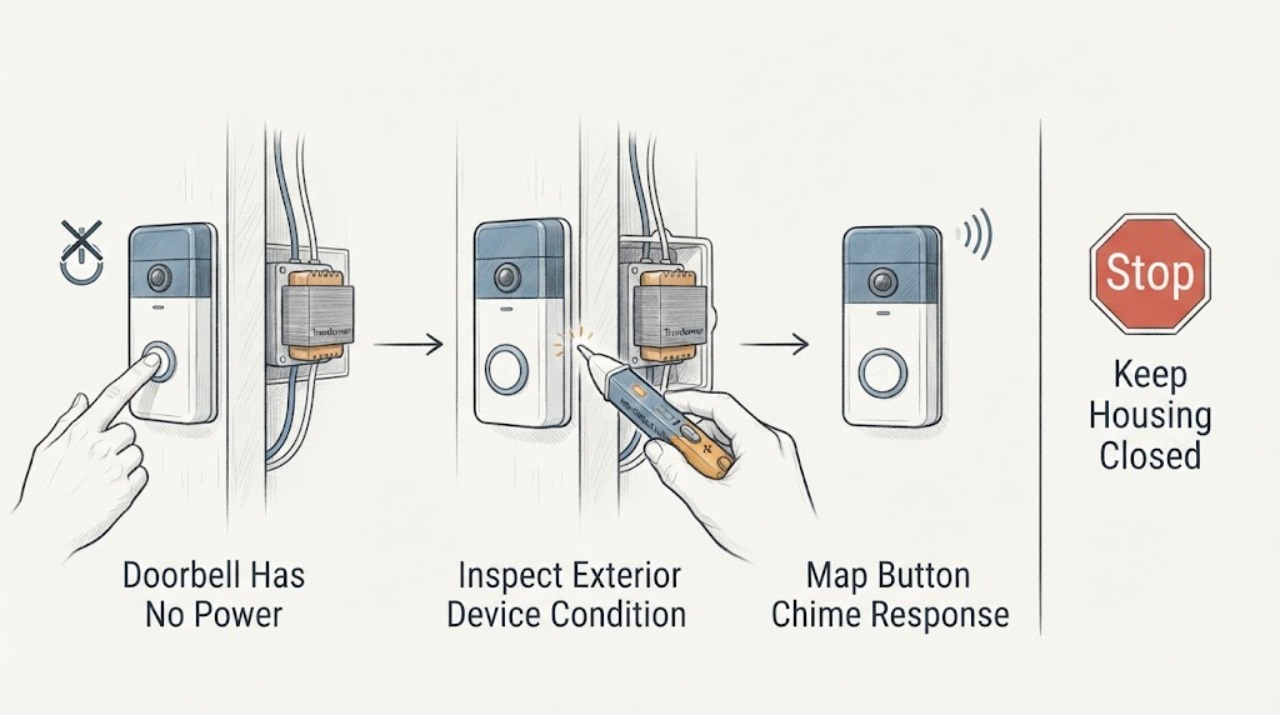
When a wired doorbell has no power, first separate a dead button or chime from a missing supply to the transformer and a damaged low-voltage path. Note whether pressing the button produces a click, hum, chime, light, or app event, and whether the chime or doorbell shows any normal sign of power. Look only at exterior labels, visible breaker or disconnect positions, and visible damage from a dry, stable position. A transformer may be near the chime, near the breaker or fuse box, or below the home, and a newer wired doorbell may require a compatible transformer and chime connector; exact requirements vary by model. Do not remove the chime or transformer cover, touch wiring, open the electrical panel, take a live measurement, bypass the chime or transformer, or repeatedly reset a breaker. Smoke, burning odor, heat, arcing, water, or exposed conductors is an immediate stop-use hazard; otherwise arrange qualified electrical service for persistent no power.
Before you begin
Safety first
- This article covers ordinary button and chime observation, visible labels, and safe-distance condition checks only. Transformer work, chime or wiring access, panel work, live measurements, protective-device work, and compatibility changes belong to a qualified electrician.
Work through in order
Diagnostic checks
Use only checks that match the exact appliance or system and its official guide.
-
Check 1
From a dry, stable position, press the doorbell button once normally and observe the button light, indoor chime sound, wired doorbell status light or app status, and any transformer or chime hum; do not hold the button down or repeat it if there is heat, odor, buzzing, or damage.
Expected result: The button lights but the chime is silent, the button and chime are both inactive, the chime hums or buzzes, or a wired smart doorbell is online while only the chime is quiet.
Next step: Record the exact response and stop repeated button presses. Use the matching branch below and arrange electrical service when the cause is not an obvious user setting.
Why this matters
Why: A partial response focuses the next handoff on the chime connector, chime settings, button path, or transformer compatibility. No response anywhere keeps the supply, transformer, protective device, wiring, and doorbell in scope; a hum or abnormal sound is not a normal power confirmation.
-
Check 2
Look at the button, chime enclosure, transformer exterior, and visible cable entry points from ordinary access for a loose cover, crack, water, corrosion, heat, discoloration, smoke residue, or exposed conductor; do not remove a cover or touch a wire.
Expected result: The visible equipment looks dry and intact, one enclosure is wet or damaged, a wire is exposed, or a part is hot, discolored, buzzing, or smells burned.
Next step: Keep the affected device out of use and keep people away from heat, water, odor, or exposed conductors. For a normal-looking system with no power, continue only with safe label and response observations.
Why this matters
Why: A localized abnormal condition identifies a safety and service boundary around that device or its wiring. A normal exterior does not prove that the transformer output or a concealed connection is present.
-
Check 3
From a safe position, read visible labels on the doorbell, chime, transformer exterior, and any clearly labeled indoor service switch or breaker without opening a panel, removing a chime cover, or touching the equipment.
Expected result: The transformer location and label are known, the label is missing or unreadable, the visible breaker or switch appears off or tripped, or no label or service control can be safely identified.
Next step: Photograph or transcribe only visible information for the electrician. Follow a documented one-time reset only if the power device is plainly intended for normal user operation and there is no hazard; if it trips again, leave it alone.
Why this matters
Why: The label and location help an electrician compare the doorbell's requirement with the installed transformer and trace the safe service boundary. An unreadable label, concealed transformer, or tripped device leaves compatibility and wiring unresolved.
-
Check 4
If the doorbell is a wired smart model, observe whether its normal status or app connection remains available while the mechanical or digital chime stays silent; if it is a conventional button, compare button movement with the chime response without opening either unit.
Expected result: The doorbell remains online but the chime does not respond, the doorbell is dark and the chime is silent, the chime rings unexpectedly, or both are inactive.
Next step: Record the model and behavior, then use the exact manufacturer's documentation or ask an electrician to confirm the compatible transformer and chime arrangement. Do not rewire or bypass the chime.
Why this matters
Why: Online-but-silent behavior can involve chime settings, a required chime connector, or compatibility rather than complete transformer loss. A dark device and silent chime keep transformer, wiring, protection, and supply in scope. Unexpected buzzing or ringing may indicate an incorrect connection or compatibility issue.
-
Check 5
Record whether the no-power symptom began after a doorbell or chime installation, transformer change, painting or renovation, storm, outage, moisture event, or battery-to-wired conversion; do not recreate the event by reconnecting wires or cycling an uncertain power source.
Expected result: The failure follows one installation or change, a storm or outage, water exposure, or no known event.
Next step: Give the timeline, visible labels, and button or chime response to the electrician. Leave the system unused when the cause is uncertain or any abnormal condition is present.
Why this matters
Why: A recent event gives the electrician a focused boundary around compatibility, disturbed wiring, moisture, or a protective-device response. No known event leaves the complete doorbell power path open for professional diagnosis.
-
Check 6
Prepare a service note listing doorbell type, button response, chime response, online or status state, transformer location and visible label, breaker or switch indication, recent changes, and every visible safety symptom.
Expected result: The evidence isolates a button, chime, transformer compatibility, wiring, protective device, or broader supply boundary, or remains inconclusive.
Next step: Give the note and safe-distance photos to a qualified electrician. Keep the doorbell, chime, and transformer path out of use until the cause is assessed.
Why this matters
Why: A structured handoff lets a qualified electrician choose safe deenergization and compatibility checks without asking the homeowner to open a panel, handle wiring, or expose the transformer.
Use your observations
Decision map
Find the observation that best matches what you see, then follow the next safe action.
-
PATH 01Safety boundary
What you see
Smoke, flame, active arcing, strong burning odor, hot or discolored equipment, water near electrical parts, exposed conductors, or a repeated protective-device trip is present.
Do this next
Stop using the doorbell system, keep people away, leave the area for smoke or fire risk, and seek emergency help from a safe location; arrange qualified electrical service when safe.
Why this path and its safety boundary
Why it matters: This may be a fire or shock hazard, not a routine no-power fault.
Safety stop: Do not touch the equipment, apply water, restore power, remove covers, or press the button again.
-
PATH 02Next step
What you see
A wired doorbell or its status remains active, but the indoor chime is silent or behaves unexpectedly.
Do this next
Record the doorbell model and chime behavior and ask an electrician or manufacturer to confirm the compatible chime arrangement. Do not bypass or rewire the chime.
Why this path and its safety boundary
Why it matters: The chime setting, chime connector, transformer compatibility, or chime wiring may be involved; complete transformer loss is not established.
-
PATH 03Safety boundary
What you see
The button, chime, and wired doorbell show no response, while no visible hazard is present.
Do this next
Record visible labels and the breaker or switch indication, follow only one documented normal reset if safe, and call a qualified electrician if power does not return.
Why this path and its safety boundary
Why it matters: The transformer supply, protective device, wiring path, or doorbell system may be interrupted.
Safety stop: Do not remove the chime or transformer cover, touch wiring, open the panel, or take a live measurement.
-
PATH 04Safety boundary
What you see
The no-power symptom began after installing a wired smart doorbell, chime, transformer, or conversion, or the transformer label cannot be matched to the device.
Do this next
Keep the system out of use and provide the exact device and transformer labels to a qualified electrician for compatibility assessment.
Why this path and its safety boundary
Why it matters: Insufficient or incompatible transformer power, chime arrangement, or disturbed wiring may be involved.
Safety stop: Do not install a substitute transformer, bridge wires, or alter the chime connector as an experiment.
-
PATH 05Next step
What you see
The doorbell stopped after an outage or storm, or other equipment on the related visible power path is also inactive.
Do this next
Check for a wider outage from a safe location and contact the utility or electrician as appropriate. Do not approach damaged service equipment or wet electrical areas.
Why this path and its safety boundary
Why it matters: A protective-device, service, utility, moisture, or wider wiring event may be involved rather than a doorbell button alone.
Helpful context
Understand the symptom
Use button and chime behavior to map the fault
A button that feels normal but produces no chime is not the same as a silent chime with a doorbell camera that remains online, or a completely dark wired device. Record which parts respond and whether a recent installation, storm, renovation, or moisture event came first. That evidence can separate the button or chime path from the transformer and wiring path without opening a box.
Transformer compatibility is model-specific
Wired smart doorbells can need more power than an older mechanical doorbell system provides, and some systems need a chime connector to deliver continuous power and protect the chime. Do not assume that a transformer label, a battery chime, or a previous doorbell installation is compatible with a new device. Record visible model information and let an electrician confirm the power path.
Keep low-voltage wiring inside the professional boundary
Doorbell wiring is often low voltage, but the transformer is connected to a higher-voltage supply and may be located near the electrical panel or in a concealed space. Low voltage does not make an unknown wire, cover, or transformer safe to handle. CPSC and OSHA guidance support stopping at ordinary observation and leaving exposed wiring, covers, and circuit verification to qualified professionals.
Safety boundary
Stop conditions
- Stop immediately for smoke, flame, active arcing, strong burning odor, hot or discolored equipment, water near electrical parts, exposed conductors, or a breaker that trips again.
- Do not remove the chime, transformer, button, or electrical-panel cover; touch wiring; take live measurements; bridge wires; or bypass a chime, transformer, or protective device.
- Do not repeatedly reset a breaker, repeatedly press a suspect button, or reconnect a new doorbell or transformer to recreate the symptom.
- Do not touch a wet, hot, loose, damaged, or buzzing enclosure, and never use water on an electrical fire.
- Stop any inspection that requires a ladder in an unstable or wet area, concealed-space access, or approach to damaged service equipment; call a qualified electrician.
Only after diagnosis
Potential parts
- doorbell transformer
Consider this category only if a qualified electrician confirms that the installed transformer is missing, failed, or incompatible with the exact doorbell and chime arrangement.
Confirm the device requirements, local wiring rules, enclosure, protection, and exact system compatibility with the electrician before ordering. - doorbell chime or chime connector
Consider this category only if the electrician or device manufacturer confirms that the chime or required connector is the failed or incompatible point.
Confirm mechanical or digital chime type, device compatibility, transformer requirements, and installation procedure before ordering. - low-voltage doorbell wiring
Consider this category only if a qualified electrician identifies an open, damaged, or unsuitable doorbell cable path.
Confirm cable route, insulation, weather exposure, device requirements, and local installation requirements with the electrician.
When checks do not resolve it
Need a professional?
Arrange qualified electrical service when a wired doorbell, chime, transformer, or wiring path remains without power after safe visible observations, when a breaker or protective device trips, when the transformer requirement is uncertain, or when a cover or circuit measurement would be needed. For smoke, fire, arcing, burning odor, hot or wet equipment, or exposed conductors, leave the area and seek emergency help from a safe location.
Safety scope: This article covers ordinary button and chime observation, visible labels, and safe-distance condition checks only. Transformer work, chime or wiring access, panel work, live measurements, protective-device work, and compatibility changes belong to a qualified electrician.
Common questions
FAQ
What should I check first when a doorbell has no power?
Observe whether the button, chime, and wired doorbell show any response, then record visible labels and the normal breaker or switch position from a safe location. Do not open the chime, transformer, or panel.
Where is a doorbell transformer usually located?
It may be near the chime, near the breaker or fuse box, or in a basement or crawl space. Do not enter a concealed or unsafe space; give the electrician the last known location.
Can a new wired doorbell need a different transformer?
Yes. Wired devices can have different power requirements, and some systems need a compatible chime connector. Confirm the exact model requirements and have an electrician handle transformer or wiring changes.
Why is my doorbell camera online but the chime silent?
The doorbell may have power while the chime setting, chime connector, compatibility, or chime wiring is wrong. Record the model and behavior and follow the exact manufacturer guidance or call an electrician.
When is a no-power doorbell an emergency?
Smoke, flame, active arcing, strong burning odor, hot or discolored equipment, water near electrical parts, exposed conductors, or a repeated breaker trip requires immediate stop-use action and help from a safe location.
Read the exact guide
Official sources
- Check Google Nest doorbell compatibilityGoogle Home and Nest Help · Google's model-specific guidance used for general wired-doorbell power-path distinctions; exact doorbell, chime, transformer, and local requirements govern.
- 1910.333 - Selection and use of work practices.Occupational Safety and Health Administration · Workplace electrical-safety standard used only to state the professional boundary for transformer supply, panel, and exposed wiring work; it is not a homeowner repair procedure.
- CPSC Guide to Home Wiring HazardsU.S. Consumer Product Safety Commission · Government home-wiring safety guidance used for stop-use and escalation boundaries around the doorbell transformer supply; it does not diagnose low-voltage doorbell parts.
Community feedback
Share a repair observation
Share a plain-text repair observation. Accepted observations are published automatically; this page may take a moment to update.