
On this page
Start here
Quick answer
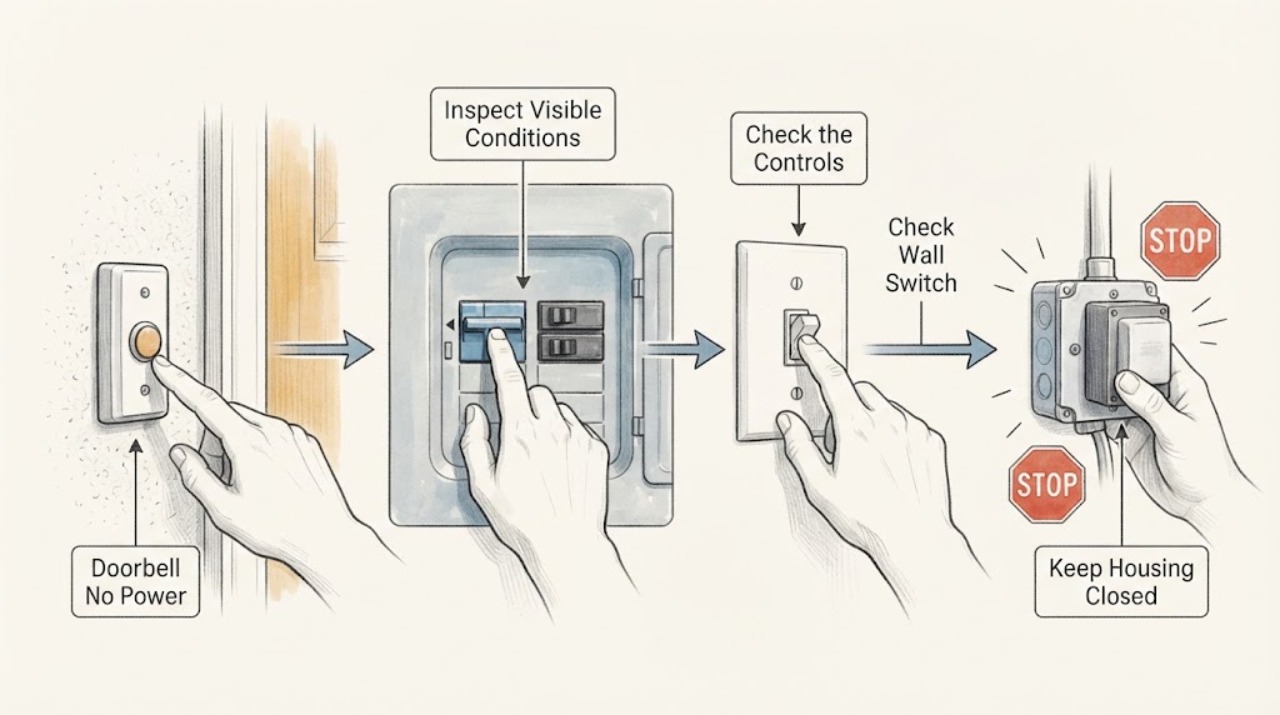
If a wired doorbell has no power, first separate a dead button or chime from a lost supply to the doorbell system. From a dry, safe position, note whether the button, chime, and any status light are all dead, check the visible breaker or fuse label and any ordinary switch that may control the chime, and inspect only the outside of the chime, transformer, and low-voltage wire route for heat, damage, or water. Do not remove a panel or chime cover, touch wiring, test voltage, or replace a transformer from a guessed rating. A tripped breaker, switched-off chime, failed transformer, loose low-voltage connection, failed button, or incompatible smart-doorbell load can produce the same symptom. Stop for smoke, burning odor, arcing, a hot or damaged transformer, exposed wire, or water and call emergency help or a qualified electrician. Leave persistent no-power faults for qualified electrical service.
Before you begin
Safety first
- Keep the system unused for smoke, arcing, burning odor, hot or wet equipment, exposed wire, shock, or repeated breaker interruption. Do not open panels or boxes, touch wiring, test voltage, test the transformer, bypass protection, or reconnect a suspect device.
Work through in order
Diagnostic checks
Use only checks that match the exact appliance or system and its official guide.
-
Check 1
From a dry, safe position, observe the doorbell button or camera, chime, and any status light or app indication without removing the device. Record whether the button is dark, the chime is silent, the chime is stuck on, or only one function has failed.
Expected result: The button and chime are both dead, the button works but the chime is silent, the chime is powered but the button does nothing, or the system reports an insufficient-power state.
Next step: Keep the equipment closed and map the next visible power clue. Do not remove the button, chime, or camera to inspect terminals; persistent or whole-system failure needs qualified service.
Why this matters
Why: A whole-system symptom points toward shared power, transformer, or circuit paths; one dead endpoint points more toward that device, its local connection, or its control path.
-
Check 2
Look at the breaker or fuse label and handle from outside the panel, without removing its cover. Note whether the labeled circuit appears on, off, or between positions, whether other home circuits work, and whether the panel is hot, wet, cracked, or discolored.
Expected result: The labeled circuit appears interrupted, the whole home or several circuits are out, the panel shows heat or water, or the handle looks normal while the doorbell remains dead.
Next step: Do not open the panel or repeatedly reset the breaker. Keep the doorbell unused and call a qualified electrician; contact the utility for a confirmed broader outage.
Why this matters
Why: An interrupted circuit can remove transformer supply, but a hot, wet, or damaged panel is a safety event. A normal handle does not prove that the doorbell transformer has a safe supply.
-
Check 3
If a normal wall switch visibly controls the indoor chime, note whether it is on and whether the chime responds when the button is pressed once. Do not remove a switch plate or chime cover, and do not repeat the press if the chime is stuck, buzzing, hot, or smells abnormal.
Expected result: The switch was off, the chime responds after the switch is on, the switch is on but the chime remains silent, or the chime stays active or makes an abnormal sound.
Next step: Leave the switch in its normal position. For persistent silence or abnormal sound, stop and arrange qualified electrical or doorbell service rather than opening the chime.
Why this matters
Why: A user-operated switch can interrupt chime operation, but silence with the switch on can involve the button, transformer, low-voltage wire, chime, or device settings. A stuck or abnormal chime is not a harmless no-sound condition.
-
Check 4
Inspect the visible exterior of the transformer, chime, button, and wire route for water, a loose-looking cover, damaged insulation, discoloration, heat, or a wire pulled from its channel. Keep hands away from wire ends and leave every enclosure closed.
Expected result: The transformer or chime is hot, wet, discolored, cracked, or noisy; visible wire insulation is damaged; or the exterior looks intact.
Next step: Stop for any warning sign and call a qualified electrician. If no warning sign is visible, continue only with model and scope records; do not open an enclosure or touch wiring.
Why this matters
Why: Heat, water, damage, and unusual sound can indicate an electrical or equipment hazard. An intact exterior cannot rule out a failed transformer, loose terminal, or concealed wire fault.
-
Check 5
For a smart or newly installed doorbell, record the exact model, installation date, power message, chime behavior, and any visible transformer label without opening the chime or panel. Compare requirements only with that model's official installation guidance.
Expected result: The model is known and its published power requirements are available, the transformer label is absent, or the system was recently changed and then lost power.
Next step: Give the model and label information to the installer or electrician. Do not select or install a transformer from a generic rating or attempt a wire change.
Why this matters
Why: Transformer voltage and capacity are device-specific. A recent installation or upgrade can expose an incompatible supply, a wrong connection, or a failed component, but the cause cannot be proven by an exterior look.
-
Check 6
Map the outage with other already-working lights or receptacles from dry positions and note whether a recent storm, renovation, power event, or device change preceded it. Do not use a meter, test probe, extension lead, or temporary supply to make the doorbell ring.
Expected result: Only the doorbell system is dead, other loads on the likely circuit are also dead, the whole home is affected, or the failure followed work or weather.
Next step: Leave the doorbell system unused and provide the map and timeline to a qualified electrician or installer. Contact the utility for a confirmed service outage.
Why this matters
Why: An isolated doorbell issue favors its transformer, switch, chime, button, or low-voltage circuit; a branch or whole-home pattern favors supply or utility investigation. Recent work raises the need for a wiring review.
-
Check 7
Prepare the service handoff with the doorbell and chime model, button and chime symptoms, breaker label and visible position, ordinary switch state, transformer label if visible, wire-route condition, recent work, and any heat, odor, buzz, water, or spark. Photograph only closed exterior surfaces.
Expected result: The fault is isolated to the doorbell system, follows the house circuit, follows a device change, or includes a safety warning.
Next step: Leave the circuit and doorbell unused and request qualified electrical or doorbell service. Escalate safety warnings immediately rather than repeating a button press or reset.
Why this matters
Why: This record lets a professional choose a circuit, switch, transformer, chime, or wiring path without the homeowner exposing live or low-voltage conductors.
Use your observations
Decision map
Find the observation that best matches what you see, then follow the next safe action.
-
PATH 01Next step
What you see
Smoke, flame, sparks, arcing, burning odor, a hot or discolored transformer, panel, switch, or chime, exposed wire, or a shock is present.
Do this next
Keep clear, do not touch or reset anything, and call emergency help or a qualified electrician as appropriate. Do not use water on electrical equipment.
Why this path and its safety boundary
Why it matters: The no-power report is accompanied by a fire or shock hazard.
-
PATH 02Next step
What you see
Water is in or near the transformer, chime, switch, panel, or another electrical part.
Do this next
Do not enter standing water or operate a switch to reach the equipment. Keep people away and have an electrician isolate and inspect it before power is restored.
Why this path and its safety boundary
Why it matters: The low-voltage symptom does not make wet equipment safe; a shock or fire risk may remain.
-
PATH 03Next step
What you see
The whole home or nearby homes are without power, while no local doorbell hazard is visible.
Do this next
Check the utility outage status from a safe location and contact the utility. Do not open the service panel or attempt a service-side repair.
Why this path and its safety boundary
Why it matters: A utility or main-supply outage is more likely than a doorbell transformer or switch fault.
-
PATH 04Next step
What you see
Other home circuits work, but the doorbell button, chime, and status light are all dead.
Do this next
Leave the system unused and ask a qualified electrician or installer to check the breaker path, transformer, chime, button, and wiring with appropriate tools.
Why this path and its safety boundary
Why it matters: The doorbell's supply path, transformer, low-voltage wiring, or shared chime connection may be interrupted.
-
PATH 05Next step
What you see
The doorbell has a status light or app connection, but the indoor chime is silent.
Do this next
Check only the visible chime switch and the model's user setting. If silence continues, arrange qualified service without opening the chime or touching wires.
Why this path and its safety boundary
Why it matters: The doorbell may have power while the chime switch, chime connection, chime setting, or chime device has a separate issue.
-
PATH 06Next step
What you see
A recent installation or device change preceded the no-power symptom, or the transformer label does not match the known device requirements.
Do this next
Return the issue to the installer or a qualified electrician and provide the exact model and visible label. Do not change transformer or wiring connections yourself.
Why this path and its safety boundary
Why it matters: Compatibility, connection, or installation quality needs model-specific review; a generic transformer swap is not justified.
-
PATH 07Next step
What you see
The breaker or fuse handle appears interrupted, or power disappears again when the doorbell or chime is used.
Do this next
Do not repeatedly reset or reconnect the doorbell. Leave the circuit off and call a qualified electrician; report exactly when the interruption occurs.
Why this path and its safety boundary
Why it matters: A circuit, transformer, chime, switch, wiring, or device fault may be causing the protective interruption.
Helpful context
Understand the symptom
Identify which part of the doorbell is actually dead
A wired doorbell normally has a button or camera, a chime, low-voltage wiring, a transformer, and a breaker or fuse feeding the transformer. “No power” may mean the button has no light, the chime does not sound, the app reports insufficient power, or the whole system is dead. Record each symptom separately. Google’s official Nest guidance uses breaker or outlet status, chime behavior, wire connections, and transformer compatibility as separate checks, but those details are specific to the listed Nest designs and should not be applied to an unknown doorbell.
The transformer is low-voltage on its output but still tied to house power
A doorbell transformer is not automatically safe to open or touch. Its supply side can be connected to the home's electrical circuit, and the low-voltage side can still short or damage equipment if wires are loose or incorrect. Do not open a breaker box, transformer enclosure, chime, or switch box to prove that power is present. The exact doorbell model and transformer rating must be checked by the manufacturer instructions or a qualified electrician.
No light or sound is not enough to diagnose wiring
A dark smart doorbell can have a dead transformer, an incompatible supply, a disconnected low-voltage lead, a failed device, or a software or network issue. A silent mechanical chime can have a local switch turned off, a blocked or damaged chime mechanism, a button fault, or no supply. Map what still works before seeking parts. CPSC describes breakers as protective devices for branch circuits and lists outages, arcing, unusual sounds, heat, odors, and damaged wiring as warning signs.
Water and electrical parts need a hard stop
Doorbells are often near exterior moisture, and the transformer or chime may be in a garage, utility area, or near a panel. If water reaches the equipment, do not enter standing water or operate a switch to reach it. CDC says wet electrical equipment should be isolated safely and inspected before power is restored. Smoke, a burning smell, sparks, or a hot transformer also ends homeowner troubleshooting.
Safety boundary
Stop conditions
- Stop immediately for smoke, flame, sparks, arcing, burning odor, a hot or discolored panel, transformer, switch, or chime, exposed wire, a shock, or a breaker that opens again. Keep clear and obtain emergency or qualified electrical help.
- Stop for water in or near the panel, transformer, switch, chime, or wiring. Do not enter standing water or operate a switch to reach power; have an electrician isolate and inspect the area.
- Do not open a breaker panel, transformer, chime, switch box, or doorbell enclosure; touch wiring; measure voltage; test a transformer; bypass a protective device; install a larger breaker; or use a temporary supply.
- Stop troubleshooting when visible checks do not restore the doorbell, when the handle looks normal but the system remains dead, or when the symptom follows a recent installation. Leave the system unused and call a qualified electrician or installer.
Only after diagnosis
Potential parts
- doorbell transformer
Consider this only after qualified diagnosis confirms that the transformer is defective or its rating is unsuitable for the exact doorbell system.
Voltage, capacity, mounting, and wiring requirements vary by doorbell and chime. Have an electrician identify and install the correct device. - doorbell chime
Consider this only when the supply and transformer are confirmed suitable and a qualified diagnosis isolates a failed or incompatible chime.
Mechanical, electronic, and smart chimes use different connection and load requirements. Confirm the exact system before selection. - doorbell button or low-voltage wire repair
Consider this only after service identifies a failed button or damaged low-voltage path rather than a breaker, switch, transformer, or chime fault.
Button and wire requirements depend on the installed system and route. Do not replace or reconnect wiring while energized.
When checks do not resolve it
Need a professional?
Request qualified electrical service for a dead doorbell system, failed chime, suspected transformer, switch or circuit issue, loose or damaged low-voltage wire, or a protective device that opens. Use the original installer when the fault follows a new installation or device change. Escalate immediately for smoke, arcing, burning odor, hot or wet equipment, shock, or exposed wiring.
Safety scope: Keep the system unused for smoke, arcing, burning odor, hot or wet equipment, exposed wire, shock, or repeated breaker interruption. Do not open panels or boxes, touch wiring, test voltage, test the transformer, bypass protection, or reconnect a suspect device.
Common questions
FAQ
What should I check first when a doorbell has no power?
Record whether the button, chime, camera or status light are dead, then look at the visible breaker label and any ordinary chime switch from a dry position. Inspect only closed exterior surfaces. Do not open a panel or touch doorbell wiring.
Can a doorbell transformer be tested by a homeowner?
Do not perform live voltage testing or open the transformer enclosure. Transformer requirements are model-specific and the supply side is part of the home's electrical system. Give the model and visible label to a qualified electrician or installer.
Why does the chime stay silent when the doorbell button works?
The chime switch, chime setting, chime connection, chime device, or its power path may be separate from the button. Check only a visible user switch and the model's user setting; persistent silence needs qualified service.
Should I reset the breaker for a dead doorbell?
Do not repeatedly reset it. If the breaker is hot, wet, damaged, or opens again, leave the circuit off and call a qualified electrician. A protective interruption needs its cause diagnosed before normal operation resumes.
When is a no-power doorbell an electrical emergency?
Treat smoke, sparks, arcing, burning odor, a hot or discolored transformer or panel, exposed wire, water near electrical equipment, a shock, or repeated breaker interruption as urgent. Keep clear and obtain emergency or qualified electrical help.
Read the exact guide
Official sources
- Troubleshoot Nest doorbell chime issuesGoogle Home and Nest Help · Google Nest-specific guidance used as a clearly marked example; other doorbell models and controls differ.
- Home Electrical Safety ChecklistUS Consumer Product Safety Commission · US consumer checklist; exact equipment and local requirements govern service.
- What to Do to Protect Yourself From Electrical HazardsCenters for Disease Control and Prevention · US public-health safety guidance; emergency and utility procedures vary by location.
- CPSC Guide to Home Wiring HazardsUS Consumer Product Safety Commission · US consumer electrical-safety guide; local codes and utility arrangements may differ.
- Get professional help to upgrade the doorbell system transformerGoogle Home and Nest Help · Nest wired 2nd- and 3rd-generation guidance; do not apply its ratings to an unidentified doorbell.
Community feedback
Share a repair observation
Share a plain-text repair observation. Accepted observations are published automatically; this page may take a moment to update.