
On this page
Start here
Quick answer
A doorbell with no power may be battery-powered with a flat battery, hardwired through a low-voltage transformer, or connected to a plug-in adapter. First determine which type you have and whether the loss affects only the doorbell, the indoor chime, a nearby outlet, or a wider circuit. Check only the visible state of the household breaker or GFCI and the condition of accessible plugs and cords; do not open a panel, remove the chime or doorbell, touch wires, or repeatedly reset protection. A hardwired doorbell can lose power because its transformer or low-voltage path is faulty even when the household breaker looks normal. If a breaker or GFCI opens again, an outlet or transformer is hot or discolored, water is present, or wiring is exposed, leave the circuit out of use and call a licensed electrician.
Before you begin
Safety first
- Keep the system out of use for heat, smoke, odor, arcing, water, exposed wiring, a damaged power device, or a repeated breaker or GFCI operation. Do not open covers or bypass protection.
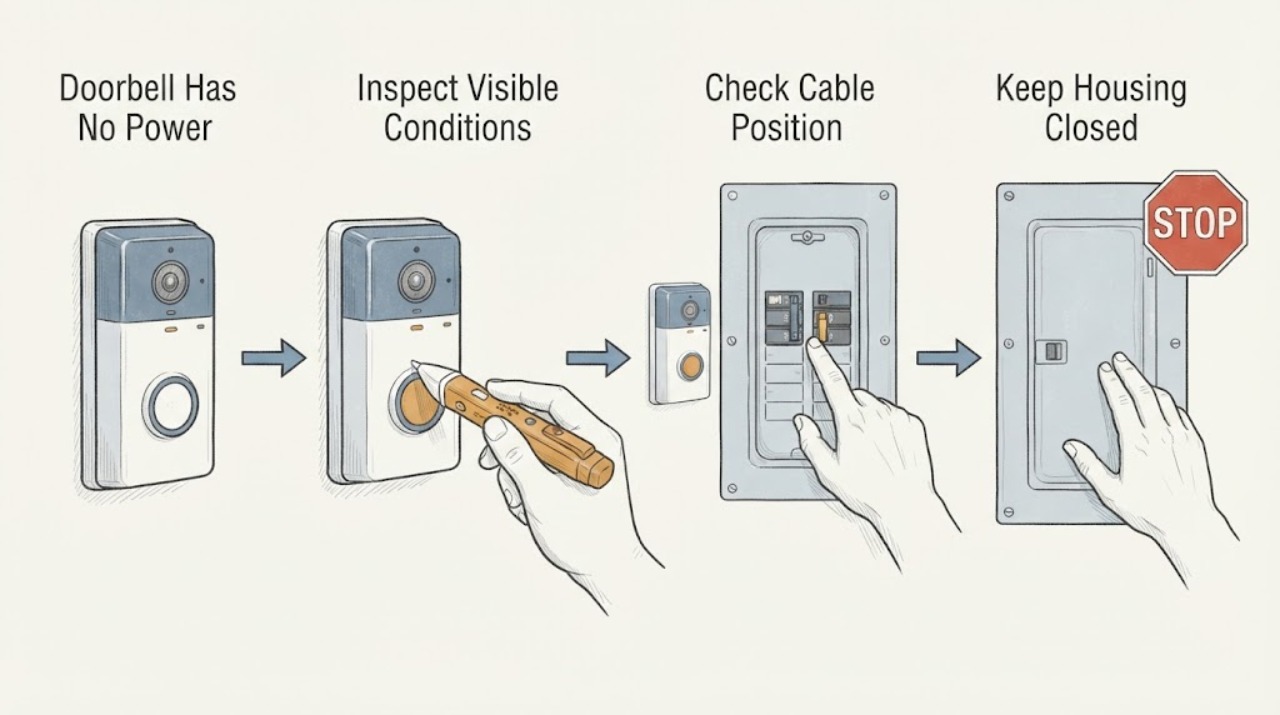
Work through in order
Diagnostic checks
Use only checks that match the exact appliance or system and its official guide.
-
Check 1
From a dry, safe position, look for smoke, burning or melted-plastic odor, a hot or discolored outlet, buzzing, water near the chime or transformer, an exposed conductor, or a breaker or GFCI that opens immediately; do not approach damaged or wet equipment.
Expected result: Any warning sign is present, or the doorbell power area cannot be reached without touching damaged equipment or standing in water.
Next step: Stop using the doorbell circuit, keep people away, and contact emergency help for smoke or fire. From a safe dry location, arrange a licensed electrician; do not reset protection again or inspect inside a cover.
Stop if: Stop immediately for smoke, fire, arcing, burning odor, heat, water, exposed wiring, shock, or an immediate repeat trip.
Why this matters
Why: This may be an electrical shock, arcing, fire, or water-contact event rather than a simple dead battery or reset.
-
Check 2
Identify whether the doorbell is battery-powered, hardwired to an indoor chime and transformer, or powered by an indoor plug-in adapter; note whether the doorbell, chime, receiver, and app or status light are all inactive or only one is affected, without removing the doorbell or chime.
Expected result: Only a battery device is inactive, a hardwired doorbell and chime are both dead, the chime is dead but the doorbell remains online, or a plug-in adapter is not lit or connected.
Next step: Use the exact device manual for a battery or app status check. For a hardwired or adapter system, continue with visible household protection and plug checks; do not open the chime or transformer.
Stop if: Stop if identification requires removing a cover, loosening a terminal, touching doorbell wires, or entering a wet or restricted area.
Why this matters
Why: A battery or receiver problem follows a different path from a household breaker or transformer problem. A hardwired system with both ends dead may have lost transformer supply, while one dead part can indicate a device, chime, or low-voltage path fault.
-
Check 3
Check whether the porch light, nearby outlet, indoor chime outlet or adapter, and other points on the same labeled household circuit work; record whether the outage affects only the doorbell or several points, and do not remove an outlet or fixture plate.
Expected result: Only the doorbell is dead, the chime or nearby outlet is dead, several points on one circuit are dead, or the whole property is without power.
Next step: Record the affected points and check the utility outage status remotely if the loss is broad. If neighboring power is present or the doorbell circuit is the only affected circuit, arrange electrical or doorbell service without opening the wiring.
Stop if: Stop for a damaged outlet, water, heat, smoke, a service-entry issue, or any request to access a shared or concealed circuit.
Why this matters
Why: A single dead doorbell suggests its battery, transformer, adapter, chime, button, or low-voltage path. Several dead points make an open breaker, GFCI, or branch-circuit issue more plausible; a whole-property outage may be a utility or service issue.
-
Check 4
Without opening the enclosure, read the visible label and handle position of the breaker feeding the doorbell transformer or adapter and check for a plainly accessible GFCI indicator or reset state; do not open the panel, handle a fuse, or touch wiring.
Expected result: The breaker is clearly open, the GFCI shows a tripped state, protection appears normal, or the responsible circuit cannot be identified safely.
Next step: If the device or circuit is unclear, leave the doorbell out of use and call a licensed electrician. If the area is dry and undamaged and the device is a clearly accessible GFCI or resettable breaker, one normal reset may be attempted according to its labeling; stop if it opens again.
Stop if: Stop for an open fuse, damaged panel, heat, odor, buzzing, moisture, exposed parts, or uncertainty about the correct protective device.
Why this matters
Why: An open protective device can remove transformer or adapter power, but it may have operated because of an overload, fault, moisture, or equipment problem. A normal-looking device does not rule out a failed transformer or concealed wiring.
-
Check 5
For a plug-in adapter, confirm from the outside that it is fully seated in a dry, accessible indoor outlet and that its cord is cool and undamaged. For a hardwired system, read only the exterior transformer label if it is plainly visible and record its location and markings; do not unplug, remove, or open either device.
Expected result: The adapter is unplugged or its outlet is dead, the cord or adapter is hot or damaged, the transformer label is missing or incompatible information is suspected, or the visible supply appears normal.
Next step: Reconnect only a cool, dry, undamaged plug that was accidentally loose. For a damaged, unlabeled, or uncertain transformer or adapter, leave the system off and arrange an electrician or qualified doorbell installer.
Stop if: Stop for a hot, cracked, wet, humming, discolored, or damaged adapter or transformer, or any need to expose its terminals.
Why this matters
Why: A disconnected adapter or a dead supply outlet may explain the outage. A damaged, unknown, or mismatched transformer needs professional evaluation because power requirements vary by doorbell model and the transformer has a household-power side.
-
Check 6
After a safe visible correction such as a charged battery, a firmly seated cool plug, or one labeled breaker or GFCI reset, make one normal doorbell press or app status check and observe whether the device, chime, and receiver recover; do not keep pressing or cycling protection.
Expected result: The doorbell returns fully, only the chime returns, the app or status light remains offline, protection opens again, or nothing changes.
Next step: If recovery is incomplete or protection opens again, leave the system off and arrange qualified service. Provide the power type, affected devices, visible protection state, and recovery result rather than replacing a transformer or rewiring the doorbell yourself.
Stop if: Stop for any repeat trip, heat, odor, smoke, water, buzzing, exposed wiring, or abnormal chime behavior.
Why this matters
Why: A full recovery supports a temporary power or battery state, while partial recovery points to a chime, transformer, adapter, low-voltage, network, or device fault. A repeat trip indicates an unresolved electrical condition.
-
Check 7
Prepare a service note with the doorbell type, device and chime models, affected functions, battery or adapter status, transformer location and label, breaker or GFCI result, nearby circuit impact, recent installation or storm, and any heat, odor, water, or noise; leave wiring and transformer diagnosis to a licensed electrician.
Expected result: The no-power symptom persists, returns after one safe recovery check, affects a hardwired system, or involves the named circuit breaker component.
Next step: Keep the affected circuit or doorbell out of use and request qualified electrical or doorbell service. Ask the professional to verify the protective device and power path before selecting a replacement component.
Stop if: Stop all user diagnosis if it would require opening a panel, handling a fuse, touching wiring, removing a transformer or chime cover, or altering a circuit.
Why this matters
Why: The remaining fault may be a breaker or GFCI, household supply, transformer, low-voltage conductor, chime, button, device, or incompatible power source.
Use your observations
Decision map
Find the observation that best matches what you see, then follow the next safe action.
-
PATH 01Next step
What you see
The doorbell is battery-powered and the household doorbell circuit is not used for its operating power.
Do this next
Charge or replace the user-accessible battery as the exact manual specifies and check the receiver or app state. Call service for a swollen battery, heat, damage, or a persistent dead device.
Why this path and its safety boundary
Why it matters: A dead device is more likely to involve battery charge, device state, receiver, or network rather than the circuit breaker.
-
PATH 02Next step
What you see
A hardwired doorbell and its indoor chime or status indicator are both inactive.
Do this next
Check only the visible breaker or GFCI state and nearby circuit impact. If protection is normal or opens again, arrange licensed electrical service; do not open the chime or transformer.
Why this path and its safety boundary
Why it matters: The household supply to the transformer, transformer, low-voltage path, or a shared chime connection may have failed.
-
PATH 03Next step
What you see
The chime or receiver works but the doorbell device is offline, or the device works while the chime is silent.
Do this next
Use the exact device app or manual for status and compatibility checks and arrange qualified doorbell service for a persistent wired-path issue. Do not remove the device or touch its terminals.
Why this path and its safety boundary
Why it matters: A device, chime compatibility, local low-voltage connection, battery, adapter, or network issue is more likely than a whole-house breaker fault.
-
PATH 04Next step
What you see
The visible breaker or GFCI is open, or it opens again after one safe labeled reset.
Do this next
Stop resetting, leave the circuit out of use, disconnect only a cool and undamaged plug if safe, and arrange licensed electrician service.
Why this path and its safety boundary
Why it matters: An overload, moisture event, damaged device, transformer, adapter, or wiring fault may remain.
-
PATH 05Next step
What you see
A nearby porch light, adapter outlet, or other point on the same household circuit is also dead.
Do this next
Record the scope and use only visible labeled controls. Arrange electrician service if power does not return or the cause is unclear; do not remove an outlet or fixture cover.
Why this path and its safety boundary
Why it matters: An open breaker or GFCI, upstream connection, utility issue, or branch-circuit fault may be removing transformer or adapter power.
-
PATH 06Next step
What you see
The hardwired transformer is unlabeled, hot, damaged, inaccessible, or suspected to be incompatible with the doorbell.
Do this next
Leave the system off and have a licensed electrician or qualified installer identify the transformer, verify compatibility, and repair or replace it as required.
Why this path and its safety boundary
Why it matters: Transformer selection and the household-power connection cannot be confirmed safely by the no-power symptom.
-
PATH 07Next step
What you see
The doorbell remains dead while visible protection, nearby power, and a safe battery or adapter check appear normal.
Do this next
Stop testing and request qualified doorbell or electrical diagnosis. Provide the power type, model, visible supply observations, and which functions still work.
Why this path and its safety boundary
Why it matters: A low-voltage conductor, transformer, chime, button, device, or internal control fault remains possible.
Helpful context
Understand the symptom
Start by identifying the doorbell type
A wireless doorbell may only need a charged battery and a working receiver or network connection. A wired doorbell normally uses a low-voltage transformer, an indoor chime, and thin doorbell conductors; the household breaker supplies the transformer rather than the button directly. A plug-in adapter has a different path again. Do not assume that a dark camera or silent chime proves the breaker is at fault.
What the breaker can tell you
If the doorbell transformer shares a household circuit, an open breaker or GFCI can remove power from it while other rooms still work. If the doorbell alone is dead and the breaker remains set, the low-voltage transformer, adapter, chime, button, wiring, or device may be involved. The visible position of a breaker is only a clue; it does not prove that concealed wiring is safe.
Wired doorbell safety
Doorbell wiring is often low voltage, but the transformer has a household-power side. Ring and Google both warn that compatible power requirements vary by model and that professional help is appropriate when the system or transformer is unknown. Keep the chime and transformer covers closed unless a qualified person has isolated the installation and is performing the work.
Safety boundary
Stop conditions
- Stop immediately for smoke, fire, visible arcing, burning odor, a hot or discolored outlet, buzzing with heat, water near the chime or transformer, shock, exposed wiring, or a damaged cord.
- Do not open the breaker panel, handle or replace a fuse, remove a chime or transformer cover, touch doorbell wires, alter a GFCI or breaker rating, or bypass protective equipment.
- Stop after one safe labeled breaker or GFCI reset if it opens again, will not stay set, makes noise, or fails to restore the nearby circuit.
- Keep a hardwired doorbell out of use when the transformer is hot, damaged, unlabeled, inaccessible, or suspected to be incompatible, and arrange qualified service.
Only after diagnosis
Potential parts
- doorbell transformer or compatible power adapter
Consider this only after a qualified person confirms that the household supply is safe and the transformer or adapter is defective, underpowered, damaged, or incompatible.
Power type and requirements vary between wired, battery-assisted, smart, and chime configurations. Confirm the exact model and installation rules before selection. - circuit breaker or GFCI device
Consider a protective-device replacement only when a licensed electrician confirms that the device itself has failed rather than responding to a downstream fault or overload.
Panel, circuit, interrupt rating, GFCI type, and local code determine compatibility. Never substitute a different rating or bypass protection. - doorbell chime, button, or low-voltage conductor
Consider this category only when service diagnosis isolates the dead chime, button, conductor, or device after the supply and transformer are verified.
Chime compatibility, conductor routing, and device requirements vary by system. Do not select a component by appearance or alter fixed wiring without qualified installation.
When checks do not resolve it
Need a professional?
A breaker or GFCI opens again, or the responsible circuit cannot be identified safely., A hardwired doorbell and chime are both dead while visible household power appears normal., The transformer or adapter is hot, damaged, unlabeled, inaccessible, or suspected to be incompatible., A nearby outlet or porch light is also dead, or the outage affects multiple rooms or the property., Only the doorbell or chime is dead after the safe battery, adapter, and visible-protection checks., Diagnosis would require opening a panel or enclosure, touching low-voltage or household wiring, or replacing a transformer or fixed device.
Safety scope: Keep the system out of use for heat, smoke, odor, arcing, water, exposed wiring, a damaged power device, or a repeated breaker or GFCI operation. Do not open covers or bypass protection.
Common questions
FAQ
Can a tripped breaker make a wired doorbell lose power?
Yes, if the breaker supplies the doorbell transformer, indoor chime, or plug-in adapter. Check only the visible labeled breaker or GFCI state and the nearby circuit impact; one safe reset is the limit, and a repeat trip needs an electrician.
Why is my wired doorbell dead when the breaker looks normal?
The transformer, adapter, chime, button, low-voltage path, device, or compatibility may be at fault. Record which functions are dead and leave the covers closed; the normal breaker position does not prove the low-voltage path is working.
Does a wireless doorbell need the doorbell breaker?
A battery-powered doorbell can run from its internal battery and may not use the wired doorbell circuit. Charge or replace the user-accessible battery as directed and check the receiver or app before investigating the breaker.
Should I replace the doorbell transformer when the device has no power?
Not from the symptom alone. A compatible transformer or adapter must match the exact doorbell and chime, and the household-power side should be handled by a qualified person. Have the supply, transformer, low-voltage path, and device diagnosed first.
When is a doorbell power problem unsafe?
Stop for smoke, burning odor, heat, buzzing, water, exposed wiring, a hot or discolored outlet, shock, or a breaker or GFCI that opens again. Keep the circuit out of use and arrange emergency or licensed electrical help.
Read the exact guide
Official sources
- Install Nest doorbell with an indoor power adapter - AndroidGoogle Nest Help · Google Nest adapter installation guidance; adapter use, wiring, and mounting vary by model and country.
- Electrical wiring in your homeWorkSafe New Zealand · General household electrical-safety guidance; local licensing, code, and equipment details can differ.
- Check Google Nest doorbell compatibilityGoogle Nest Help · Google Nest doorbell guidance; it is model- and region-specific and should not be generalized to another doorbell without its manual.
- Troubleshooting power for hardwired doorbellsRing · Ring hardwired doorbell guidance; exact power requirements and chime behavior vary by Ring model and installation.
Community feedback
Share a repair observation
Share a plain-text repair observation. Accepted observations are published automatically; this page may take a moment to update.