
On this page
Start here
Quick answer
A buzzing Hunter ceiling fan may have a loose blade or light-kit part, an incorrect bulb, a control or dimmer that is not compatible with the fan, a receiver or motor problem, or a wiring or breaker issue. First determine whether the sound changes with fan speed or occurs only when the light is on, then make only ordinary-access checks with the fan stopped and power off for the specific check. If the sound is crackling or sizzling, comes with a burning or popcorn-like odor, is traced to wiring or the breaker, or continues after safe checks, turn the fan off and arrange qualified electrical or manufacturer service. Do not open the canopy or switch box, reach into the fan, or keep operating a noisy unit with heat, smoke, or electrical damage.
Before you begin
Safety first
- This article supports listening, front-of-fixture observation, and model-manual checks with the fan stopped. A certified electrician or qualified fan technician must handle wiring, switch boxes, breaker work, canopy access, internal controls, motor, receiver, and mounting repairs.
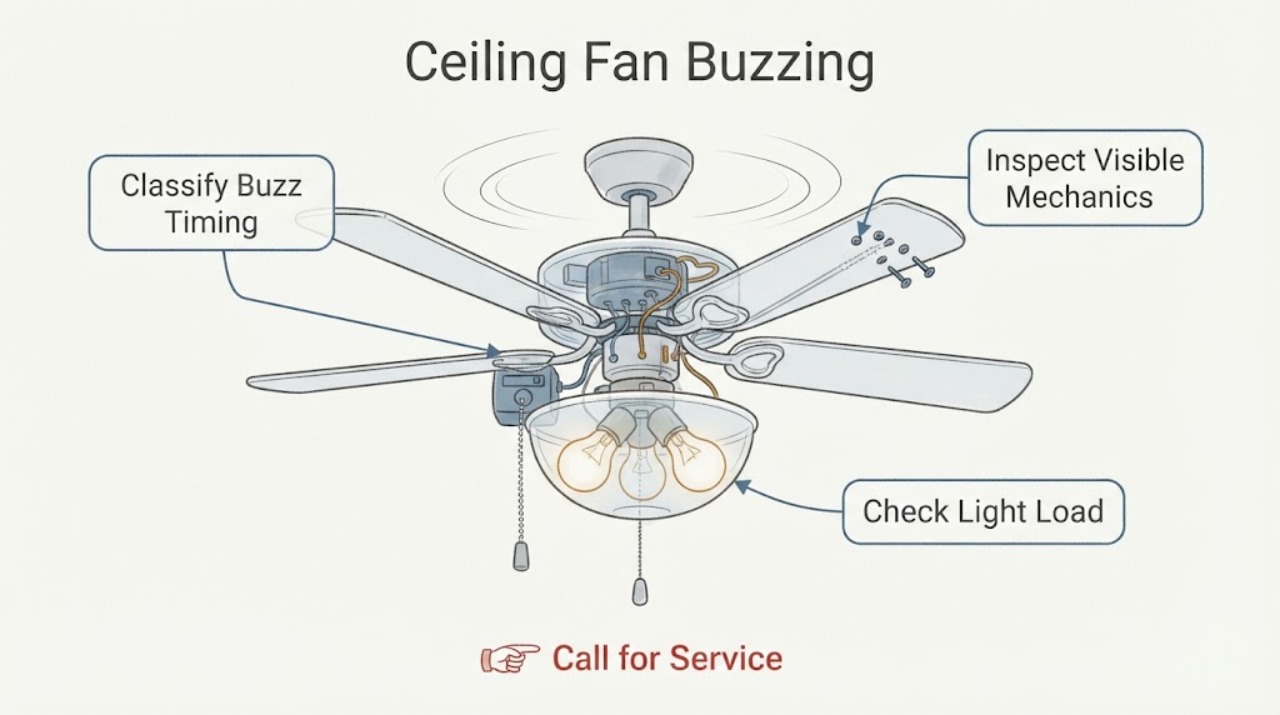
Work through in order
Diagnostic checks
Use only checks that match the exact appliance or system and its official guide.
-
Check 1
From the floor and with the fan area clear, switch the Hunter fan and light through their normal controls one at a time; listen briefly at each fan speed and with the light off, without touching the spinning fan.
Expected result: Record whether the buzz is present while stopped, starts with blade rotation, changes with speed, occurs only with the light on, or follows one wall control or remote setting.
Next step: Turn the fan and light off after the comparison and continue only with the matching safe external check; arrange service for a buzz that is electrical, unexplained, or present while stopped.
Stop if: Stop immediately for crackling, sizzling, smoke, burning or popcorn-like odor, heat, sparks, or any sound from wiring or the breaker.
Why this matters
Why: A speed-related rattle supports a mechanical or balance check; a light-only hum points toward the bulb or light control; a control-setting hum points toward the wall control, dimmer, or receiver. A buzz while stopped may be electrical and needs more caution.
-
Check 2
With the wall control off and blades fully stopped, inspect the fan from the floor for a visibly loose blade, blade holder, light-kit trim, pull chain, shade, canopy, or downrod; use the model manual before attempting any hardware adjustment.
Expected result: Look for a part that moves independently, a blade that sits out of line, a shade or light cover that rattles, or a fan that wobbles as it runs; do not climb or reach toward the fan just to confirm movement.
Next step: If the exact manual permits a simple adjustment from safe, stable access, follow it with power off; otherwise photograph the part and arrange fan service rather than improvising overhead work.
Stop if: Do not use an unstable ladder, touch the fan while it can move, remove the canopy, alter mounting hardware, or continue if the fan is loose at the ceiling.
Why this matters
Why: Hunter associates clicking or rubbing with loose blade hardware or incorrect blade-holder installation and associates wobble with hardware, alignment, balance, or installation. A visible mechanical issue is different from an electrical hum and may still require stable access or a professional.
-
Check 3
If the buzz occurs only with the light on, switch the light off, allow the bulb and shade to cool, and read the bulb marking and fixture instructions without opening the light kit or touching wiring.
Expected result: Record whether the installed bulb matches the fixture's specified type and wattage, whether the shade or bulb is visibly loose or damaged, and whether the noise stops when the light is off.
Next step: Replace a cool bulb only with the exact type and wattage allowed by the model instructions if the socket and shade are intact; otherwise leave the light off and arrange service.
Stop if: Do not exceed the fixture marking, touch a hot or damaged bulb, open the light kit, bypass a limiter, or handle exposed wires.
Why this matters
Why: A light-only buzz with an incorrect bulb or loose visible shade supports a light-kit or bulb check. A correct, intact bulb with persistent noise points toward the light control, receiver, socket, or wiring rather than permission to change wiring.
-
Check 4
Without removing a switch plate or opening the fan, note whether the buzzing changes when the fan uses its intended remote, pull chain, or compatible control and whether the light is connected to a wall dimmer.
Expected result: The sound may appear only at one speed, with a variable control, with a dimmer, or whenever a particular receiver or light control is used; record the control model if it is visible.
Next step: Use only the control and compatibility arrangement specified by the model manual; leave a noisy or uncertain control unused and arrange qualified fan or electrical service.
Stop if: Do not remove the switch plate, open the canopy, change wiring, defeat a control, or connect a standard dimmer to a fan unless a qualified person verifies compatibility.
Why this matters
Why: Hunter notes that variable speed controls can produce hum and that light dimmers often hum; an incompatible control or receiver can also create noise. A control-related pattern does not justify rewiring or substituting a control by guesswork.
-
Check 5
With the fan and light off, listen from a safe distance for noise at the closed wall control, outlet, or circuit breaker and look for heat, odor, discoloration, moisture, smoke, or crackling; do not touch the electrical equipment as a test.
Expected result: Classify the remaining symptom as a mechanical noise, a fan-only electrical hum, a hum at a control or receiver, a breaker or wiring noise, or an emergency warning sign.
Next step: Leave the fan and light off for wiring, breaker, or unexplained electrical noise and arrange a certified electrician; provide the model and timing notes for a fan-only issue.
Stop if: Do not open the electrical box, touch a hot or wet control, reset a buzzing breaker, spray the fan, or continue operating equipment with smoke, sparks, odor, or visible damage.
Why this matters
Why: A Hunter guide directs wiring or breaker buzzing to certified professional investigation, while a persistent fan-only hum may involve the receiver or motor. Heat, odor, smoke, moisture, or crackling raises the electrical safety urgency.
Use your observations
Decision map
Find the observation that best matches what you see, then follow the next safe action.
-
PATH 01Safety boundary
What you see
The noise follows blade rotation or speed and a blade, holder, shade, or other external part looks loose or out of line.
Do this next
With power off, follow the exact model manual for any safe accessible adjustment; otherwise arrange fan service and keep the fan off if it wobbles or is loose at the ceiling.
Why this path and its safety boundary
Why it matters: Loose hardware, alignment, balance, or installation is more likely than a control-only hum.
Safety stop: Do not reach toward moving blades, remove the canopy, use an unstable ladder, or alter ceiling mounting hardware.
-
PATH 02Safety boundary
What you see
The buzz begins only when the Hunter light is on and stops when the light is off.
Do this next
Verify the cool bulb and visible shade against the model instructions; leave the light off and arrange service if the correct intact bulb does not resolve the sound.
Why this path and its safety boundary
Why it matters: The bulb, shade, light control, socket, or light-kit electronics are more likely than the blade assembly.
Safety stop: Do not exceed the marked bulb specification, open the light kit, bypass a limiter, or use a damaged socket or bulb.
-
PATH 03Safety boundary
What you see
The sound changes with a variable speed control or is present only when a dimmer or particular wall control is used.
Do this next
Stop using the noisy control and have a qualified person verify the control, receiver, light, and fan compatibility against the model manual.
Why this path and its safety boundary
Why it matters: Hunter identifies solid-state variable controls and light dimmers as possible sources of electrical hum; compatibility remains a product-specific question.
Safety stop: Do not open the switch box, rewire the control, or substitute a dimmer or receiver by appearance.
-
PATH 04Safety boundary
What you see
The buzz is fan-only, persists with the correct light off, and no loose external part or control pattern explains it.
Do this next
Leave the fan off if the noise is worsening or accompanied by heat or odor, record the model number, and request Hunter or qualified service.
Why this path and its safety boundary
Why it matters: A receiver or motor issue is possible, but internal diagnosis and replacement depend on the exact Hunter model.
Safety stop: Do not open the motor housing, remove the receiver, replace a capacitor, or make wiring changes as a homeowner test.
-
PATH 05Safety boundary
What you see
The sound is traced to wiring, a closed wall control, an outlet, or the circuit breaker rather than the fan body.
Do this next
Leave the affected equipment off and arrange a certified electrician; describe where the sound was heard without opening the enclosure.
Why this path and its safety boundary
Why it matters: Hunter treats wiring and breaker buzzing as an electrical fault or overload concern requiring professional investigation.
Safety stop: Do not touch, tighten, reset repeatedly, remove covers, or continue operating a buzzing electrical device.
-
PATH 06Safety boundary
What you see
The fan or control crackles or sizzles, smells burned or like popcorn, smokes, sparks, becomes hot, or shows melted or charred parts.
Do this next
Turn off power from a safe control if possible, keep clear, and arrange prompt qualified electrical service; use emergency procedures for active smoke or fire.
Why this path and its safety boundary
Why it matters: This is an immediate electrical stop condition, not a normal fan hum or a balance adjustment.
Safety stop: Do not operate, touch, spray, open, or test the fan or electrical enclosure.
Helpful context
Understand the symptom
First separate a mechanical buzz from an electrical hum
With people clear of the blades, note whether the sound occurs when the fan is stopped, only while the blades rotate, only when the light is on, or at one control setting. A vibration or rattle that follows blade speed makes loose hardware, blade balance, or installation more likely. A steady hum that changes with a wall control or disappears when the light is off points more toward the control, bulb, receiver, or light kit. The sound pattern narrows the check but does not prove a component is safe to replace.
Hunter's own guide keeps wiring and breaker work outside ordinary troubleshooting
Hunter says unusual fan noise can follow installation or component issues, but its noisy-fan guidance is supplemental to the model-specific manual. It directs wiring repairs to a certified electrician and says a buzzing breaker needs professional investigation. Keep checks to the external fan, light, and control behavior unless a qualified person is doing de-energized electrical work.
Do not treat crackling, sizzling, or odor as a normal fan hum
A gentle hum can be control-related, but crackling, sizzling, a popcorn-like odor, smoke, heat, or visible damage is a stop condition. Turn the fan and light off immediately from a safe control if possible, keep clear, and arrange qualified electrical service. Do not spray the fan, open its housing, or keep testing to locate the sound.
Keep the model identity with the service request
Hunter recommends using the model-specific manual and having the model number available when a motor or other component may be involved. Record the model marking, whether the light is affected, the control type, the speed or setting that changes the sound, and any visible loose or damaged part. That information helps a technician select a compatible repair without guessing.
Safety boundary
Stop conditions
- Do not touch the fan while blades are moving, reach overhead from an unstable ladder, or alter ceiling mounting or wiring as a routine homeowner check.
- Do not open the canopy, switch box, light kit, receiver, motor housing, or electrical enclosure unless qualified electrical personnel are performing the work.
- Do not exceed the light fixture's marked bulb specification, bypass a limiter, or substitute a dimmer, receiver, capacitor, or control without model-specific compatibility guidance.
- Turn the fan and light off and arrange prompt qualified service for crackling, sizzling, smoke, sparks, burning or popcorn-like odor, heat, moisture, discoloration, or visible damage.
- Arrange certified electrical or Hunter service when buzzing persists after safe external checks, is traced to wiring or a breaker, or the fan is loose, wobbling, or internally noisy.
Only after diagnosis
Potential parts
- Hunter compatible light bulb
Consider this only if the model manual permits a replacement and the installed bulb is incorrect, failed, damaged, or associated with a light-only buzz.
Match the exact fixture marking and model instructions; do not exceed the permitted bulb type or wattage. - Hunter compatible wall control or receiver
Consider this only after the exact fan model and control arrangement are identified and a qualified diagnosis links the noise to the control or receiver.
Confirm model-specific compatibility, wiring arrangement, and installation instructions; do not substitute a dimmer or receiver by appearance. - Hunter blade hardware or balance kit
Consider this only when the model manual or technician confirms loose, damaged, misaligned, or unbalanced blade hardware as the cause.
Match the exact fan model and mounting design; an accessory does not correct a loose ceiling box, wiring fault, or unsafe mounting condition.
When checks do not resolve it
Need a professional?
Arrange qualified fan or electrical service when the buzz persists after safe external checks, the sound comes from a control, wiring, outlet, or breaker, the receiver or motor may be involved, the fan is loose or wobbling, or the model-specific compatibility is unknown. Turn power off from a safe control and escalate promptly for crackling, sizzling, smoke, sparks, burning odor, heat, moisture, discoloration, or visible damage.
Safety scope: This article supports listening, front-of-fixture observation, and model-manual checks with the fan stopped. A certified electrician or qualified fan technician must handle wiring, switch boxes, breaker work, canopy access, internal controls, motor, receiver, and mounting repairs.
Common questions
FAQ
Why is my Hunter ceiling fan buzzing?
Possible sources include loose blade or light-kit parts, an incorrect bulb, an incompatible dimmer or speed control, a receiver, a motor, wiring, or a breaker. Note whether the sound changes with fan speed or occurs only when the light is on, then follow only the safe external checks for that pattern.
Is a humming sound from a ceiling fan normal?
Some variable speed controls can create a hum, but a new, worsening, or unexplained buzz should not be assumed normal. A buzz from wiring or a breaker, or one accompanied by heat, odor, crackling, smoke, or visible damage, needs qualified electrical attention.
Can a dimmer switch make a Hunter ceiling fan buzz?
Hunter says light dimmer switches often create an electrical hum, and variable fan controls can also hum. Do not rewire or substitute a control by guesswork; use the model manual and have a qualified person verify compatibility.
Should I tighten the blades on a buzzing Hunter fan?
With the fan stopped and power off for the check, you may inspect visible blade or holder looseness only if the model manual and safe access permit the adjustment. Do not use an unstable ladder, reach toward the fan, remove the canopy, or alter ceiling mounting hardware.
When should I call an electrician for a buzzing ceiling fan?
Call when the sound is traced to wiring, a switch, outlet, or breaker; when a receiver, motor, or internal control may be involved; or when safe external checks do not resolve it. Turn the fan and light off and escalate promptly for crackling, sizzling, smoke, sparks, burning odor, heat, moisture, or visible damage.
Read the exact guide
Official sources
- CPSC Guide to Home Wiring HazardsU.S. Consumer Product Safety Commission · General U.S. consumer electrical-safety guidance; the installed fan instructions and local electrical requirements also apply.
- Why is my fan humming?Hunter Fan Team · Hunter support guidance about electrical control systems in ceiling fans; it does not replace the installed model manual or electrical diagnosis.
- How to Fix a Noisy Ceiling FanHunter Fan · Hunter's supplemental general guidance; the model-specific Hunter manual controls the installed fan and a certified electrician handles wiring repairs.
- Why is my fan wobbling?Hunter Fan Team · Hunter support guidance for installed Hunter fans; overhead access and mounting repairs require safe access and qualified service when uncertain.
Community feedback
Share a repair observation
Share a plain-text repair observation. Accepted observations are published automatically; this page may take a moment to update.