
On this page
Start here
Quick answer
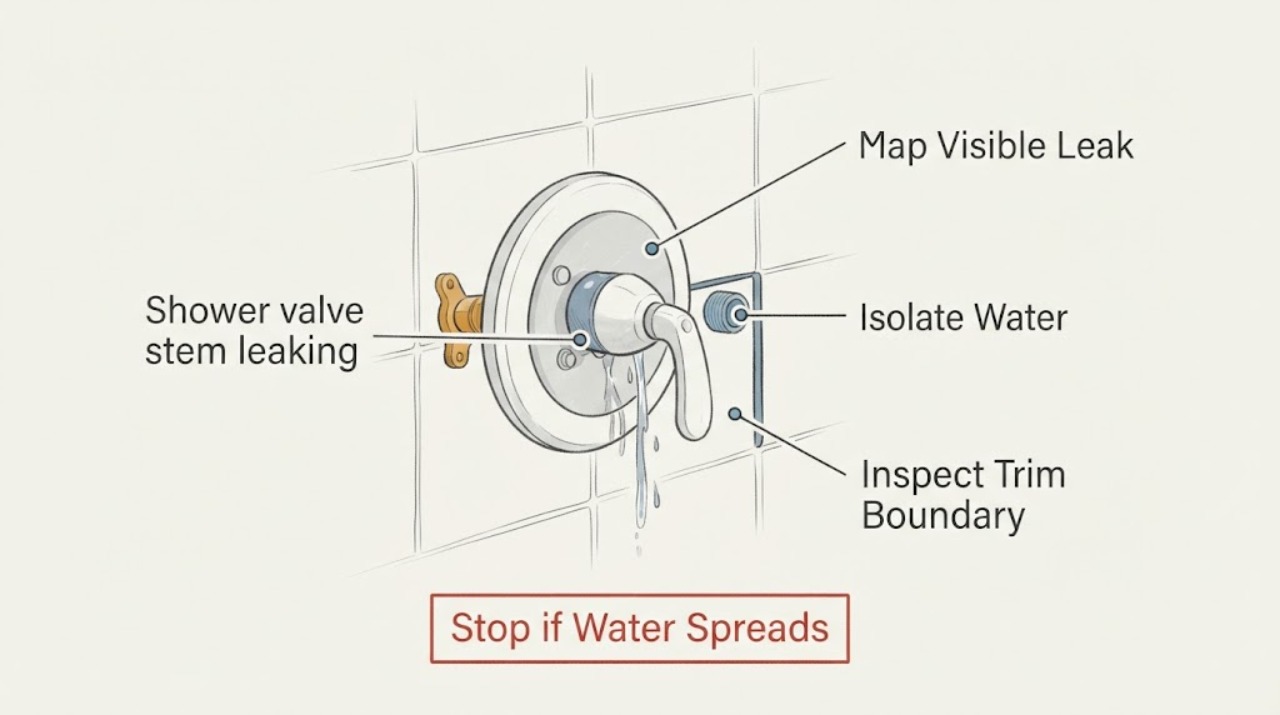
A leak that appears around an American Standard shower handle or valve stem can come from a worn stem seal or cartridge, a loose or damaged trim seal, a connection that leaks only while the shower runs, or a leak behind the wall. Turn the shower off, contain the water, and identify whether the leak is at the handle, the escutcheon, the shower arm, or the wall before removing anything. American Standard uses model-specific shower cartridges and pressure-balance or thermostatic valve arrangements, so do not assume that a generic stem or cartridge fits. If water reaches the wall or floor, the leak continues with the handle off, the local stop cannot isolate it, or trim removal would expose the valve, stop using the shower and arrange qualified plumbing service.
Before you begin
Safety first
- This article supports observation, safe water isolation, model identification, and an authorized controlled test only. Do not open walls, remove a valve stem or cartridge, loosen pressurized fittings, or bypass temperature-control features.
Work through in order
Diagnostic checks
Use only checks that match the exact appliance or system and its official guide.
-
Check 1
Dry the handle, escutcheon, shower arm, tub spout, and nearby wall with a towel, then run the shower briefly in its normal way while watching from outside the spray path; turn the control fully off and keep observing without removing trim.
Expected result: Record whether the first moisture appears at the handle or stem, around the escutcheon, at a threaded outlet, from the shower arm or spout, or from the wall; note whether it occurs only while running or continues after shutoff.
Next step: Photograph the first wet point and the dry area below it. Continue only with ordinary-access checks when the wall remains dry; isolate the water and arrange qualified plumbing service for any hidden or continuing leak.
Stop if: Stop testing immediately for water entering the wall, a soft or stained wall, a ceiling stain below, uncontrolled flow, hot-water scald risk, or any need to open the wall.
Why this matters
Why: Moisture that starts at the handle while the valve is open makes an accessible stem seal or cartridge area plausible. Moisture at the escutcheon or wall, or a drip that continues with the control off, makes a trim seal, rough-in connection, or concealed leak more likely than a simple handle adjustment.
-
Check 2
Turn the shower control off and, only if the valve system clearly provides an accessible service stop described by its instructions, close that stop gently; otherwise use the home's accessible main water shutoff or contact a plumber rather than forcing the handle or a hidden stop.
Expected result: Check whether water flow stops completely, slows but continues, or cannot be isolated; check the exposed area again for fresh moisture without touching energized or concealed parts.
Next step: Keep the shower out of use and arrange service when the stop will not close, the leak continues, or the only shutoff is inaccessible. Do not resume operation merely because the drip slows.
Stop if: Do not force a stop, remove a valve cover, loosen a pressurized fitting, or continue if water is spraying, flooding, reaching electrical equipment, or cannot be isolated safely.
Why this matters
Why: A complete shutoff creates a safer boundary for documentation and model identification. Continued flow or an unknown shutoff means the leak is not under control and may involve the valve body or supply, not just the visible stem seal.
-
Check 3
With water isolated and the exact product instructions available, inspect only the outside of the handle, escutcheon, visible fasteners, and gasket edge; do not pry the trim or pull a stem or cartridge from the valve body.
Expected result: Look for a loose handle, cracked trim, a displaced visible gasket, corrosion, a gap where water can enter, or water that is already behind the escutcheon; record whether the handle moves normally without force.
Next step: Leave the trim in place and give the observations and photos to a plumber or manufacturer when water is behind it, the handle binds, or the model instructions do not clearly authorize the next step.
Stop if: Stop before removing the escutcheon or handle if water is not isolated, the fastener is seized, the trim could disturb the valve, or opening it would expose the rough-in or wall cavity.
Why this matters
Why: A loose or damaged exterior seal may explain water around the trim, but moisture behind the escutcheon does not establish that a stem seal is the only failure. A handle that binds or trim that will not release safely is a model-specific service issue.
-
Check 4
Read the visible American Standard markings and collect the model information from the trim, valve documentation, or installation record without relying on appearance alone; note whether the documentation describes a shower faucet cartridge, pressure-balance cartridge, or thermostatic valve.
Expected result: Record the exact model or family if available, the valve type, the presence of service stops, and whether the documented replacement is a stem, cartridge, seal, or complete compatible assembly; mark the identity as unknown if those details cannot be confirmed.
Next step: Use the exact model instructions or provide the model evidence to a qualified plumber or American Standard support for part identification before ordering or disassembling anything.
Stop if: Do not substitute a visually similar cartridge, defeat a pressure-balance or thermostatic feature, or open the valve body to compare parts.
Why this matters
Why: American Standard publishes distinct shower cartridge and pressure-balance or thermostatic components. An unknown identity leaves compatibility unresolved, so a generic stem replacement could create a new leak, temperature-control problem, or damaged valve.
-
Check 5
After an authorized accessible adjustment or model-specific service has been completed and all visible parts are restored, place a dry tissue below the handle and escutcheon, restore water slowly, and run one brief test while watching the wall side and the area below.
Expected result: The tissue and wall stay dry with the control off and on, or moisture returns at the handle, trim edge, outlet connection, or hidden side; note whether the leak appears only during flow or continues after shutoff.
Next step: Close the stop or main supply again if the leak returns, keep the shower unused, and arrange qualified plumbing service with the model, leak location, and test result.
Stop if: Stop the test for fresh wall moisture, a ceiling or floor stain, uncontrolled flow, temperature instability, damaged trim, or any need to access the valve behind the wall.
Why this matters
Why: A dry controlled test supports that the accessible service boundary is holding, but it does not prove a concealed rough-in is sound. Any returning moisture means the cause or seal is unresolved and should not be chased by tightening harder.
Use your observations
Decision map
Find the observation that best matches what you see, then follow the next safe action.
-
PATH 01Safety boundary
What you see
The leak begins at the handle or stem only while the shower is running, stops when the control is off, and the wall and escutcheon remain dry.
Do this next
Isolate water, identify the exact valve model, and use only the model-authorized seal or cartridge procedure; arrange service if the handle binds or the leak returns.
Why this path and its safety boundary
Why it matters: An accessible stem seal, cartridge, or handle-area seal is more plausible than a continuously pressurized concealed leak, but the exact American Standard valve system is still needed.
Safety stop: Stop if moisture moves behind the escutcheon, persists with the control off, or requires valve-body or wall access.
-
PATH 02Safety boundary
What you see
The escutcheon gap or wall becomes wet, water runs downward behind the trim, or a room below shows dampness even when the handle is off.
Do this next
Stop using the shower, isolate the water without forcing a stop, and request prompt qualified plumbing and water-damage assessment.
Why this path and its safety boundary
Why it matters: A trim seal, rough-in connection, valve body, or concealed supply leak is more likely than an isolated visible stem seal; continued operation can spread water damage.
Safety stop: Do not remove the wall, pry the trim, or run more tests to estimate the hidden leak.
-
PATH 03Safety boundary
What you see
The first moisture is at the shower arm, tub spout, or another threaded outlet rather than at the handle, and the wall remains dry.
Do this next
Keep the shower off until the exact connection procedure and seal type are confirmed; have a plumber service a seized, damaged, or wall-connected fitting.
Why this path and its safety boundary
Why it matters: The outlet connection seal or fitting may be involved, so replacing a valve stem would not address the observed location.
Safety stop: Do not over-tighten, twist the pipe in the wall, add unapproved sealant, or continue if the wall starts to wet.
-
PATH 04Safety boundary
What you see
The trim or valve identity cannot be confirmed, or the visible cartridge or stem does not match the documentation.
Do this next
Photograph the markings and provide them to a qualified plumber or the manufacturer for exact identification before ordering or removing a component.
Why this path and its safety boundary
Why it matters: Compatibility is unresolved. American Standard's shower cartridge, pressure-balance, and thermostatic arrangements are not interchangeable based on appearance.
Safety stop: Do not install a generic stem or cartridge, force retaining hardware, or bypass temperature-control components.
-
PATH 05Safety boundary
What you see
The accessible stop cannot close, water continues after the shower is off, or the leak is too active to contain at the fixture.
Do this next
Use the main shutoff if it can be operated safely, protect the area from water, and arrange urgent plumbing service; use emergency help for an uncontrolled flooding condition.
Why this path and its safety boundary
Why it matters: The water source is not safely isolated, and the problem may extend into the valve body or supply rather than the handle area.
Safety stop: Do not loosen pressurized fittings or keep testing while water is reaching electrical equipment, ceilings, floors, or other rooms.
-
PATH 06Safety boundary
What you see
The area appears dry immediately after an authorized service, but moisture returns at the handle, escutcheon, or wall during the controlled test or later use.
Do this next
Isolate the water again, stop using the shower, and give the technician the before-and-after leak location, model identity, and test result.
Why this path and its safety boundary
Why it matters: The seal, cartridge, trim, connection, or concealed valve problem is not resolved; repeated tightening can damage the valve or trim and hide the actual source.
Safety stop: Do not repeat disassembly, substitute another part, or continue using the shower when water reaches the wall or floor.
Helpful context
Understand the symptom
Start by locating the water, not by replacing a stem
The phrase valve stem leaking describes where water is noticed, not necessarily which part has failed. Water may emerge at the handle while the valve is open, collect behind the escutcheon, run from the shower arm or tub spout connection, or travel from the rough-in valve into the wall. A drip that continues with the control fully off is more concerning than a small seep that appears only while the valve is running. Dry the visible area, watch one normal cycle from a safe position, and do not remove the wall or force the handle to prove the source.
American Standard shower valves are not one universal stem design
American Standard's product documentation distinguishes shower faucet cartridges from pressure-balance and thermostatic valve components, and trim kits can include service stops or other features that vary by valve system. Use the exact model and installation information to identify what is behind the handle. A valve stem, cartridge, packing seal, retaining hardware, and trim gasket are different possibilities; a part that looks similar can still be wrong for the valve.
Treat hidden water as a stop condition
If water is visible at the wall, the escutcheon gap stays wet after the shower is off, paint or drywall is soft, or a room below shows a stain, do not keep operating the shower to compare drips. Shut off the available water supply without forcing a stop and arrange plumbing assessment. Portland's official leak guidance also uses the principle of isolating a leak at an accessible shutoff or the main supply when a local shutoff is unavailable, then checking for leaks after water is restored.
Safety boundary
Stop conditions
- Stop using the shower for water behind the escutcheon, a wet wall or ceiling below, soft drywall, staining, mold-like odor, or any leak that continues with the control off.
- Do not force the handle, service stop, escutcheon, retaining hardware, shower arm, or another threaded fitting; do not loosen a pressurized connection.
- Do not open the wall, pull the valve stem or cartridge, bypass pressure-balance or thermostatic protection, or install a generic component as a test.
- Stop for uncontrolled flow, water reaching electrical equipment, flooding, scalding or unstable temperature, or an isolation valve that will not close.
- Do not keep operating the shower to compare drips after hidden moisture is suspected; isolate the water and arrange qualified plumbing service.
Only after diagnosis
Potential parts
- American Standard shower valve cartridge or stem seal
Consider this category only when the leak is confirmed at the handle or stem during operation and the exact valve model and service instructions identify a compatible seal or cartridge.
Confirm the exact American Standard model and whether it uses a shower faucet, pressure-balance, or thermostatic cartridge before ordering; do not rely on appearance alone. - shower escutcheon gasket or trim seal
Consider this category only when the trim seal is visibly displaced or damaged, the wall-side valve is dry, and the model instructions identify a replaceable seal.
Confirm the trim and valve family, seal dimensions, and manufacturer procedure; a trim gasket cannot correct a leak from the rough-in valve or supply. - compatible rough-in valve or supply seal
Consider this category only after a qualified assessment locates the leak at the rough-in valve or a concealed connection rather than the accessible handle area.
A plumber must confirm the exact valve system, access method, connection type, and compatible replacement before any wall or valve work.
When checks do not resolve it
Need a professional?
Arrange qualified plumbing service when a leak continues with the shower off, appears behind the escutcheon or wall, cannot be isolated, returns after an authorized accessible service, involves a seized or damaged handle, or requires valve or wall access. Prompt assessment is appropriate for water damage, a ceiling or floor stain, an inaccessible main shutoff, or a leak that is increasing. Provide the exact American Standard markings, valve type if known, first wet location, whether the leak occurs only while running, shutoff behavior, photos, and any prior work.
Safety scope: This article supports observation, safe water isolation, model identification, and an authorized controlled test only. Do not open walls, remove a valve stem or cartridge, loosen pressurized fittings, or bypass temperature-control features.
Common questions
FAQ
Does a leaking American Standard shower handle always mean the valve stem needs replacement?
No. The water may come from a stem seal, model-specific cartridge, trim gasket, outlet connection, valve body, or a concealed supply. First map the first wet point and whether the leak continues with the control off, then identify the exact valve system before choosing a part.
Can I install a generic shower valve stem or cartridge?
Do not assume it fits. American Standard publishes different shower faucet, pressure-balance, and thermostatic components. Confirm the exact model and the manufacturer's service information, or have a plumber identify the compatible component.
When is a shower valve leak an emergency?
Stop using the shower and isolate the water promptly when flow cannot be stopped, water is entering the wall, a ceiling or floor below is wet, flooding is increasing, water reaches electrical equipment, or temperature becomes unstable. Arrange qualified plumbing service; use emergency assistance for an uncontrolled flooding or immediate hazard.
Should I tighten the shower handle or escutcheon to stop the leak?
Only an exact model instruction should authorize an accessible adjustment, and it should be done with water isolated. Do not force a handle, trim, service stop, or threaded fitting; recurring moisture or water behind the trim needs qualified diagnosis rather than repeated tightening.
Read the exact guide
Official sources
- How to fix a faucet leakPortland Water Bureau · General leak-safety guidance applied here to the water-isolation and stop-use boundary; the page is not an American Standard shower-valve repair manual.
- Temperature Control Pressure Balance Valve CartridgeAmerican Standard · Use for distinguishing a pressure-balance cartridge from a simple stem seal and for the need to preserve model-specific temperature-control components.
- Shower Faucet Cartridge with ScrewsAmerican Standard · Use for the distinction between an American Standard shower faucet cartridge and a generic valve-stem assumption; exact fit remains model-specific.
- Time Square® Single Handle Thermostatic Shower Valve Trim KitAmerican Standard · Use for the model-specific distinction between trim and rough-in valve functions and for recognizing integrated service and temperature-control features; other American Standard models may differ.
Community feedback
Share a repair observation
Share a plain-text repair observation. Accepted observations are published automatically; this page may take a moment to update.