
On this page
Start here
Quick answer
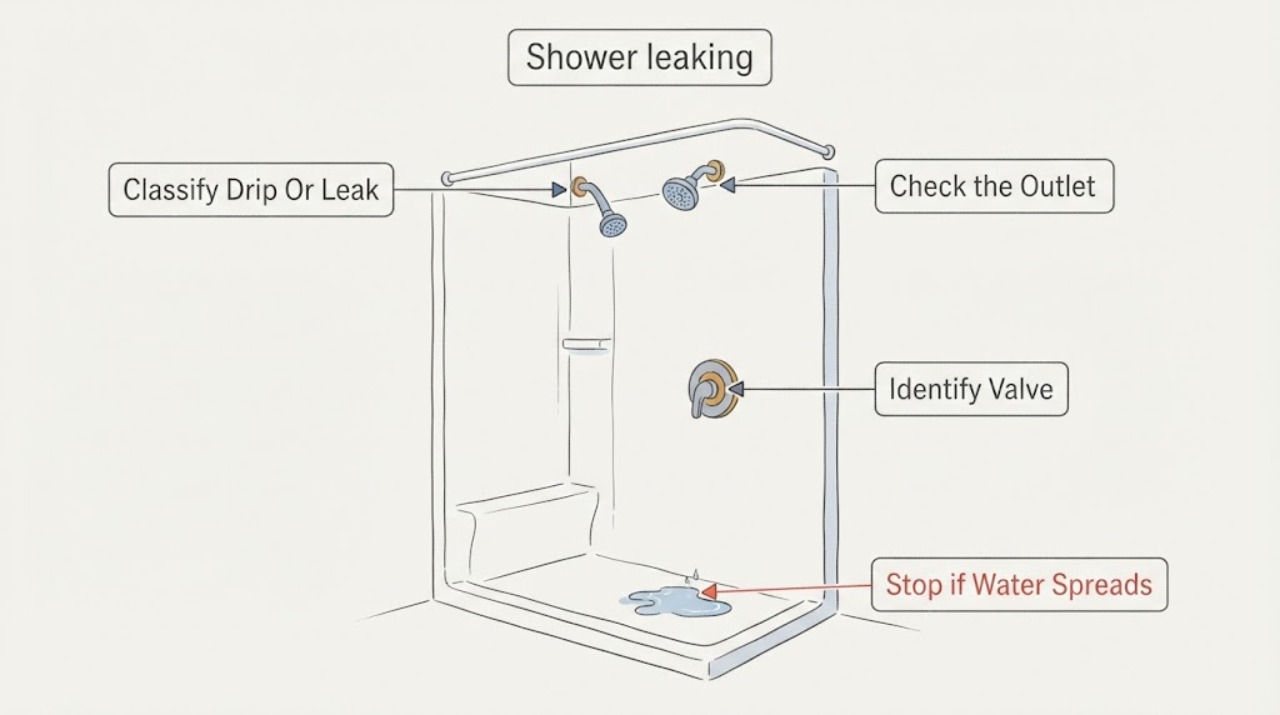
A leaking Kohler shower needs a source-and-pattern check before any part is replaced. Water that tapers off briefly from the showerhead after use can be residual water, while a continuous flow with the control closed points more toward a valve seal, pressure-balancing unit, diverter, or another internal component. Water from the handle, escutcheon, hose joint, wall, ceiling, or adjacent room is a different connection or concealed-leak path. First identify the exact Kohler valve and outlet layout, observe whether one or several outlets are involved, and inspect exposed areas from a dry, stable position. Do not remove concealed trim, open the wall, force a valve, or change a cartridge as a test. Stop using the shower and arrange qualified plumbing service for continuous flow, temperature instability, visible seepage, or any water damage.
Before you begin
Safety first
- This article supports ordinary-access observation, model identification, drying, and exposed-surface inspection only. It does not authorize valve or cartridge disassembly, pressure adjustment, outlet-pipe changes, wall or ceiling access, or force on shutoffs.
Work through in order
Diagnostic checks
Use only checks that match the exact appliance or system and its official guide.
-
Check 1
After a normal shower, turn the control fully off and observe the affected outlet from a stable, dry position without touching or removing the trim.
Expected result: Water appears as separated drops that taper and stop, a continuous stream, or a drip that returns after stopping; record whether it comes from the showerhead, hand shower, or tub spout.
Next step: Use the residual-water branch only when the drip stops and every exposed connection stays dry; otherwise identify the valve and arrange plumbing assessment.
Stop if: Stop for a steady stream, water reaching a wall or ceiling, a slippery floor, or any uncontrolled flow that could cause damage.
Why this matters
Why: A short, self-ending outlet drip can be residual water draining from the head or connected pipe. Continuous or recurring flow with the control closed is more consistent with a valve or internal seal problem.
-
Check 2
Record which outlets are installed and which outlet or diverter position was selected when the leak appeared; do not force the diverter or remove the control plate.
Expected result: Only the showerhead drips, the tub spout and showerhead respond together, the drip follows one diverter position, or more than one outlet leaks while controls are closed.
Next step: Photograph the layout and provide the outlet pattern to a plumber; do not correct a suspected installation or back-pressure issue by changing pipework or internal parts yourself.
Stop if: Stop using the shower if the diverter is loose, jammed, leaking around the wall, or cannot hold an outlet without a continuous stream.
Why this matters
Why: A single outlet supports a residual-water or local outlet path. Simultaneous or diverter-dependent flow makes back pressure, outlet-port blockage, diverter, valve, or non-return behavior more likely than a showerhead-only leak.
-
Check 3
From a dry, ordinary-access position, record the Kohler name, trim markings, valve model if visible in existing documentation, and whether the installation is single-control, thermostatic, or another arrangement.
Expected result: The valve identity is confirmed, only the trim is known, or the model and valve type are unknown.
Next step: Use Kohler product support or a qualified plumber to identify the valve before selecting a cartridge, pressure-balancing unit, seal, or other part.
Stop if: Do not remove trim, pull a cartridge, or open the wall solely to discover the model.
Why this matters
Why: Kohler's published dripping path for Rite-Temp valves is not proof for every Kohler shower. An unknown valve can contain a different cartridge, balancing unit, diverter, or service-stop arrangement.
-
Check 4
With the shower unused, dry the visible showerhead, hose joint, spout, handle perimeter, escutcheon edge, and nearby floor; then inspect from outside the wall for fresh moisture without loosening anything.
Expected result: The spray face alone becomes wet, a hose or threaded joint wets, water appears at the handle or escutcheon, or moisture appears below, behind, or beside the shower.
Next step: Photograph the first wet location and stop shower use when water can reach structure. Arrange qualified service for a connection, valve, wall, ceiling, or floor leak.
Stop if: Do not remove the escutcheon, open the wall or ceiling, add surface sealant over the leak, or continue using a shower that is wetting the structure.
Why this matters
Why: Spray-face moisture after a brief tail can be residual. A wet connection suggests a seal or fitting leak, while handle, wall, ceiling, or adjacent-room moisture raises a concealed valve or plumbing concern.
-
Check 5
During one normal cycle, note whether the leak is accompanied by temperature fluctuation, pressure change, a handle that will not reach its stop, unusual noise, or delayed flow; do not measure or adjust internal pressure yourself.
Expected result: Temperature and pressure stay stable, or the leak coincides with a fluctuating temperature, unusual noise, delayed outlet response, or a control that cannot shut off.
Next step: Record the timing, outlet, control position, and any sound or temperature change for the technician. Stop repeated testing when control or temperature behavior is abnormal.
Stop if: Stop for scalding risk, sudden pressure change, a control that cannot shut off, or water entering a wall or ceiling.
Why this matters
Why: Stable behavior with a self-ending outlet drip favors residual water. Temperature or pressure symptoms can involve the pressure-balancing unit, valve, back pressure, or supply conditions and need model-specific diagnosis.
-
Check 6
If a clearly identified local shutoff is present and operates normally, isolate the shower supply only as a temporary damage-control step; otherwise leave controls alone and arrange service.
Expected result: The leak stops with the shower supply isolated, the valve is absent or seized, or other fixtures are also affected.
Next step: Keep the shower out of service as needed and provide the technician the model, outlet map, leak source, timing, exposed moisture, and isolation result; do not dismantle the valve.
Stop if: Do not force the shutoff, close an unidentified building valve, open the wall, or restore use after water damage without inspection.
Why this matters
Why: Stopping after isolation supports a pressurized shower-fitting leak but does not identify the failed part. A seized or unknown shutoff, or multiple affected fixtures, requires broader plumbing assessment.
Use your observations
Decision map
Find the observation that best matches what you see, then follow the next safe action.
-
PATH 01Next step
What you see
Only the showerhead or hand shower releases separated drops after use, the drops taper and stop, and the handle, connections, wall, ceiling, and floor remain dry.
Do this next
Monitor the pattern and confirm the exact Kohler valve and showerhead instructions; do not replace an internal valve part solely for a short self-ending tail.
Why this path and its safety boundary
Why it matters: Residual water draining from the outlet is more likely than a valve that is continuously passing pressurized water.
-
PATH 02Safety boundary
What you see
A continuous stream or recurring flow comes from the showerhead or spout while the control is closed and does not stop after the outlet has emptied.
Do this next
Arrange qualified service with the exact Kohler valve identity and leak timing; a technician determines the compatible mixer, balancing, cartridge, or seal repair.
Why this path and its safety boundary
Why it matters: An internal seal, pressure-balancing unit, cartridge, valve, or installation-related fault is more likely than residual water.
Safety stop: Do not remove the cartridge, force the control, or install a repair kit based only on a similar trim appearance.
-
PATH 03Safety boundary
What you see
Water appears from the showerhead and tub spout together, follows diverter selection, or the outlet response is delayed after shutoff.
Do this next
Document the outlet and diverter pattern and request qualified plumbing diagnosis using the exact valve and installation details.
Why this path and its safety boundary
Why it matters: Back pressure, outlet-port blockage, diverter behavior, tubing, or valve installation may be involved; the showerhead alone is not proven defective.
Safety stop: Do not change connecting pipework, enlarge outlet ports, or alter a diverter or pressure-control component as a user test.
-
PATH 04Safety boundary
What you see
Water first appears at a hose joint, handle, escutcheon, wall, ceiling, adjacent room, or shower base rather than only at the outlet.
Do this next
Dry the area, isolate a clearly identified local supply if safe, stop using the shower, and arrange prompt plumbing inspection.
Why this path and its safety boundary
Why it matters: A seal, exposed connection, valve-body connection, or concealed plumbing leak is possible and can cause structural damage.
Safety stop: Do not remove trim, tighten hidden parts, add surface sealant, or open the wall or ceiling.
-
PATH 05Next step
What you see
The leak occurs with temperature fluctuation, sudden pressure change, unusual valve noise, or a handle that does not fully shut off.
Do this next
Stop use for scalding or uncontrolled-flow risk and arrange qualified valve service with the exact Kohler model and symptoms.
Why this path and its safety boundary
Why it matters: The pressure-balancing unit, cartridge, valve, supply, or back-pressure condition needs assessment; this is not a simple residual-drip decision.
Helpful context
Understand the symptom
A drip, a stream, and a wall leak are different problems
Kohler defines a drip as separated drops and a leak as continuous flow. A few drops from the showerhead while the outlet empties can be residual water; a continuing stream with the control closed is a valve-sealing concern. Water around the handle, escutcheon, hose joint, wall, ceiling, or floor is not explained by residual water at the spray face and should be treated as a connection or concealed leak until checked.
Use the Kohler valve identity to choose the right branch
Kohler's dripping guidance is specific to single-control Rite-Temp valves, and its delayed-flow guidance names several valve families and installation conditions. A Kohler shower may also have a tub spout, diverter, hand shower, pressure-balancing unit, or different cartridge arrangement. Record the valve and trim identity before interpreting a symptom or considering a service part.
Protect the wall before investigating the valve
A leak that reaches the wall, ceiling, or adjacent room can cause damage even when the visible shower leak seems small. Dry exposed surfaces, limit use, and arrange qualified plumbing service when water continues or the source is hidden. Kohler's valve-cleaning instructions include shutoff, pressure release, seals, and reassembly checks, so internal work should follow the exact model procedure and be handled by a qualified person when the model or access is uncertain.
Safety boundary
Stop conditions
- Do not remove a Kohler cartridge, pressure-balancing unit, escutcheon, valve cap, or concealed control as a user test.
- Do not force a handle, diverter, service stop, threaded connection, or seized trim, and do not add sealant over an active leak.
- Stop using the shower for a steady stream, water inside a wall or ceiling, visible water damage, or a slippery or unsafe floor.
- Stop immediately for scalding risk, unstable temperature, sudden pressure change, water near electrical equipment, or a control that will not shut off.
- Do not apply a Rite-Temp or other Kohler repair procedure to an unknown valve; identify the exact model and use its instructions or qualified service.
Only after diagnosis
Potential parts
- Kohler shower valve cartridge or mixer assembly
Consider this category only after qualified diagnosis confirms continuous flow with the control closed and the exact Kohler valve identifies the compatible internal assembly.
Confirm the valve family, trim, pressure-balancing or thermostatic arrangement, and current Kohler fit information before ordering. - Kohler pressure-balancing unit or O-ring set
Consider this category only when the exact Kohler Rite-Temp valve and qualified inspection link the leak or temperature symptom to the balancing unit or its seals.
Confirm the exact valve model, seal placement, and manufacturer procedure; do not use an internal repair kit as a generic leak test. - Kohler shower connection seal
Consider this category only when an exposed connection is confirmed to leak and the exact Kohler instructions identify a replaceable seal.
Confirm the connection and seal design for the exact fitting; do not overtighten or conceal a wall-side leak with surface sealant.
When checks do not resolve it
Need a professional?
Arrange qualified plumbing service when water continues after the outlet has drained, the showerhead or spout leaks with the control closed, multiple outlets flow together, temperature or pressure changes, a connection or wall becomes wet, the valve is unknown, or any cartridge, pressure-balancing, diverter, seal, or concealed plumbing work is required. Stop use promptly for a steady flow or structural water damage.
Safety scope: This article supports ordinary-access observation, model identification, drying, and exposed-surface inspection only. It does not authorize valve or cartridge disassembly, pressure adjustment, outlet-pipe changes, wall or ceiling access, or force on shutoffs.
Common questions
FAQ
How can I tell whether my Kohler shower has residual water or a real leak?
A few separated drops from the showerhead that taper and stop while the handle, connections, and wall stay dry can be residual outlet water. A continuous stream or recurring flow after the outlet has emptied, or water from the handle, wall, or ceiling, should be treated as a leak and assessed by a plumber.
Why does my Kohler showerhead drip when the valve is off?
Kohler says residual water can drain from a showerhead after shutoff, but continued flow can indicate an internal seal or valve issue. Back pressure, outlet interaction, tubing, or the specific valve design can also affect delayed dripping, so identify the exact valve before choosing a repair.
Should I replace the Kohler cartridge for a leaking shower?
Not before the leak source and exact valve are identified. Kohler publishes different guidance for Rite-Temp valves, pressure-balancing units, outlet interaction, and other fittings. A qualified technician should confirm the model and failed component before a cartridge or seal is selected.
What if my Kohler shower is leaking behind the handle or wall?
Water at the handle, escutcheon, wall, ceiling, or adjacent room may be a connection or concealed plumbing leak rather than outlet residual water. Dry the area, stop using the shower when needed, isolate a clearly identified local supply if safe, and arrange prompt plumbing inspection.
Read the exact guide
Official sources
- K-304 Rite-Temp® Valve - CleaningKohler Assist · Use to establish that internal valve maintenance requires shutoff, pressure release, correct seals, and exact model procedure; it is not a generic user disassembly instruction.
- Delayed Flow, Dripping or Back Pressure from Shower Head and/or Tub SpoutKohler Assist · Use to separate outlet interaction and installation-related back pressure from a simple showerhead leak; the named valve families and installation requirements are model-specific.
- Customer Service & Product Support | KOHLERKohler Co. · Use when the Kohler shower model or valve is unknown and model-specific product support or repair documentation is needed.
- Rite-Temp Valve Dripping from Showerhead or SpoutKohler Assist · Primary source for the exact distinction between residual outlet water and continuous Rite-Temp valve leakage; its diagnosis is specific to identified single-control valves.
Community feedback
Share a repair observation
Share a plain-text repair observation. Accepted observations are published automatically; this page may take a moment to update.