
On this page
Start here
Quick answer
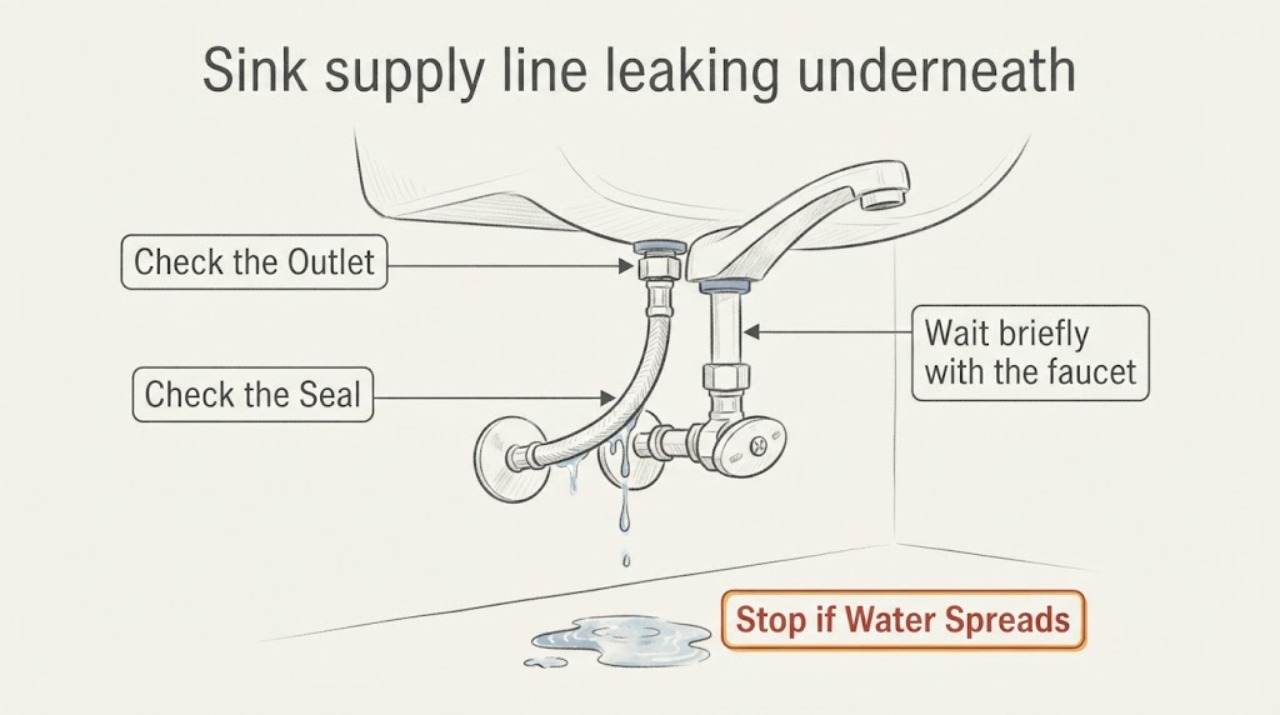
If an American Standard sink supply line is leaking underneath, first protect the cabinet and identify the first wet point with the faucet off. A continuous drip at a shutoff, braided tube, compression connection, or faucet inlet is a pressurized supply leak; water that appears only while the faucet or sink drain is used may instead come from a hose, faucet body, drain, or trap. Close the affected local shutoff gently if it operates normally, open the faucet briefly to relieve pressure, and do not remove a line under pressure. American Standard's product information shows that supply-line length and connection style vary by faucet model, so do not order a generic hose from appearance alone. Arrange plumbing service when a valve will not stop the water, a hose is split, the source is hidden, water reaches electrical equipment, or the cabinet or wall is damaged.
Before you begin
Safety first
- A qualified plumber should replace or repair pressurized supply connections, seized shutoffs, concealed piping, damaged drain fittings, and any connection that cannot be safely identified or isolated.
Work through in order
Diagnostic checks
Use only checks that match the exact appliance or system and its official guide.
-
Check 1
Move items out of the cabinet, place a container or towel under the suspected line, and stop using the sink if water is spraying, the cabinet floor is collapsing, or water is near an outlet, disposal wiring, dishwasher connection, or powered equipment.
Expected result: The leak is a small isolated drip away from electricity, or it is pressurized, spreading, near electrical equipment, or damaging the cabinet or wall.
Next step: For spreading water or electrical exposure, keep away from the wet equipment, isolate water at the safest accessible upstream valve if possible, and arrange qualified plumbing/electrical help. Otherwise dry the area before tracing.
Why this matters
Why: A contained drip may allow a brief source-tracing check. Pressurized flow, electrical exposure, or structural damage can cause flooding, shock, or concealed-water damage.
-
Check 2
With the faucet off and the area dry, touch a dry tissue to each accessible shutoff valve, house supply tube, American Standard supply-line connection, faucet inlet, drain body, trap joint, and sink underside without tightening anything.
Expected result: The first wet point is a valve, house tube, faucet supply line, faucet inlet, drain/trap joint, sink underside, or no point becomes wet.
Next step: Mark the first wet point and whether the drip continues with the faucet untouched. If no point is wet, continue with one controlled use test rather than disassembling the cabinet.
Why this matters
Why: The first wet point is more useful than the lowest drip. A wet supply connection with the faucet off supports a pressurized supply leak; a wet drain joint needs a drain-side test instead.
-
Check 3
Wait briefly with the faucet and drain unused. If the local hot and cold shutoffs are clearly identified and turn normally, close the affected valve gently, then open the faucet briefly to check whether the flow is relieved; do not force a corroded stop.
Expected result: The drip continues with the faucet off, stops after the faucet shutoff closes, continues despite the shutoff, or the valve will not turn safely.
Next step: Leave a leaking or unreliable shutoff in the safest position and arrange plumbing service. Do not remove a supply line under pressure or turn a seized valve with tools.
Why this matters
Why: A continuing drip with no use supports a pressurized line or valve leak. Stopping after a faucet shutoff implicates the faucet-side supply; continued flow suggests the valve, house-side pipe, or another source.
-
Check 4
After the supply side is dry or isolated, run a small amount of water through the faucet without using a spray or pullout function, then repeat with the spray or pullout/pull-down function if fitted; stop at the first drip.
Expected result: The leak appears only during ordinary faucet flow, only when the spray or wand is used, at a hose or quick connection, around the faucet base, or not at the faucet.
Next step: Close the faucet and record the exact connection, faucet style, and model if known. Perform only a model-approved hand check; if the hose is split or the connection remains wet, close the shutoffs and arrange service.
Why this matters
Why: A use-related leak can come from a faucet hose, inlet, spray connection, faucet body, or base rather than the continuously pressurized house line. American Standard's model pages show that supply and hose arrangements vary.
-
Check 5
If the faucet-side test is dry, add a small controlled amount of water to the basin and watch the drain flange, tailpiece, P-trap, wall connection, and cabinet floor; do not run a disposal or reach into wet electrical equipment.
Expected result: The leak starts only while the basin drains, at the drain or trap, at a wall connection, or the drain test remains dry.
Next step: Stop using the sink if a drain or trap joint leaks and arrange plumbing service, especially for a corroded, moving, or hidden connection. Do not overtighten plastic fittings or use sealant as a substitute for repair.
Why this matters
Why: Moisture that begins during draining supports a drain-side gasket or joint leak, not a supply-line failure. A dry drain test keeps the faucet supply, shutoff, or concealed source in consideration.
-
Check 6
Record the leak frequency, first wet point, hot or cold side, hose and connection style, faucet model, shutoff behavior, and any cabinet or wall damage; photograph only dry external labels and fittings.
Expected result: The leak is steady, intermittent during use, tied to one hot/cold inlet, tied to a spray hose, associated with a valve, or impossible to localize.
Next step: Use the model information to locate the correct manufacturer instructions or give the record to a qualified plumber. Do not order a hose, compression fitting, valve, cartridge, or seal solely from a photo or generic description.
Why this matters
Why: Frequency, side, connection style, and model information narrow the likely supply-line or valve family. American Standard does not establish one supply-hose fit for every faucet.
Use your observations
Decision map
Find the observation that best matches what you see, then follow the next safe action.
-
PATH 01Next step
What you see
Water continues with the American Standard faucet untouched and is first wet at a supply hose, faucet inlet, shutoff valve, or house-side tube.
Do this next
Close the affected local shutoff if it operates normally, contain the drip, and arrange plumbing service. Do not remove the line or force the valve.
Why this path and its safety boundary
Why it matters: A pressurized supply or shutoff leak is more likely than a drain or faucet-use leak.
-
PATH 02Next step
What you see
The leak appears only while the faucet or spray wand is used and starts at a hose, quick connection, or faucet inlet.
Do this next
Stop using the faucet, close its shutoffs, and identify the exact American Standard model and connection style before any part is selected. Arrange service if the hose is damaged or the connection is not clearly serviceable.
Why this path and its safety boundary
Why it matters: A model-specific faucet hose or inlet connection is more likely than a continuously pressurized house-side line.
-
PATH 03Next step
What you see
The cabinet stays dry until water is poured into the basin or drained, and the first wet point is the drain body, P-trap, wall connection, or sink underside.
Do this next
Stop using the sink and arrange plumbing service for a leaking drain or trap, particularly when the joint is corroded, moving, concealed, or near electrical equipment.
Why this path and its safety boundary
Why it matters: A drain-side gasket, trap, flange, or branch connection is more likely than the American Standard supply line.
-
PATH 04Next step
What you see
Water runs down from the faucet deck, handle, spout, or spray head and appears underneath while the supply-line connections remain dry.
Do this next
Dry the deck and trace one controlled use event. Identify the American Standard model before considering a seal or hose, and arrange service if the leak continues.
Why this path and its safety boundary
Why it matters: An above-counter faucet body, base seal, spray hose, or wand connection is more likely than an under-sink supply-line leak.
-
PATH 05Next step
What you see
The leak cannot be stopped, a hose is split, a shutoff is seized or unreliable, water reaches electrical equipment or the cabinet structure, or the source is hidden.
Do this next
Keep people away from wet electrical equipment, isolate water at the safest accessible upstream valve, and arrange qualified plumbing/electrical service. Do not keep using the sink or open walls to search for the source.
Why this path and its safety boundary
Why it matters: Flooding, electrical, and concealed-water risks outweigh further tracing or part selection.
Helpful context
Understand the symptom
A wet cabinet does not identify the leaking line
Water can travel along a flexible tube, the sink underside, a drain tailpiece, or the cabinet wall before it drips. Dry the area, then use a dry tissue to find the first new wet point with the faucet off. A supply line leak can continue while the sink is unused because the line remains pressurized. If the cabinet stays dry until the faucet or drain is used, test those events separately instead of assuming the supply line is at fault.
Use shutoff behavior to separate supply from use-related leaks
A normal local shutoff under the sink should isolate its faucet inlet when closed, but old or seized valves may not close fully. Turn a valve only gently and verify by briefly opening the faucet; do not force it or remove a hose while pressure remains. If water continues with the faucet off and the local valve closed, the house-side supply, valve body, or another upstream source remains possible.
American Standard connections are model-dependent
American Standard product pages show that supply-line details differ by faucet. One model lists flexible supply lines with 3/8-inch compression connections, while the brand also lists separate supply-hose repair parts. Treat those details as identification clues, not universal specifications. Record the faucet model and the connection at both ends before considering a replacement.
Do not mistake a drain leak for a supply leak
If the cabinet is dry with the faucet off but becomes wet while water drains from the basin, inspect the drain body, sink flange, P-trap, and any dishwasher or disposal branch instead. A faucet-base or spray-hose leak can also run down from above the counter. Use one small, controlled event at a time and stop as soon as a drip appears.
Contain the leak and know when to stop
Keep a container under the first wet point and remove stored items so the cabinet can dry. A split hose, failed shutoff, hidden moisture, swollen cabinet floor, or water near electrical equipment needs qualified service. Do not rely on tape or caulk to repair a pressurized connection, and do not continue testing an active leak just to make the source more obvious.
Safety boundary
Stop conditions
- Shut off water at the safest accessible valve and arrange prompt plumbing service for a split supply line, uncontrollable flow, damaged cabinet or wall, or water near an outlet, disposal wiring, dishwasher connection, or powered equipment.
- Do not force a corroded shutoff, remove a pressurized supply hose, pull apart a model-specific quick connection, or rely on tape or caulk as a repair for a pressurized leak.
- Do not open electrical equipment, reach into wet wiring, open walls or flooring, or continue running water to reproduce an active leak.
- Arrange qualified service when the first wet point is hidden, the leak continues after a local shutoff is closed, the faucet model or connection style is unknown, or a replacement hose, valve, seal, or fitting cannot be verified for the exact installation.
- Stop and arrange service if a new drain or trap leak appears during testing, the cabinet floor is swelling, sewage or contaminated water is present, or the leak returns after a connection was disturbed.
Only after diagnosis
Potential parts
- American Standard faucet supply hose
Consider this only when tracing confirms the faucet-side supply hose is split, kinked, or leaking at its approved connection after the water is safely isolated; a house-side valve or pipe leak needs a different repair.
Match the exact American Standard faucet model, hose length, connector type, hot/cold routing, and installation instructions before ordering. - sink shutoff valve or supply fitting
Consider this only when a steady leak is confirmed at the shutoff body or its connection and the water can be isolated safely; do not substitute it for a faucet-hose diagnosis.
Match the existing pipe material, connection, valve orientation, and local plumbing requirements; a corroded or inaccessible valve should be handled by a qualified plumber. - sink drain or trap gasket
Consider this only when water appears during basin draining and the first wet point is a drain flange, trap, or branch joint rather than the American Standard supply line.
Match the sink, drain assembly, trap material and dimensions, and any dishwasher or disposal configuration; do not overtighten or use a sealant patch for an active leak.
When checks do not resolve it
Need a professional?
Use a plumber for a pressurized or recurring supply-line leak, a failed or seized shutoff, a concealed or structural leak, a damaged drain connection, or any situation involving water near electrical equipment.
Safety scope: A qualified plumber should replace or repair pressurized supply connections, seized shutoffs, concealed piping, damaged drain fittings, and any connection that cannot be safely identified or isolated.
Common questions
FAQ
How can I tell whether the American Standard supply line or the drain is leaking?
With the faucet off, a first wet point at a shutoff, supply tube, or faucet inlet supports a pressurized supply leak. If the cabinet stays dry until water is poured into and drained from the basin, inspect the drain body and P-trap instead.
Can I replace an American Standard sink supply hose with any hose that looks similar?
No. American Standard lists supply hoses as repair parts, and its product pages show that connection details vary by model. Confirm the exact faucet model, hose length, connector type, and installation instructions first.
Should I close both sink shutoff valves?
Close only the affected local valve if it is clearly identified and turns normally; then briefly open the faucet to verify whether pressure is relieved. If a valve is seized, unreliable, or the leak continues, use the safest accessible upstream valve and arrange service.
Why does the cabinet get wet only when I use the spray hose?
A spray or pullout hose, quick connection, faucet inlet, or above-deck faucet leak may appear only during that use. Stop the test at the first drip, close the shutoffs, and identify the model before selecting a hose or seal.
When should I stop tracing the leak myself?
Stop for a split hose, uncontrollable flow, a seized shutoff, hidden moisture, swollen cabinetry, sewage backup, a damaged drain connection, or water near electrical equipment. Those conditions need qualified plumbing or electrical service.
Read the exact guide
Official sources
- Safety and maintenance tipsCity of Minneapolis · Municipal sewer and drain safety guidance; local layouts and responsibilities vary
- Edgemere 1-Handle Pull-Out Kitchen FaucetAmerican Standard · Edgemere 1-handle pull-out kitchen faucet only; other American Standard models may use different supply lines or connections
- THIS WAY TO A BETTER HOMEU.S. Department of Housing and Urban Development · General residential maintenance guidance; fixture design and local plumbing requirements vary
- Faucet Supply HoseAmerican Standard · American Standard faucet supply hose product page; exact hose fit and connection depend on the faucet model
Community feedback
Share a repair observation
Share a plain-text repair observation. Accepted observations are published automatically; this page may take a moment to update.