
On this page
Start here
Quick answer
Stop using the Delta sink until you know where the water starts. Dry the underside, place a dry tissue or paper towel below the basket strainer, and add only a small amount of clean water to the sink while watching from a safe position. A leak that begins around the flange at the sink opening points toward the strainer seal or mounting area; a leak that begins at the drain connection or P-trap is a different repair. Delta's 72010 strainer is a model-specific kitchen-sink assembly with a top-mount flange and brass basket, and Delta warns on its drain guidance that a seal between a flange and sink can leak even when water appears to be draining normally. Do not force the locknut, rotate the flange, cut pipe, or dismantle a wet or corroded assembly. If the leak worsens, reaches electrical equipment, floods the cabinet, or cannot be localized safely, stop using the sink and arrange qualified plumbing service.
Before you begin
Safety first
- Keep the sink unused for flooding, wastewater, a cracked or corroded fitting, or water near electrical equipment. Close only an accessible dry fixture water stop for a worsening supply leak; do not dismantle the drain, force fittings, use heat, or run a disposal in a wet cabinet.
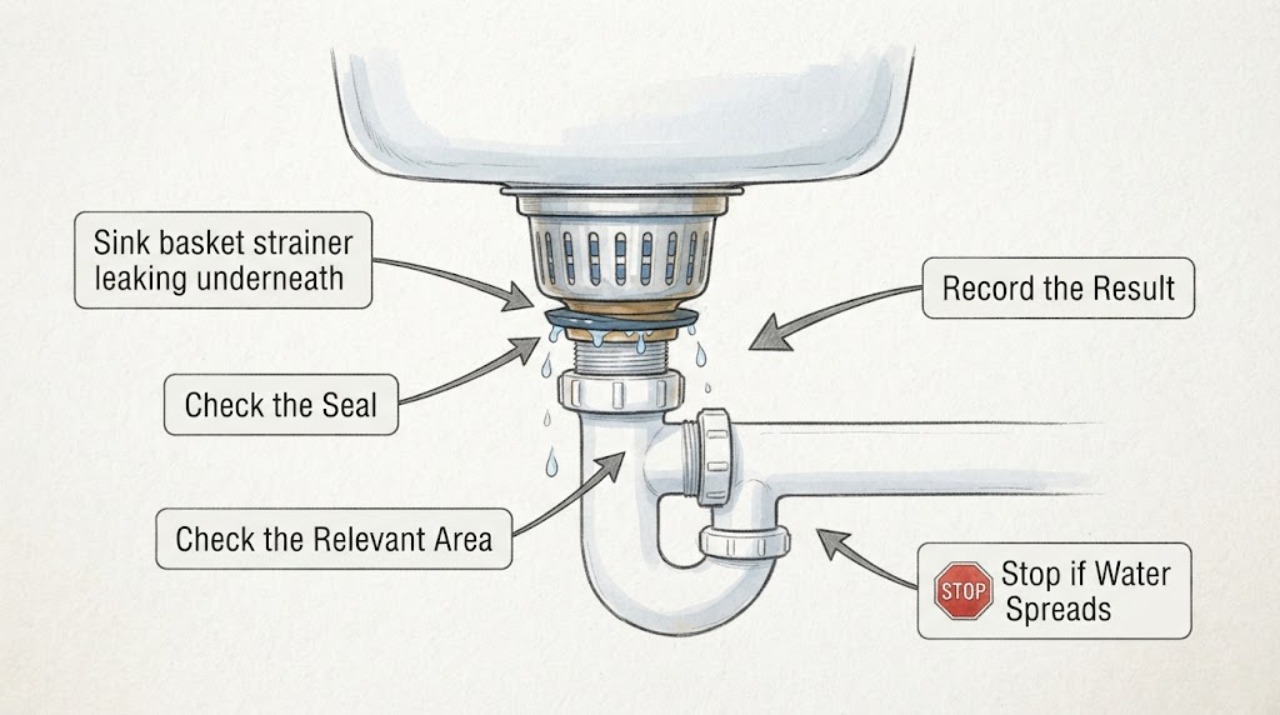
Work through in order
Diagnostic checks
Use only checks that match the exact appliance or system and its official guide.
-
Check 1
Stop using the sink, remove stored items from the cabinet, and dry the visible underside of the basket strainer, drain body, P-trap, faucet supply tubes, and cabinet base. Place a dry tissue or paper towel below each likely starting point without touching a corroded joint.
Expected result: Record whether the first wet spot appears directly below the strainer flange, at a drain or P-trap connection, on a faucet supply tube, or on the cabinet floor with no active fitting visible.
Next step: Keep the sink unused and photograph the wet point. Stop for a spray, rapidly spreading water, a cracked fitting, or water near electrical equipment and arrange prompt plumbing service.
Why this matters
Why: The first wet point is more useful than the largest puddle. A flange-area start makes the basket strainer seal or mounting area more likely; a P-trap or supply-tube start points away from the basket strainer.
-
Check 2
With the underside dry and no active flood, add only a small amount of clean water to the sink basin and watch the underside while the water stands briefly and then drains. Do not fill the basin, run a disposal, or repeat the test if any joint starts leaking quickly.
Expected result: Water appears while the basin is holding water, only as water drains through the basket, or at the P-trap or wall connection after the strainer area stays dry.
Next step: Stop the test after one controlled observation and record the timing. Have a plumber confirm the basket flange, drain connection, and trap path before any part is selected.
Why this matters
Why: A leak while the basin is holding water is more consistent with the strainer flange or basin seal. A leak only during drainage makes the drain body, connection, or P-trap path more relevant; the result does not prove which seal or fitting failed.
-
Check 3
Inspect the visible top of the Delta basket strainer and the sink surface around its flange for movement, a visible gap, cracked metal, missing seal material, sink damage, or debris preventing the flange from sitting evenly. Do not pry the flange or turn the basket to test it.
Expected result: The flange edge looks evenly seated, a gap or movement is visible, the basket or flange is cracked, or the sink surface is chipped or rough around the opening.
Next step: Photograph the opening and keep the sink dry. Do not add putty, silicone, or a replacement seal over an unknown existing installation; arrange model-appropriate service for a suspected flange seal or sink-surface problem.
Why this matters
Why: A gap, movement, crack, or damaged sink surface can prevent a seal at the basket strainer. An evenly seated appearance does not rule out a hidden seal failure, especially when the leak begins only during use.
-
Check 4
Follow the visible drain path below the basket to the tailpiece, P-trap, and wall or disposal connection, looking for a drip trail, a loose-looking joint, corrosion, a crack, or a connection that moves. Keep hands and tools away from wet or stressed fittings.
Expected result: The strainer area stays dry while a lower connection drips, the P-trap is wet, the wall or disposal connection is wet, or no lower connection leaks during the small test.
Next step: Stop using the sink for any lower-joint leak, corrosion, crack, or movement and arrange service. Do not tighten by guesswork or remove a connection with standing water or wastewater.
Why this matters
Why: A lower connection or P-trap leak is a separate plumbing fault and may only appear while the sink drains. No lower leak increases suspicion of the basket flange or its seal but cannot confirm it.
-
Check 5
Check whether the water could be from a Delta faucet supply tube, shutoff connection, spray hose, or water spilled over the sink rim rather than the basket strainer. Use a dry cloth to trace only accessible surfaces; do not operate a suspected electrical disposal while the cabinet is wet.
Expected result: A supply tube or faucet connection wets first, water tracks from the sink rim, a disposal connection is wet, or all accessible supply and drain surfaces remain dry until the basket area is tested.
Next step: For a worsening supply leak, close the accessible fixture water stops only from a dry, safe position and keep the sink unused; remember that faucet stops do not isolate a drain leak. Arrange service for any disposal, supply, or drain connection leak.
Why this matters
Why: A supply or rim leak can run along the cabinet and imitate a strainer leak. A disposal or drain-path leak may be downstream of the basket. A basket-origin pattern remains provisional until the flange and lower fittings are inspected by a professional.
-
Check 6
Record the complete Delta model or product marking, sink type, whether a disposal is attached, the exact point and timing of the leak, and whether the leak appears with standing water, draining water, or both. Take photos before moving any hardware.
Expected result: The model is clear or unknown; the leak is at the flange, lower drain, P-trap, supply, or rim; and the leak is intermittent, continuous, or worsening.
Next step: Keep the sink unused and provide the record to qualified plumbing service. Do not buy a basket strainer, P-trap kit, or supply line until the leak source and model fit are confirmed.
Why this matters
Why: A model and timing record helps a plumber distinguish a basket strainer seal, sink opening, drain connection, P-trap, or supply-line problem. Similar-looking Delta strainers and generic seals are not proof of compatibility.
Use your observations
Decision map
Find the observation that best matches what you see, then follow the next safe action.
-
PATH 01Next step
What you see
The first wet point is directly below the Delta basket flange, and water appears while the basin holds water or drains through the strainer while lower joints stay dry.
Do this next
Keep the sink unused and have a plumber confirm the flange, seal, sink opening, and model-specific strainer assembly. Do not rotate or force the flange or add sealant over the existing assembly.
Why this path and its safety boundary
Why it matters: A basket strainer flange seal or mounting-area problem is more likely than a P-trap or faucet supply leak.
-
PATH 02Next step
What you see
The strainer area remains dry but a tailpiece, P-trap, wall, or disposal connection drips only while water drains.
Do this next
Stop using the sink and arrange plumbing service for the affected connection. Do not tighten a corroded or wet joint by guesswork or remove it with wastewater present.
Why this path and its safety boundary
Why it matters: A lower drain-path or trap connection is more likely than a leaking basket flange.
-
PATH 03Next step
What you see
A Delta faucet supply tube, shutoff connection, or sink rim wets before the basket area, or water tracks from above the cabinet.
Do this next
If a supply leak worsens, close the accessible fixture water stops from a dry safe position, keep the cabinet clear, and arrange service. Faucet stops do not stop a drain or basket leak.
Why this path and its safety boundary
Why it matters: The leak is more likely in the faucet supply or sink edge, not the basket strainer itself.
-
PATH 04Next step
What you see
The basket or flange is cracked, moves at the sink opening, the sink surface is damaged, or the leak continues after a previous seal repair.
Do this next
Keep the sink unused and request model-specific inspection of the basket strainer, flange seal, sink opening, and drain connection. Do not force the mounting hardware or layer new sealant over an unknown repair.
Why this path and its safety boundary
Why it matters: A damaged or incorrectly sealed assembly is more likely, and repeated tightening can worsen the sink or drain connection.
-
PATH 05Next step
What you see
Water spreads rapidly, reaches electrical equipment or a disposal, the cabinet is flooding, wastewater is present, or the leak source cannot be localized safely.
Do this next
Stop using the sink, keep clear of wet electrical equipment, close an accessible fixture water stop only if dry and safe for a worsening supply leak, and obtain prompt qualified plumbing service. Do not restart a disposal or dismantle the drain.
Why this path and its safety boundary
Why it matters: Further testing risks water damage, shock, contamination, or a larger fitting failure.
Helpful context
Understand the symptom
The leak's starting point matters
Water under a sink may come from the basket strainer flange at the sink opening, the drain connection below it, a P-trap joint, a faucet supply tube, or water spilled from the basin. A wet P-trap does not prove the strainer is leaking. Drying the area and observing a small, controlled drain event can separate these paths without turning a minor seep into cabinet damage.
Delta strainers are model-specific assemblies
Delta's 72010 product page describes a kitchen-sink flange and strainer with a top-mount flange and brass basket. Delta's drain guidance also shows that a flange seal can leak into the drain assembly even when water does not fall onto the cabinet floor. Use the installed model, sink opening, and visible hardware to identify the assembly; do not assume a generic basket, seal, or mounting hardware fits.
Observation before disassembly
This check stays at the fixture-observation level. Do not loosen a locknut, rotate a flange, pull a stuck basket, cut a drain, or open a corroded connection. Drain leaks can continue even after faucet supply stops are closed, so stop using the sink and protect the cabinet while service is arranged.
Safety boundary
Stop conditions
- Stop using the sink for a rapidly spreading leak, cabinet flooding, wastewater, a cracked or corroded fitting, water near electrical equipment or a disposal, or a leak that cannot be localized safely.
- Do not rotate or force the Delta basket strainer, flange, locknut, P-trap, disposal connection, or wall connection; do not cut pipe, use heat, or layer new sealant over an unknown installation.
- For a worsening faucet supply leak, close an accessible fixture water stop only from a dry and safe position. Remember that faucet stops do not isolate a basket-strainer or drain leak.
- Do not run a disposal or perform tool work in a wet cabinet. Keep children and pets away from standing or contaminated water and arrange qualified service.
Only after diagnosis
Potential parts
- p-trap kit
Consider this only if diagnosis confirms that the leak starts at a damaged or corroded P-trap or its connections rather than at the basket strainer flange.
Match drain size, material, trap layout, disposal or wall connection, cabinet clearance, and local requirements. Confirm the exact installation before selecting a kit. - faucet supply line
Consider this only if observation or qualified inspection shows that a Delta faucet supply line or its connection wets before the basket strainer.
Supply lines vary by faucet model, connection, length, and installation. Confirm the faucet model and leak diagnosis before selecting one. - sink basket strainer
Consider this only when diagnosis confirms a cracked or failed basket-strainer flange or seal and the exact Delta assembly is identified.
Confirm sink opening, flange, mounting hardware, drain or disposal arrangement, and complete Delta model before selecting a replacement; appearance alone is not enough.
When checks do not resolve it
Need a professional?
Call a plumber for a Delta basket-strainer leak that is continuous, recurring, worsening, model-uncertain, associated with a damaged sink opening, or accompanied by a lower drain, P-trap, disposal, or supply connection leak.
Safety scope: Keep the sink unused for flooding, wastewater, a cracked or corroded fitting, or water near electrical equipment. Close only an accessible dry fixture water stop for a worsening supply leak; do not dismantle the drain, force fittings, use heat, or run a disposal in a wet cabinet.
Have this ready
- Provide the Delta model or product marking, sink type, disposal status, photos of the top flange and underside, first wet point, timing during standing or draining water, cabinet condition, prior seal work, and whether the leak is clean or contaminated.
Common questions
FAQ
How do I tell if the Delta basket strainer is leaking?
Dry the underside and observe a small amount of clean water. If the first wet point is directly below the flange while lower drain joints stay dry, the basket seal or mounting area is more likely. A plumber should confirm it before disassembly.
Why does water leak underneath only when the sink drains?
A drain connection, P-trap, disposal connection, or basket assembly may leak only while water is moving. Trace the first wet point rather than assuming the largest puddle identifies the source.
Can I tighten the Delta basket strainer locknut?
Do not tighten it by guesswork, especially when the fitting is wet, corroded, moving, or connected to a fragile sink. Excessive force or flange rotation can worsen a seal; arrange model-appropriate plumbing service.
Will closing the faucet shutoff stop a basket-strainer leak?
No. Faucet supply stops can limit water from the faucet, but they do not isolate a drain or basket-strainer leak. Stop using the sink and protect the cabinet while service is arranged.
Could the P-trap be leaking instead of the Delta strainer?
Yes. A P-trap or lower drain connection may drip only when water drains. Dry the area and observe the first wet point; do not loosen a wet, corroded, or wastewater-filled connection.
Do all Delta sink basket strainers use the same replacement seal?
Do not assume that. Delta assemblies vary by model, sink opening, flange, and drain or disposal arrangement. Confirm the complete model and diagnosis before selecting a strainer or seal.
When is an under-sink leak urgent?
Stop immediately for flooding, wastewater, a rapidly worsening leak, a cracked or corroded fitting, water near electrical equipment or a disposal, or any situation you cannot inspect safely. Arrange prompt qualified plumbing service.
Read the exact guide
Official sources
- Why doesn't my pop-up sink stopper stop the water from draining?Delta Faucet Company · Delta sink drain flange-seal leak diagnosis and model-specific drain assembly cautions
- Kitchen Sink Flange & Strainer in Chrome 72010Delta Faucet Company · Delta kitchen sink basket-strainer assembly, flange, basket, and model-specific product features
- Delta Faucet Support and Parts ResourcesDelta Faucet Company · Delta sink-faucet support, product identification, and parts resources
- Sewer Smarts and Plumbing BasicsCity of Superior, Wisconsin · Household sink drain arrangement, P-trap location, and distinction between fixture and downstream plumbing
Community feedback
Share a repair observation
Share a plain-text repair observation. Accepted observations are published automatically; this page may take a moment to update.