
On this page
Start here
Quick answer
If an American Standard toilet fill valve keeps running, first determine whether water is entering the tank continuously, spilling into the overflow tube, or leaking from the tank through the flush seal. Close the toilet supply valve if the bowl is rising or the valve will not shut off. With the tank lid removed and the water level safe, check that the float moves freely and that the refill tube is not interfering with the valve or overflow. If the valve matches American Standard's removable water-control design, shut off the supply and use the manufacturer's debris-clearing sequence; do not remove an unfamiliar valve cap. Reopen the supply slowly and test one cycle. Continued flow, a leaking supply, a damaged tank or flush valve, or a valve that cannot be identified needs a plumber.
Work through in order
Diagnostic checks
Use only checks that match the exact appliance or system and its official guide.
-
Check 1
Remove the tank lid and watch the water path without touching the moving parts: into the tank through the fill valve, down the overflow tube, or from the tank through the flush seal.
Expected result: Water enters continuously through the fill valve, reaches the overflow tube, or the fill valve stops while water still enters the bowl.
Next step: Use the fill-valve checks for inlet flow; use the flush-seal branch when the valve stops but the bowl continues to receive water. Close the supply if the level rises toward the overflow.
Stop if: Stop immediately for an overflow, water on the floor, or a supply valve that will not close.
Why this matters
Why: Continuous inlet flow points to the fill valve or float. Water at the overflow indicates the tank level is not being controlled. Flow into the bowl after inlet flow stops points more toward a flush seal or flapper leak.
-
Check 2
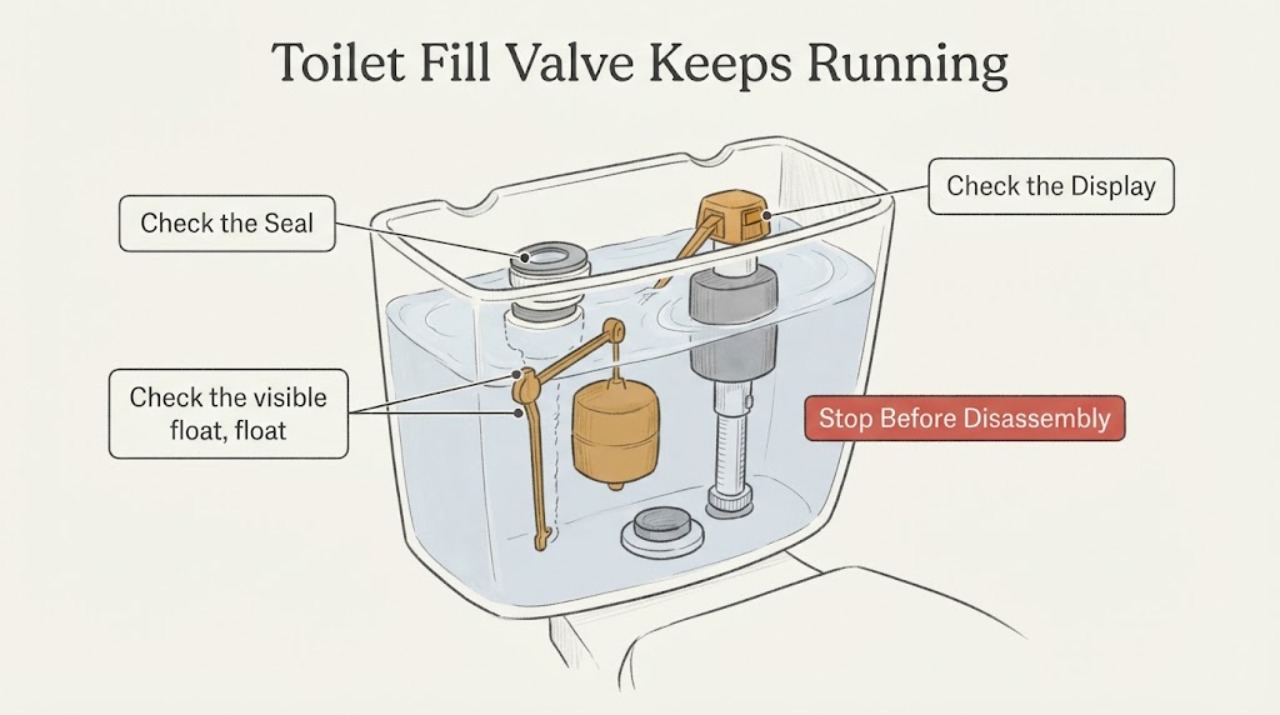
Check the visible float, float rod or arm, refill tube, and overflow tube for rubbing, tangles, or a tube that is not held in its intended position.
Expected result: The float touches the tank wall, the arm binds, the refill tube interferes with movement, or all visible parts move freely.
Next step: Correct only an obvious external tangle or contact without bending the rod or moving a secured fitting. If the visible arrangement is normal, continue to the model-specific debris check.
Stop if: Stop if the float, tank wall, overflow tube, or valve body is cracked or if correcting the position would stress a connection.
Why this matters
Why: A mechanical obstruction can prevent the water-control valve from reaching its shutoff position. Free movement makes debris inside the valve or a worn valve more likely.
-
Check 3
Close the toilet supply valve and flush once to lower the tank before inspecting the water-control top; keep a small container and cloth ready for residual water.
Expected result: The supply closes and the tank lowers, the valve continues to admit water, or the valve cannot be shut off.
Next step: Proceed only when the supply is off and the valve design is identifiable. If the shutoff fails, use the home shutoff only if safely accessible and arrange service.
Stop if: Stop if the fixture shutoff leaks, will not turn, or water continues under pressure.
Why this matters
Why: A successful shutoff creates a controlled condition for debris service. Water that does not stop or a seized shutoff means the valve is not safe to open.
-
Check 4
If the cap and arm match the American Standard water-control design, lift the arm, rotate the top as directed, cover the uncapped valve with the container, and briefly pulse the supply on and off to clear loose debris.
Expected result: Debris or scale is expelled, the water path clears, the top does not match the guide, or the valve body leaks while open.
Next step: Leave the supply off until the top is correctly reinstalled; use the toilet model instructions for any other design. Do not probe the valve with a sharp object or leave it uncapped.
Stop if: Stop if the top will not release as described, the valve body cracks, or water cannot be controlled.
Why this matters
Why: Material at the valve inlet can keep the shutoff from seating. A different cap design or a leak means the published sequence does not apply safely.
-
Check 5
Reinstall the water-control top only as the matching model guide directs, open the supply slowly, and watch the tank level until the valve stops.
Expected result: The valve shuts off at its normal level, still trickles after shutoff, runs into the overflow, or leaks around the top.
Next step: Close the supply again if the valve runs, overfills, or leaks. Use the exact model parts information before considering a replacement water control.
Stop if: Stop if the tank level is uncontrolled, the top leaks, or the shutoff cannot contain the flow.
Why this matters
Why: A stable stop after cleaning supports a debris restriction. A continuing trickle can indicate a worn seal or unresolved debris; overflow or an external leak indicates a control or installation fault.
-
Check 6
After the valve appears to stop, observe one complete flush and refill while looking at the overflow tube and bowl, then wait for the refill to end.
Expected result: The tank fills and stops, the bowl receives a small refill stream that never ends, the tank water falls between flushes, or the toilet runs again soon after stopping.
Next step: Use the flush-seal branch when the tank loses water; use the fill-valve parts branch when the inlet itself continues to run. Arrange service for a concealed or damaged valve.
Stop if: Stop after one failed cycle if the bowl rises, the tank overflows, water appears outside the toilet, or the run-on returns without a clear adjustment.
Why this matters
Why: A complete stop supports a corrected fill valve. A bowl stream or falling tank level after fill-valve shutoff points to the flush seal or flapper. Repeated run-on after a clean valve suggests a worn water-control part or another model-specific fault.
Use your observations
Decision map
Find the observation that best matches what you see, then follow the next safe action.
-
PATH 01Next step
What you see
Do this next
Use the American Standard debris sequence only if the valve matches it. If the trickle returns, identify the exact model and replace the water control conditionally or call a plumber.
-
PATH 02Next step
What you see
Do this next
Inspect the flush seal and flapper for a chain obstruction or damage, then use the model-based parts guide. Do not replace the fill valve first.
-
PATH 03Next step
What you see
Do this next
Correct only a plainly visible obstruction without bending parts. If the movement remains abnormal, arrange service for adjustment or replacement.
-
PATH 04Next step
What you see
Do this next
Stop user repair, use the home shutoff only if safely accessible, and contact a plumber with the toilet model and observed water path.
Helpful context
Understand the symptom
What continuous running tells you
A fill valve is supposed to stop adding water when the tank reaches its normal level. If water continues into the tank, the float or valve may be dirty, misadjusted, obstructed, or worn. If the valve stops but water still moves from the tank into the bowl, the flush seal or flapper is a different lead. Watch the path before replacing a part.
Use the correct American Standard procedure
American Standard publishes a debris-clearing sequence for a water-control design with a removable top. The guide is not a universal instruction for every fill valve. Confirm the toilet model and stop if the cap, float, or water-control body does not match the guide.
Control overflow first
A running toilet can waste water and a failed shutoff can allow an overflow. Close the fixture supply when possible, keep the tank and floor dry, and do not open a pressurized connection. A plumber should handle a leaking or seized valve and any hidden tank or supply fault.
Safety boundary
Stop conditions
- Stop and close the supply when water reaches the overflow tube, the bowl rises, or water appears on the floor.
- Stop if the fixture shutoff will not close, leaks, or requires force; do not open the fill valve under pressure.
- Stop if the water-control cap does not match the American Standard guide, the valve body or tank is cracked, or a fitting must be disconnected.
- Stop and arrange plumbing service when the toilet runs after the model-specific check, the flush seal is damaged, or the source of water movement is unclear.
Only after diagnosis
Potential parts
- toilet water-control or fill valve
Consider this only when the float moves freely, the visible setup is correct, the matching debris procedure does not restore shutoff, and the inlet continues to run or trickle.
Confirm the exact toilet model and water-control design from American Standard documentation before selecting a replacement. - water-control debris or plunger repair kit
Consider this only when the model documentation identifies a serviceable water-control top or repair kit and the valve behavior matches an internal debris or seal problem.
American Standard notes that repair-kit availability depends on the model; do not infer fit from the valve's color or shape. - toilet flapper or flush seal
Consider this only when the fill valve shuts off but the tank loses water into the bowl and the flush seal is visibly worn, obstructed, or damaged.
Match the toilet model and flush-valve design; a fill-valve symptom alone does not justify this part.
When checks do not resolve it
Need a professional?
Call a plumber when the fill valve still runs after the matching debris procedure, the shutoff or water-control body leaks, the tank or flush valve is damaged, the toilet uses an unfamiliar design, or water continues into the bowl from a concealed flush-seal fault.
Common questions
FAQ
Why does an American Standard toilet fill valve keep running?
The float may be obstructed, debris may keep the water-control valve from seating, or the tank may be losing water through the flush seal and making the valve refill. Watch where the water moves before choosing a part.
What should I do if the tank is filling into the overflow tube?
Close the toilet supply valve and stop flushing. Inspect only visible float movement and use a model-matched debris procedure; call a plumber if the valve will not close or the overflow continues.
Can I clean an American Standard fill valve myself?
Only when the valve matches the manufacturer's removable-top guide and the supply is fully off. Follow the model sequence, keep the valve covered during the controlled rinse, and stop if the cap or body does not match.
How can I tell if the flapper is causing the toilet to run?
If the fill valve stops but the tank level falls and water still enters the bowl, the flush seal or flapper is the stronger lead. A fill valve that never stops adding water is a different path.
When should I call a plumber for a running toilet?
Call when the supply cannot be shut off, water reaches the overflow or floor, the tank or valve is damaged, the model is unclear, or running returns after the safe model-specific checks.
Read the exact guide
Official sources
- How To Clean The Toilet Water Control Valve Of DebrisAmerican Standard · Official American Standard guide for a matching water-control design; its cap-removal and rinse sequence is not universal to every fill valve.
- DynaCleanAmerican Standard · Official American Standard description of a self-cleaning refill-orifice feature on specific Ultima diaphragm flush valves; not a claim about the assigned toilet model.
- SupportAmerican Standard · Official American Standard support page with a toilet parts service guide and product support resources.
- GlossaryAmerican Standard · Official American Standard glossary used to distinguish the water-control inlet from the flush valve, flapper, refill tube, and overflow path.
Community feedback
Share a repair observation
Share a plain-text repair observation. Accepted observations are published automatically; this page may take a moment to update.