
On this page
Start here
Quick answer
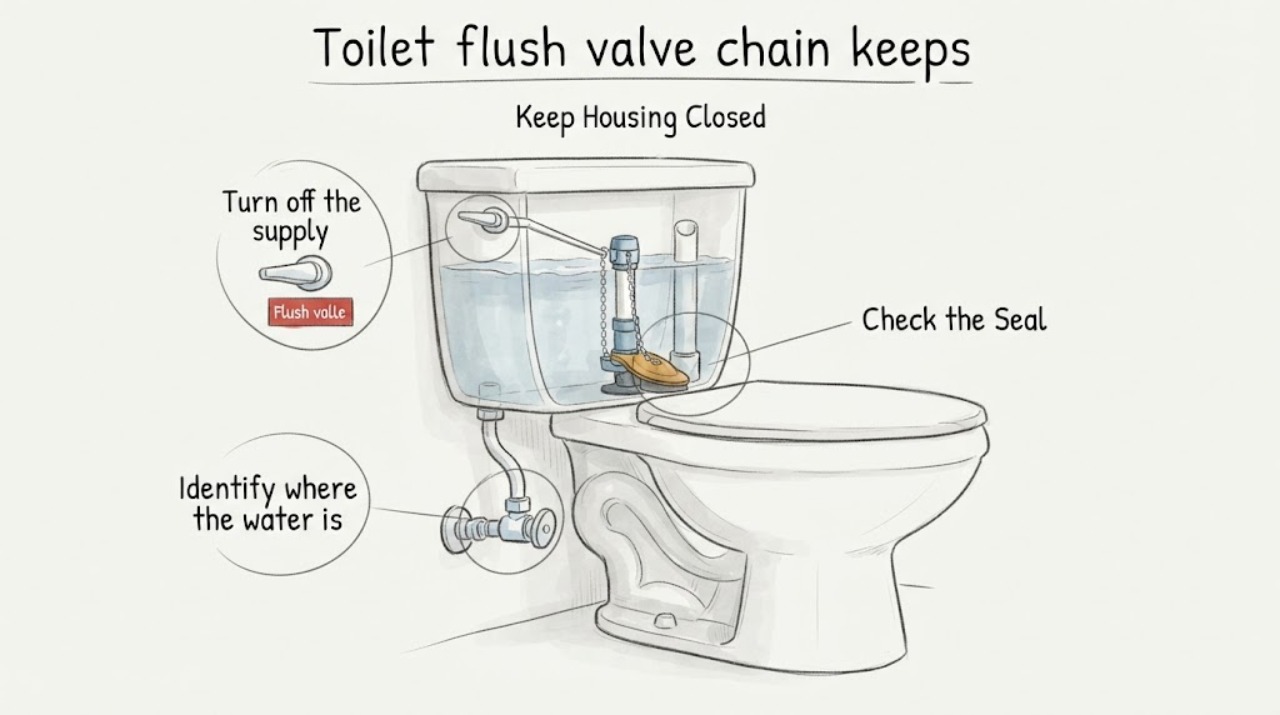
When an American Standard toilet with a flush valve chain keeps running, first identify whether water is continuously entering the bowl or only refilling into the overflow. A chain that is tangled, too tight, caught under the trip lever, or holding the flapper open can prevent the flush valve from reseating; a worn or dirty flapper seal can leak even when the chain moves freely. Turn off the water supply before inspecting the tank, make sure the chain and lever move without holding the valve open, and use the exact American Standard model instructions for adjustment. If the flapper will not seal, the water level reaches the overflow, the lever or valve is damaged, or the toilet still runs after the chain is free, arrange plumbing service rather than forcing the mechanism.
Work through in order
Diagnostic checks
Use only checks that match the exact appliance or system and its official guide.
-
Identify where the water is going
With the lid in place unless you need a brief visual check, observe whether water is a continuous stream into the bowl, a quiet refill that stops, a periodic refill, or water rising toward the overflow inside the tank. Note whether the fixture has a household tank and chain or a tankless commercial flushometer.
Expected result: Water runs into the bowl continuously; the tank refills periodically; the water reaches the overflow; or the fixture has no tank chain.
Next step: Use the matching branch below and record the toilet model before changing any adjustment.
Stop if: Do not reach into a tankless flushometer or remove a flush-valve cover to investigate a running condition.
Why this matters
Why: Continuous bowl flow favors a flush valve or flapper seal held open or leaking. Periodic refilling also indicates tank water loss. Water at the overflow shifts attention to the water-control or float setting, while a tankless valve requires a different service path.
-
Turn off the supply and inspect the chain path
Turn off the toilet's water supply, remove the tank lid, and look at the flush valve chain without pulling it. Check whether the chain is tangled, caught under the tank lid or lever, attached to the wrong hole, or so tight that it pulls the flapper or valve open when the handle is released.
Expected result: The chain is taut, tangled, caught, detached, or pulling the valve open; or it hangs freely with the lever at rest.
Next step: Remove only an accessible obstruction and reconnect the chain according to the exact American Standard model instructions. Leave the supply off if the chain cannot release the valve or a linkage is damaged.
Stop if: Do not bend the trip lever, force a valve arm, or invent a chain length or attachment point from another toilet model.
Why this matters
Why: A chain or linkage that remains under tension can hold the flush valve open and make the toilet keep running. Free chain movement makes a seal, seat, water-control, or valve-body issue more likely.
-
Check whether the flapper or flush-valve seal reseats
With the supply still off, inspect the visible flapper or flush-valve seal and its seat for displacement, mineral debris, cracks, warping, or a chain hook that prevents full closure. Do not pry the seal or remove an assembly unless the model-specific American Standard instructions cover that procedure.
Expected result: The seal is visibly damaged or displaced; debris is visible at the seat; the chain is free but the seal does not sit evenly; or the seal appears intact and seated.
Next step: Clean only accessible debris using the model guidance. For a damaged seal, use the full model number to identify a conditional seal or flush-valve repair; do not assume a universal part fits.
Stop if: Do not scrape a sealing surface with a sharp tool, use chemical cleaners in the tank, or dismantle a valve under pressure.
Why this matters
Why: A damaged, displaced, or obstructed seal can let tank water enter the bowl even when the chain is no longer pulling. An intact, even seal shifts the diagnosis toward water level, the trip lever, the valve body, or a model-specific adjustment.
-
Confirm the trip lever returns and releases the chain
With the supply off, move the tank handle or trip lever only through its normal travel and watch the hook, rod, and chain. Compare the resting position with the model instructions; on applicable VorMax designs, the American Standard procedure calls for the hook to engage under the valve-body tab and for the flapper to reach its frame stop.
Expected result: The lever sticks, does not return, the hook misses its engagement point, the rod is bent, or the linkage returns freely without lifting the valve.
Next step: Apply only the model-documented adjustment. If the lever, hook, rod, or valve body is bent or broken, keep the supply off and arrange plumbing repair.
Stop if: Do not force the handle, enlarge a mounting hole, or substitute a lever or chain without confirming model compatibility.
Why this matters
Why: A sticking or mis-engaged lever can maintain lift on the flush valve after the flush. Free return with no residual lift makes the seal or water-control path more likely.
-
Check the tank water-control clue
After the chain and seal checks, use the model instructions to observe the tank's normal water level as it refills. Look for water entering the overflow or a refill that does not stop; do not adjust a float or water control while the supply is open unless the model instructions explicitly make that a user adjustment.
Expected result: Water reaches the overflow, the water control continues filling, the level stops normally, or the bowl still receives water after the tank level stops.
Next step: Follow the model manual for a permitted water-control adjustment. If filling does not stop or the bowl continues to receive water, arrange service and leave the supply off when practical.
Stop if: Do not bypass the water control, block the overflow, or alter internal plumbing to hide the running sound.
Why this matters
Why: Overflow or continuous filling points toward water-control or float regulation rather than a chain alone. A normal tank level with bowl flow points back to the flapper or flush-valve seal and its linkage.
-
Restore water and verify one complete release
Once an accessible obstruction is corrected and the model guidance permits restoring water, open the supply slowly and watch one normal flush cycle. Confirm the lever returns, the chain releases, the valve closes, the refill stops, and the bowl no longer receives a steady stream.
Expected result: The valve closes and the running stops; the chain remains under tension; the bowl still receives water; or the tank refill continues.
Next step: If the condition remains, turn the supply off again and use the corresponding service branch. Do not repeat flushes indefinitely while water is being wasted.
Stop if: Do not keep operating a toilet that cannot shut off, leaks at the tank, or has a broken linkage.
Why this matters
Why: A quiet completed cycle supports a chain or linkage obstruction as the cause. Continued bowl flow indicates a seal or valve problem, while continued filling indicates the water-control path.
-
Escalate a persistent run-on condition
If the chain is free, the lever returns, the seal appears seated, and the toilet still runs, stop repeated adjustments. Record the full American Standard model, whether water enters the bowl or overflow, the chain and seal observations, and any visible damage for a qualified plumber.
Expected result: The running stops after a safe linkage correction; the seal or valve is damaged; water control will not stop; or the same symptom returns after a temporary improvement.
Next step: Keep the supply off when practical and arrange plumbing service. Provide the model, symptom location, photos, and which checks changed the behavior.
Stop if: Do not remove internal valve parts, solder or alter supply piping, or service a commercial flushometer without the proper instructions and training.
Why this matters
Why: A recurrence or a damaged seal, valve body, lever, or water control indicates a component or model-specific fault that cannot be identified reliably from chain tension alone. A commercial tankless valve may have a different run-on mechanism.
Use your observations
Decision map
Find the observation that best matches what you see, then follow the next safe action.
-
PATH 01Next step
What you see
The toilet has a tank chain, the chain is taut, tangled, caught, or attached so the flapper or flush valve remains lifted after the handle returns.
Do this next
Turn off the supply, remove the accessible obstruction, and restore only the chain arrangement shown for the exact American Standard model. Verify one complete release cycle.
Why this path and its safety boundary
Why it matters: A linkage or trip-lever release problem is more likely than a failed seal.
-
PATH 02Next step
What you see
The chain hangs freely and the lever returns, but water continues into the bowl or the tank periodically refills.
Do this next
Keep the supply off while checking only accessible seal seating and use the exact model instructions for a conditional seal or valve repair. Call a plumber if the seat or valve body is damaged.
Why this path and its safety boundary
Why it matters: A flapper or flush-valve seal is not closing or is damaged; chain adjustment alone is unlikely to solve it.
-
PATH 03Next step
What you see
The chain and seal do not hold the valve open, but the tank keeps filling or water reaches the overflow.
Do this next
Follow the model manual for any permitted water-control adjustment. If filling does not stop, shut off the supply and arrange plumbing service.
Why this path and its safety boundary
Why it matters: Water-control or float regulation is more likely than a flush valve chain fault.
-
PATH 04Next step
What you see
The trip lever sticks, the hook or rod is bent, the flush valve does not reach its stop, or the chain cannot be attached without force.
Do this next
Do not force the mechanism. Keep the water off and arrange model-specific plumbing repair, with the model number and a photograph of the linkage.
Why this path and its safety boundary
Why it matters: A damaged or misaligned linkage or valve assembly is preventing reliable closure.
-
PATH 05Next step
What you see
The fixture has no tank chain and uses an American Standard piston or diaphragm flushometer, yet water continues after a flush.
Do this next
Do not open the flushometer as a tank repair. Identify the valve model and arrange qualified commercial plumbing service using its installation and repair documentation.
Why this path and its safety boundary
Why it matters: This is a different valve family; American Standard identifies refill-orifice debris or mineral buildup as one possible run-on mechanism for Ultima diaphragm valves.
Helpful context
Understand the symptom
First separate a chain problem from a refill problem
Look in the bowl and listen at the tank. A steady stream into the bowl points toward a flapper or flush-valve seal that is not closing, often because the chain or trip lever holds it open. A tank that refills periodically may be losing water through the seal, while water that rises into the overflow points toward the water-control or float setting instead. American Standard defines the flapper as the tank seal and the trip lever as the part that actuates the flush valve, so do not adjust the chain without checking what the water is doing.
A chain should release the valve after the handle returns
A chain caught on the tank hardware, a lever that does not return, or an adjustment that leaves the chain pulling upward can keep a flapper from seating. American Standard's VorMax instructions show the trip-lever hook engaging the valve body and describe a model-specific adjustment so the flapper reaches its stop. The exact linkage differs by toilet family; use the model manual rather than copying a setting from another American Standard design.
If the chain moves but water still leaks, inspect the seal path
A chain can move normally while a flapper or flush-valve seal remains worn, displaced, or contaminated. American Standard's Champion instructions use the symptom of continuous running to direct attention to the flush-valve seal and show the chain being detached and reattached during a model-specific seal procedure. Do not order a seal by appearance alone: toilet families and valve designs differ.
Commercial flushometers are a different mechanism
Some American Standard commercial toilets use piston or diaphragm flush valves rather than a household tank flapper and chain. American Standard says run-on in that valve family can involve debris or mineral buildup at the refill orifice. If the fixture has no tank chain, do not apply tank-flapper instructions; identify the valve style and use its installation or service documentation.
Safety boundary
Stop conditions
- Turn off the toilet water supply before inspecting or changing tank linkage, and keep it off if the valve will not close.
- Do not force a stuck handle, bend the trip lever, scrape a seal with a sharp tool, block the overflow, or use tank chemicals to solve a running condition.
- Arrange plumbing service for a torn or damaged seal, broken lever or valve, water that will not stop at the control, recurring run-on, or a leak at the tank or supply connection.
- Do not dismantle a flushometer, alter supply piping, or work on internal valve parts without the exact model documentation and appropriate training.
Only after diagnosis
Potential parts
- flush valve chain or trip lever linkage
Consider this category only when the chain, hook, rod, or trip lever is broken, bent, detached, or cannot release the flush valve after the exact model check.
Confirm the complete American Standard toilet model and linkage design before ordering; chain and lever arrangements vary by toilet family. - flapper or flush-valve seal
Consider this category only when the chain and lever release normally but the seal is damaged, displaced, or still allows water into the bowl.
Verify the exact American Standard model and flush-valve design before selecting a seal; do not assume a Champion, VorMax, or other family part fits. - toilet water-control or fill-valve assembly
Consider this category only when the tank continues filling or water reaches the overflow after the flush valve chain and seal are released.
Confirm the model and water-control configuration before ordering; the overflow symptom alone does not identify a compatible part.
When checks do not resolve it
Need a professional?
Arrange qualified plumbing service when the chain is free but the bowl still receives water, the flapper or flush-valve seal is damaged, the trip lever or valve body is bent, the tank water control will not stop, the symptom returns after a temporary chain correction, or the fixture is a tankless commercial flushometer. Provide the full American Standard model, photographs, and whether water is entering the bowl or reaching the overflow.
Have this ready
- Provide the complete American Standard model, tank or tankless configuration, whether water enters the bowl or overflow, chain and lever position, seal condition, water-control behavior, photos, and which safe correction changed the symptom.
Common questions
FAQ
Can the flush valve chain make an American Standard toilet keep running?
Yes. If the chain is tangled, caught, detached incorrectly, or left under tension, it can keep the flapper or flush valve from closing. Turn off the supply, inspect the accessible linkage, and follow the exact American Standard model instructions for reconnecting or adjusting it.
What if the chain moves freely but water still runs into the bowl?
A flapper or flush-valve seal may be worn, displaced, or unable to seat. American Standard's Champion and VorMax guidance connects leaking or continuously running symptoms with seal inspection or replacement. Use the complete model number before selecting a seal, and arrange service if the seat or valve body is damaged.
Why does the tank keep filling even when the chain is not tight?
If water reaches the overflow or the refill never stops, the water-control or float path may be the issue rather than the chain. Follow the model manual for any permitted adjustment; shut off the supply and call a plumber if filling continues.
Do commercial American Standard flush valves use a chain and flapper?
Not necessarily. Commercial piston and diaphragm flushometers use a different mechanism. American Standard identifies refill-orifice debris or mineral buildup as one possible run-on cause for its Ultima diaphragm valves, so use the valve's model-specific service documentation instead of tank-chain instructions.
Read the exact guide
Official sources
- How To Replace The Flapper Float Ball On The Cadet ToiletAmerican Standard · American Standard Cadet toilet flapper, flush valve chain hook, trip lever arm, and model-specific replacement sequence
- How To Change The Silicone Seal On A VorMax ToiletAmerican Standard · American Standard VorMax leaking toilet, silicone flapper seal, chain, trip lever, and model-specific service steps
- How To Adjust Your VorMax Toilet Flush Valve SettingsAmerican Standard · American Standard VorMax toilet chain, trip-lever hook, flapper stop, water supply, and model-specific valve adjustment
- GlossaryAmerican Standard · American Standard definitions of flapper, flush valve, trip lever, water control, and related toilet components
- How To Replace The Accelerator Flush Valve Seal in Your Champion ToiletAmerican Standard · American Standard Champion toilet continuous running, flush-valve seal, chain, trip lever, and model-specific repair guidance
- Ultima Diaphragm Flush Valves from American Standard Aim to Stop Valve Run-On Before It StartsAmerican Standard · American Standard commercial diaphragm flushometer run-on, refill-orifice debris, mineral buildup, and valve-specific service context
- Ultima Diaphragm Flush ValvesAmerican Standard · American Standard Ultima commercial diaphragm flush-valve run-on, self-cleaning orifice technology, and valve-family distinctions
Community feedback
Share a repair observation
Share a plain-text repair observation. Accepted observations are published automatically; this page may take a moment to update.