
On this page
Start here
Quick answer
A leaking A. O. Smith water-heater temperature-and-pressure relief valve (T&P valve) is a safety signal, not a valve to cap, plug, bypass, or tighten as a routine fix. If hot water is discharging forcefully, the tank is overheating, the gas flame or vent looks abnormal, an electrical area is wet, or a gas or carbon-monoxide warning is present, leave the area and obtain emergency or qualified help. If the situation is stable, turn off the heater's fuel or power and cold-water supply only at safe external controls, stay clear of the hot discharge, and identify whether water is coming from the valve outlet, threaded connection, or tank fitting. A. O. Smith identifies thermal expansion, excessive temperature or pressure, a defective valve, and a tank or connection leak as different possibilities; a qualified professional must diagnose and correct the cause without blocking the relief path.
Before you begin
Safety first
- Keep the heater isolated when safe and leave the discharge path open. Do not plug the valve, remove the discharge pipe, touch hot water, adjust gas or electrical controls, test pressure, or restart after flooding, overheating, combustion warning, or electrical water exposure.
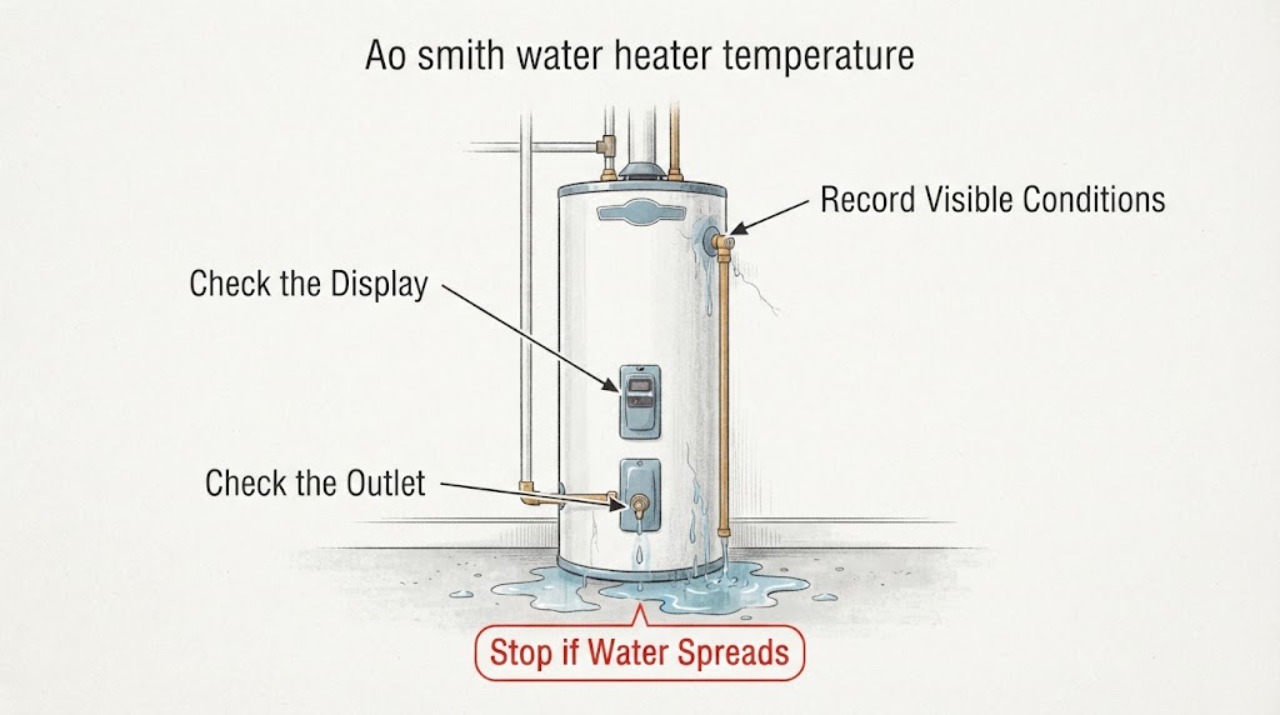
Work through in order
Diagnostic checks
Use only checks that match the exact appliance or system and its official guide.
-
Check 1
For a forceful hot discharge, rapid leak, overheating indication, gas odor, soot, abnormal flame or venting, carbon-monoxide alarm, or water near electrical equipment, leave the area and do not touch the heater. If no immediate hazard is present and controls are safely accessible, turn off the heater's external fuel or power control and cold-water supply without approaching the discharge or opening a panel.
Expected result: The discharge is forceful or hot, the heater is overheating, a gas or CO warning exists, an electrical area is wet, or the leak is a small stable drip.
Next step: Leave for an emergency or gas-safety warning. Otherwise keep fuel or power and water off when safe, keep people away from the discharge, and arrange qualified water-heater service.
Why this matters
Why: Forceful hot discharge or a combustion, gas, CO, or electrical warning takes priority over diagnosis. A stable drip still means the relief path or the system pressure or temperature needs professional evaluation; it is not safe to seal the valve.
-
Check 2
From a safe distance, use a dry cloth only on an accessible cool exterior surface to trace the first wet location without touching the valve, discharge pipe, hot water, gas parts, or wiring. Distinguish water at the discharge outlet, at the valve's tank or threaded connection, at another fitting, or from the tank shell or base.
Expected result: Water exits the discharge pipe, appears around the T&P connection, starts at another pipe or drain fitting, or appears from the tank body or base.
Next step: Do not tighten or remove the T&P valve. Keep the heater isolated and have a qualified person inspect the exact source and the tank, fittings, discharge line, and relief device.
Why this matters
Why: Discharge-pipe flow can reflect relief-valve activation or a valve that will not reseat. A threaded-connection leak, another fitting, or tank-body leak is a different repair path; A. O. Smith identifies a tank leak as a serious replacement-level condition.
-
Check 3
Without opening the heater or operating the relief lever, note whether the T&P discharge is an occasional drip, a recurring weep during or after heating, or a large hot release. Record whether the leak stops when the heater is isolated, but do not restore power, fuel, or water solely to repeat the test.
Expected result: The valve drips intermittently, discharges during heating, releases a large volume of hot water, or continues leaking after the heater is isolated.
Next step: Keep the heater off and obtain professional diagnosis of temperature, pressure, expansion control, valve condition, and the heating system. Do not adjust the thermostat to conceal the symptom.
Why this matters
Why: A. O. Smith associates intermittent weeping with pressure or thermal expansion and large hot discharge with excessive temperature; a leak that continues after isolation can indicate a valve that will not reseat or residual hot water. None of these observations proves the gas, electric, thermostat, or valve component that caused it.
-
Check 4
Inspect only the outside of the discharge pipe and its termination for a cap, plug, crushed section, obstruction, or contact with electrical equipment; do not insert anything, clamp it, reduce its size, or place a valve in line. Do not remove insulation if it could be hot.
Expected result: The discharge path is blocked, capped, damaged, incorrectly routed, wet at an electrical area, or visibly open and unobstructed.
Next step: Do not operate a heater with a blocked or damaged discharge path. Keep clear of the outlet and have a qualified person restore the model- and code-compliant relief arrangement and diagnose the activation cause.
Why this matters
Why: A blocked or altered relief path prevents the T&P valve from safely releasing pressure and hot water. A clear path does not make a leaking valve safe; the valve may be activating because of pressure or temperature or may need replacement.
-
Check 5
Read the rating plate and valve tag from a dry, safe position and record the complete A. O. Smith model and serial number, fuel or power type, valve location, discharge direction, recent installation or plumbing changes, and whether the home has a pressure-reducing device or closed-water-system expansion equipment. Do not measure or alter pressure yourself.
Expected result: The model and valve markings are clear, the installation recently changed, pressure-control equipment is present or unknown, or the tank or valve rating is unreadable.
Next step: Provide the record and photographs to a qualified plumber. Do not order a relief valve by appearance or install one with a different rating.
Why this matters
Why: A. O. Smith says valve and tank ratings must correspond and that thermal expansion or high incoming pressure can activate a T&P valve. A professional needs the exact model, valve marking, and system configuration before selecting a valve or pressure-control remedy.
-
Check 6
Check the surrounding floor and drain pan without touching the heater for spreading water, rust, tank-body corrosion, or water that reaches electrical equipment. If the heater has been flooded or the tank shell is leaking, do not operate it or attempt a valve-only repair.
Expected result: Water is contained at the valve, water is spreading from the base, the tank is corroded or wet, flooding occurred, or electrical equipment is exposed to water.
Next step: Keep fuel or power and water isolated when safe, keep away from wet electrical areas, and arrange qualified service or replacement evaluation. Do not restart the heater to confirm the leak.
Why this matters
Why: A. O. Smith identifies base leaks and tank leaks as potentially serious internal problems, and its safety instructions prohibit operation after flooding or water damage. A valve replacement cannot repair a leaking tank shell or make wet electrical equipment safe.
Use your observations
Decision map
Find the observation that best matches what you see, then follow the next safe action.
-
PATH 01Next step
What you see
The T&P discharge releases a large amount of very hot water, the heater is overheating, or a high-temperature condition is suspected.
Do this next
Stay clear, isolate the heater only from safe external controls, do not touch the relief lever or thermostat, and obtain urgent qualified service. Never cap the discharge path.
Why this path and its safety boundary
Why it matters: A temperature-control or high-temperature safety problem is more likely than a harmless valve drip, and the discharge can scald.
-
PATH 02Next step
What you see
The valve or discharge pipe weeps intermittently, especially during heating, while no hot discharge or combustion warning is present.
Do this next
Keep the heater off until a professional checks pressure, expansion control, valve rating, and valve condition. Do not reduce, block, or substitute the relief path.
Why this path and its safety boundary
Why it matters: Thermal expansion or elevated system pressure is more likely, though a defective valve or incorrect system configuration remains possible.
-
PATH 03Next step
What you see
Water seeps at the valve's threaded connection or tank fitting rather than exiting the discharge outlet.
Do this next
Do not remove or tighten the valve while the tank is hot or pressurized. Isolate the heater and have a qualified person inspect the connection; a leak at a welded tank spud may require heater replacement.
Why this path and its safety boundary
Why it matters: A connection seal, fitting, or tank spud problem is more likely than relief-valve activation through the outlet.
-
PATH 04Next step
What you see
The relief path is blocked, capped, crushed, or discharges toward electrical equipment, regardless of the drip rate.
Do this next
Do not operate the heater or alter the pipe as a quick fix. Keep clear of the outlet and arrange qualified service to restore the required discharge path and investigate why the valve is leaking.
Why this path and its safety boundary
Why it matters: The safety discharge arrangement has been compromised and cannot be treated as a normal leak.
-
PATH 05Next step
What you see
Water comes from the tank base, the heater was flooded, corrosion or a tank-shell leak is visible, or water reaches electrical equipment.
Do this next
Keep the unit isolated, avoid wet electrical areas, and obtain urgent qualified service or replacement evaluation. Do not restart the heater or drain a hot tank yourself.
Why this path and its safety boundary
Why it matters: Internal tank or electrical damage is more likely and a relief-valve-only repair is unsafe or ineffective.
Helpful context
Understand the symptom
A T&P leak is a safety event with several possible causes
The same puddle can come from the T&P discharge pipe, the valve's threaded connection, a tank fitting, condensation, a drain valve, or the tank itself. A. O. Smith says intermittent weeping can occur when pressure rises from thermal expansion, while a large hot discharge can indicate excessive temperature. The visible valve may be operating as designed, leaking because it is damaged, or responding to a deeper heating or pressure problem.
Never defeat the relief path
The T&P valve and discharge pipe must remain able to release hot water and pressure. Do not cap, plug, block, reduce, clamp, or place another valve in the discharge path, and do not hold the relief lever open while the heater is hot. A replacement valve must match the heater's model and rating and should be installed by a qualified person.
Gas, electrical, scald, and carbon-monoxide limits
Do not touch wet electrical parts, open a gas burner compartment, adjust a gas control or thermostat, measure gas or water pressure, remove the T&P valve, or drain a hot tank as an ordinary-user check. If gas odor, flame outside the burner, soot, vent spillage, a carbon-monoxide alarm, or illness is present, leave immediately and contact emergency or gas-safety help from outside.
Safety boundary
Stop conditions
- Do not cap, plug, block, clamp, reduce, disconnect, or place a valve in the T&P relief-valve discharge path. A blocked relief path can create an explosion hazard.
- Stay clear of hot discharge and stop immediately for overheating, forceful discharge, gas odor, abnormal flame or venting, a carbon-monoxide alarm, illness, or water near electrical equipment.
- Do not remove or replace the T&P valve, test the lever on a hot or unstable heater, adjust gas or electric controls, measure pressure, or drain a hot tank as an ordinary-user check.
- Keep the heater off for flooding, tank-shell or base leakage, damaged vent or gas components, a valve that continues to leak, or any uncertain source, and arrange qualified plumbing service.
Only after diagnosis
Potential parts
- water heater relief valve
Consider this only after a qualified person confirms the T&P valve is defective or will not reseat and rules out unsafe temperature, pressure, expansion, connection, and tank conditions.
Relief-valve temperature, pressure, discharge capacity, connection, and orientation must match the exact A. O. Smith heater and its rating plate. Never substitute, remove, or plug a valve as a homeowner test. - water heater drain valve
Consider this only when inspection confirms that water originates at the drain valve rather than the T&P valve, discharge pipe, tank connection, or tank body.
Drain-valve connection and access vary by A. O. Smith model. Isolate the heater and cool or drain it only under qualified, model-specific procedures. - water heater drain pan
Consider this only as a containment or installation measure after a professional resolves the leak source and confirms the pan is suitable for the heater location; it does not repair a relief-valve activation or tank leak.
Pan dimensions, drain routing, floor support, and local requirements are installation-specific. Do not use a pan to conceal an active relief discharge or blocked safety path.
When checks do not resolve it
Need a professional?
Request urgent service for a forceful hot discharge, overheating, a blocked relief path, water near electrical equipment, gas or carbon-monoxide warning, flooding, a tank-shell leak, or a valve that keeps leaking. A stable intermittent drip still needs prompt qualified diagnosis.
Safety scope: Keep the heater isolated when safe and leave the discharge path open. Do not plug the valve, remove the discharge pipe, touch hot water, adjust gas or electrical controls, test pressure, or restart after flooding, overheating, combustion warning, or electrical water exposure.
Have this ready
- Provide the complete A. O. Smith model and serial number, fuel or power type, valve and discharge-pipe markings, first wet location, drip or discharge pattern, whether it occurs during heating, pressure-control or expansion-equipment information, recent installation or plumbing changes, and photographs taken from a safe dry position.
Common questions
FAQ
Why is my A. O. Smith water heater T&P relief valve leaking?
A. O. Smith identifies thermal expansion or high pressure, excessive temperature, a valve that will not reseat, a threaded connection, and tank or fitting leaks as different possibilities. A professional must identify the cause; do not plug the valve.
What should I do first when the relief valve drips?
Stay clear of hot water, keep the heater isolated at safe external controls when possible, and arrange qualified service. Do not touch the valve or discharge pipe if hot, and do not repeatedly restore operation to test the drip.
Can I cap or plug a leaking T&P relief valve?
No. A. O. Smith warns that the valve and discharge pipe must not be capped, blocked, or plugged because they need to release dangerous temperature or pressure.
Does a dripping relief valve always mean the valve is bad?
No. Intermittent weeping can reflect thermal expansion or high system pressure, while a large hot discharge can indicate excessive temperature. A damaged valve is only one possible cause.
What does a large amount of hot water from the discharge pipe mean?
It can indicate relief-valve activation from excessive temperature or pressure and presents a scald hazard. Stay clear, isolate the heater only from safe controls, and obtain urgent qualified service.
Can I replace the A. O. Smith T&P valve myself?
Do not treat replacement as a routine DIY step. The valve rating, discharge capacity, connection, and discharge routing must match the heater, and the underlying pressure or temperature cause must be diagnosed by a qualified person.
What if the leak is from the tank base instead of the T&P valve?
A base or tank-shell leak can indicate serious internal tank damage and is not repaired by replacing the relief valve. Keep the heater isolated and arrange professional service or replacement evaluation.
When should I call a plumber for an A. O. Smith relief-valve leak?
Call for every recurring or continuous drip, hot discharge, blocked or damaged discharge path, overheating, suspected high pressure or thermal expansion, water near electrical parts, flooding, tank leakage, gas or CO warning, or any need to remove or replace the valve.
Read the exact guide
Official sources
- Technical Bulletins - Bulletin #52 Leaking Temperature and Pressure Relief ValveA. O. Smith · AO Smith T&P relief-valve leak symptoms, temperature and pressure activation, sizing, and corrective categories
- A.O. Smith – Voltex™A. O. Smith · A. O. Smith relief-valve discharge-path requirements, qualified replacement boundary, and no-plug warning
- Why Is My Water Heater Leaking?A. O. Smith · A. O. Smith water-heater leak-source checks, T&P pressure or temperature context, base leaks, isolation, and professional service
- Technical Bulletins - Bulletin #51 Puddle On The FloorA. O. Smith · A. O. Smith water-heater puddle and T&P discharge-pipe leak-source differentiation
- Safety Features in Tank Water HeatersA. O. Smith · A. O. Smith T&P safety function, thermal expansion, overheating, gas-water-heater flammable-vapor, and professional-help guidance
- IMPORTANT SAFETY INFORMATIONA. O. Smith · A. O. Smith relief-valve and discharge-line safety, no-blocking requirement, gas, electrical, and carbon-monoxide warnings
Community feedback
Share a repair observation
Share a plain-text repair observation. Accepted observations are published automatically; this page may take a moment to update.