
On this page
Start here
Quick answer
A slow or blocked sink drain can be local to the visible fixture and P-trap, or it can be farther downstream in the branch drain, vent, or sewer connection. First stop adding water, protect yourself from wastewater, and compare this fixture with nearby drains. Gurgling, wastewater rising elsewhere, repeated backup, or floor water points beyond a simple trap blockage. If no drain chemical has been used and the P-trap is an accessible, removable slip-joint assembly, a careful external inspection can show whether the obstruction is in the U-shaped trap; if the trap is clear, the blockage is likely farther along. Do not open a trap after chemical cleaner has been poured, mix cleaners, force solvent-welded fittings, enter standing water near electrical equipment, or continue when sewage is backing up or the source is uncertain—use a licensed plumber.
Before you begin
Safety first
- This article supports observation and, only for an untreated accessible removable trap, a cautious external inspection. It does not authorize chemical handling, concealed-pipe work, powered augering, sewer entry, electrical contact, or forced disassembly.
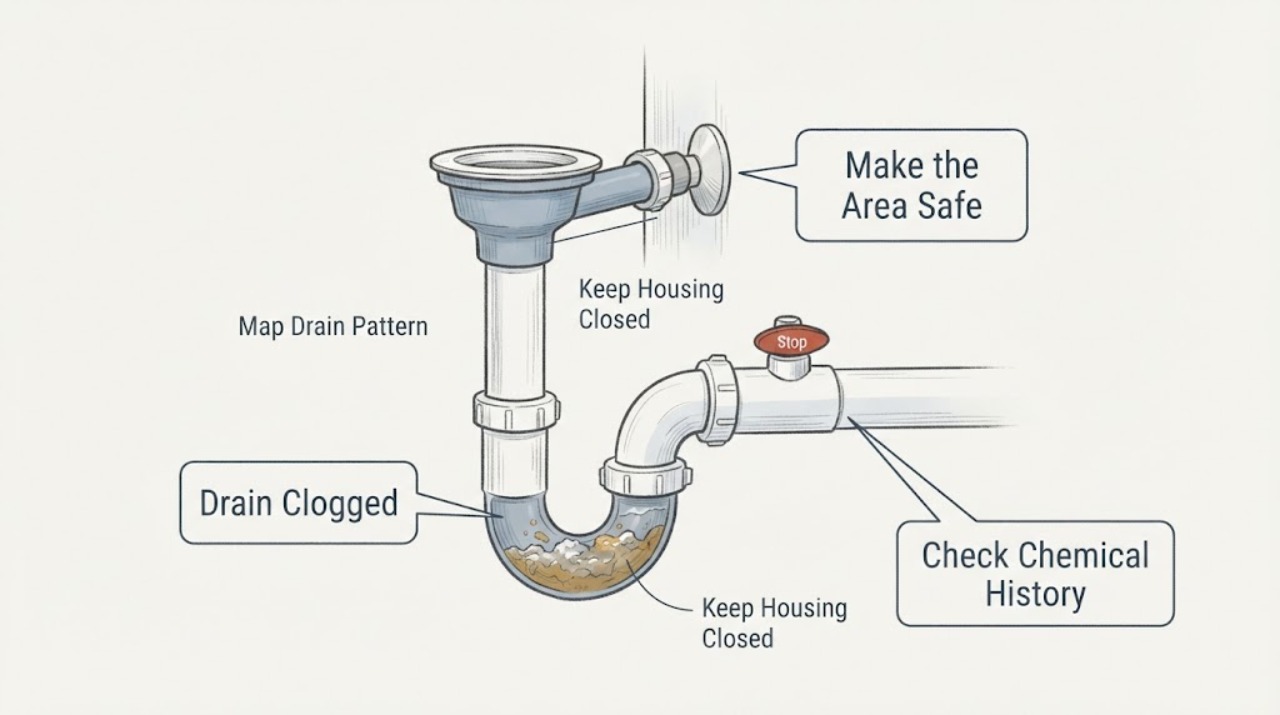
Work through in order
Diagnostic checks
Use only checks that match the exact appliance or system and its official guide.
-
Check 1
Stop running water into the affected fixture, keep people and pets away from wastewater, remove items from below the sink or around the drain, and look from a dry position for water near outlets, appliances, extension cords, or other electrical equipment.
Expected result: The area is dry and contained, wastewater is present but away from electrical equipment, or water/sewage has reached an electrical hazard or is spreading across the floor.
Next step: If it is safe and dry to do so, stop the fixture's water supply; otherwise leave the area and arrange plumbing or emergency assistance. Do not touch electrical equipment while standing in water.
Stop if: Stop immediately for standing water near electricity, sewage backup, a contaminated or slippery floor, a burst pipe, structural damage, or an inability to isolate the water safely.
Why this matters
Why: A contained, dry work area may allow a low-risk visual check. Water near electricity, sewage spreading, or an unsafe floor changes the job from a simple trap inspection to immediate isolation and professional response.
-
Check 2
Before plunging, loosening a trap, or adding any product, ask whether drain opener, bleach, descaler, vinegar, or another cleaner was poured into this drain or remains in the standing water; keep the original label if a product was used.
Expected result: No chemical product was used, a product was used but the line is now fully flushed according to its label, or the product and dilution/contact state are unknown or still present.
Next step: If any cleaner is present or uncertain, stop mechanical work, do not mix or add another product, ventilate without standing over the drain, and give the product information to a plumber or poison/emergency service. Continue only when no cleaner was used and the area is safe.
Stop if: Never mix drain cleaners, bleach, acids, vinegar, ammonia, or other household chemicals; do not pour a second product into a blocked drain or use a plunger against chemical residue.
Why this matters
Why: An untreated drain can be considered for ordinary mechanical checks within the fixture's safe design. Chemical residue can splash or react with another product and makes opening or plunging unsafe; an unknown state should be treated as contaminated.
-
Check 3
Without sending more water into the blockage, observe the affected fixture and nearby drains or toilets for slow flow, gurgling, rising water, odor, or backup; record whether the problem is limited to one fixture or shared by several fixtures.
Expected result: Only one fixture is slow, several fixtures gurgle or back up, a floor drain collects water, or sewage returns through another fixture.
Next step: Use the one-fixture result to decide whether a safe, accessible P-trap inspection is appropriate. For shared backup, sewage return, or floor-drain collection, stop and call a plumber or the responsible sewer utility rather than opening the trap first.
Stop if: Do not repeatedly flush or run water to test a shared blockage, and do not continue when wastewater is rising, foul odor is strong, or another fixture is backing up.
Why this matters
Why: One-fixture symptoms are compatible with a fixture opening, stopper, tailpiece, or P-trap obstruction. Shared symptoms, floor collection, gurgling, and sewage return make a branch, vent, building drain, or sewer problem more likely than an isolated trap.
-
Check 4
From a dry position, look under the fixture for a visible U-shaped P-trap and determine whether its connections are accessible slip joints or a glued/solvent-welded, concealed, corroded, or damaged assembly; do not force a fitting.
Expected result: The trap is visible and removable without disturbing concealed piping, or it is glued, concealed, badly corroded, leaking, damaged, or inaccessible.
Next step: Proceed only with the external inspection if the trap is accessible, no chemical was used, the supply is isolated, and a bucket and gloves can be positioned safely. Otherwise stop and arrange service.
Stop if: Do not cut glued pipe, pry fittings, move a heavy fixture, open a concealed wall, or continue if the trap is leaking, brittle, or cannot be supported safely.
Why this matters
Why: An accessible union or slip-joint trap may serve as a controlled inspection point. A solvent-welded, concealed, corroded, or damaged trap needs a plumber because forcing it can create a leak or damage the drainage system.
-
Check 5
Only for an accessible, removable, untreated trap, put on gloves and eye protection, place a stable pan or bucket below the trap, support the U-shaped section, and loosen the slip-joint nuts slowly from a normal standing position; keep your face and skin away from the opening.
Expected result: The trap opens without force and contains a visible obstruction, contains only water and sediment, does not open safely, or releases unexpected liquid, odor, pressure, or a damaged seal.
Next step: If the trap does not open freely or the liquid is unexpected, resecure the area without further handling and call a plumber. If a local obstruction is plainly visible and the trap remains undamaged, remove only what can be handled without tools or force and continue to the seal check.
Stop if: Do not open a trap after chemical use, use a torch or heat, hammer fittings, insert a hand into an unknown line, or proceed if the trap is solvent-welded, corroded, pressurized, or leaking.
Why this matters
Why: A visible obstruction in the trap supports a local P-trap blockage. A clear trap shifts suspicion downstream or toward the fixture opening. Unexpected liquid, chemical odor, pressure, corrosion, or a damaged seal means the inspection is no longer low risk.
-
Check 6
If the untreated removable trap contains a plainly visible obstruction and no fitting or seal is damaged, empty it into the pan, remove the obstruction without sharp force, rinse the trap away from the living area, and refit the original washers and joints in their original positions by the manufacturer's or fixture instructions.
Expected result: The obstruction is removed and the trap seals without a drip, the trap still leaks, a washer is missing or damaged, or the drain remains blocked after the trap is clear.
Next step: Keep the area dry and make only a brief, controlled flow observation if the connection is stable. If it leaks or remains blocked, stop water use and call a plumber rather than tightening indefinitely or probing the wall line.
Stop if: Do not overtighten plastic nuts, substitute missing seals without confirming fit, use unapproved sealant, run repeated flushes, or push a rigid tool into concealed piping.
Why this matters
Why: A clear, leak-free trap followed by restored flow supports a local blockage. A leak points to seal, joint, or pipe damage. Continued blockage after a clear trap means the issue is likely at the fixture opening, trap arm, vent, branch line, or farther downstream.
-
Check 7
If the trap is clear or cannot be safely opened, observe the fixture opening, visible tailpiece, cleanout, and nearby drains from ordinary access for a stopper obstruction, gurgling, backup, slow recovery, or water returning elsewhere; do not open walls or insert tools into concealed piping.
Expected result: The fixture opening is obstructed but accessible, the visible opening is clear while flow remains blocked, several drains share the symptom, or water returns through another fixture or floor drain.
Next step: Remove only a plainly visible surface obstruction by safe ordinary access. Otherwise isolate water use and call a plumber for a drain auger, cleanout, vent, branch, or sewer assessment appropriate to the property.
Stop if: Do not send a powered auger through an unknown opening, open a cleanout under pressure, enter a crawlspace or sewer, or continue after sewage backup or floor-water spread.
Why this matters
Why: An obstruction at the fixture opening can be a local service item if it can be removed without chemicals or force. A clear opening with a blocked trap arm, shared symptoms, or return through another fixture points to downstream, vent, or sewer work.
-
Check 8
Only after the trap connection is intact, dry, and stable, perform one brief, low-volume flow observation while watching the trap and nearby fixtures from a safe position; stop immediately if water rises or any joint drips.
Expected result: Water drains normally with no leak, drains slowly but stays in the fixture, backs up or gurgles elsewhere, or leaks at the trap connection.
Next step: Stop testing after the single observation. Use the result to arrange service when flow is not normal, backup is shared, or a leak appears; do not keep adding water to prove the blockage.
Stop if: Do not run a full basin, flush multiple fixtures, or continue testing when wastewater rises, a floor drain backs up, a trap leaks, or electrical equipment could be contacted.
Why this matters
Why: Normal flow without a leak supports a successful local correction. Slow or returning water after a clear trap indicates a remaining downstream restriction. A drip means the connection or seal is not ready for continued use.
-
Check 9
Prepare a service note with the fixture location and type, first wet point, whether the P-trap was accessible or inspected, chemical history, nearby-fixture symptoms, photos of visible piping and leaks, and the exact result after any safe inspection.
Expected result: The note distinguishes a local trap obstruction, a clear trap with continued blockage, a shared backup, chemical exposure, or an unsafe/inaccessible assembly.
Next step: Give the note, product label if a chemical was used, and photos to the plumber or responsible property/sewer service. Keep the affected fixture out of use until the professional advises otherwise.
Stop if: Do not order or install a replacement trap, cleanout, vent, or drain chemical solely from a symptom; confirm the actual configuration and local requirements first.
Why this matters
Why: This evidence helps a plumber choose between fixture service, trap-arm or branch-line clearing, vent/sewer investigation, leak repair, or chemical-safety handling without repeating unsafe tests.
Use your observations
Decision map
Find the observation that best matches what you see, then follow the next safe action.
-
PATH 01Safety boundary
What you see
Drain opener or another cleaner was used, remains in the water, or the chemical history is unknown.
Do this next
Stop mechanical work, do not add another product, keep the label/container, and arrange plumber or poison/emergency guidance appropriate to any exposure.
Why this path and its safety boundary
Why it matters: Opening, plunging, or mixing products could expose a person to corrosive or reactive material.
Safety stop: Do not loosen the P-trap, put a hand or tool in the drain, mix products, or use a plunger against suspected chemical residue.
-
PATH 02Safety boundary
What you see
Only one fixture is affected, the area is dry, no chemical was used, and the P-trap is an accessible removable assembly.
Do this next
Isolate water, use a pan and protective equipment, open the trap slowly without force, and stop for unexpected liquid, odor, corrosion, or leakage.
Why this path and its safety boundary
Why it matters: A local trap or fixture obstruction is plausible and a cautious external inspection may distinguish it from a downstream fault.
Safety stop: Do not cut, pry, hammer, or open concealed or solvent-welded piping.
-
PATH 03Safety boundary
What you see
The P-trap is clear or the visible fixture opening is clear, but the drain remains slow or blocked.
Do this next
Stop repeated flow tests and have a plumber use the appropriate cleanout or drain equipment and assess the downstream line.
Why this path and its safety boundary
Why it matters: The obstruction is more likely in the trap arm, branch drain, vent, or sewer connection than in the U-shaped trap.
Safety stop: Do not send a powered auger into an unknown opening, open a pressured cleanout, or open walls as a homeowner shortcut.
-
PATH 04Safety boundary
What you see
Several fixtures gurgle or back up, water collects on a floor, or sewage returns through another fixture.
Do this next
Stop using connected fixtures, keep people away from contaminated water, and call a plumber or the responsible sewer utility.
Why this path and its safety boundary
Why it matters: The pattern is consistent with a shared branch, building drain, vent, or sewer problem and may worsen with additional water.
Safety stop: Do not keep flushing, plunge into sewage, open the trap as a substitute for locating the shared blockage, or touch nearby electrical equipment from standing water.
-
PATH 05Safety boundary
What you see
The trap is concealed, solvent-welded, brittle, corroded, leaking, or cannot be opened without force or moving the fixture.
Do this next
Leave the fixture isolated and arrange a plumber to inspect the accessible cleanout, trap, connections, and downstream line.
Why this path and its safety boundary
Why it matters: An attempted DIY opening could create a hidden leak, release wastewater, or damage the drainage system.
Safety stop: Do not cut pipe, pry joints, move a heavy fixture, or open a wall to reach the trap.
-
PATH 06Safety boundary
What you see
A trap joint drips, a washer is displaced or damaged, or water appears at a concealed connection after the inspection.
Do this next
Stop water use, dry and contain the area, and arrange plumbing service for the exact joint, seal, and pipe configuration.
Why this path and its safety boundary
Why it matters: The fixture is not safe to return to service; the obstruction may be accompanied by a seal or pipe problem.
Safety stop: Do not keep tightening plastic joints, add unapproved sealant, or run more water to check a leak.
Helpful context
Understand the symptom
What the P-trap can and cannot tell you
The P-trap is the U-shaped section under a sink or at another fixture. It holds a water seal that helps prevent sewer gas from entering the building. A blockage in the trap often affects one fixture and may be visible after a safe, permitted inspection. A clear trap does not clear the branch drain behind the wall, the vent, or the building sewer, so the next step must change when the local check is negative.
Use the first wet point and the pattern of backup
Do not assume the part you can see is the source. Note whether water stops at one basin, rises in another fixture, returns through a floor drain, or appears at a pipe joint. Gurgling in several drains, water collecting on a floor, and sewage coming back are escalation signals. A single fixture with a dry surrounding area supports a more localized inspection, provided the trap is safe to access.
Chemical cleaner changes the procedure
Drain openers and other cleaners may be corrosive or reactive. EPA advises following labels and not pouring household hazardous waste down drains, and poison-safety guidance says never to mix household chemicals. If any cleaner may be in the stagnant water or trap, do not plunge, loosen fittings, or put a hand or tool into the line; keep the product container and call a plumber or local poison/emergency service if there was exposure.
Safety boundary
Stop conditions
- Stop for standing water near electrical equipment, sewage backup, floor-water spread, a burst pipe, structural damage, or an unsafe contaminated floor.
- Do not mix drain cleaners, bleach, acids, vinegar, ammonia, or other household chemicals; do not use a plunger or open the P-trap against suspected chemical residue.
- Do not cut solvent-welded pipe, force corroded fittings, open concealed walls, move a heavy fixture, or use powered drain equipment from an unknown access point.
- Do not repeatedly flush or run water when several fixtures gurgle, another fixture backs up, a floor drain collects water, or sewage returns.
- Arrange a plumber when the trap is clear but the drain remains blocked, the trap is inaccessible or damaged, a connection leaks, chemical exposure is possible, or the obstruction may be in the branch, vent, or sewer line.
When checks do not resolve it
Need a professional?
Call a licensed plumber when more than one fixture is affected, sewage backs up, water reaches a floor or electrical hazard, the P-trap is concealed, solvent-welded, corroded, or leaking, any chemical cleaner was used or may remain, the trap is clear but flow is still blocked, or a cleanout, branch drain, vent, or sewer line may be involved. Keep the fixture out of service until the cause and safe repair are confirmed.
Safety scope: This article supports observation and, only for an untreated accessible removable trap, a cautious external inspection. It does not authorize chemical handling, concealed-pipe work, powered augering, sewer entry, electrical contact, or forced disassembly.
Common questions
FAQ
How can I tell if a clog is in the P-trap?
A single affected fixture with an accessible removable P-trap makes a local obstruction plausible. Only an untreated, safe inspection can confirm it. If the trap is clear but the fixture remains blocked, suspect the trap arm, branch, vent, or sewer rather than continuing to work on the trap.
What if several drains are slow or gurgling?
Stop adding water. Several affected fixtures, gurgling, floor-water collection, or sewage returning elsewhere points to a shared branch, building drain, vent, or sewer problem and needs a plumber or the responsible sewer utility.
Can I remove the P-trap after using drain cleaner?
No. Treat the standing water and trap as contaminated when cleaner was used or the history is uncertain. Do not open, plunge, or mix products; keep the label and arrange qualified plumbing or poison-safety guidance.
What is the purpose of a P-trap?
The U-shaped trap holds a water seal that helps prevent sewer gas from entering the building while allowing wastewater to flow. It is not proof that every blockage is inside that U-shaped section.
When should a plumber handle a clogged drain?
Call a plumber for shared backup, sewage or floor-water spread, chemical exposure, a concealed or glued trap, corrosion or leaks, a clear trap with continued blockage, or any need for a cleanout, powered equipment, concealed-pipe access, vent work, or sewer investigation.
Read the exact guide
Official sources
- Safety & Maintenance TipsCity of Minneapolis · City of Minneapolis resident sewer-maintenance guidance; symptom patterns are general indicators, while local plumbing configuration controls the repair.
- Prevention TipsHealth Resources and Services Administration, U.S. Department of Health & Human Services · U.S. Poison Help household chemical-prevention guidance.
- Household Hazardous Waste (HHW)U.S. Environmental Protection Agency · EPA household hazardous-waste guidance; product labels and local hazardous-waste rules control a particular chemical.
- Waste and vent pipe installationKing County, Washington · King County government plumbing guidance; it describes common waste/vent principles and does not replace local code or a fixture manufacturer's instructions.
- Disinfecting and Flushing Your PipesCity of Oklahoma City · City of Oklahoma City utility guidance; the page's odor-focused P-trap suggestion is used here only to support the distinction between a local trap and a deeper line problem.
Community feedback
Share a repair observation
Share a plain-text repair observation. Accepted observations are published automatically; this page may take a moment to update.