
On this page
Start here
Quick answer
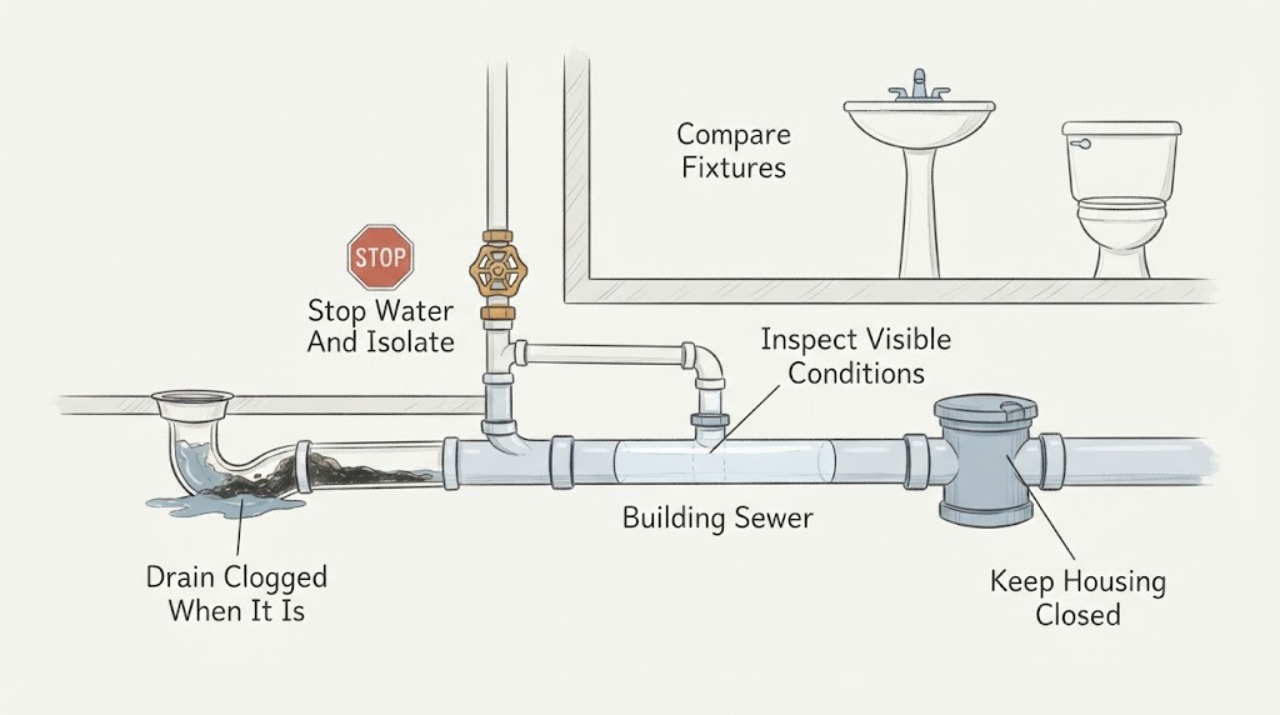
If this clogged drain is the only available outlet or wastewater route in the situation, do not try to force water through it or improvise a second route. Stop using the drain and all connected water fixtures, then determine whether the problem is limited to this opening or also affects other fixtures. From a dry, safe position, note the water level, overflow direction, visible obstruction, lowest point, and any cleanout without opening it. Do not pour drain chemicals into a blocked line, mix cleaners, enter sewage, or use electrical equipment in standing water. If the only usable drain is backing up, the area is contaminated, several fixtures are affected, or the obstruction is beyond visible access, use a licensed plumber; contact the local sewer utility when backup may involve a public main.
Before you begin
Safety first
- This article supports stopping water use, safe observation, area isolation, and utility-versus-plumber triage only. It does not authorize sewage entry, chemical treatment, cleanout opening, manhole access, cabling, jetting, excavation, electrical work, or buried-line repair.
Work through in order
Diagnostic checks
Use only checks that match the exact appliance or system and its official guide.
-
Check 1
Stop all water use that could discharge to the affected drain, including flushing, sinks, showers, laundry, and dishwashing, and keep the only available route and any overflow area clear of people and pets.
Expected result: Record whether water or sewage is rising, standing, flowing from the opening, or reaching an outlet, cord, appliance, or other electrical equipment; note whether the room can be left without stepping into water.
Next step: Keep the area isolated and arrange plumbing service; if electrical equipment or outlets are wet, leave them untouched and obtain qualified electrical assessment before re-energizing.
Stop if: Do not step into contaminated or electrified water, operate a pump, vacuum, fan, or appliance in water, or try to stop an active sewage flow by blocking the opening.
Why this matters
Why: Stopping discharge prevents a limited blockage from becoming a larger backup. Water near electricity, raw sewage, or an unsafe access route is a hazard-control decision, not a clog test.
-
Check 2
Without adding water, observe other fixtures and drainage points from dry, stable positions and map which ones are slow, backing up, or normal; identify the lowest affected point if one is visible.
Expected result: Classify the pattern as only this drain, several fixtures on one branch, multiple fixtures on separate branches or floors, a low-point overflow, or an exterior cleanout or street overflow.
Next step: Give the map and lowest-point observation to a plumber; contact the local sewer utility before assuming the blockage is private when backup occurs without current water use or appears broader than the building.
Stop if: Do not flush, run a fixture to compare flow, enter a flooded lower level, or approach sewage, a manhole, or unstable flooring.
Why this matters
Why: One affected opening supports a local branch question. Several fixtures, a low point, or an exterior overflow supports a downstream building-sewer or public-main question. “Only option here” changes the urgency of stopping water but does not establish the obstruction's ownership.
-
Check 3
From ordinary safe access, look at the drain grate, strainer, trap exterior, or other visible opening and photograph what can be seen without removing parts, reaching in, or pouring water.
Expected result: Record whether a removable surface obstruction is plainly visible, the opening is covered by standing wastewater, the fixture is damaged, the water level changes without use, or the cause cannot be seen without disassembly.
Next step: Keep the drain unused and provide the image and exact location to the plumber. Let the professional choose whether a safe, compatible clearing method is appropriate.
Stop if: Do not reach into sewage, remove a trap or grate under pressure, insert a wire or tool, use compressed air, or force a fragile fitting.
Why this matters
Why: A clearly visible surface obstruction may be described to the plumber, but a full opening, changing level, damaged fitting, or unseen obstruction indicates a downstream or hazardous condition. Visibility is not permission to probe or dismantle.
-
Check 4
If an indoor or outdoor cleanout is visible, photograph its location and exterior condition from a stable position without loosening the cap, digging, moving a cover, or approaching a contaminated or unstable area.
Expected result: Record whether the cleanout is dry, visibly full, overflowing, damaged, buried, displaced, or close to electrical equipment, a gas line, a public right of way, or unstable ground.
Next step: Send the location and exterior photos to the plumber and utility, and keep the only available drain unused until a professional chooses safe access and clearing steps.
Stop if: Do not open a full cap, remove a manhole cover, dig, probe, cable, jet, or move the appliance or ground around a buried line.
Why this matters
Why: A cleanout location can help a plumber compare the fixture side with the building sewer or public connection. A full or damaged cleanout may be pressurized or contaminated, so it is not a user-access point.
-
Check 5
Record whether any drain opener, bleach, ammonia, solvent, or other product was added and whether anyone or anything contacted wastewater; do not add another product or attempt neutralization.
Expected result: Record the product name if known, time of use, visible fumes, unusual odor, skin or eye contact, contaminated surfaces, and whether the overflow has reached living areas or electrical equipment.
Next step: Tell the plumber and appropriate emergency or health service exactly what was used; keep people and pets away and arrange qualified cleanup for contaminated materials.
Stop if: Do not mix cleaners, enter a fume-filled area, handle contaminated items without appropriate protection, or pour chemicals into any drain.
Why this matters
Why: Chemical residue changes the clearing and protective-equipment plan, while sewage contact changes cleanup and health precautions. Mixing cleaners can create dangerous fumes and injure occupants or a plumber.
-
Check 6
Use the fixture map, timing, visible opening, cleanout location, weather or neighborhood pattern, and exposure history to request the appropriate service without adding water to prove the diagnosis.
Expected result: Record whether the problem appears limited to this drain, extends to the private building line, occurs without building use, or coincides with a public sewer or street overflow.
Next step: Keep the only available drain and connected fixtures out of use until the professional confirms safe flow and cleanup; provide photos, location, and the complete event record.
Stop if: Do not resume water use, cable or jet the line, open a cleanout, use chemical opener, or make a buried-line repair based on surface symptoms.
Why this matters
Why: A licensed plumber handles a branch, trap, building sewer, or private lateral. A local sewer utility should assess a possible public main or shared line. Sewage, chemical, electrical, or structural hazards can require additional qualified responders.
Use your observations
Decision map
Find the observation that best matches what you see, then follow the next safe action.
-
PATH 01Safety boundary
What you see
Only the drain identified as the only available option is slow or blocked, while other fixtures appear normal and there is no overflow.
Do this next
Keep this route unused, provide the visible-opening observations to a plumber, and monitor other fixtures without adding water.
Why this path and its safety boundary
Why it matters: A local branch or trap obstruction is possible, but the condition does not prove it is safe to open or chemically treat.
Safety stop: Do not pour chemical opener, probe the opening, remove a trap under pressure, or divert wastewater into an unsafe area.
-
PATH 02Safety boundary
What you see
Several fixtures, separate branches, floors, or a lower drain are slow or backing up, or the lowest point overflows.
Do this next
Stop all building water use and request plumber and utility triage with the fixture map and lowest-point photos.
Why this path and its safety boundary
Why it matters: The obstruction may be downstream in the building sewer, private lateral, connection, or public main rather than at this drain opening.
Safety stop: Do not flush, run appliances, open a cleanout, or enter contaminated water.
-
PATH 03Safety boundary
What you see
Water or sewage rises while no one is using the building's fixtures, or nearby public areas show a related overflow.
Do this next
Contact the local sewer utility before assuming the private line is responsible and keep the only available route and all fixtures unused.
Why this path and its safety boundary
Why it matters: A public main, shared line, or upstream obstruction is possible and cannot be classified as a private drain clog from one observation.
Safety stop: Do not approach a manhole, open a cleanout, create a flow test, or discharge water to compare levels.
-
PATH 04Safety boundary
What you see
A visible cleanout or drain opening is full, overflowing, damaged, or cannot be assessed without opening or disassembly.
Do this next
Keep the area isolated and give the exterior condition and location to a licensed plumber or utility.
Why this path and its safety boundary
Why it matters: The line may be pressurized, contaminated, or structurally damaged; visible access is not a safe user procedure.
Safety stop: Do not loosen a cap, remove a cover, reach in, probe, dig, cable, jet, or move anything to gain access.
-
PATH 05Safety boundary
What you see
Drain chemicals, mixed-cleaner fumes, raw sewage, or contaminated standing water or materials are present.
Do this next
Keep people and pets away, disclose every product used, and arrange qualified plumbing and cleanup assistance.
Why this path and its safety boundary
Why it matters: Exposure control and safe cleanup take priority over locating the clog.
Safety stop: Do not mix products, enter fumes, use electrical equipment in water, or handle contaminated materials without suitable protection.
-
PATH 06Safety boundary
What you see
Standing water reaches electrical equipment, the floor or ground is unstable, or access would require excavation or entry into a lower flooded area.
Do this next
Leave the area undisturbed and use qualified electrical, utility, and plumbing professionals to assess it.
Why this path and its safety boundary
Why it matters: Shock, fall, collapse, or buried-utility hazards make ordinary drain checks unsafe.
Safety stop: Do not step into water, touch equipment, dig, remove covers, or create a hose or fixture test.
Helpful context
Understand the symptom
Treat the only available drain as a capacity and safety constraint
Here, “only option here” means this is the only available drain or wastewater route for the immediate situation; it does not prove where the blockage is. Do not divert water into an unsafe area, another fixture, a yard, or a storm drain. Stop discharge first, then observe whether the obstruction is at the opening, a nearby branch, the building sewer, or farther downstream.
A single opening and a system backup are different decisions
If only one outlet is slow and other fixtures work normally, a local branch obstruction is possible. If several fixtures back up, a low point overflows, or wastewater rises without current use, a downstream building sewer or public main becomes more likely. The fixture pattern guides who to contact but cannot safely identify the line without professional assessment.
Visible access does not make a blocked line safe to open
A strainer, trap, cleanout, or floor drain may conceal pressure, contaminated water, sewer gas, or a fragile fitting. Photograph the exterior and visible water level from a stable, dry position. Do not reach into the opening, loosen a full cleanout, remove a manhole cover, or insert a tool into a line as a first response.
Chemical and electrical hazards end ordinary troubleshooting
Chemical opener can remain in a blocked line and create an exposure for the next person who opens it; mixed cleaners can create dangerous fumes. Raw sewage can carry harmful organisms, and standing water can energize nearby equipment. Keep people and pets away and tell the plumber what happened before any clearing or cleanup begins.
Safety boundary
Stop conditions
- Stop using the only available drain and all connected fixtures when backup is suspected; do not flush or run water to test the line.
- Do not enter sewage or standing water, touch wet electrical equipment, or operate pumps, vacuums, fans, appliances, outlets, or cords in water.
- Do not open a full or pressurized cleanout, remove a manhole cover, dig, cable, jet, probe, or disassemble a drain under pressure.
- Do not pour chemical opener into the blocked line or mix bleach, ammonia, solvents, or other cleaners; tell the plumber what was already used.
- Keep children and pets away and request a plumber; contact the local utility when backup occurs without current use or may involve a public main.
Only after diagnosis
Potential parts
- drain strainer or grate assembly
Consider this category only if a plumber confirms that the visible strainer or grate is damaged and is the actual restriction or sealing problem.
Confirm opening dimensions, drain type, material, and local requirements; do not remove a full grate or use a replacement to conceal a downstream backup. - building sewer cleanout access assembly
Consider this category only when qualified assessment finds a damaged or missing private cleanout component and confirms the correct access arrangement.
Confirm pipe material, diameter, location, pressure condition, and local requirements with the plumber; do not open a full cleanout as a user test. - branch drain or building sewer pipe section
Consider this category only when locating or inspection confirms a damaged pipe segment rather than an unlocated surface clog.
Confirm pipe material, diameter, depth, connection, permits, and utility locating with a licensed plumber; do not excavate from surface symptoms alone.
When checks do not resolve it
Need a professional?
Call a licensed plumber when the only available drain remains blocked, the obstruction is not plainly visible from safe access, the line needs a cleanout or branch assessment, or the blockage returns. Contact the local sewer utility when several fixtures or low points back up, wastewater rises without current building use, or public areas may be involved. Request urgent qualified assistance for raw sewage in living areas, chemical fumes, active overflow, water near electricity, unstable ground, or any need to open a cleanout or excavate. Provide the fixture map, timing, photos, cleanout location, weather or neighborhood pattern, and chemical-exposure history.
Safety scope: This article supports stopping water use, safe observation, area isolation, and utility-versus-plumber triage only. It does not authorize sewage entry, chemical treatment, cleanout opening, manhole access, cabling, jetting, excavation, electrical work, or buried-line repair.
Common questions
FAQ
What does “only option here” change when a drain is clogged?
It means this drain is the only available outlet or wastewater route in the immediate situation, so stopping water use is especially important. It does not prove whether the blockage is at the opening, a branch, the building sewer, or the public main. Map other fixtures without adding water and request a plumber.
How can I tell whether the blockage is local or farther downstream?
Without running water, note whether only this drain is affected or whether several fixtures, floors, low points, a cleanout, or a public area back up. Backup without current building use raises a public-main or shared-line possibility. A plumber or utility must confirm the actual location.
Should I open the cleanout or drain trap?
Do not open a full or pressurized cleanout or dismantle a drain containing wastewater. Photograph its exterior and location from a stable, dry position and let a licensed plumber choose safe access. Do not probe, cable, jet, dig, or move covers as a first response.
Can I use chemical drain opener when this is the only drain?
Do not add chemical opener to a blocked line. It can remain in the pipe and create an exposure for the next person who opens it, and mixing products can generate dangerous fumes. Tell the plumber exactly what was already added and keep people and pets away.
When is a clogged drain an urgent safety issue?
Treat it as urgent when raw sewage or active overflow is present, water reaches electrical equipment, fumes are present, the only route cannot be isolated, the floor or ground is unstable, or several fixtures back up. Stop water use, keep away, and use qualified plumbing, utility, cleanup, or electrical assistance as appropriate.
Read the exact guide
Official sources
- Residential Wastewater ManagementFairfax County Public Works and Environmental Services · County wastewater guidance used for general residential sewer-backup triage; local ownership and emergency procedures vary by jurisdiction.
- Utility EmergenciesNewport Department of Utilities · Municipal utility guidance used for general sewer-backup safety; local utility procedures vary by location.
- Sewer Backup - DEPNew York City Department of Environmental Protection · New York City sewer guidance used for general explanation of public-main and private-service-line boundaries; local reporting and ownership rules vary.
Community feedback
Share a repair observation
Share a plain-text repair observation. Accepted observations are published automatically; this page may take a moment to update.