
On this page
Start here
Quick answer
A leaking drain line can be a loose visible joint, a cracked trap or pipe, a backed-up drain forcing water out, or a concealed leak in a wall, floor, or ceiling. First stop or reduce the fixture use that makes the leak worse, identify whether the liquid is clean water or wastewater, and keep people away from standing water near electricity. From ordinary access, note the exact point where water first appears and whether it occurs while one fixture drains or without use. You may dry and observe an accessible fitting, but do not disconnect a pressurized connection, open a hidden line, or pour chemicals into a blocked drain. Continuous leaking, sewage backup, contamination, ceiling or wall damage, or an inaccessible or damaged line is a plumber service boundary.
Before you begin
Safety first
- This article supports dry, ordinary-access observation and safe isolation only. Do not enter contaminated water, dismantle pressurized or hidden piping, open walls or ceilings, use drain chemicals, or work near wet electricity.
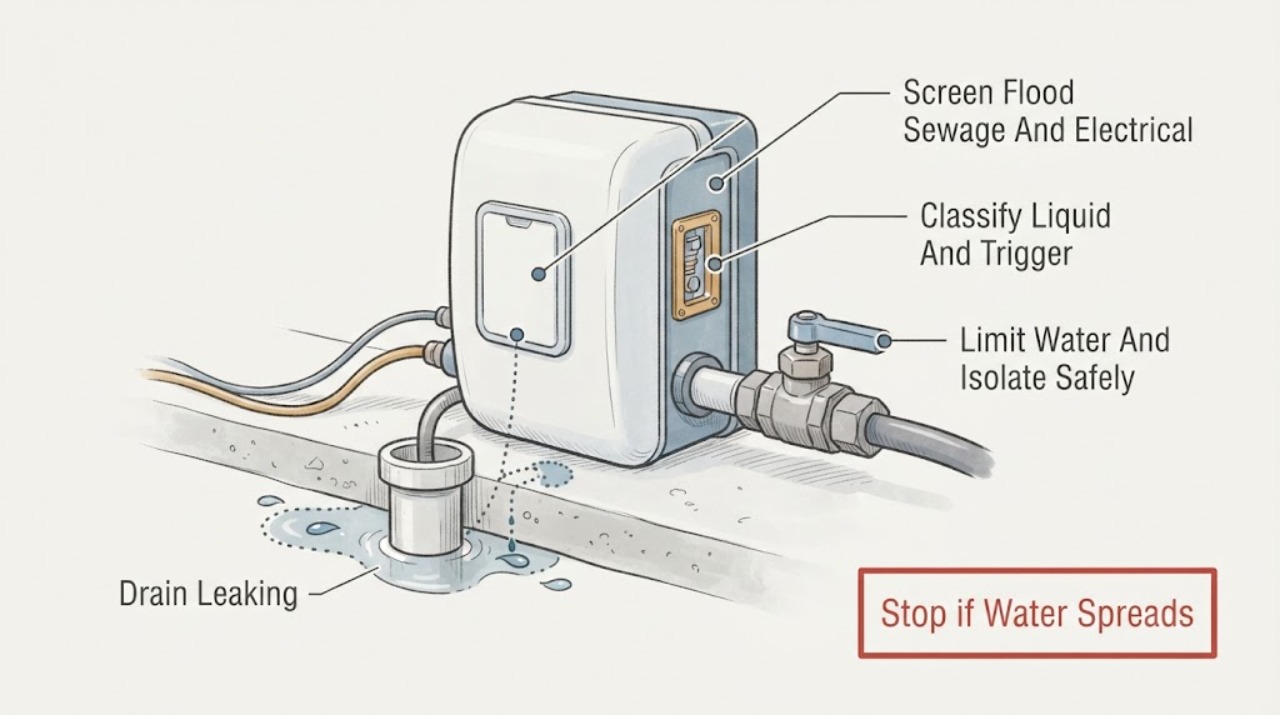
Work through in order
Diagnostic checks
Use only checks that match the exact appliance or system and its official guide.
-
Check 1
Before approaching the leak, look from a dry, safe position for rapid flow, sewage or foul wastewater, water near outlets or electrical equipment, a wet ceiling, wall or floor that feels unstable, exposed wiring, or water entering a neighboring unit.
Expected result: Record whether the liquid is unknown or contaminated, whether the leak is active without fixture use, whether standing water is near electricity, and whether building materials are swelling, sagging, or softening.
Next step: Stop using the affected fixtures. If safe without touching wet electrical equipment, close the local water shutoff or main supply and isolate power at a dry, accessible disconnect; keep clear and arrange a plumber, electrician, emergency response, or cleanup professional as appropriate.
Stop if: Do not touch wet electrical devices, enter contaminated water, stand under a bulging ceiling, or keep using fixtures after a rapid leak or sewage backup.
Why this matters
Why: Flooding, sewage, electrical contact, and structural damage are not routine fitting checks. These conditions can cause illness, shock, property damage, or collapse.
-
Check 2
From ordinary access, note the liquid's appearance or odor without touching it and identify whether it appears while a sink, shower, toilet, appliance, or other fixture drains, or whether it leaks when no fixture is being used.
Expected result: A leak that follows one fixture's discharge suggests that fixture branch or its drain connection. Foul water, debris, or backup through another fixture suggests a wastewater restriction. A leak with no use suggests a pressurized, concealed, or upstream source that should not be opened by the homeowner.
Next step: Stop the triggering fixture and follow the visible-joint, backup, or concealed-leak branch. Treat unknown liquid as potentially contaminated until a professional identifies it.
Stop if: Do not taste, handle, sniff closely, or use chemicals to test an unknown or sewage-contaminated liquid.
Why this matters
Why: Liquid type and timing separate a local drain connection from a shared blockage, sewer backup, supply-related leak, or concealed building-water path.
-
Check 3
Stop or limit the fixture use that increases the leak; if water continues without use, close the nearest accessible water shutoff or the main supply only when it can be reached without entering water or disturbing electrical equipment.
Expected result: The leak may slow or stop after the source fixture or water supply is isolated, or it may continue because the line contains residual water, a shared drain is backed up, or the source is elsewhere.
Next step: Keep water use limited, protect belongings from a dry location, and arrange plumbing service if flow continues, the line is hidden, or the shutoff is inaccessible.
Stop if: Do not enter standing water to reach a shutoff, operate wet electrical equipment, or dismantle a pressurized connection.
Why this matters
Why: A change after isolation helps distinguish active supply flow from residual or wastewater flow, but it does not identify a hidden break or make a pressurized repair safe.
-
Check 4
After the area is dry and isolated as safely as possible, inspect only visible, accessible drain-line sections for a displaced seal, loose-looking joint, crack, corrosion, separated pipe, or water trail that begins at a higher point.
Expected result: A clear first wet point at a visible joint or cracked section supports a local plumbing repair. A dry visible line with water emerging from a wall, floor, ceiling, cabinet void, or another higher path indicates concealed or traveling water.
Next step: Photograph and mark the first wet point for the plumber. Do not tighten, cut, glue, snake, or remove the line when the leak is active, contaminated, pressurized, or connected to hidden piping.
Stop if: Do not force fittings, open walls or ceilings, climb unsafely, or work on a line with water pressure or sewage behind it.
Why this matters
Why: The first wet point is more useful than the largest puddle, but an external view cannot prove the condition of hidden pipe, vent, sewer lateral, or framing.
-
Check 5
Only if there is no rapid flow, sewage, structural or electrical danger and the affected fixture is safe to use, observe one brief, low-volume drain event from a dry position while another person watches the visible line; stop at the first renewed leak.
Expected result: Water appearing at one local joint during that fixture's discharge supports a branch-drain connection issue. Backup, gurgling, slow drainage, or water appearing at another fixture suggests a shared restriction or downstream problem; a leak without the test suggests a concealed or non-fixture source.
Next step: Stop using the fixture and give the plumber the fixture, timing, first wet point, and flow observations. Arrange urgent service for active or recurring discharge leaks.
Stop if: Do not repeat the test, pour drain chemicals, use a flame or electrical device to locate water, or continue if wastewater, rapid flow, or structural damage appears.
Why this matters
Why: Timing can narrow the source but cannot clear a line, prove a blockage location, or justify repeated flushing. Wastewater or a leak near electricity ends the test.
-
Check 6
If more than one fixture drains slowly, a floor drain overflows, sewage appears, or the leak follows a shared discharge, stop nonessential water use and record which fixtures are affected without entering the wastewater.
Expected result: Multiple slow or backing-up fixtures point beyond a single visible joint toward a shared branch, building drain, sewer lateral, or septic system. Sewage, debris, or contaminated standing water makes ordinary cleanup unsafe.
Next step: Keep people and pets away, avoid contact, and arrange a qualified plumber and appropriate wastewater or cleanup authority. Reduce water use until the line is assessed.
Stop if: Do not plunge, snake, open a cleanout, pump, or handle sewage unless the correct professional procedure and protective controls are in place.
Why this matters
Why: EPA and CDC identify blockages, line breaks, and wastewater-system problems as potential causes of backups that threaten health and property; a shared line needs professional diagnosis.
-
Check 7
Stop troubleshooting and arrange plumber service when the leak is continuous, concealed, recurring, contaminated, connected to a shared line, or not resolved by safe isolation and observation.
Expected result: Provide the address or fixture location, liquid type, first wet point, trigger and timing, affected fixtures, shutoff result, visible pipe condition, photos, property damage, sewage or septic context, and electrical or structural hazards.
Next step: Keep the affected water use stopped, maintain a safe exclusion area, and arrange qualified plumbing service; request urgent response for active flooding, sewage backup, or water entering electrical or structural areas.
Stop if: Do not reopen the line, enter contaminated water, open walls or ceilings, or resume use merely because the visible puddle has dried.
Why this matters
Why: A plumber can distinguish a local drain joint from a hidden pipe, vent, sewer lateral, septic, or building-water fault and choose a controlled repair without exposing the occupants to pressure, contamination, or structural risk.
Use your observations
Decision map
Find the observation that best matches what you see, then follow the next safe action.
-
PATH 01Safety boundary
What you see
Rapid flow, sewage or foul backup, water near electrical equipment, a wet or bulging ceiling, exposed wiring, structural softening, or water entering another unit is present.
Do this next
Stop fixture use; isolate water and power only from a dry, safe position, keep people away, and arrange urgent plumbing, electrical, emergency, or cleanup help.
Why this path and its safety boundary
Why it matters: This is an immediate safety and damage-control event.
Safety stop: Do not enter contaminated or electrically wet water, stand under a damaged ceiling, or operate equipment in the wet area.
-
PATH 02Safety boundary
What you see
A clean or non-contaminated leak starts at one visible accessible drain connection only when one fixture discharges, with no electrical or structural hazard.
Do this next
Keep use limited, photograph the first wet point, and arrange plumber repair; do not force or dismantle the joint.
Why this path and its safety boundary
Why it matters: A local trap, joint, gasket, or branch connection may be involved.
Safety stop: Stop if the leak becomes continuous, pressurized, contaminated, or spreads toward electricity.
-
PATH 03Safety boundary
What you see
A fixture drains slowly, another fixture backs up, a floor drain overflows, or wastewater appears during discharge.
Do this next
Stop nonessential water use, keep clear of wastewater, and arrange qualified plumber or wastewater service.
Why this path and its safety boundary
Why it matters: A shared blockage, line break, sewer lateral, or septic problem may be forcing water back.
Safety stop: Do not plunge, snake, open a cleanout, pump, or handle sewage as a casual homeowner test.
-
PATH 04Safety boundary
What you see
Visible drain sections are dry but water appears from a wall, floor, ceiling, cabinet void, or a point different from the fixture being used.
Do this next
Stop or limit water use, mark the first observed wet point, avoid opening the structure, and arrange plumber or building professional inspection.
Why this path and its safety boundary
Why it matters: The visible puddle may be downstream from a concealed drain, supply, building, or roof source.
Safety stop: Do not cut walls or ceilings, climb unsafely, or assume the lowest wet spot is the pipe break.
-
PATH 05Safety boundary
What you see
Water continues when no fixture is used or does not slow after the safest accessible shutoff.
Do this next
Keep the main or local supply isolated if safe, protect the area from a dry position, and request prompt plumber service.
Why this path and its safety boundary
Why it matters: A pressurized, upstream, residual, or concealed source may be involved.
Safety stop: Do not disconnect or cap a pressurized line, enter standing water, or run fixtures to search for the source.
-
PATH 06Safety boundary
What you see
The area is dry and safe, no contamination or structural/electrical hazard exists, and a single fixture can be observed briefly from ordinary access.
Do this next
Observe once, stop at renewed leakage, and provide the timing and first wet point to a plumber if unresolved.
Why this path and its safety boundary
Why it matters: One controlled observation may identify whether discharge triggers a visible leak, but it cannot prove hidden pipe condition.
Safety stop: Do not repeat flushing, add chemicals, or continue if wastewater, rapid flow, or damage appears.
-
PATH 07Safety boundary
What you see
The leak recurs, remains active, is concealed or shared, is contaminated, or cannot be safely isolated or identified.
Do this next
Keep affected fixtures out of use and arrange qualified plumbing service with the recorded evidence and safety conditions.
Why this path and its safety boundary
Why it matters: The line needs professional diagnosis and controlled repair.
Safety stop: Do not open hidden piping, use unverified chemicals, enter wastewater, or resume normal water use because symptoms temporarily stop.
Helpful context
Understand the symptom
Identify the liquid before choosing a repair path
A drain-line leak may release clean water from a trap or supply-adjacent connection, gray wastewater from a sink or shower, or sewage from a backup. Do not taste or handle unknown liquid. Note its color, odor, debris, and whether it appears only when a fixture drains. EPA and CDC treat sewage-contaminated water as a health concern, so contamination changes the response from a simple fitting observation to isolation and professional cleanup or plumbing help.
Use timing to find the first wet point
Dry the accessible area only if doing so is safe, then observe from a distance while using no more water than necessary. A leak that appears directly below one visible joint while one fixture drains is different from water appearing with no fixture use, backing up through a floor drain, or spreading from a wall or ceiling. Do not assume the lowest wet spot is the broken section; water can travel along framing and flooring.
Visible fittings are an observation boundary, not a full repair
You can look for a displaced gasket, a visibly loose slip-nut, a crack, corrosion, or a pipe that has pulled away, but do not force a fitting or dismantle a concealed line. A line under pressure, a shared building drain, or a pipe in a wall or ceiling needs the correct isolation and tools. A plumber can distinguish a local trap or branch problem from a main drain, sewer, vent, or structural-water source.
Stop immediately for contamination or electrical exposure
Limit water use when wastewater backs up and keep children and pets away. Do not touch electrical devices in or near wet areas until they are dry and safe, and do not enter a contaminated or structurally damaged area to chase a hidden leak. CDC recommends professional inspection and service when a wastewater or septic system may be damaged; a plumber or appropriate cleanup professional should set the next step.
When checks do not resolve it
Need a professional?
Arrange qualified plumber service for a continuous, recurring, concealed, pressurized, shared-line, or unidentified drain leak; a visible joint that still leaks after safe isolation; slow drains or backups affecting multiple fixtures; or damage to walls, floors, ceilings, or another unit. Request urgent plumbing, electrical, emergency, or cleanup help for rapid flooding, sewage exposure, water near electricity, exposed wiring, a bulging or soft ceiling, structural damage, or contamination. Use the local authority or septic professional when a private wastewater system is involved.
Safety scope: This article supports dry, ordinary-access observation and safe isolation only. Do not enter contaminated water, dismantle pressurized or hidden piping, open walls or ceilings, use drain chemicals, or work near wet electricity.
Common questions
FAQ
How do I find where a drain line is leaking?
From a dry, safe position, note the liquid type and whether it appears only when one fixture drains. Dry visible areas if safe and look for the first wet point, not just the largest puddle. Water from a wall, floor, ceiling, or another higher point needs professional inspection.
What should I do if a drain leak is sewage?
Stop nonessential water use, keep people and pets away, avoid contact, and arrange qualified plumbing and appropriate cleanup or wastewater help. Do not enter contaminated standing water or casually open the line.
Can I tighten or disconnect a leaking drain fitting myself?
Do not force or disconnect a fitting while the line is pressurized, actively leaking, contaminated, hidden, or near electricity. Photograph the visible condition and arrange a plumber, who can determine whether the issue is local or part of a shared or concealed line.
Why does a drain leak appear only when the sink or shower runs?
Timing can point to that fixture's branch, trap, joint, or a downstream restriction, but water can travel from a higher or hidden point. Stop at the first renewed leak, record the fixture and timing, and have a plumber inspect it.
What if water from the drain leak is near an outlet or appliance?
Do not touch wet electrical equipment or enter standing water. From a dry position, stop water use and isolate power only if safe, then arrange qualified electrical and plumbing help. Treat smoke, sparks, exposed wiring, or rapid flooding as urgent hazards.
Read the exact guide
Official sources
- Sanitary Sewer Overflows (SSOs)U.S. Environmental Protection Agency · EPA guidance describing blockages and line breaks as possible causes of sewage overflows that can back up into homes and threaten public health.
- Leak Detection and Flow Monitoring DevicesU.S. Environmental Protection Agency · EPA WaterSense guidance describing common leak causes, visible moisture, irregular flow, and property-damage risk; it is not a pipe-repair procedure.
- Guidelines for Septic and Onsite Wastewater SystemsCenters for Disease Control and Prevention · CDC guidance to avoid contact with sewage-contaminated standing water, avoid wet septic electrical devices, reduce water use during wastewater emergencies, and obtain professional inspection when systems are damaged.
Community feedback
Share a repair observation
Share a plain-text repair observation. Accepted observations are published automatically; this page may take a moment to update.