
On this page
Start here
Quick answer
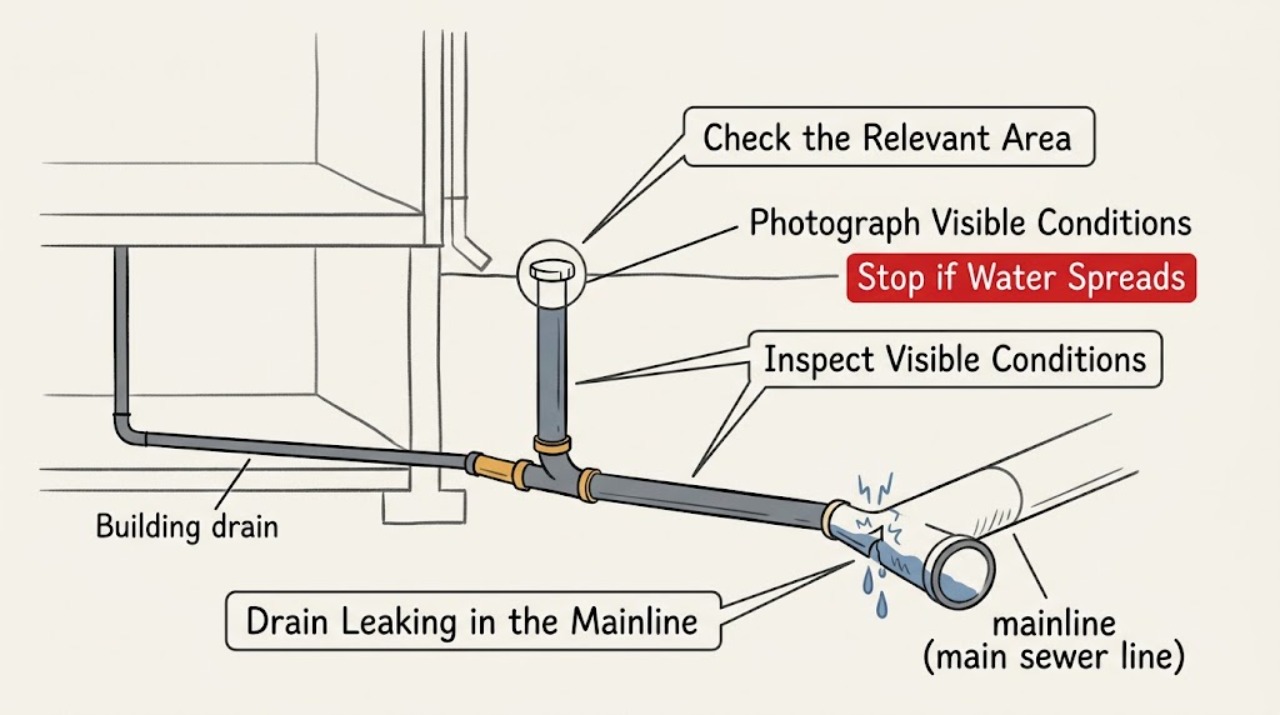
A leak described as being in the mainline is not a sink-trap repair. First reduce or stop water use if wastewater is backing up, keep people and pets away from sewage, and do not open a pressurized cleanout, pour chemicals into the line, dig, or enter an excavation. Note whether several fixtures gurgle or back up together, whether wastewater or odor appears at a cleanout or in the yard, and whether the problem follows heavy rain. A licensed plumber can locate the private lateral and inspect it with a camera; the public utility may need to check the sewer main. Responsibility and permits vary by location, so confirm the boundary before repair.
Work through in order
Diagnostic checks
Use only checks that match the exact appliance or system and its official guide.
-
Check 1
Stop adding water if sewage is backing up or the leak is active, keep people and pets away from the contaminated area, and observe from dry ground. Do not touch flooded electrical equipment or enter a hole, trench, or unstable ground.
Expected result: Wastewater is rising, raw sewage is visible, the smell is strong, the floor or yard is becoming unstable, or contaminated water is near electrical equipment.
Next step: Stop use of the drainage system and arrange urgent licensed plumbing or sewer service. Keep the area isolated; if electricity may be affected, have a qualified person make the circuit safe rather than walking through water.
Why this matters
Why: The situation presents contamination, structural, or electrical risk and is beyond a household drain-clearing experiment.
-
Check 2
List every affected fixture and observe whether symptoms occur together: flush a toilet only if there is no backup and no active leak, otherwise simply note existing gurgling, slow drains, or standing water without running a test flow.
Expected result: One sink or floor drain is affected, or multiple toilets, showers, sinks, and floor drains slow or back up at the same time.
Next step: For multiple fixtures, stop water use and call the local wastewater utility or licensed plumber according to local procedure; request that the public main and private lateral be distinguished before repair. For one fixture, have a plumber confirm that the leak is not downstream in the shared line before treating it as a mainline issue.
Why this matters
Why: A single fixture points toward a local branch or trap, while multiple fixtures make a building drain, private lateral, or public main restriction more likely.
-
Check 3
From a safe position, photograph and describe the liquid and location: clean water or wastewater, inside or outside, at a visible joint, near a capped cleanout, in a yard depression, or near the street. Do not remove a cleanout cap or probe the line.
Expected result: The liquid smells like sewage or contains solids, appears at a cleanout or yard point, follows discharge from several fixtures, or appears only after rain; alternatively it is clean supply water from a local pipe.
Next step: Give the observations and photos to the plumber or utility. Do not use chemical drain cleaner, high-pressure equipment, a rod, or an open excavation as a substitute for locating the leak.
Why this matters
Why: Odor, solids, location, and timing help separate a sanitary sewer leak from a supply or stormwater problem, but they cannot prove which side of the property boundary is responsible.
-
Check 4
Check only visible, accessible surfaces for a loose cleanout cap, sewage staining, recurring wet soil, a sinkhole-like depression, or a foul odor; stay clear of suspected voids and do not dig or operate machinery over the route.
Expected result: A wet or odorous area repeats at the same yard or sidewalk location, soil is settling, or sewage is surfacing outside while interior fixtures also drain poorly.
Next step: Arrange a licensed plumber's line location and camera inspection. If the evidence points toward the public main or right-of-way, notify the local wastewater utility before private excavation or repair.
Why this matters
Why: A cracked, separated, blocked, or leaking lateral or main connection is possible. Surface evidence does not identify the exact pipe or ownership boundary.
-
Check 5
Ask the local wastewater utility whether it can check the public main, and ask the plumber to identify the private lateral's upper and lower sections, cleanouts, and connection point before anyone quotes excavation or replacement.
Expected result: The utility reports a clear or blocked public main, the plumber's camera locates a defect in the private route, or the location remains uncertain.
Next step: Keep the line unused as needed and follow the utility and licensed plumber's written location and permit guidance. Do not authorize digging in a right-of-way until underground utilities, responsibility, and permits are confirmed.
Why this matters
Why: The repair path and payer can change at the boundary. A private lateral may be owner-maintained, while the public main or lower section may fall under utility rules; the exact result is local.
-
Check 6
After the leak location is documented and the area is declared safe, have the licensed plumber or utility choose clearing, lining, spot repair, replacement, or other work based on the camera findings; keep any required repair exposed until inspection.
Expected result: The inspection shows a removable obstruction without a pipe defect, a crack or separated joint, root or soil intrusion, a collapsed section, or a defect in the public main.
Next step: Follow the licensed professional's repair and inspection plan. Do not backfill, reconnect, or cover an underground repair before required local inspection, and reduce grease, wipes, and other unsuitable material entering the system.
Why this matters
Why: Clearing a blockage does not prove that a leaking or structurally damaged pipe is repaired. The repair method, permits, and responsible party depend on the finding and location.
Use your observations
Decision map
Find the observation that best matches what you see, then follow the next safe action.
-
PATH 01Next step
What you see
Raw sewage is backing up, surfacing, or near electrical equipment, or the ground is unstable
Do this next
Stop water use, isolate the area, do not enter contaminated or flooded spaces, and arrange urgent licensed plumbing or sewer help.
Why this path and its safety boundary
Why it matters: Urgent contamination or electrical and structural hazard
-
PATH 02Next step
What you see
Only one fixture or local visible joint leaks and all other fixtures work normally
Do this next
Have a plumber inspect the local connection and confirm downstream flow before treating it as a mainline repair.
Why this path and its safety boundary
Why it matters: A local branch, trap, or exposed connection remains more likely than a mainline failure
-
PATH 03Next step
What you see
Several fixtures slow, gurgle, or back up together
Do this next
Stop water use and ask the utility and a licensed plumber to locate the problem on both sides of the property boundary.
Why this path and its safety boundary
Why it matters: A building drain, private lateral, or public main restriction or leak is possible
-
PATH 04Next step
What you see
Sewage odor, wet soil, or a recurring depression appears outdoors near the line
Do this next
Do not dig. Request professional locating and camera inspection, and notify the utility if the public main or right-of-way may be involved.
Why this path and its safety boundary
Why it matters: A buried lateral or main connection may be leaking or broken
-
PATH 05Next step
What you see
The issue follows heavy rain or occurs in a septic or saturated-soil setting
Do this next
Reduce water use and obtain local wastewater or septic-professional guidance; do not pump, dig, or enter a flooded system without trained help.
Why this path and its safety boundary
Why it matters: Infiltration, overload, or a septic or stormwater condition may be involved in addition to a pipe defect
-
PATH 06Next step
What you see
The public utility reports its main is clear but the licensed plumber locates a private lateral defect
Do this next
Follow the plumber's documented repair plan and local permit and inspection rules; do not cover the work early.
Why this path and its safety boundary
Why it matters: Private-line repair and local permitting may be required
Helpful context
Understand the symptom
What mainline can mean
People often call the whole underground route a mainline. In utility terminology, the building drain or private lateral carries wastewater from the property toward the public sewer main, which is usually under a street. A leak in the private section and a problem in the public main can look similar from inside the building, so the first job is to document the pattern and have the line located.
Treat wastewater as a contamination and structure hazard
Sewage can contain pathogens and hazardous chemicals. Keep children and pets out of the affected area, avoid skin or eye contact, and do not run more water to see whether the leak clears. If contaminated water is near an outlet, appliance, pump, or other electrical equipment, stay out of the water and have a qualified professional make the area safe.
Use patterns, not a single fixture, to locate the path
A single wet joint or fixture can be local. Several slow drains, gurgling toilets, simultaneous backups, or sewage surfacing at a cleanout or yard point are stronger evidence of a building drain, private lateral, or public main problem. Rain-linked symptoms can involve infiltration or a system that is overloaded; they still require local utility and licensed-plumber assessment.
Leave underground work to the right professional
A camera inspection and locating equipment can show whether the line is cracked, separated, blocked, or leaking and where the boundary lies. Excavation, right-of-way work, pipe repair, and cleanout opening may require a licensed contractor, permits, utility locating, and inspection. Do not expose a line or cover a repair based on an unverified guess.
Safety boundary
Stop conditions
- Stop all nonessential water use when sewage backs up, the leak is active, or multiple fixtures are affected.
- Keep away from sewage, contaminated floodwater, unstable soil, sinkholes, trenches, and any wet area near electrical equipment.
- Do not open a pressurized or overflowing cleanout, pour chemical cleaner into a suspected mainline, rod or jet the line, dig, or enter an excavation as a household repair.
- Do not run heavy equipment or cover a repair until underground utilities, the property boundary, permits, and required inspection are confirmed.
- Stop and obtain licensed plumbing or utility help when the leak persists, returns after clearing, has sewage odor or solids, or affects more than one fixture.
Only after diagnosis
Potential parts
- sewer cleanout cap or seal
Relevant only if inspection finds a damaged accessible cap or seal and the connection is not under active pressure or sewage backup.
Have a plumber confirm the pipe size, thread or fitting, material, and local requirements before selecting a replacement. - private lateral pipe section
Relevant only when licensed camera inspection documents a crack, separated joint, collapse, or other defect in the owner-maintained section.
Pipe material, depth, access, permits, and ownership boundary must be confirmed locally before repair or replacement. - backflow prevention device
Consider only after a qualified plumber or local authority determines that the building's elevation and sewer layout make backflow protection appropriate.
This is a code- and site-specific plumbing decision, not a substitute for repairing a leaking or broken line.
When checks do not resolve it
Need a professional?
Call a licensed plumber promptly for a suspected mainline or private-lateral leak, sewage odor, outdoor surfacing, recurring backups, multiple affected fixtures, or any line that needs camera inspection or underground work. Contact the local wastewater utility as well when the public main, street, right-of-way, or shared boundary may be involved. Use urgent help for sewage entering occupied space or approaching electrical equipment.
Common questions
FAQ
What does a mainline drain leak usually mean?
It may mean a leak or blockage in the building drain, private sewer lateral, connection, or public sewer main. Several affected fixtures and outdoor sewage signs make a shared downstream problem more likely, but only locating and inspection can establish the section.
How can I tell a local drain leak from a mainline problem?
One fixture or visible local joint suggests a branch or trap. Multiple toilets, sinks, showers, or floor drains slowing or backing up together point farther downstream toward the building drain, lateral, or public main.
Should I open the sewer cleanout when the mainline is leaking?
Do not open an overflowing or pressurized cleanout as a household test. Observe it from a safe distance and have a licensed plumber or utility handle access, clearing, and locating.
Who is responsible for a leaking sewer mainline?
Responsibility varies by jurisdiction and by the exact section. A private lateral may be owner-maintained while a public main may belong to the utility; confirm the boundary with the local utility and the plumber's documented inspection.
Can I use chemical drain cleaner or a sewer rod for a mainline leak?
No. Chemicals, rods, jetting, digging, or excavation can worsen contamination or damage and cannot prove where a leak is. Use a licensed plumber for camera inspection and approved clearing or repair.
When is a leaking drain an emergency?
Treat sewage entering living space, contaminated water near electrical equipment, unstable ground, a rapidly worsening leak, or multiple simultaneous backups as urgent. Stop water use, isolate the area, and obtain qualified plumbing or utility help.
Read the exact guide
Official sources
- Sewer Lateral InformationCounty of San Diego Department of Public Works · Official county guidance used for licensed camera inspection, cleanout context, sewage odor or recurring-clog triggers, and local lateral responsibility examples.
- Broken Sewer and Drain Lines- Guide to Repairs, Permits and InspectionsCity of Portland Bureau of Development Services · Official city guide used for sewer-line leak signs, sewage hazards, boundary examples, permits, utility locating, licensed work, and inspection requirements; local requirements vary.
- If You Have a Plumbing BlockageTown of Simsbury Water Pollution Control Authority · Official municipal guidance used for multiple-fixture and public-main warning signs; contact the user's own local utility for the applicable procedure.
- Septic Systems - What to Do after the FloodU.S. Environmental Protection Agency · Official EPA guidance used only for flooded or saturated-soil and septic safety boundaries, reduced water use, electrical caution, and trained-specialist limits; it is not a diagnosis of a municipal mainline.
- How to Take Care of Your Sewer LateralSan Francisco Public Utilities Commission · Official utility guidance used for the general distinction between private lateral and public main, licensed inspection, and local responsibility examples; local rules elsewhere may differ.
Community feedback
Share a repair observation
Share a plain-text repair observation. Accepted observations are published automatically; this page may take a moment to update.