
On this page
Start here
Quick answer
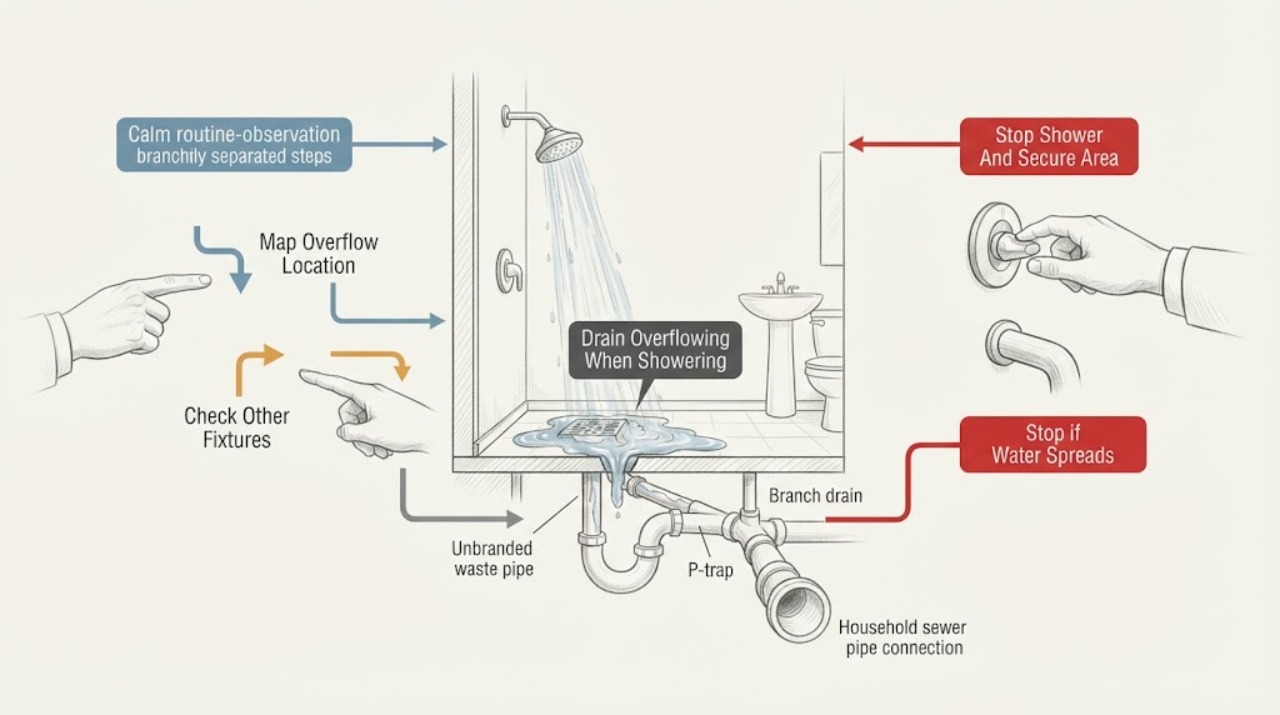
Stop the shower as soon as the water level rises and keep people out of the wastewater. First note whether only the shower backs up or whether a toilet, basin, bath, or another fixture also drains slowly or overflows. A shower-only overflow usually points to the nearby waste, trap, or branch drain; several affected fixtures, gurgling, sewage odor, or water rising in another low fixture can indicate a shared drain or sewer restriction. Do not keep running the shower, pour caustic or mixed chemicals into the drain, or use a powered tool when wastewater, hidden piping, or electrical fittings could be affected. From a dry position, remove only the visible drain cover or strainer if it lifts without tools, clear hair or debris at the opening, and use a suitable plunger only when no chemical cleaner is present and the fixture is intact. If wastewater is present, the overflow returns immediately, more than one fixture is affected, the blockage is beyond the trap, a cleanout is inaccessible, or water is near an electrical fitting, stop and arrange a qualified plumber. Record the first wet point, timing relative to the shower, affected fixtures, drain sounds, prior chemical use, and any property or sewage damage for the service call.
Work through in order
Diagnostic checks
Use only checks that match the exact appliance or system and its official guide.
-
Check 1
Turn off the shower and stand clear of the water; keep children and pets away while looking from a dry position at the shower, floor, nearby fixtures, outlets, switches, and any visible pipework.
Expected result: Record whether the water is clear or foul-smelling, hot, rising quickly, spreading beyond the shower, reaching an outlet or light, or accompanied by a damaged fitting, ceiling stain, or active leak.
Next step: Do not use the shower or other affected fixture. If safely accessible from a dry position, close the local or main water supply and isolate affected electricity without touching wet equipment; arrange qualified plumbing or electrical help.
Stop if: Do not wade through water, touch a wet outlet or switch, remove a light fitting, or keep running the shower to see how high the water rises.
Why this matters
Why: Wastewater, hot water, rapid spread, property damage, or water near electricity makes continued DIY testing unsafe and can require immediate containment or professional help.
-
Check 2
After the water source is stopped and the area is safe, identify the first place water appeared and note whether it came from the shower drain, a floor drain, the toilet, a bath, a basin, a pipe joint, or outside the property.
Expected result: Record whether water is confined to the shower tray, rises from another low fixture, leaks from a joint or ceiling, or is visible at an outdoor inspection point or manhole.
Next step: Use the local-drain branch when only the shower is affected; use the shared-drain or sewer branch when other fixtures or an external point also backs up; use a leak or building-maintenance service when the water comes from a pipe, ceiling, or wall.
Stop if: Do not lift a heavy cover, enter an inspection chamber, open a ceiling, or handle sewage without appropriate professional controls.
Why this matters
Why: The first wet point helps separate a local shower waste restriction from a shared branch, sewer backup, or supply leak. A drain overflow is not the same as a pressurized pipe leak.
-
Check 3
Without adding more water to the blocked shower, observe the toilet, basin, bath, laundry waste, and any nearby floor drain for slow drainage, gurgling, odor, or water movement; do not flush or run another fixture if the system is backing up.
Expected result: Record whether every other fixture is normal, one nearby fixture is affected, several fixtures are affected, or wastewater rises when another fixture is used.
Next step: Keep all affected fixtures out of use and arrange a plumber for a multi-fixture pattern. If neighboring properties or a shared external drain are also affected, report it through the landlord, building manager, or responsible water authority as appropriate.
Stop if: Do not flush, fill a bath, run a washing machine, or use a second fixture to force water through a suspected shared blockage.
Why this matters
Why: A single affected shower favors a local waste or trap restriction. Several fixtures or backflow in a low fixture suggests a branch, shared drain, or sewer restriction and raises contamination risk.
-
Check 4
Only when the drain opening is accessible without tools and no chemical cleaner is present, remove the visible strainer or cover as designed and look for hair, soap residue, or an object at the opening; use gloves and avoid contact with standing wastewater.
Expected result: Record whether debris is plainly visible at the surface, the cover is damaged or missing, the water level begins to fall, or the restriction is not visible.
Next step: Remove only loose surface debris that can be lifted safely and restore the cover. If the cover needs tools, the water is contaminated, or the blockage is not visible, stop and arrange plumbing service.
Stop if: Do not put hands into deep standing water, push debris farther down, remove a trap, or use a sharp object or powered auger at the opening.
Why this matters
Why: A surface obstruction may explain a shower-only overflow, but a clear opening does not rule out a trap or downstream blockage. A damaged or missing cover can also create a safety and debris-entry problem.
-
Check 5
If the shower waste is intact, the water is not dangerously hot, no chemical product has been used, and the restriction is local, place a suitable plunger over the drain to make a seal and use one careful manual attempt without splashing.
Expected result: Record whether the water level drops and then drains normally, moves only slightly, returns immediately, or spills elsewhere when pressure is applied.
Next step: Rinse only with a small amount of water when the drain is flowing and no hazard exists; otherwise stop. If the overflow returns or another fixture moves, arrange a plumber rather than repeating the attempt.
Stop if: Do not plunge after drain chemicals, use excessive force on a cracked tray or fitting, or continue when wastewater splashes or another fixture rises.
Why this matters
Why: A temporary improvement supports a local movable restriction but does not prove the line is clear. No movement, backflow elsewhere, or immediate return points to a deeper or shared restriction.
-
Check 6
Before any further clearing attempt, ask everyone who used the bathroom whether a drain cleaner, bleach, acid, caustic product, or other chemical was poured into the shower; read the label without touching the standing water.
Expected result: Record the exact product if known, the approximate time, whether more than one product was used, and whether fumes, heat, discoloration, or skin or eye exposure occurred.
Next step: Stop all DIY clearing, ventilate only without creating exposure, keep people away, and tell the plumber exactly what was used. Follow the product label or local poison/emergency guidance for any exposure.
Stop if: Do not mix products, add water to dilute an unknown chemical, use a plunger or wet vacuum, or put a hand or tool into chemically contaminated water.
Why this matters
Why: Unknown or mixed chemical residue can injure a person and can make plunging, scooping, or disassembly unsafe. Chemical history changes the job from routine clearing to controlled professional handling.
-
Check 7
From a safe location, note whether the overflow happens only while the shower runs, continues after the shower stops, appears after rain, or coincides with use of another fixture or a neighboring property.
Expected result: Record the timing, rain or groundwater conditions, gurgling, sewer odor, external drain or manhole overflow, and whether nearby homes report the same problem.
Next step: Keep water use low and arrange a plumber for a private line. Contact the landlord, building manager, or responsible local water/drain authority when the pattern is shared or outside the property boundary.
Stop if: Do not open a manhole, enter a chamber, walk through contaminated floodwater, or assume a public sewer is private based only on the bathroom symptom.
Why this matters
Why: Overflow only during shower flow suggests a restricted local or branch capacity. Backflow without shower use, rain-linked flooding, an external overflow, or several properties affected may involve a shared sewer, stormwater ingress, or public drainage issue.
-
Check 8
Once the water source is isolated, inspect only from a dry position for water near bathroom sockets, switches, lights, fans, heaters, appliance cords, flooring, walls, ceilings, or cabinetry.
Expected result: Record wet or discolored electrical fittings, flickering, tripped protection, soft or lifting flooring, staining, mold, or water passing through a ceiling.
Next step: Keep the affected circuit and fixtures out of use. Isolate power only if the consumer unit and route are dry and safe; arrange a qualified electrician and plumber for affected electrical or concealed building systems.
Stop if: Do not touch, dry, remove, or reset a wet electrical fitting, and do not enter a ceiling or wall cavity to follow the leak.
Why this matters
Why: Drain wastewater can create shock, fire, contamination, and building-damage risks. A drain clearing job may need electrical, building, or remediation support in addition to a plumber.
-
Check 9
Only if the visible debris was removed, no chemical was used, no other fixture is affected, and the shower area is dry and intact, allow a small amount of clean water to confirm whether the drain now accepts flow; do not run a full shower.
Expected result: Record whether the water drains promptly, drains slowly, rises again, gurgles, or causes movement in another fixture.
Next step: Stop after one failed check, keep the shower out of use, and arrange a plumber with the result and the earlier observations. Do not keep adding water to test capacity.
Stop if: Do not perform this check with sewage, hot water, chemical residue, a leak near electricity, an unstable floor, or a previously overflowing shared system.
Why this matters
Why: A single normal-flow check supports a cleared local obstruction, but slow, recurring, or cross-fixture movement means the restriction remains or is downstream.
-
Check 10
Prepare a service report with the address context, first wet point, shower type and drain location, timing, water or sewage appearance, other affected fixtures or properties, visible debris, plunger result, chemical history, rain relationship, electrical or building impact, and any photos taken only from a safe dry position.
Expected result: The overflow returns, the water remains, more than one fixture is affected, the restriction is beyond the opening, a cleanout or trap requires tools, the line repeatedly blocks, or property/electrical damage is present.
Next step: Keep the shower and affected fixtures out of use and arrange a qualified plumber. Add building management, landlord, water authority, electrician, or remediation support when the pattern or damage requires it.
Stop if: Do not remove traps or cleanouts, snake a concealed line, use a pressure washer, open a manhole, or select replacement parts from the symptom alone.
Why this matters
Why: A local trap, branch blockage, shared sewer restriction, damaged pipe, collapsed line, venting problem, or unrelated leak remains possible and cannot be identified safely from the shower opening alone.
Use your observations
Decision map
Find the observation that best matches what you see, then follow the next safe action.
-
PATH 01Safety boundary
What you see
Wastewater, foul odor, hot water, rapid flooding, water near electrical fittings, smoke, a tripped protection device, or structural damage is present.
Do this next
Stop the shower and keep people away. Isolate water or electricity only from a dry, safe position and arrange qualified plumbing, electrical, or emergency help as appropriate.
Why this path and its safety boundary
Why it matters: The immediate problem is contamination, burn, shock, fire, or property safety, not a routine drain-clearing task.
Safety stop: Do not touch wet electrics, wade through wastewater, use a wet vacuum, or continue testing.
-
PATH 02Safety boundary
What you see
Only the shower backs up, other fixtures remain normal, and there is no chemical, electrical, hot-water, or structural hazard.
Do this next
Inspect the accessible strainer and, only when safe, make one careful manual plunger attempt. Stop and call a plumber if flow does not return or the overflow recurs.
Why this path and its safety boundary
Why it matters: A local shower waste, strainer, trap, or nearby branch restriction is more likely than a whole-property sewer backup, although the exact location is not proven.
Safety stop: Do not remove a trap, push debris deeper, use an auger, or repeat testing after a failed attempt.
-
PATH 03Safety boundary
What you see
A toilet, basin, bath, floor drain, or another fixture also drains slowly, gurgles, or rises when the shower is used.
Do this next
Stop using affected fixtures and arrange a qualified plumber. In a rented, shared, or managed property, notify the responsible manager or landlord; use local authority reporting where the public or shared drain is implicated.
Why this path and its safety boundary
Why it matters: The restriction may be in a shared branch or main drain, and using more fixtures could spread wastewater or increase flooding.
Safety stop: Do not flush, run appliances, fill a bath, or use chemicals to force the shared line clear.
-
PATH 04Safety boundary
What you see
An outdoor drain or manhole overflows, the problem occurs outside the property boundary, or neighboring properties have the same symptom.
Do this next
Keep indoor water use low, stay away from contaminated water and covers, and report the precise location to the responsible local authority, water provider, landlord, or building manager while arranging private plumbing help if needed.
Why this path and its safety boundary
Why it matters: A shared sewer, public drain, stormwater overload, or wider infrastructure restriction may be involved rather than only the shower waste.
Safety stop: Do not lift covers, enter chambers, or walk through sewage or floodwater.
-
PATH 05Safety boundary
What you see
A drain product, bleach, acid, caustic product, or more than one cleaner was poured into the standing water, or the chemical history is unknown.
Do this next
Stop DIY clearing, keep people away, ventilate without exposure, and disclose the product and timing to a qualified plumber and any emergency or poison service required locally.
Why this path and its safety boundary
Why it matters: The liquid may injure skin, eyes, or lungs and makes plunging, scooping, or disassembly unsafe.
Safety stop: Do not mix products, add another chemical, plunge, vacuum, or reach into the drain.
-
PATH 06Safety boundary
What you see
A loose obstruction is visible at the accessible strainer, no other fixture is affected, and the water is safe to handle.
Do this next
Remove only the loose debris, restore the strainer, and make at most one small clean-water check if all safety conditions remain clear. Call a plumber if it is slow or returns.
Why this path and its safety boundary
Why it matters: The surface debris may be restricting the shower waste, but downstream flow still needs one cautious confirmation.
Safety stop: Do not push debris down, use sharp tools, or continue if the opening or tray is damaged.
-
PATH 07Safety boundary
What you see
One careful manual plunger attempt produces no flow, only slight movement, immediate return of water, or movement in another fixture.
Do this next
Keep fixtures out of use and arrange qualified plumbing service with the observation and any chemical history.
Why this path and its safety boundary
Why it matters: The restriction may be deeper, shared, chemically contaminated, or associated with a damaged fitting; repeating force can spread water or damage the system.
Safety stop: Do not plunge repeatedly, use a powered auger, or remove a trap or cleanout without professional control.
-
PATH 08Safety boundary
What you see
The shower repeatedly overflows after temporary clearing, the pipe appears damaged, or blockages recur without a clear surface cause.
Do this next
Arrange a plumber to diagnose the line and document the recurring pattern; a specialist inspection may be needed when the line cannot be assessed from the fixture.
Why this path and its safety boundary
Why it matters: A defective, damaged, collapsed, root-affected, or poorly routed line may require investigation rather than another surface treatment.
Safety stop: Do not keep using chemicals or force tools into a line that repeatedly fails.
-
PATH 09Safety boundary
What you see
The accessible debris was removed, one small safe-flow check drains promptly, and no other fixture or property hazard appears.
Do this next
Use the shower normally only if the area remains dry and intact; stop immediately if slow drainage, gurgling, odor, or overflow returns and arrange a plumber.
Why this path and its safety boundary
Why it matters: The immediate obstruction may have cleared, but the line should be monitored for recurrence rather than assumed repaired.
Safety stop: Do not treat a temporary improvement as proof that a recurring or shared restriction is resolved.
Helpful context
Understand the symptom
Why a shower can overflow
A shower sends a sustained flow into a relatively small waste line. Hair, soap residue, scale, or a displaced object can restrict the local waste or trap. A branch drain restriction can affect the shower and nearby fixtures, while a shared drain or sewer restriction can make several fixtures back up together. The overflow location matters: water standing only in the shower is different from wastewater rising in a bath, toilet, floor drain, or another low fixture.
Treat wastewater as a contamination hazard
Water that has backed up through a drain may contain sewage and should not be handled casually. Stop the water source, keep children and pets away, and avoid splashing. Do not use a bathroom electrical fitting if water has reached it. If a leak or overflow is near electricity, isolate the affected supply only from a dry, safe location and arrange qualified help.
The local-versus-shared decision
Council drainage guidance recommends checking where the problem occurs and whether other properties or fixtures are affected. A single shower with otherwise normal fixtures is more consistent with a local waste or branch restriction. Several fixtures, neighboring properties, an overflowing inspection point, or a problem outside the property boundary changes the next contact to the building manager, water authority, landlord, or plumber according to local responsibility.
What not to pour down a blocked drain
Do not combine drain products, add a second chemical after an earlier one, or use a plunger after an unknown chemical has been poured into the standing water. Some public-housing guidance warns against caustic soda because it can damage plastic fittings. Tell the plumber exactly what product was used, how much, and when; do not conceal chemical exposure.
When a plumber needs more than a surface check
A recurring overflow, a blockage beyond the visible opening, several fixtures affected, a suspected broken or collapsed pipe, or an inaccessible cleanout needs professional diagnosis. Repeated blockages can indicate a defective or damaged pipe; a specialist may need to inspect the line rather than repeatedly treat the shower opening.
Safety boundary
Stop conditions
- Stop immediately for wastewater, foul odor, rapid flooding, hot water, water near electrical fittings, smoke, a tripped protection device, structural damage, or an active leak from a pipe or ceiling.
- Stop using the shower and all fixtures that contribute to or receive the backup; do not flush, fill a bath, or run an appliance to test a suspected shared blockage.
- Do not mix drain products, plunge after unknown chemicals, add caustic substances, or reach into chemically contaminated standing water.
- Do not open traps, cleanouts, walls, ceilings, inspection chambers, or manholes; do not use a powered auger or pressure tool as a first check.
- Do not wade through wastewater, touch wet electrical equipment, lift heavy covers, or continue testing after one safe surface check fails.
Only after diagnosis
Potential parts
- shower drain strainer or grate
Consider only when the existing accessible strainer is broken, missing, or unable to retain debris after the drain itself is confirmed clear.
Confirm the drain opening dimensions and fitting type; a replacement cover does not clear a downstream blockage. - shower waste trap
Consider only when qualified diagnosis identifies a cracked, displaced, inaccessible, or persistently blocked trap and the installation allows replacement.
Confirm the installed waste configuration and access before selecting a trap; do not dismantle a wet or contaminated connection as a first check. - drain cleanout access fitting
Consider only when a plumber identifies a missing or damaged access fitting that prevents safe maintenance of the branch line.
Confirm pipe size, location, code requirements, and whether the line is private or shared; this is not a substitute for locating the blockage. - damaged branch drain section
Consider only when inspection confirms a cracked, collapsed, displaced, or otherwise defective section is causing recurrent overflow.
Pipe material, diameter, routing, access, and local requirements must be confirmed by a qualified plumber; do not choose a pipe section from the symptom alone.
When checks do not resolve it
Need a professional?
Arrange qualified plumbing service when the overflow returns, water remains, the visible opening is clear but flow is slow, more than one fixture is affected, a trap or downstream line needs tools, the blockage is recurrent, or there is a suspected damaged pipe. Contact the landlord, building manager, or responsible local drain authority when several properties or an external/shared drain are affected. Arrange qualified electrical help for water near sockets, switches, lights, fans, appliances, wiring, or protection devices. Treat sewage, rapid flooding, chemical exposure, and water entering the building structure as urgent safety conditions.
Common questions
FAQ
Why does the drain overflow only when I shower?
A shower sends sustained flow into the waste line, so a local strainer, trap, or branch restriction may show up only during showering. Check whether other fixtures are affected, then inspect only the accessible opening when safe. If the water returns or another fixture backs up, arrange a plumber.
How can I tell whether the blockage is in the shower or the main drain?
If only the shower is affected, a local waste or branch restriction is more likely. If a toilet, bath, basin, floor drain, neighbor, or external manhole also backs up, treat it as a shared or main-drain possibility and stop using fixtures until it is assessed.
Can I plunge a shower drain that is overflowing?
Only make one careful manual attempt when the drain is local, the fitting is intact, no chemical product has been used, and the water is safe to handle. Stop if there is no improvement, water moves in another fixture, or wastewater splashes. Do not plunge after unknown chemicals.
What should I do if drain cleaner was already used?
Do not add another product, plunge, scoop, or reach into the standing water. Record the exact product and timing, keep people away, and tell the plumber. Mixed or unknown chemicals make a routine drain check unsafe.
When is a shower drain overflow an emergency?
Stop immediately for sewage, rapid flooding, water near electrical fittings, ceiling or wall damage, hot water, chemical exposure, or a repeated overflow affecting several fixtures. Keep clear and isolate water or electricity only from a dry safe position before arranging qualified help.
Read the exact guide
Official sources
- Blocked or Defective DrainsDover District Council · Household drains and shared or main sewer symptoms; local responsibility varies by jurisdiction
- Sanitary Sewer Overflows (SSOs)U.S. Environmental Protection Agency · Sewage-backup and shared sewer risk framing; local emergency and utility procedures still control
- Repairs handbookReading Borough Council · Household shower and waste symptoms; adapt responsibility and exact repair method to the property and local rules
- Report a problem with a drainBristol City Council · External drain or public-location overflow reporting; local authority responsibility varies by location
- Blocked drainsSouthampton City Council · General household drainage triage; responsibility and reporting route vary by location
Community feedback
Share a repair observation
Share a plain-text repair observation. Accepted observations are published automatically; this page may take a moment to update.