
On this page
Start here
Quick answer
If a drain is still slow after you opened a stopper, strainer, cleanout, or other accessible opening, first identify exactly what was opened and whether the symptom is limited to one fixture. A visible hair or soap obstruction at a stopper or strainer can sometimes be removed from ordinary safe access, but a slow drain after the opening is clear can be farther down the branch, related to the trap, vent, or main drain. Reduce water use, do not pour chemical cleaner into a line you may reopen, and do not remove a pressurized cleanout cap. Multiple slow fixtures, gurgling, sewage smell, backup, or water at a cleanout needs a plumber rather than repeated flushing or deeper DIY work.
Before you begin
Safety first
- This article supports identification, water-use reduction, and ordinary-access visual checks only. Do not handle sewage or chemical liquid, remove a cleanout cap or trap, snake or camera a concealed line, excavate, or perform electrical work in a wet area.
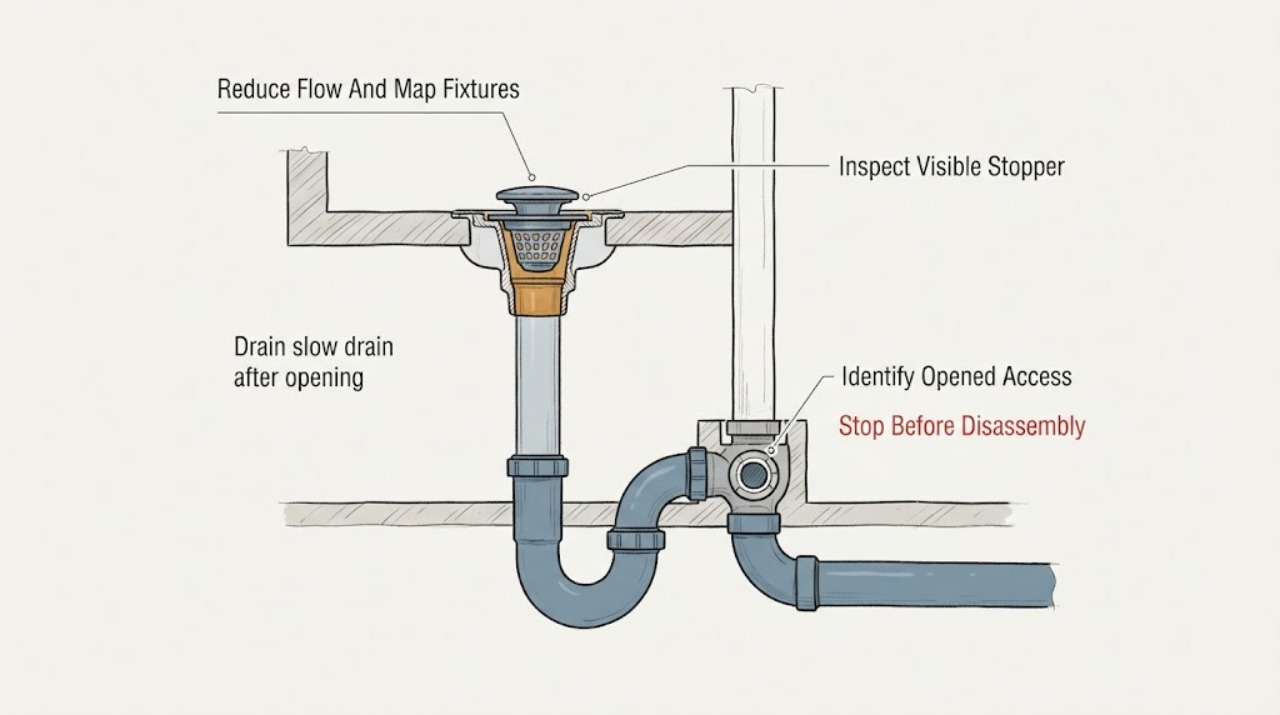
Work through in order
Diagnostic checks
Use only checks that match the exact appliance or system and its official guide.
-
Check 1
From a dry, stable position, identify exactly what was opened: a stopper or strainer at one fixture, a trap, a cleanout cap, or another valve or access point; do not reopen an uncertain cap or reach into standing water.
Expected result: Record the opening, whether it was already loose or fully removed, whether water or sewage was visible, whether any pressure or odor was present, and whether the drain became faster, stayed slow, or stopped draining after the opening.
Next step: Keep the opening identified in your notes and continue only with the matching low-risk branch; arrange plumbing service before reopening a cleanout, trap, or contaminated access point that is not clearly safe.
Stop if: Stop immediately for sewage, chemical odor or splash risk, standing water near electrical equipment, a pressurized or stuck cap, or an opening that cannot be restored without force.
Why this matters
Why: A stopper or strainer opening supports a localized visible check. A trap or cleanout opening changes the spill and pressure risk, while no improvement after opening suggests the restriction is farther along or the opened point is not the blockage location.
-
Check 2
Stop unnecessary water use and, without deliberately flooding or repeatedly flushing, observe the affected fixture and nearby fixtures for their existing drainage behavior.
Expected result: Classify the symptom as one fixture only, more than one fixture, a floor drain or lower fixture backing up, gurgling when another fixture runs, or a strong sewage smell; note whether water level rises or falls on its own.
Next step: Keep water use to a minimum and give the plumber the fixture map and symptom timing; do not test the suspected line by running a full tub, washer, or repeated flushes.
Stop if: Stop all drain testing for rising wastewater, sewage, overflow, contamination, or water approaching electrical equipment.
Why this matters
Why: One isolated slow fixture is more consistent with a local restriction. Several slow fixtures, shared gurgling, a lower-level backup, or sewage odor raises concern for a shared branch, building drain, or sewer lateral and is not a reason to add more water.
-
Check 3
If the opened point is a removable stopper or strainer and the water is clear and fully drained, use gloves and ordinary safe access to look for hair, soap, food particles, or other visible debris at the opening; remove only loose material that comes away without force.
Expected result: Record whether a visible obstruction was present, whether the opening is clear after the loose material is removed, and whether the next small normal use drains more evenly without backup or leakage.
Next step: Replace the stopper or strainer only as designed, wipe the area dry, and use the result to choose the local or professional branch; do not push debris farther into the line.
Stop if: Do not reach into sewage, use a sharp tool, force a stuck fitting, remove a trap, or continue if chemical cleaner may be present.
Why this matters
Why: A clear, localized obstruction with improved drainage supports a near-opening restriction. A clean opening with no improvement suggests a deeper branch, trap, vent, or shared-line issue; resistance or a damaged fitting means the user-accessible check has ended.
-
Check 4
Before any further opening or cleaning, make a safe record of products added to the drain, the time they were added, the amount if known, and whether the water or residue has an unusual color, odor, heat, or irritation risk.
Expected result: Classify the history as no chemical product, an unknown product, a known drain cleaner or descaler, mixed products, or wastewater or sewage present; note any skin, eye, breathing, or splash concern without touching the residue.
Next step: Keep people away, preserve the product containers or names for the plumber, ventilate only from a safe position, and request professional instructions before further access or treatment.
Stop if: Do not mix products, add another chemical, use heat, plunge against suspected chemical liquid, or touch residue; leave the area and seek appropriate urgent help for fumes, burns, or breathing difficulty.
Why this matters
Why: No chemical history leaves a safer basis for a plumber's next step. An unknown, mixed, or caustic product history makes reopening and plunging hazardous, while wastewater changes the cleanup and contamination boundary.
-
Check 5
If a cleanout is visible and dry, observe its exterior and surrounding ground from a safe position without loosening the cap or creating a flow test.
Expected result: Note whether the cleanout area is dry, stained, wet, overflowing, foul-smelling, damaged, or below the level of standing wastewater, and whether the slow drain affects fixtures upstream of it or throughout the property.
Next step: Photograph the cleanout and tell the plumber its location, level, odor, and timing; keep water use low until the downstream path is assessed.
Stop if: Do not remove, drill, pry, strike, or loosen the cleanout cap, and stop if wastewater, gas-like odor, unstable ground, or electrical equipment is nearby.
Why this matters
Why: A dry cleanout does not rule out a deeper restriction, but water or sewage at the cleanout supports a downstream or shared-line concern. A damaged or pressurized-looking cap is not a user repair point.
-
Check 6
Use the opening identity, fixture map, visible-obstruction result, chemical history, cleanout observation, and any change after one safe check to decide the plumbing service scope.
Expected result: Choose localized service for one fixture that remains slow after a clear opening, or shared-line and sewer-lateral assessment for multiple slow fixtures, gurgling, sewage odor, wastewater, or a wet or overflowing cleanout; record when the symptom began and whether weather or a property event preceded it.
Next step: Request a qualified plumber and provide the exact opening, symptom map, photos, chemical history, and safe-access limits; keep the affected fixtures unused until the professional gives a safe test plan.
Stop if: Stop all DIY work for sewage backup, contamination, active leakage, chemical exposure, a blocked essential drain, repeated overflow, or any need to open a pressurized or concealed line.
Why this matters
Why: The pattern determines whether a plumber should begin near the fixture or assess a branch, building drain, cleanout, or sewer lateral. It does not identify a failed part or authorize snaking, camera work, excavation, or line opening by the user.
Use your observations
Decision map
Find the observation that best matches what you see, then follow the next safe action.
-
PATH 01Safety boundary
What you see
Only one fixture is slow, the opened stopper or strainer had loose visible debris, the water was clear, and drainage improved after that debris was removed.
Do this next
Restore the stopper or strainer as designed, monitor ordinary use, and request plumbing service if the slow drain returns or a leak appears.
Why this path and its safety boundary
Why it matters: A near-opening restriction is plausible, but improvement should be confirmed without repeated flushing or pushing material deeper.
Safety stop: Do not force the fitting, use sharp tools, add chemical cleaner, or continue if the fixture backs up or leaks.
-
PATH 02Safety boundary
What you see
One fixture remains slow after a clear stopper or strainer opening, or the opening was clear from the start.
Do this next
Stop at ordinary-access inspection and ask a plumber to diagnose the branch; provide the opening point and before-and-after drainage result.
Why this path and its safety boundary
Why it matters: The restriction may be in the trap, branch, vent, or a concealed section beyond the accessible opening.
Safety stop: Do not remove a trap, snake a concealed line, or push a tool past resistance as a user experiment.
-
PATH 03Safety boundary
What you see
Several fixtures are slow, fixtures gurgle together, a lower fixture backs up, or there is sewage odor or wastewater.
Do this next
Reduce water use, keep people away from wastewater, and request qualified plumbing assessment of the branch and downstream line.
Why this path and its safety boundary
Why it matters: A shared branch, building drain, or sewer lateral concern is more likely than a single stopper obstruction.
Safety stop: Do not keep flushing, run a washer or tub to test flow, reopen a cleanout, or handle sewage without appropriate professional direction.
-
PATH 04Safety boundary
What you see
A drain product was added, products may have been mixed, the product is unknown, or standing water or residue may be chemical or sewage.
Do this next
Leave the access closed, keep people and pets away, retain product information, and request professional instructions; seek urgent help for fumes, burns, or breathing symptoms.
Why this path and its safety boundary
Why it matters: Further opening, plunging, or contact can expose a person to splash, fumes, or a reaction; the ordinary DIY path is not safe.
Safety stop: Do not add another product, use heat, plunge, reach into the liquid, or reopen a cap that could release pressure.
-
PATH 05Safety boundary
What you see
A visible cleanout is wet, stained, overflowing, foul-smelling, damaged, or surrounded by wastewater.
Do this next
Keep water use low, stay clear of the cleanout, photograph it from a safe distance, and call a qualified plumber for line assessment.
Why this path and its safety boundary
Why it matters: The observation raises a downstream or shared-line concern and may involve contaminated water or a pressurized access point.
Safety stop: Do not loosen or remove the cap, enter standing water, use electrical equipment in the wet area, or excavate the line.
Helpful context
Understand the symptom
Clarify what after opening means
The phrase after opening is important because it can mean different things: removing a stopper or strainer, opening a trap or cleanout, or opening a valve or access point elsewhere in the drain path. Note the exact opening, what was visible, whether water was standing there, and whether the drain improved at all. Do not assume that seeing an open passage proves the blockage is gone; the restriction may be beyond that point or in another connected path.
Separate a local restriction from a shared line problem
A single slow fixture with no backup usually supports a localized observation around its stopper, strainer, trap, or nearby branch. Slow drainage at several fixtures, gurgling when another fixture runs, sewage odor, or wastewater at a floor drain points to a shared branch, building drain, or sewer lateral. City guidance recommends reducing water use for a blocked or stubborn drain, because more flow can turn a slow line into an overflow.
Treat chemical history and cleanout pressure as stop signals
Before reopening anything, record whether drain cleaner, descaler, bleach, or another chemical was added. Do not mix products, reach into contaminated water, or reopen a line that may spray chemical solution or wastewater. A cleanout cap can retain pressure or release sewage; observe the area from a safe position and leave removal, drain snaking, camera inspection, and line cleaning to a qualified plumber when the path is not clearly safe.
Safety boundary
Stop conditions
- Stop all testing for sewage backup, wastewater, rising water, strong sewage or chemical fumes, splash, burns, breathing symptoms, or contamination.
- Do not mix drain products, add another chemical, use heat, or plunge against unknown or chemical liquid.
- Do not remove, loosen, drill, pry, strike, or force a trap, cleanout cap, concealed line, or stuck fitting; a cleanout may release pressure or sewage.
- Keep water away from electrical equipment and do not enter standing water to operate a switch, appliance, pump, or tool.
- Do not run repeated flushes, a washer, or a full tub to test a slow or shared line; reduce water use until the path is assessed.
- Stop after one safe visible check when the opening is clear but the drain remains slow, or when more work would require tools, concealed access, or professional line cleaning.
Only after diagnosis
Potential parts
- stopper or strainer assembly
Consider this category only if the accessible stopper or strainer is confirmed damaged, missing, or unable to seat after the blockage is addressed and a compatible replacement is warranted.
Confirm the exact drain opening, dimensions, style, and manufacturer's or plumber's fit guidance before ordering; a new stopper does not clear a deeper line restriction. - trap seal or gasket
Consider this category only when a qualified plumber confirms a trap was opened and its seal is damaged or leaking after safe service.
Confirm the exact trap material, size, connection, and local plumbing requirements; do not remove a trap as a diagnostic experiment. - cleanout cap or seal
Consider this category only after a qualified plumber confirms that an accessible cleanout cap or seal is damaged and is the source of leakage, not the symptom of a blocked line.
Confirm thread, size, material, pressure and drainage application, and local requirements with the plumber; do not loosen a cap that may be pressurized or contaminated.
When checks do not resolve it
Need a professional?
Call a qualified plumber when a drain remains slow after a safe visible stopper or strainer check, when the opened point was a trap or cleanout, when multiple fixtures are affected, or when gurgling, sewage odor, backup, leakage, a wet cleanout, chemical history, or repeated recurrence is present. Keep water use low and provide the exact opening, fixture map, photos, chemical history, and drainage timeline.
Safety scope: This article supports identification, water-use reduction, and ordinary-access visual checks only. Do not handle sewage or chemical liquid, remove a cleanout cap or trap, snake or camera a concealed line, excavate, or perform electrical work in a wet area.
Common questions
FAQ
What does after opening mean for a slow drain?
It means the drain stayed slow after an access point was opened, but the access point matters. A stopper or strainer opening supports a visible local check; a trap or cleanout opening changes spill and pressure risk. Record exactly what was opened and whether flow changed.
Should I keep running water to test the drain?
No. Reduce unnecessary water use while the cause is uncertain. Repeated flushing, a full tub, or a washer load can turn a slow or shared restriction into an overflow, especially when another fixture is also slow or gurgling.
When does a slow drain suggest a main or shared-line problem?
Several slow fixtures, shared gurgling, a lower fixture backing up, sewage odor, wastewater, or a wet cleanout suggests a shared branch, building drain, or sewer lateral concern. Keep water use low and call a qualified plumber.
Can I open the cleanout cap to see whether it is blocked?
Do not loosen or remove a cleanout cap as a test. It may release pressure or sewage. Observe the exterior from a safe, dry position and give the plumber photos, water level, odor, and timing.
What if I already poured drain cleaner into the line?
Do not add another product, mix chemicals, plunge against unknown liquid, or reopen the access point. Keep people and pets away, retain the product information, and request professional instructions; get urgent help for fumes, burns, or breathing symptoms.
Read the exact guide
Official sources
- This Way to a Better HomeU.S. Department of Housing and Urban Development · HUD home-maintenance reference used only for removing an accessible drain cover or strainer for inspection and recognizing when major plumbing work needs an expert; installed-system instructions control.
- Prevent Blocked DrainsCity of Tampa · Municipal wastewater guidance used for general drain-blockage and cleanout observations; local plumbing configuration and rules may differ.
- How to Take Care of Your Sewer LateralSan Francisco Public Utilities Commission · Municipal sewer-lateral guidance used to explain the connection from private fixtures to the public sewer; local ownership and maintenance rules vary.
- Broken Sewer and Drain LinesCity of Portland · Municipal building guidance used for leakage, odor, wastewater, and qualified sewer-line work; it does not replace local plumbing rules.
- Sewer DepartmentCity of Winterset · Municipal sewer-department guidance used for symptom patterns such as multiple slow fixtures, gurgling, sewage odor, and floor-drain wastewater; responsibility varies by jurisdiction.
Community feedback
Share a repair observation
Share a plain-text repair observation. Accepted observations are published automatically; this page may take a moment to update.