
On this page
Start here
Quick answer
If an upstairs bathroom drain becomes slow right after a toilet flush, first treat the timing as a clue rather than proof that the toilet caused the restriction. One sink or tub that is slow with no sound or rise points more toward its stopper, trap, or local branch. Gurgling, water movement in another fixture, a rising tub or shower, or more than one affected drain points toward a shared branch, building sewer, or vent concern. Stop adding water if wastewater backs up, smells strongly of sewage, or appears downstairs. Do not use a chemical opener or plunge after chemicals have been poured; keep the product container and tell the plumber. A qualified plumber can determine whether the restriction is on the private branch, building sewer, vent path, or a public main.
Before you begin
Safety first
- The plumber determines whether the fault is at the fixture, trap, private branch, building sewer, vent path, onsite wastewater system, or public main and selects safe equipment and containment. The homeowner should not enter tanks, open concealed piping, climb to a roof vent, or work in wastewater.
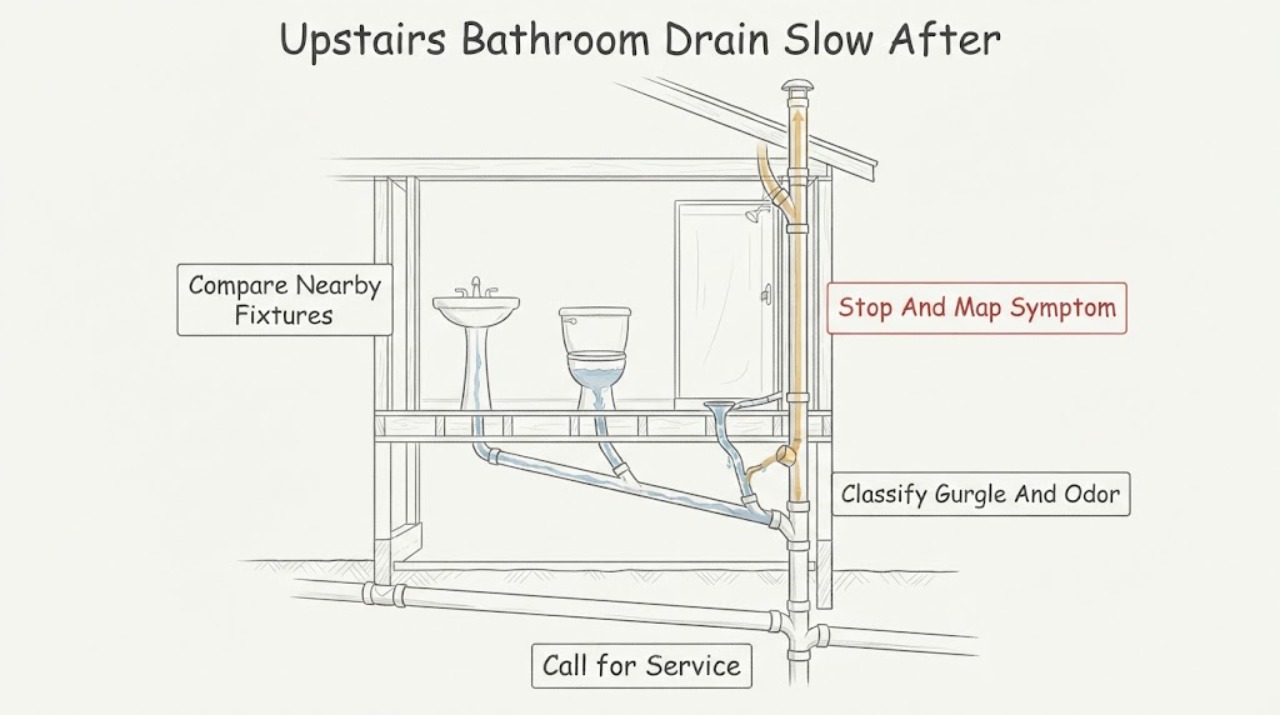
Work through in order
Diagnostic checks
Use only checks that match the exact appliance or system and its official guide.
-
Check 1
Stop adding water while the symptom is present, then from dry flooring record which upstairs fixture is slow and what happened immediately after the toilet flush: gurgle, air movement, standing water, rising water, odor, or no visible change.
Expected result: The sink, tub, or shower is slow with no other response; one or more fixtures gurgle or move; wastewater rises; or the report is only a gradual slow drain with no flush-linked response.
Next step: Photograph the water level and write down the flush timing, affected fixture, sound, odor, and whether the issue is recurring before arranging service.
Stop if: Stop all troubleshooting for wastewater backup, foul sewage odor, active overflow, or water near electrical equipment; keep people and pets away and arrange urgent qualified help.
Why this matters
Why: A single quiet fixture supports a local drain check. A flush-linked response in another fixture, rising water, or sewage odor suggests a shared restriction or wastewater hazard and should not be tested with more water.
-
Check 2
Without deliberately running more water, observe nearby fixtures and any accessible lower-level drain from a dry, safe position after a normal flush has already occurred; do not remove covers or enter pooled water.
Expected result: Only the original sink or tub is slow; a nearby sink, tub, shower, or floor drain gurgles or changes level; several fixtures are affected; or a lower level shows water or staining.
Next step: Use the comparison to tell the plumber whether the symptom is isolated, bathroom-wide, building-wide, or accompanied by a lower-level leak; stop water use when more than one fixture is involved.
Stop if: Do not flush or run faucets to reproduce a backup, lift a floor drain cover, handle sewage, or walk through wet areas near outlets or wiring.
Why this matters
Why: One fixture favors its stopper, trap, or local branch. Several fixtures reacting together favors a shared branch or building sewer issue. Lower-level dampness can indicate a concealed leak or backup path, not merely a slow fixture.
-
Check 3
From the bathroom doorway, note whether the sound occurs during the flush, while the bowl settles, or later, and whether it is accompanied by sewer odor, bubbling, or movement in an unused fixture; do not open a wall or roof vent.
Expected result: There is no sound; a repeatable gurgle follows a flush; bubbling or air movement occurs without backup; or the sound comes with odor, rising water, or sewage.
Next step: Record the exact timing and affected fixture for a plumber; if the pattern repeats or combines with backup, stop all water use and request prompt evaluation.
Stop if: Do not climb, inspect a roof termination, insert a cable into an inaccessible opening, or continue if sewage, strong odor, or water movement creates a contamination risk.
Why this matters
Why: A repeatable flush-linked gurgle can fit a partial shared-line restriction or vent concern, but the sound cannot identify which one. Odor, bubbling with rising water, or sewage makes the situation urgent rather than a vent experiment.
-
Check 4
From a dry, stable location below the upstairs bathroom, look at the ceiling, wall, floor, and visible pipe chase for a fresh stain, damp patch, soft or bulging finish, dripping, or water near electrical equipment; do not open the finish.
Expected result: The area is dry; there is a new stain or dampness; the finish is soft or bulging; active water is visible; or wiring, a light, or an outlet is wet.
Next step: If safely accessible, stop the local water supply and keep the area isolated; provide photos and the first-wet-point location to a plumber and arrange electrical assessment when wiring is involved.
Stop if: Stop for active leakage, ceiling bulging, unstable material, standing water, or any need to touch wet electrical equipment or enter a wet area.
Why this matters
Why: A dry lower level does not rule out an intermittent concealed leak. New dampness or finish movement raises property-damage urgency, and water at electrical equipment adds an electrical hazard independent of the drain diagnosis.
-
Check 5
Ask everyone who used the fixture whether drain opener, toilet cleaner, bleach, descaler, or another chemical was poured into the drain, and record the product name, approximate time, and whether anything was mixed; do not add another product.
Expected result: No chemical was used; a labeled product was used and remains identifiable; products were mixed; or the product and amount are unknown.
Next step: Keep the original container or a photograph, ventilate only as appropriate without spreading fumes, and tell the plumber exactly what was used; seek poison or emergency guidance for exposure symptoms.
Stop if: Do not mix cleaners, pour neutralizer, plunge, snake, remove a trap, bail liquid, or handle splash-contaminated water after chemical use.
Why this matters
Why: No chemical history leaves ordinary, low-risk observations available if no backup is present. Any chemical history changes splash and exposure risk; mixed or unknown products require the plumber to be told before mechanical work.
-
Check 6
Only when there is no wastewater backup, no chemical history, and the problem is isolated to one fixture, inspect the visible stopper or strainer from normal access for hair or debris without opening the wall or forcing a fitting.
Expected result: Debris is visibly caught at the removable surface; the surface is clear; the fixture has a trap or cleanout that is not safely accessible; or water begins to rise while observing.
Next step: Remove only loose visible debris if it can be done without contact with wastewater, then arrange service if flow remains slow; otherwise leave the fixture unused for the plumber.
Stop if: Stop if water rises, sewage appears, a fitting would need force, a cleanout is under pressure, or any tool could splash an unknown substance.
Why this matters
Why: Visible surface debris can explain an isolated slow fixture. A clear surface, inaccessible trap, or rising water makes a deeper local branch or shared-line assessment more likely and is not a reason to use stronger chemicals.
-
Check 7
Prepare a concise service handoff with the fixture map, flush timing, sounds, odors, water levels, lower-level observations, chemical history, property sewer or septic context, and any recent plumbing work.
Expected result: The plumber can see whether the problem is isolated or shared, whether it is recurring after a flush, whether there is a leak or contamination hazard, and whether the home uses a public sewer or an onsite system.
Next step: Keep water use to the minimum needed for safety until advised, request qualified plumbing service, and report any active backup or lower-level seepage as urgent.
Stop if: Do not enter a sewage tank, open concealed piping, climb to a roof vent, use powered drain equipment, or attempt to stop an overflow by working in contaminated water.
Why this matters
Why: This evidence helps the professional choose between a local fixture or branch assessment, building sewer or vent investigation, public-main coordination, or septic-service evaluation. It does not authorize the homeowner to clear a main line or enter a tank.
Use your observations
Decision map
Find the observation that best matches what you see, then follow the next safe action.
-
PATH 01Safety boundary
What you see
Only one fixture is slow and the other observations are normal.
Do this next
Treat the stopper, strainer, trap, or local branch as the focused service discussion. Make only a safe visible-surface observation, then arrange a plumber if flow remains slow.
Why this path and its safety boundary
Safety stop: Stop if the water rises, the problem spreads to another fixture, sewage appears, or a fitting would need force.
-
PATH 02Safety boundary
What you see
Several fixtures gurgle, change level, drain slowly together, or show wastewater backup.
Do this next
Stop using water throughout the affected area and request prompt plumbing evaluation of the shared branch, building sewer, and any public-main boundary.
Why this path and its safety boundary
Safety stop: Do not add water to test the line, handle sewage, or use a chemical opener.
-
PATH 03Safety boundary
What you see
The sound or air movement repeats after flushing, but there is no safe evidence that identifies a particular obstruction.
Do this next
Give the timing and affected fixture to a plumber for a vent-versus-partial-line assessment; do not climb or open a concealed or roof vent.
Why this path and its safety boundary
Safety stop: Escalate promptly if odor, bubbling, rising water, or sewage develops.
-
PATH 04Safety boundary
What you see
The lower level shows a possible concealed leak or water is near electrical equipment.
Do this next
Stop using the affected bathroom, keep people away from the wet area, and arrange prompt plumbing service; use qualified electrical help when wiring or equipment is affected.
Why this path and its safety boundary
Safety stop: Do not touch wet electrical equipment, enter standing water, or open the ceiling or wall.
-
PATH 05Safety boundary
What you see
A chemical may remain in the drain or liquid, or the exposure history cannot be ruled out.
Do this next
Stop mechanical clearing attempts, preserve the product information, and tell the plumber before any service; seek exposure help if anyone has symptoms.
Why this path and its safety boundary
Safety stop: Never mix products or handle unknown liquid without appropriate professional guidance.
-
PATH 06Safety boundary
What you see
The home has an onsite system or the symptom is accompanied by broader wastewater-system warning signs.
Do this next
Reduce water use and contact a qualified plumber or onsite wastewater service provider for a system-level evaluation; provide the symptom timeline.
Why this path and its safety boundary
Safety stop: Do not enter a tank, handle wastewater, or attempt pump, screen, or tank maintenance without qualified service.
Helpful context
Understand the symptom
Why the flush timing matters
A toilet flush briefly moves a large volume of water through the bathroom branch. If the sink, tub, or shower responds at that moment, the event can expose a restriction or air-flow problem farther along the shared path. Timing alone does not identify the blockage: a single fixture can still have a local stopper or trap restriction, while a branch or building sewer can affect several fixtures. Record what changed, which fixtures responded, and whether any water actually rose before adding more water.
Separate a local fixture problem from a shared drain problem
A slow drain limited to one sink or tub, with no gurgling, odor, or water movement elsewhere, supports a local observation and a plumber if it persists. A second fixture that gurgles or moves when the upstairs toilet flushes, or several fixtures that slow together, is a different decision: stop water use and have the branch or building sewer assessed. Missouri Department of Health and Senior Services lists slow drains, gurgling, sewage backup, sewer blockage, and a plugged vent among wastewater warning signs.
Treat wastewater, downstairs dampness, and chemicals as boundaries
Do not handle sewage or enter pooled water. Check the ceiling, wall, or floor below only from a dry, stable position; a new stain, damp patch, soft or bulging finish, or water near wiring can mean the upstairs event has become a concealed leak and needs prompt service. If a drain opener, toilet cleaner, or other chemical was used, do not mix products or use a mechanical tool that could splash the liquid. Keep the labeled container or a photo of it for the plumber.
A vent suspicion is not a roof-access project
A repeatable gurgle after flushing, slow drainage without an obvious local obstruction, or air movement in an unused fixture can fit a vent restriction or a partial shared-line problem. Those signs do not prove that the vent is blocked, and a homeowner should not climb onto a roof or open concealed piping to test the theory. Give the pattern to a plumber, who can choose an appropriate inspection method and distinguish a private line from a public sewer issue.
Safety boundary
Stop conditions
- Stop using water and keep people and pets away for sewage backup, foul wastewater, active overflow, rising water, or several fixtures affected together.
- Stop for water, staining, a bulging ceiling, or a wet area near outlets, lights, or wiring; do not touch wet electrical equipment.
- Stop after drain chemicals were used or mixed; do not add products, plunge, snake, remove a trap, or handle unknown liquid.
- Stop for a need to open walls, enter a sewage tank, climb onto a roof, use powered drain equipment, or work in contaminated water.
- Stop and arrange qualified service when the slow drain returns after a flush, spreads beyond one fixture, or cannot be safely localized.
Only after diagnosis
Potential parts
- stopper or strainer
Consider this only when one fixture is affected and visible stopper or strainer damage is identified; a shared flush-linked symptom is not evidence that this part is the cause.
Confirm the fixture type, dimensions, finish, and manufacturer's fit information before ordering. - drain trap or accessible cleanout component
Consider this only after a qualified plumber identifies a damaged or inaccessible trap or cleanout component during a local-branch assessment.
A plumber must verify pipe material, size, configuration, access, and local requirements; do not select a part from the symptom alone. - vent or branch drain component
Consider this only when professional inspection identifies a damaged vent or branch-line component rather than a temporary surface restriction.
The exact layout, material, size, and permitted repair method must be confirmed on site by qualified plumbing service.
When checks do not resolve it
Need a professional?
Call a qualified plumber for recurring flush-linked slow drainage, gurgling, multiple affected fixtures, suspected branch/main/vent trouble, or any concealed leak. Treat sewage backup, active overflow, downstairs seepage, water near electrical equipment, or chemical history as urgent information when booking.
Safety scope: The plumber determines whether the fault is at the fixture, trap, private branch, building sewer, vent path, onsite wastewater system, or public main and selects safe equipment and containment. The homeowner should not enter tanks, open concealed piping, climb to a roof vent, or work in wastewater.
Have this ready
- The upstairs fixture that is slow and the exact time relative to a toilet flush
- Which other fixtures changed, including gurgling, bubbling, water movement, or rising level
- Photos of water level, the first visible wet point, stains, and any lower-level damage from a safe dry position
- Whether the property uses a public sewer or onsite wastewater system
- Any drain opener, toilet cleaner, bleach, or other chemical used, with the labeled container or a photo
- Recent plumbing work, recurring history, weather timing, and whether water use has been stopped
Common questions
FAQ
Why does my upstairs bathroom drain slow down after I flush?
The flush can reveal a partial restriction or air-flow problem in a shared bathroom branch or building sewer, but timing alone does not prove the cause. If only one fixture is slow, start with a safe visible-surface observation; if other fixtures gurgle, move, or back up, stop using water and request plumbing service.
Does gurgling mean the vent is blocked?
Gurgling can fit a vent concern, but it can also occur with a partial shared-line restriction or another wastewater fault. Record when it happens and which fixture responds; do not climb onto a roof or open concealed piping to test the vent.
What should I do if a downstairs ceiling gets wet after the upstairs flush?
Stop using the affected bathroom, keep people away from the wet area, and arrange prompt plumbing service. Look only from a dry, stable position, and do not touch wet wiring, outlets, lights, a bulging ceiling, or pooled water.
Can I use drain cleaner before calling a plumber?
Do not add a chemical opener when the cause is uncertain, especially when several fixtures are affected or water may back up. If any chemical was already used, do not mix products or use a mechanical tool; keep the label information and tell the plumber before service.
How can a plumber tell whether the problem is my branch or the public sewer?
The plumber or utility compares which fixtures are affected, the property connection, and the location of the restriction. A clear timeline showing that several fixtures respond to an upstairs flush helps them decide whether to investigate a local branch, building sewer, vent path, onsite system, or public main.
Read the exact guide
Official sources
- Sanitary Sewer Overflows (SSOs)U.S. Environmental Protection Agency · Supports treating sewage backup and blockages as contamination, property-damage, and public-health concerns.
- SewerCity of Roseville · Supports distinguishing a public main or service from a private lateral and giving the utility or plumber a clear backup description.
- Household Hazardous Waste (HHW)U.S. Environmental Protection Agency · Supports not mixing or pouring hazardous household products into drains, preserving labels, and using safer professional guidance when chemical history exists.
- Home MaintenanceU.S. Environmental Protection Agency · Supports prompt attention to leaks, safe visual checks, and treating unexplained water as potential home damage.
- Troubleshooting System ProblemsMissouri Department of Health and Senior Services · Supports slow or sluggish drains, gurgling or bubbling fixtures, sewage backup, sewer blockage, plugged vents, wastewater safety, reduced water use, and qualified plumber or service-provider escalation.
Community feedback
Share a repair observation
Share a plain-text repair observation. Accepted observations are published automatically; this page may take a moment to update.