
On this page
Start here
Quick answer
When a drain will not drain, first determine whether the problem is limited to one fixture or affects several drains. A single sink, tub, or shower often points to a local stopper, trap, or branch blockage; slow or backed-up fixtures throughout the home can indicate a larger private sewer line or main-line problem. Stop adding water if the level is rising, keep wastewater away from skin, and do not mix or add drain chemicals. If no chemical cleaner has been used, a properly fitting plunger is a reasonable low-risk first check; a plumber's snake may be appropriate only when the tool and access are suitable. If plunging does not restore flow, the blockage returns, multiple fixtures are affected, or wastewater backs up at a floor drain, stop and contact a licensed plumber or the responsible utility.
Before you begin
Safety first
- The homeowner should not mix chemicals, use mechanical tools against unknown chemical residue, open a cleanout, remove a trap containing standing liquid, or use powered clearing equipment without appropriate safeguards.
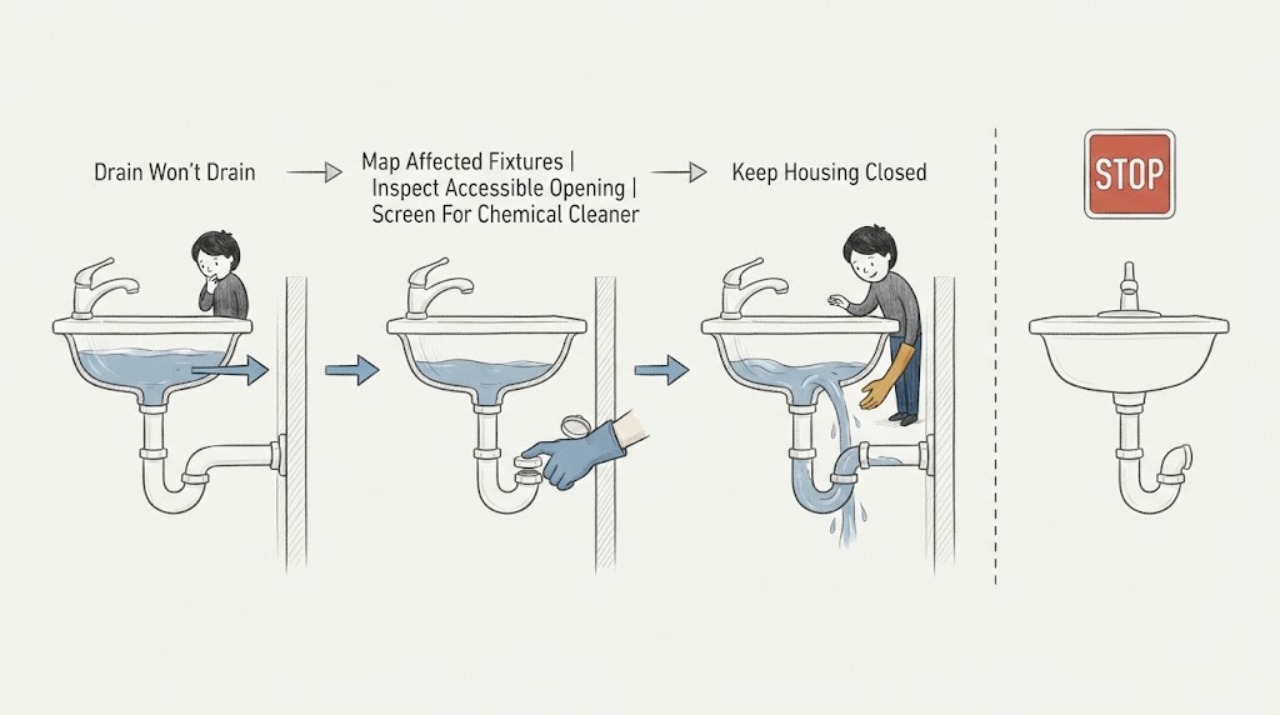
Work through in order
Diagnostic checks
Use only checks that match the exact appliance or system and its official guide.
-
Check 1
Stop running water into the affected fixture and check other nearby sinks, tubs, showers, toilets, and any accessible floor drain without opening a cleanout or entering wastewater. Note which fixtures are slow, completely stopped, gurgling, or backing up.
Expected result: Record whether only one fixture is affected or several fixtures share the same symptom, and whether wastewater rises from a lower floor drain when an upper fixture is used.
Next step: For a single fixture with no chemical cleaner present, continue to the visible-obstruction and plunger checks. For multiple fixtures, a floor-drain backup, or sewage exposure, stop water use and contact the utility or a licensed plumber to locate the blockage.
Stop if: Stop immediately if wastewater is rising, spreading, smells strongly of sewage, or could contact skin, electrical equipment, or living areas; keep people and pets away and arrange professional help.
Why this matters
Why: A single affected fixture is more consistent with a local fixture, trap, or branch restriction. Several affected fixtures or a floor-drain backup points farther downstream toward a private service line or sewer main and should not be treated as a simple sink clog.
-
Check 2
From a dry, stable position, inspect the drain opening, strainer, and stopper for hair, food, wipes, or another visible obstruction. Remove only an obvious surface item that can be lifted without reaching into standing wastewater or disassembling the plumbing; wear appropriate gloves and place removed material in the trash.
Expected result: See whether the opening becomes clear and water begins to move, or whether the water level and blockage remain unchanged.
Next step: If the opening is clear and no chemical cleaner was used, try a correctly sized plunger. If the item cannot be reached safely, the fixture has standing wastewater, or chemical cleaner may be present, stop and call a plumber.
Stop if: Do not reach into unknown liquid, cut pipe, remove a trap, or use a tool if a chemical opener may be present or the access is unstable.
Why this matters
Why: A visible obstruction that restores flow points to a local blockage. No change means the restriction may be below the opening, in the trap or branch, or farther downstream; it is not a reason to add more chemicals or force a tool.
-
Check 3
Before any plunger, snake, trap work, or water addition, establish whether anyone has poured drain opener or another cleaner into the blocked fixture or connected line. Check the product container or ask occupants; do not taste, smell closely, or put hands into the water to identify it.
Expected result: If no chemical product was used, ordinary low-risk mechanical checks may remain possible. If a chemical product was used, the product and approximate time may be known or uncertain, but the standing water should be treated as potentially hazardous.
Next step: With known or possible chemical cleaner, keep the area ventilated without leaning over the drain, keep people and pets away, preserve the product information, and tell a licensed plumber what happened. With no chemical cleaner, proceed only to a controlled plunger check.
Stop if: Never mix products, add a second cleaner, use a plunger or snake against unknown chemical residue, or handle a leaking container; seek professional or local hazardous-material guidance.
Why this matters
Why: Chemical residue can make splashing, trap removal, or mechanical clearing unsafe. EPA says to follow product labels and not mix hazardous household products; uncertainty about the product is a reason to stop rather than guess.
-
Check 4
Only when the drain is free of chemical cleaner and the fixture and overflow are accessible, use a plunger that seals the opening without excessive force. Keep your face away from the opening, use controlled strokes, and stop if the fixture, connected fixture, or water level behaves unexpectedly; do not use a vehicle, compressed air, or improvised pressure device.
Expected result: The water may move and begin draining, move briefly and return, remain fully blocked, or rise in another fixture.
Next step: Run only a small amount of clean water to confirm stable drainage after a successful check. If flow is not restored, the blockage returns, or another fixture backs up, stop and contact a licensed plumber.
Stop if: Stop if the plunger cannot seal, the fixture may crack or overflow, water moves to another fixture, or chemical cleaner might be present.
Why this matters
Why: A sustained return of flow suggests the local restriction may have opened. Brief movement followed by a stop suggests the obstruction remains or lies farther along. Water rising elsewhere indicates a shared downstream restriction and makes continued plunging inappropriate.
-
Check 5
If a suitable plunger does not restore stable flow, document the fixture pattern, water level, sounds, visible material, any prior chemical use, and what was tried. Request a licensed plumber or the responsible utility to locate the obstruction before authorizing stronger equipment or line work.
Expected result: A professional can establish whether the restriction is local, in a private service line, or in the public main, and can identify recurring roots, pipe damage, or a vent or layout issue when the symptom does not clear.
Next step: Provide the service professional with the full symptom and chemical-use history. Keep affected fixtures out of use until flow is confirmed and the cause of recurrence is addressed.
Stop if: Do not keep adding water, repeat forceful attempts, open a cleanout, remove a trap containing unknown liquid, or use powered equipment without appropriate training and safeguards.
Why this matters
Why: Persistent or widespread symptoms are not proof that a stronger consumer chemical or more force will solve the problem. The location determines whether a fixture-level clearing, private-line repair, or utility response is appropriate.
Use your observations
Decision map
Find the observation that best matches what you see, then follow the next safe action.
-
PATH 01Safety boundary
What you see
Two or more fixtures are slow or backed up, or wastewater rises through a basement or floor drain.
Do this next
Stop using water and contact the responsible utility or a licensed plumber to locate the obstruction before attempting local clearing.
Why this path and its safety boundary
Why it matters: The restriction may be in a shared branch, private sewer service line, or public main rather than at one drain opening.
Safety stop: Do not keep flushing or running faucets, and keep people and pets away from wastewater.
-
PATH 02Next step
What you see
Drain opener or another chemical may have been added to the blocked line, or nobody can establish what was used.
Do this next
Do not add or mix products and do not plunge, snake, or remove the trap. Preserve the label information, keep the area clear, and tell a licensed plumber or appropriate local hazardous-material service what occurred.
Why this path and its safety boundary
Why it matters: Standing water and splashes may contain a hazardous residue, and mechanical clearing can spread it.
-
PATH 03Next step
What you see
Only one fixture is affected, no chemical cleaner was used, and a visible obstruction is accessible without entering wastewater.
Do this next
Remove only the accessible surface material without disassembly, then use a correctly fitting plunger if needed. Stop if flow does not remain restored.
Why this path and its safety boundary
Why it matters: The problem may be a local blockage near the opening.
-
PATH 04Next step
What you see
A controlled plunger check restores flow and no other fixture backs up.
Do this next
Confirm with a small amount of clean water, monitor for recurrence, and arrange a plumber if the drain slows again, gurgles, or affects another fixture.
Why this path and its safety boundary
Why it matters: The restriction may have shifted or opened locally, but recurrence can indicate remaining buildup or a deeper problem.
-
PATH 05Next step
What you see
The plunger does not restore flow, flow returns only briefly, the tool cannot seal, or the blockage recurs.
Do this next
Stop escalating force and contact a licensed plumber with the fixture and chemical-use history.
Why this path and its safety boundary
Why it matters: The obstruction may be below the local opening, the access may be unsuitable, or the line may have another defect.
Helpful context
Understand the symptom
Start with the pattern, not the product
A completely stopped drain does not by itself identify where the obstruction is. A bathroom sink that alone stays full can have a local blockage near its stopper or trap. If a tub, sink, toilet, or floor drain also slows or backs up, the restriction may be farther downstream in the branch or sewer service line. That distinction changes the next step: a local, accessible obstruction may respond to a plunger or suitable hand tool, while a widespread backup needs a plumber or utility to establish which line is blocked.
Keep chemical and mechanical methods separate
Do not pour more cleaner into standing water and do not combine products. EPA classifies some leftover household cleaners as hazardous and says to follow the product label for safe handling and disposal. Wisconsin DNR lists a plunger or drain snake as a nonhazardous alternative for drain cleaner. If a chemical opener has already been used, tell the plumber exactly what product was used and when; do not plunge, snake, remove a trap, or handle the standing water until a professional gives safe instructions for that situation.
What a successful first check does and does not prove
If a plunger restores flow, the obstruction may have shifted or opened, but a recurring or incomplete improvement still needs attention. If a snake reaches resistance without restoring drainage, the restriction may be deeper, the access may be unsuitable, or the pipe may have a defect. Neither result proves that the line is permanently clear. Stop escalating force when the water level rises, another fixture backs up, or the tool cannot be controlled safely.
Safety boundary
Stop conditions
- Stop adding water when the level is rising or wastewater is backing up elsewhere.
- Do not mix drain cleaners or add a second product to a blocked line.
- Do not plunge, snake, remove a trap, open a cleanout, or handle standing water when chemical cleaner may be present.
- Do not use compressed air, powered equipment, a vehicle, or improvised pressure to force a blockage clear.
- Stop and arrange professional help for multiple affected fixtures, a floor-drain backup, sewage exposure, recurring blockage, pipe damage, or an uncontrolled overflow.
When checks do not resolve it
Need a professional?
Safety scope: The homeowner should not mix chemicals, use mechanical tools against unknown chemical residue, open a cleanout, remove a trap containing standing liquid, or use powered clearing equipment without appropriate safeguards.
Common questions
FAQ
Why do several drains stop draining at once?
Several slow or backed-up fixtures, especially with wastewater rising at a floor drain, can indicate a shared branch, private sewer service line, or public main problem rather than one local drain opening. Stop using water and have the line located.
Can I use a plunger on a drain that has drain cleaner in it?
Do not guess. If chemical cleaner was used or may be present, do not plunge, snake, remove a trap, or handle the standing water; preserve the product information and tell a licensed plumber. EPA advises careful handling and not mixing hazardous household products.
Should I add more chemical cleaner when the drain is still blocked?
No. Do not add or mix products in a blocked line. Use only a suitable mechanical check when the line is free of chemical residue, or arrange professional help.
When is a drain blockage a plumber's job?
Call a licensed plumber when flow does not return after a controlled, chemical-free plunger check, the symptom recurs, multiple fixtures are affected, wastewater backs up at a floor drain, the pipe may be damaged, or chemical residue may be present.
Read the exact guide
Official sources
- Household Hazardous Waste (HHW)U.S. Environmental Protection Agency · Lists a plunger or plumber's snake as an alternative to drain cleaner and advises following labels and not mixing hazardous household products.
- Sanitary Sewer MaintenanceCity of South St. Paul, Minnesota · Explains that one backed-up fixture is more likely inside the house, while multiple slow fixtures or a floor-drain backup may involve the private service line or public main.
- Household hazardous wasteWisconsin Department of Natural Resources · Identifies drain cleaner as household hazardous waste and lists a plunger or drain snake as a nonhazardous alternative while warning against incompatible chemical mixtures.
Community feedback
Share a repair observation
Share a plain-text repair observation. Accepted observations are published automatically; this page may take a moment to update.