
On this page
Start here
Quick answer
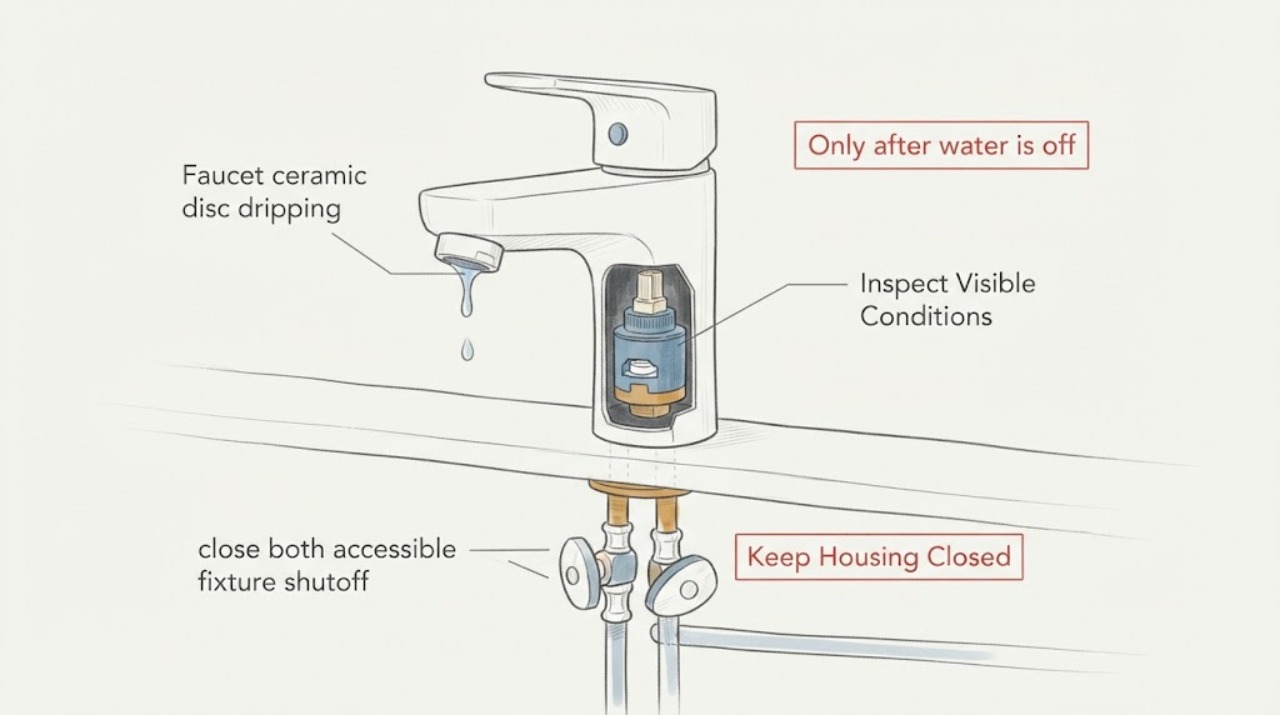
A ceramic-disc faucet that drips continuously after the handle is closed usually needs its cartridge, ceramic valve, seals, or valve seat assessed; a drip that stops soon after shutoff may instead be residual water or debris at the outlet. Identify where and when water appears first. Before any handle or valve disassembly, close the fixture's hot and cold shutoff valves, open the faucet to release pressure, and verify that water has stopped. If a shutoff will not close, the drip is from a supply connection, or the faucet still leaks after a compatible cartridge or seal service, stop and call a plumber.
Work through in order
Diagnostic checks
Use only checks that match the exact appliance or system and its official guide.
-
Check 1
With the handle fully closed, dry the spout and base with a towel and observe the faucet without turning on other fixtures.
Expected result: Record whether drops come from the spout, handle, base, supply connection, or below the sink, and whether the drip stops after a short drain-down or continues steadily.
Next step: Photograph the leak location and prepare the faucet model information; if water is at a supply connection or cabinet, protect the area and consider prompt plumbing service.
Stop if: Stop if water is spraying, the cabinet is flooding, the leak is near electrical equipment, or the source cannot be seen safely.
Why this matters
Why: A brief spout drip can be residual water or aerator debris; a continuous spout drip points toward the valve or cartridge. Water at the base or supply connection may not be a ceramic-disc fault.
-
Check 2
Before removing a handle or valve, close both accessible fixture shutoff valves, open the faucet briefly, and confirm that flow and pressure have stopped.
Expected result: The faucet should stop supplying water and no pressure should return while the valves remain closed; a valve that turns freely without stopping flow is a failed shutoff.
Next step: Proceed only when the fixture is dry and depressurized; otherwise close the nearest safe upstream isolation if known and call a plumber.
Stop if: Stop immediately for a shutoff that will not close, a seized valve requiring force, uncontrolled flow, or uncertainty about which line supplies the fixture.
Why this matters
Why: A depressurized fixture is the required starting condition for disassembly. If water continues, the fixture cannot be safely opened at this scope and the building supply may need professional isolation.
-
Check 3
Only after water is off and pressure is released, remove the handle and valve cover according to the faucet's model-specific documentation, then inspect the accessible cartridge or ceramic-disc assembly without forcing it.
Expected result: Look for mineral debris, a damaged or flattened seal, corrosion, a cracked cartridge body, or a valve assembly that does not match the faucet model; keep small parts organized.
Next step: Use the faucet model and the removed part for compatibility confirmation; stop at damaged, seized, or uncertain components and arrange professional repair.
Stop if: Stop for trapped pressure, broken ceramic, sharp fragments, corrosion that may damage the body, or any need to force, drill, or cut the faucet.
Why this matters
Why: Debris or worn seals may explain a drip, while a cracked or incorrect cartridge requires a compatible replacement. Damage in the valve body or seized components can exceed a simple parts change.
-
Check 4
After a confirmed compatible cartridge, ceramic-disc valve, or seal service is installed by the appropriate person, reopen the fixture shutoffs slowly while watching the faucet and connections.
Expected result: Check for a continuing spout drip, seepage around the handle or base, leaks under the sink, and normal hot/cold control as pressure returns.
Next step: Close the fixture shutoffs again if safe and arrange plumbing service when the drip persists or any connection leaks.
Stop if: Stop reopening for testing if water runs uncontrolled, a connection leaks, the handle binds, or water reaches electrical equipment.
Why this matters
Why: A dry result supports the serviced part as the cause; a continuing drip or new seepage suggests wrong fit, valve-body damage, a remaining seal problem, or a different leak path.
-
Check 5
If the drip remains, compare its location and timing with the original record without repeatedly cycling or tightening the faucet.
Expected result: Record whether it is continuous at the spout, appears only while the handle moves, returns at the base, or occurs at a supply line; note any cabinet swelling or persistent dampness.
Next step: Keep water isolated when practical, protect the cabinet, and provide the plumber with the model, part identity, leak location, and what changed during testing.
Stop if: Stop all use for flooding, a failed shutoff, structural cabinet damage, mold-like growth, or water near electrical devices.
Why this matters
Why: A persistent spout drip after compatible service may indicate valve-body or cartridge fit issues, while base or supply leakage calls for a different plumbing diagnosis.
Use your observations
Decision map
Find the observation that best matches what you see, then follow the next safe action.
-
PATH 01Safety boundary
What you see
The drip stops shortly after the handle closes and is confined to the spout.
Do this next
Inspect or professionally clean the aerator only if it is safely accessible; if the drip becomes continuous, reassess the cartridge or valve.
Why this path and its safety boundary
Safety stop: Do not disassemble the valve while the fixture water is on or assume a short drain-down proves the ceramic disc is sound.
-
PATH 02Safety boundary
What you see
The spout drips continuously with the handle closed.
Do this next
Close and verify both fixture shutoff valves before any disassembly, then identify the model-specific ceramic-disc cartridge or valve.
Why this path and its safety boundary
Safety stop: Do not open the faucet if a shutoff fails, pressure remains, or the cartridge is seized.
-
PATH 03Safety boundary
What you see
Water appears at the handle, base, supply connection, or under-sink line rather than the spout.
Do this next
Keep the fixture isolated and request plumbing assessment for seals, connections, or body damage instead of ordering a ceramic-disc part by symptom alone.
Why this path and its safety boundary
Safety stop: Do not tighten or dismantle a wet connection by force, and do not leave an expanding cabinet leak unattended.
-
PATH 04Safety boundary
What you see
The cartridge or ceramic-disc assembly is cracked, corroded, seized, or does not match the model.
Do this next
Stop and have a plumber confirm the correct replacement and inspect the valve body before reassembly.
Why this path and its safety boundary
Safety stop: Do not pry ceramic fragments, drill the faucet, or substitute a part based only on appearance.
-
PATH 05Safety boundary
What you see
The faucet still drips or seeps after compatible service and slow reopening.
Do this next
Close the fixture shutoffs if safe and call a plumber with the model, leak location, and test observations.
Why this path and its safety boundary
Safety stop: Stop repeated water cycling and leave the fixture isolated for uncontrolled flow, electrical contact, or cabinet flooding.
Helpful context
Understand the symptom
First separate a short drain-down from a continuous drip
KOHLER's faucet guidance distinguishes a temporary drip caused by debris at the aerator from a continuous leak associated with a worn valve or cartridge. The EPA WaterSense program also advises turning off the water line before working on a dripping faucet. That distinction keeps a ceramic-disc diagnosis focused and prevents opening a pressurized fixture.
A replacement part must match the faucet
Ceramic-disc cartridges and related seals are not universal. The faucet model, valve family, handle arrangement, and leak location determine which part could fit. A visible drip does not by itself prove that the ceramic disc is cracked, so inspect only after the fixture water is off and the lines are depressurized.
Only after diagnosis
Potential parts
- faucet cartridge
Consider this only when continuous spout dripping and the model-specific inspection support cartridge or valve wear; it is not a general fix for a base or supply-line leak.
Confirm faucet model, valve family, dimensions, handle arrangement, and manufacturer fit information before ordering. - faucet repair kit
Consider this only when the confirmed faucet design uses serviceable seals or ceramic-disc components and the water is isolated before service.
Match the exact model and valve assembly; do not assume a kit fits because the faucet has a similar appearance. - faucet o-ring kit
Consider this only when inspection identifies a worn or flattened accessible O-ring at the leak location rather than a damaged cartridge or valve body.
Confirm seal material, size, location, and potable-water suitability for the faucet model before use.
When checks do not resolve it
Need a professional?
Call a plumber when a fixture shutoff will not stop water, the leak is at a supply connection or valve body, a ceramic component is cracked or seized, water is reaching electrical equipment, or dripping continues after compatible service.
Have this ready
- Provide the faucet model if known, drip location and timing, photos, shutoff behavior, whether pressure was released, the inspected part identity, and any cabinet or floor water damage.
Common questions
FAQ
Why does a ceramic-disc faucet drip after I turn it off?
A brief drip may be residual water or aerator debris, while a continuous drip can indicate a worn cartridge, ceramic valve, or seal. Locate the leak first and isolate water before any disassembly.
Do I need to shut off water before removing the faucet handle?
Yes. Close the fixture's hot and cold shutoff valves, open the faucet to release pressure, and verify that flow has stopped before opening the handle or valve area.
Can any ceramic-disc cartridge replace the dripping one?
No. Cartridge and seal fit depend on the faucet model and valve design. Confirm the exact model and compatible part before ordering or installing.
When should a plumber handle the drip?
Call a plumber for a failed shutoff, uncontrolled flow, supply-connection leak, seized or cracked ceramic parts, water near electricity, or a drip that continues after compatible service.
Read the exact guide
Official sources
- How to Fix a Leaky Sink FaucetKohler Co. · Supports the ordered safety and diagnostic distinction for a dripping faucet without asserting brand-specific fit for this unbranded topic.
- Leaking from End of SpoutKohler Assist · Supports the article's first branch for residual aerator water versus continuous valve/cartridge leakage.
- Fix a Leak WeekU.S. Environmental Protection Agency WaterSense · Supports identifying leak location and isolating the water supply before faucet repair.
Community feedback
Share a repair observation
Share a plain-text repair observation. Accepted observations are published automatically; this page may take a moment to update.