
On this page
Start here
Quick answer
A faucet that continues dripping with its handle closed usually has a shutoff problem in the cartridge, stem, washer, or seat, but a drip from the base, handle, hose, or supply connection is a different leak path. First dry the faucet and identify where water starts, then determine whether a high-arc spout is only releasing residual water for a short period or is being continuously supplied. Check the faucet type and model information before choosing a cartridge or seal because parts vary by design and are not interchangeable by appearance. You may inspect visible connections and, if clearly labeled and safe to reach, close the local supply valves by hand to limit water damage; do not force a valve, remove the handle or cartridge, or work on a pressurized fitting without the correct model procedure. Arrange plumbing service for a continuous spout drip, water under the sink, a stuck shutoff, concealed leak, damaged faucet body, or any repair that requires disassembly and pressure isolation.
Before you begin
Safety first
- Do not disassemble a pressurized faucet, force a corroded shutoff, loosen a supply connection, use tools on a leaking fitting, or work on a concealed or wall-mounted valve without the correct model procedure and safe isolation. Keep water away from electrical equipment and do not leave an uncontrolled leak unattended.
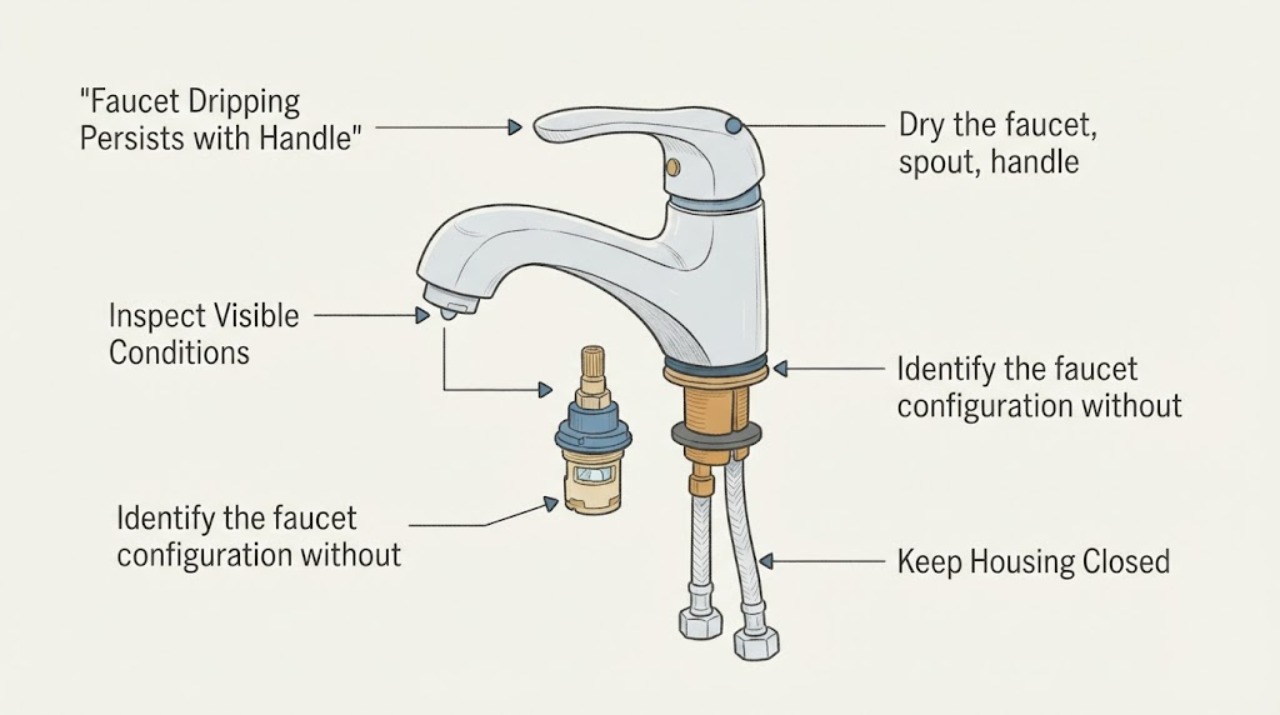
Work through in order
Diagnostic checks
Use only checks that match the exact appliance or system and its official guide.
-
Check 1
Dry the faucet, spout, handle, base, countertop, and under-sink cabinet. With the handle in its normal closed position, watch where the first new drop forms and trace upward without touching a hot surface or moving a pressurized connection.
Expected result: Water forms at the spout outlet; around the handle or base; at a hot or cold hose and valve under the sink; or at the body, escutcheon, or wall area behind the faucet.
Next step: Photograph the first wet location and place a container or towel to protect the cabinet. If a supply valve is clearly labeled and turns freely by hand, close it to limit damage; otherwise stop and arrange plumbing service.
Stop if: Stop for water near electrical equipment, an uncontrolled stream, a stuck or corroded shutoff, a concealed wall leak, or any need to loosen a pressurized fitting.
Why this matters
Why: A spout outlet drip points toward the faucet's shutoff cartridge, stem, washer, or seat. A handle or base leak points toward an internal seal or body joint. An under-sink hose or valve leak is a supply-side problem, and a wall or concealed leak needs a different service response.
-
Check 2
For a spout drip, leave the faucet untouched after closing the handle and observe whether the water stops after the water held in the spout has drained. Do not repeatedly open and close the handle or use a tool to force it farther toward the closed position.
Expected result: A high-arc spout releases a few residual drops and then stays dry; the drip continues at a steady or recurring rate; or the water runs rather than drips.
Next step: Record the spout shape and whether the drip stopped. If it continues, close a freely operating local supply valve if one is clearly identified and arrange service rather than trying to tighten the handle or spout.
Stop if: Stop if the flow increases, the handle becomes loose or stuck, the faucet body moves, or the drip reaches an electrical appliance or cabinet contents.
Why this matters
Why: A short-lived high-arc drip can be residual water, not a failed valve. A continuing or recurring drip means water is still passing the shutoff and needs a valve or cartridge diagnosis; a running stream raises the urgency and possible supply-valve or major internal failure.
-
Check 3
Identify the faucet configuration without disassembly: single handle or two handles, kitchen, bathroom, tub, shower, or specialty fixture; pull-out or fixed spout; and the brand or model marking on the faucet, manual, or receipt if available.
Expected result: The faucet has one cartridge, separate hot and cold controls, a diverter or specialty valve, no readable model information, or a recent cartridge or handle installation.
Next step: Use the manufacturer's identification and parts guide or give the configuration and photographs to a plumber. Do not order a generic cartridge or assume a part from another model will fit.
Why this matters
Why: Different faucet families use different cartridges, stems, washers, seats, diverters, and seals. A recent installation or repair can leave a seal mis-seated or a handle not fully in the closed position, while missing model information makes a visually matched part unreliable.
-
Check 4
Inspect visible hot and cold supply hoses, shutoff valves, mounting area, and cabinet floor for droplets, mineral trails, corrosion, or a wet connection while the faucet remains closed. Do not tighten or loosen a nut, hose, or valve to test it.
Expected result: The faucet is dry under the sink and water only exits the spout; a hose or valve is wet; the cabinet is wet but the faucet body is dry; or water appears only when the handle is moved.
Next step: Photograph the wet connection, place a container beneath it, and close a clearly labeled local valve by hand only if it turns freely. Arrange plumbing service for a supply leak, corroded valve, or water under the cabinet.
Stop if: Stop for a corroded or immovable valve, a pressurized spray, water near electrical equipment, or any need to access a concealed connection.
Why this matters
Why: A dry supply area keeps the internal faucet valve high on the list. A wet hose, valve, or cabinet connection identifies a separate supply leak that can continue even when the handle is closed. Movement-dependent water can indicate a body, stem, or mounting seal issue.
-
Check 5
After the visible check, prepare the service handoff: record the leak location, whether it is continuous or residual, faucet type and model, hot or cold side if known, any recent work, local shutoff status, and photographs before anything is removed.
Expected result: The evidence shows a continuous spout drip, handle or base leak, supply-side leak, recent installation symptom, or a leak whose source cannot be seen safely.
Next step: Arrange qualified plumbing service for disassembly, pressure isolation, cartridge or washer replacement, or concealed work. Keep the local valve closed if it was safely closed, and do not restore pressure to a connection that is actively leaking.
Stop if: Stop all hands-on troubleshooting for an uncontrolled leak, damaged faucet body, concealed leak, failed shutoff, or any repair requiring removal of pressurized parts.
Why this matters
Why: These patterns lead to different scopes: a model-specific cartridge or stem, seal or mounting repair, hose or shutoff replacement, correction of recent assembly, or concealed plumbing investigation. The source location is more useful than the drip count alone.
Use your observations
Decision map
Find the observation that best matches what you see, then follow the next safe action.
-
PATH 01Next step
What you see
Water continues from the spout outlet with the handle closed after residual water should have drained, and the under-sink supply area is dry.
Do this next
Use the manufacturer's model-specific parts information or arrange plumbing service for valve diagnosis and replacement. Do not force the handle or buy a cartridge by appearance.
Why this path and its safety boundary
Why it matters: A cartridge, stem, washer, seat, or internal seal is more likely than a supply-hose leak. The exact repair depends on faucet type and model.
-
PATH 02Next step
What you see
The spout stops, but water appears around the handle, base, mounting area, or only when the handle is moved.
Do this next
Arrange model-specific service and provide photographs. Keep the cabinet dry and do not tighten hidden retaining parts or disassemble the handle while the supply remains pressurized.
Why this path and its safety boundary
Why it matters: A cartridge O-ring or grommet, handle mechanism, mounting seal, body joint, or improper recent installation is more likely than a leak through the spout outlet.
-
PATH 03Next step
What you see
The faucet body is dry but a hot or cold hose, shutoff valve, connection, or cabinet floor becomes wet.
Do this next
Close a clearly labeled local valve by hand only if it turns freely and arrange plumbing service for the hose, valve, or connection. Stop if the valve is corroded, stuck, or sprays water.
Why this path and its safety boundary
Why it matters: The leak is on the supply side and can continue independently of the handle position. A cartridge replacement would not correct it.
-
PATH 04Next step
What you see
A high-arc spout releases a small amount of water after closing but then remains dry, with no wet handle, base, or cabinet.
Do this next
Monitor whether it stops after the normal drain-down period. Arrange service if it returns repeatedly, never stops, or is accompanied by another leak path.
Why this path and its safety boundary
Why it matters: Water retained in the spout can drain by gravity and may be normal rather than an ongoing valve leak.
-
PATH 05Next step
What you see
The drip began immediately after installation or cartridge work, the model is unknown, the shutoff cannot isolate the faucet, or water is coming from a concealed area.
Do this next
Stop disassembly, protect the cabinet, and arrange a plumber who can identify the faucet and isolate the water safely before service.
Why this path and its safety boundary
Why it matters: Incorrect assembly, a damaged or mismatched seal, a supply or valve problem, or a concealed plumbing leak is possible. A generic replacement part is not a safe conclusion.
Helpful context
Understand the symptom
Where the water appears changes the diagnosis
Water from the spout with the handle fully closed is usually a valve-sealing symptom: a cartridge, stem, washer, seat, or internal seal may not be closing the water path. Water appearing around the handle, base, or under the sink can instead come from a cartridge seal, body joint, hose, valve, or connection. A high-arc spout can also release water that was already retained in the spout, but that residual should not continue indefinitely. Locate the start of the water before buying a part.
Protect the cabinet and avoid pressurized disassembly
Wipe the area dry, place a container under a spout drip, and use towels under the cabinet while arranging service. If a clearly labeled local supply valve turns freely by hand, it may be closed to limit damage; do not force a stuck valve. Do not remove a handle, cartridge, hose, or supply fitting while water is pressurized, and do not work on a concealed or wall-mounted valve without its model procedure and safe access.
Only after diagnosis
Potential parts
- faucet cartridge or stem assembly
Consider this category only when a continuous spout drip or handle leak is confirmed as an internal valve symptom and the faucet model and configuration identify the correct assembly.
Confirm the exact faucet model, handle count, valve family, dimensions, orientation, and manufacturer parts diagram. Cartridges that look alike may not be interchangeable. - faucet washer, seat, O-ring, or grommet
Consider this category only when the identified faucet design uses a serviceable washer, seat, O-ring, or grommet and the leak location supports that seal as the cause.
Match the exact faucet design and seal material or dimensions from the manufacturer's documentation. Do not substitute a generic seal without confirming the fit and water-service use. - faucet supply hose or shutoff valve
Consider this category only when a visible under-sink inspection identifies the hose, valve, or connection as the source rather than the faucet outlet.
Confirm connection type, length, valve configuration, material, and local plumbing requirements. A supply-side part will not repair an internal spout drip.
When checks do not resolve it
Need a professional?
Stop and arrange qualified plumbing service for a continuous spout drip, a running leak, water under the sink, a stuck or corroded shutoff, a concealed leak, a damaged faucet body, water near electrical equipment, or any repair requiring removal of a handle, cartridge, stem, washer, hose, or pressurized fitting. A short high-arc residual drip may be normal only if it stops and no other leak path is present.
Safety scope: Do not disassemble a pressurized faucet, force a corroded shutoff, loosen a supply connection, use tools on a leaking fitting, or work on a concealed or wall-mounted valve without the correct model procedure and safe isolation. Keep water away from electrical equipment and do not leave an uncontrolled leak unattended.
Common questions
FAQ
Why does my faucet drip even when the handle is closed?
If the spout continues dripping after residual water has drained, the internal shutoff may not be sealing. A cartridge, stem, washer, seat, O-ring, grommet, or recent assembly issue can be involved, and the correct part depends on the faucet model. A leak at the handle, base, hose, or valve is a different path.
Is a drip from a high-arc faucet always a failed cartridge?
No. A high-arc spout can retain water after the handle is closed and release it for a short period. If the spout becomes dry and stays dry, that may be residual water. A drip that continues or returns, or water that appears around the base or under the sink, needs leak diagnosis.
Can I tighten the faucet handle to stop the drip?
Do not force or tighten the handle as a generic fix. A persistent spout drip usually needs the model-specific cartridge, stem, washer, or seat identified, while a base or under-sink leak may not involve the handle at all. Arrange service if the handle is loose, stuck, or does not reach its normal closed position.
How do I know whether the leak is under the sink instead of inside the faucet?
Dry the area and watch for the first new moisture with the handle closed. A wet hose, shutoff valve, connection, or cabinet floor indicates a supply-side leak that can continue independently of the handle. A dry cabinet with water only at the spout keeps an internal valve issue higher on the list.
How do I choose a replacement cartridge for a dripping faucet?
Identify the faucet model and configuration first, then use the manufacturer's parts diagram or a plumber's identification. Cartridge families and seal sizes are not universal, and a visually similar part may not fit or seal. Do not remove a cartridge from a pressurized faucet to compare it.
Read the exact guide
Official sources
- My faucet has a high-arc spout and it does not immediately shut off after the handle(s) are turned off. Why is this?Moen Solutions · Manufacturer explanation for a short-lived high-arc spout drip that is not necessarily a continuous leak
- Fixture leaks from the end of the spoutMoen Solutions · Manufacturer troubleshooting for faucet water leaking from the spout end or handle area
- WaterSense Labeled Homes Technical Sheet: Free of Water LeaksU.S. Environmental Protection Agency, WaterSense · Government leak-check guidance for faucet outlets and hot and cold connections, hoses, and valves
- Find Parts and Identify Your ProductDelta Faucet · Manufacturer parts guidance for identifying cartridges and repair categories for spout, base, and handle drips
Community feedback
Share a repair observation
Share a plain-text repair observation. Accepted observations are published automatically; this page may take a moment to update.