
On this page
Start here
Quick answer
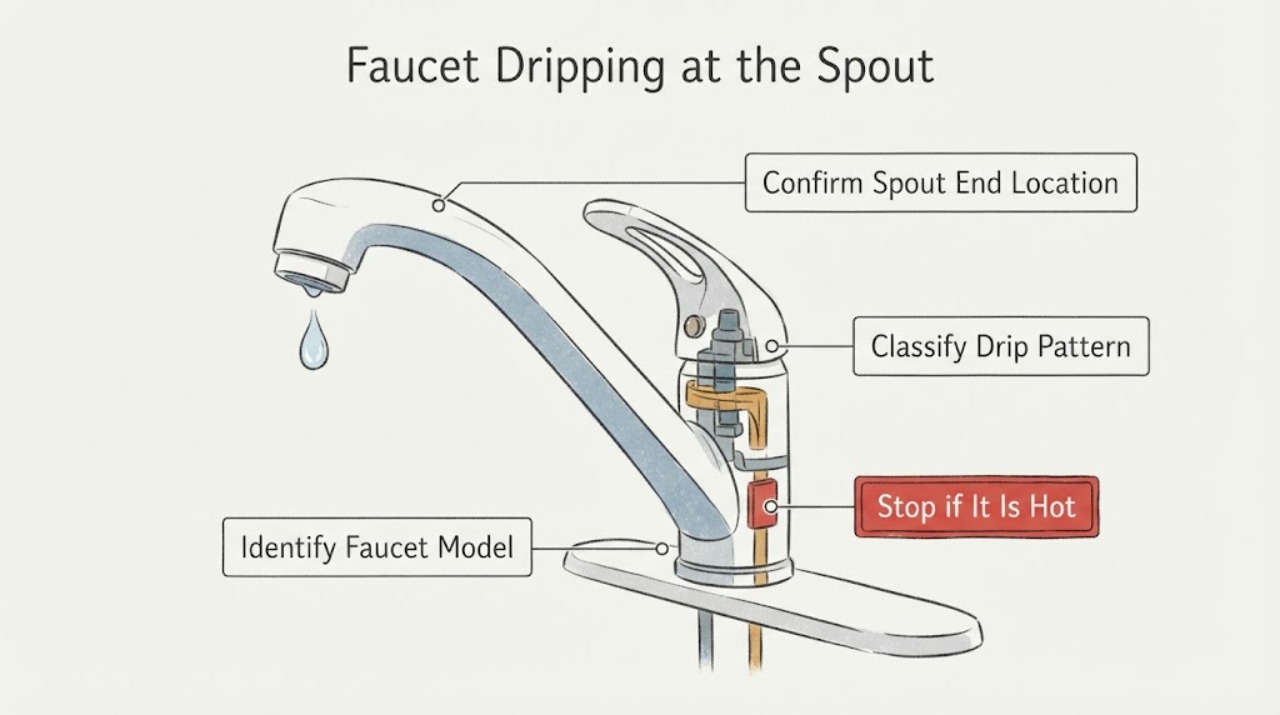
First confirm that water is coming from the end of the faucet spout after the handle is off, rather than from the spout base, handle, supply connection, or below the sink. A continuous end-of-spout drip commonly points to a cartridge, valve, stem, or sealing problem; single-handle and two-handle faucets use different service parts, and the exact model must be identified before ordering anything. Check the handle response, observe whether one or both sides are affected, look for a visible leak or unsafe condition, and use only an accessible fixture shutoff if the drip is worsening and the valve turns normally. Do not force a shutoff, remove a cartridge under pressure, guess at a replacement, or keep using a faucet that sprays, floods, has scalding water, or cannot be isolated. Arrange qualified plumbing service when the model or fault is uncertain, the drip continues, or water is reaching cabinets, walls, or electrical equipment.
Before you begin
Safety first
- The plumber should determine whether the cause is a cartridge, stem, seat, seal, spout, handle mechanism, supply connection, shutoff, or concealed plumbing issue before selecting parts.
Work through in order
Diagnostic checks
Use only checks that match the exact appliance or system and its official guide.
-
Check 1
Dry the visible faucet with a cloth, leave the handle or handles fully off, and observe from a normal standing position where the first new water appears; do not remove trim or reach below the sink while water is present.
Expected result: Water forms at the spout outlet, runs from the spout base, rises around a handle, appears under the counter, or cannot be localized safely.
Next step: Photograph the first wet point and continue only with checks appropriate to that location; arrange prompt service for an under-sink leak or an uncertain location.
Stop if: Stop for a spray, rapidly pooling water, a wet electrical outlet or appliance, a damaged hose, or any need to enter a cabinet with unstable contents.
Why this matters
Why: An end-of-spout drip supports a valve, cartridge, stem, or seal check. A base, handle, or under-sink leak is a different repair path and can damage cabinetry even when the outlet also drips.
-
Check 2
With the faucet controls operated normally and without force, note the drip after shutoff and whether the cold side, hot side, or both sides are affected; do not repeatedly cycle a loose or damaged handle.
Expected result: The drip is continuous, stops after a short residual period, occurs only from one handle, occurs from both handles, or becomes a stream when a handle moves.
Next step: Record the pattern and handle type for model-specific service; use an accessible local shutoff only if the leak is worsening and the valve turns normally without force.
Stop if: Do not force the handle, remove a handle or cartridge under pressure, or continue operating a faucet that sprays or cannot shut off.
Why this matters
Why: A continuous drip after shutoff is more consistent with a valve or cartridge that is not sealing. One affected handle narrows the check to that side on a two-handle faucet; a residual-only drip may be water left in the spout, while a stream or difficult handle indicates a worsening control or seal problem.
-
Check 3
From safe, dry access, photograph the faucet, handle arrangement, visible brand or model marking, spout shape, and any product paperwork; do not disassemble the handle to identify a cartridge.
Expected result: The model is clear, only the brand is known, the faucet has one handle, the faucet has two handles, or the marking and design are ambiguous.
Next step: Use the manufacturer's product-identification and parts information or give the photos to a plumber before ordering a replacement.
Stop if: Do not order a part from appearance alone, mix parts from different faucet models, or remove a retaining nut or cartridge as an identification experiment.
Why this matters
Why: A clear model lets the manufacturer parts diagram identify the correct cartridge, stem, seat, spring, or seal family. Brand-only or ambiguous information is not enough to claim fit, and single- and two-handle designs can use different components.
-
Check 4
Look from a dry, stable position at the spout, handle, deck, supply lines, shutoff valves, cabinet floor, and nearby wall for water, corrosion, mineral trails, swelling, or a connection that is moving; do not touch hot water or corroded hardware.
Expected result: Only the outlet drips, the base or supply connection is wet, the cabinet or wall is swelling, the shutoff is corroded or inaccessible, or no external damage is visible.
Next step: Use the accessible fixture shutoff only when it is clearly identified and turns normally; otherwise keep the area clear and request plumbing service, especially for cabinet, wall, or electrical exposure.
Stop if: Do not force a corroded valve, disconnect a supply line, touch hot or contaminated water, or enter standing water near electrical equipment.
Why this matters
Why: An outlet-only drip keeps the valve or cartridge in focus. Water at the base, supply, cabinet, or wall indicates a second or different leak that can require broader plumbing repair; no visible damage does not rule out a hidden leak.
-
Check 5
Compare the exact manufacturer instructions for the identified faucet with the observed leak location and decide whether the instructions describe a user-accessible shutoff and cartridge or seal procedure; do not begin disassembly if the instructions are missing or unclear.
Expected result: The documentation identifies a model-specific cartridge or seal, the faucet model is unknown, the leak location does not match the guide, or the procedure requires access under pressure or force.
Next step: Follow only the exact manufacturer's safe procedure or provide the documentation and photos to a qualified plumber; keep the faucet isolated if the drip is worsening.
Stop if: Do not remove a cartridge or stem without proper isolation and pressure relief, use excessive force, mix incompatible seals, or leave the faucet partly disassembled.
Why this matters
Why: A model-specific cartridge or seal procedure may explain the spout drip, but an unknown model or mismatched leak location makes a guessed repair unreliable. A difficult or pressurized procedure is a service boundary, not a reason to apply more force.
-
Check 6
Prepare a service record with the first wet point, drip pattern, handle count, model information, photos, local shutoff status, and any cabinet, wall, hot-water, or pressure concern.
Expected result: The record describes a model-specific end-of-spout drip, an unidentified faucet, a base or supply leak in addition to the drip, or a faucet that cannot be safely isolated.
Next step: Arrange qualified plumbing service for a continuous or recurring drip and provide the record before ordering parts; use the local shutoff to limit damage only when it operates normally.
Stop if: Do not keep using a faucet that floods, sprays, is dangerously hot, or sends water toward electrical equipment.
Why this matters
Why: A clear record helps a plumber distinguish a cartridge or valve-sealing problem from a spout seal, supply, shutoff, or wider plumbing issue. It cannot establish part compatibility without model confirmation.
Use your observations
Decision map
Find the observation that best matches what you see, then follow the next safe action.
-
PATH 01Next step
What you see
Water appears at the spout only briefly after shutoff, then stops completely; the handle operates normally and no new water appears at the base or under the sink.
Do this next
Repeat the location observation after normal use without forcing the handle; request service if the drip persists, increases, or leaves mineral buildup.
Why this path and its safety boundary
Why it matters: Residual water in the spout is more plausible than a continuously leaking valve, but a drip that returns after each use should be monitored rather than dismissed.
-
PATH 02Next step
What you see
A single-handle faucet continues to drip or stream from the spout after shutoff, with no separate base or supply leak.
Do this next
Use the manufacturer product information to identify the correct cartridge family or ask a plumber to inspect it; do not remove the handle or cartridge as a guess.
Why this path and its safety boundary
Why it matters: A cartridge or its seals are a leading model-dependent possibility, but Moen notes that cartridge designs are not interchangeable and the exact faucet must be identified.
-
PATH 03Next step
What you see
A two-handle faucet drips continuously and the drip changes when one handle is moved or isolated, while the spout base and supply connections remain dry.
Do this next
Record which side changes the drip and obtain model-specific parts or qualified plumbing service; do not mix two-handle components or force a stiff control.
Why this path and its safety boundary
Why it matters: The affected side's cartridge, stem, seat, or seal is more likely than a whole-faucet leak, but the correct repair family depends on the model and handle design.
-
PATH 04Next step
What you see
Water first appears around the spout base, handle, deck, supply connection, cabinet floor, or wall, even though water may also be visible at the spout.
Do this next
Use the local shutoff only if it turns normally and is safe to reach, keep the cabinet or area clear, and arrange prompt plumbing service.
Why this path and its safety boundary
Why it matters: A spout-end cartridge diagnosis does not cover the additional leak. Spout seals, supply connections, shutoffs, or concealed plumbing may need assessment, and cabinetry or wall damage can progress quickly.
-
PATH 05Next step
What you see
The faucet sprays, will not shut off, the handle is loose or jammed, water is rapidly pooling, or the local shutoff cannot isolate the fixture.
Do this next
Keep the faucet unused, close the accessible supply only if it operates normally, protect nearby contents without touching unsafe water, and request urgent plumbing service.
Why this path and its safety boundary
Why it matters: This is a water-damage and control failure, not a routine drip diagnosis. Continued use can spread water or make a small seal problem harder to contain.
-
PATH 06Next step
What you see
The drip is continuous or recurring, but the model, handle design, leak location, or correct service procedure cannot be confirmed safely.
Do this next
Keep the faucet isolated as practical and give a qualified plumber the photos, model clues, handle count, drip timing, and shutoff status.
Why this path and its safety boundary
Why it matters: A cartridge, stem, seal, spout, or supply diagnosis remains uncertain; selecting a generic repair part risks a second leak or an incomplete shutoff.
Helpful context
Understand the symptom
Verify the leak location before choosing a repair
A drop forming at the outlet after the handle is off is a different problem from water running around the spout base, up through the handle, or below the counter. Dry the visible surfaces from a safe position, wait briefly with the handle off, and watch the first place that becomes wet. The location changes whether a cartridge, stem, spout seal, supply connection, or another part should be evaluated.
Continuous and post-use drips point to different checks
A continuous stream or drip after shutoff suggests that the valve is not closing fully; manufacturer guidance commonly points to a cartridge or its seals, but the precise design varies. A few drops that stop may be residual water in the spout rather than an active valve leak. If the drip returns, worsens, or appears with a loose or difficult handle, record the pattern instead of forcing the control.
Model identity is part of the plumbing diagnosis
Cartridges, stems, seats, and seals are not universal. Record the manufacturer, model marking, handle count, finish, and photos before considering a part. Delta and Moen both direct owners to identify the faucet and use the associated parts information; a similar-looking cartridge can be the wrong size or design.
Safety boundary
Stop conditions
- Do not force a faucet handle or shutoff valve, remove a cartridge under pressure, disconnect a supply line, or leave the fixture partly disassembled.
- Stop and isolate the faucet as safely possible for a spray, rapidly pooling water, a leak at the base or supply, cabinet or wall swelling, or water near electrical equipment.
- Do not order a cartridge, stem, seat, seal, or spout by appearance alone; identify the exact faucet model and handle design first.
- Keep children away from hot water and request qualified plumbing service for a continuous or recurring spout drip, a faucet that will not shut off, an inaccessible shutoff, or an unresolved leak location.
Only after diagnosis
Potential parts
- faucet cartridge or stem-and-seal service assembly
Consider this only after the leak is confirmed at the spout outlet and the exact faucet model, handle design, affected side, and manufacturer service information identify a compatible cartridge, stem, or seal assembly.
Cartridges and seals are not universal. Confirm the model-specific parts diagram and installation requirements with the manufacturer or qualified plumber before ordering; do not substitute a similar-looking part.
When checks do not resolve it
Need a professional?
Use prompt service for a persistent spout drip and urgent service for a spray, no shutoff, rapidly pooling water, hot-water hazard, base or supply leak, water damage, or electrical exposure.
Safety scope: The plumber should determine whether the cause is a cartridge, stem, seat, seal, spout, handle mechanism, supply connection, shutoff, or concealed plumbing issue before selecting parts.
Have this ready
- Photos showing the first wet point, spout outlet, base, handle, supply connections, and cabinet or wall condition
- Whether the faucet has one or two handles and whether the drip is continuous, residual, or side-specific
- Brand, model marking, finish, paperwork, and any manufacturer parts information
- Local fixture shutoff status and whether it turns normally without force
- Any spray, hot-water, pressure, recent installation, prior repair, or water-damage history
Common questions
FAQ
Why does a faucet drip from the spout after I turn it off?
A continuous drip usually means the valve is not sealing fully. Manufacturer guidance commonly points to a cartridge, stem, or seal, but the correct part depends on the faucet model and whether it has one or two handles.
How do I know the leak is really at the spout?
Dry the visible surfaces, leave the handle off, and watch where new water first appears. Water at the outlet is different from water at the spout base, handle, supply connection, or below the sink and may require a different repair.
Can I replace a faucet cartridge without identifying the model?
No. Cartridges and seals are not universal, and single- and two-handle faucets can use different parts. Record the model and use the manufacturer's parts information or ask a plumber before ordering.
What should I do if the faucet will not shut off?
Stop using it and close the accessible fixture shutoff only if it is clearly identified and turns normally without force. Keep the area clear and request urgent plumbing service if water is pooling, spraying, or reaching cabinets, walls, or electrical equipment.
Is a few drops from the spout always an active leak?
Not always. Water left inside the spout can produce a brief residual drip that stops completely. If drops return after each use, continue, worsen, or leave mineral buildup, treat it as a recurring leak and arrange service.
Read the exact guide
Official sources
- Fixture leaks from the end of the spoutMoen Incorporated · Supports distinguishing an end-of-spout drip from other leak locations, identifying cartridge seals or grommets as possible causes, and using model-specific repair information.
- Find Parts and Identify Your ProductDelta Faucet Company · Supports identifying the faucet model first and recognizing that Delta's repair-part families differ by handle design and leak location.
- Kitchen Faucet: Leaking From The SpoutMoen Incorporated · Supports identifying a cartridge as the usual flow-control component when a faucet continues to drip from the spout and checking the exact model before repair.
Community feedback
Share a repair observation
Share a plain-text repair observation. Accepted observations are published automatically; this page may take a moment to update.