
On this page
Start here
Quick answer
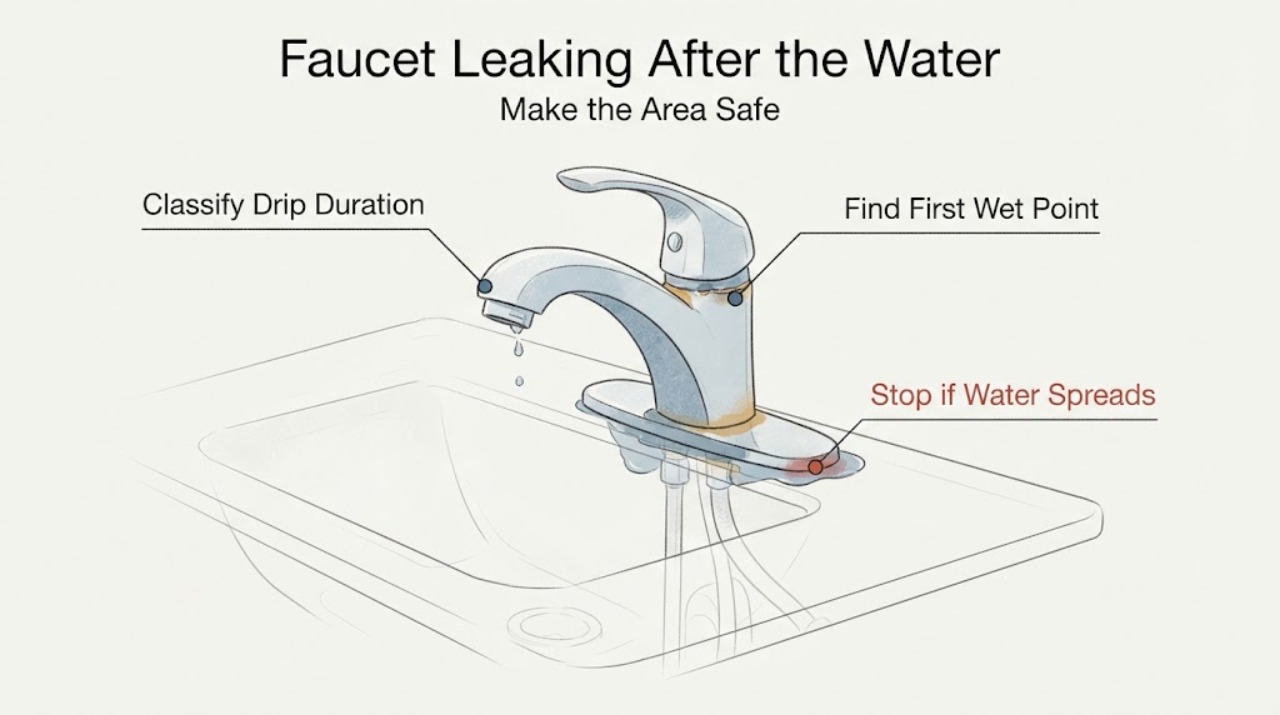
A few drops immediately after a faucet is closed can be residual water in the spout or outlet, but a drip that continues, restarts, or appears at the handle, base, supply connection, wall, or cabinet needs a leak check. Keep the condition exactly as reported—after water flow is terminated e—and first determine whether water is still being supplied or is only draining from the fixture. Dry the area, identify the first wet point, and close the accessible local or main water shutoff if the leak is active and the valve can be reached safely. If isolating hot or cold supply changes the leak, record that result; if water is hidden, spreading, near electricity, or cannot be stopped, stop testing and call a qualified plumber.
Before you begin
Safety first
- The reader-level scope is dry-position observation and safe operation of an accessible shutoff only. A professional must diagnose or repair pressurized connections, internal cartridges, stems, seats, seals, valves, concealed plumbing, water damage, and any electrical equipment contacted by water.
Work through in order
Diagnostic checks
Use only checks that match the exact appliance or system and its official guide.
-
Check 1
From a dry, stable position, move people and loose belongings away from the wet area, place a towel or container only where it will not create a trip hazard, and look for an accessible faucet shutoff or main water shutoff. Close the water supply only if the valve is reachable without entering standing water or touching wet electrical equipment.
Expected result: The water stops or slows when a safe shutoff is closed, or the shutoff cannot be reached safely; note standing water, spray, rapid pooling, and any nearby outlet, appliance, cord, or wiring.
Next step: If the leak is controlled and the area is dry, continue with non-destructive location checks. If it is not controlled or water is near electrical equipment, stay clear and request urgent plumbing and, when needed, electrical assessment.
Stop if: Do not step into standing water, touch wet electrical equipment, operate a switch or breaker from a wet position, or reach behind a cabinet to force a shutoff.
Why this matters
Why: A leak that continues with the faucet closed and supply open is an active supply-side or internal-control problem. Water near electricity, rapid pooling, or an unsafe shutoff location is a safety stop rather than a reason to keep testing.
-
Check 2
With the handle or handles fully closed and the area dry, observe the outlet without opening the faucet. Note whether drops fall briefly and stop, continue at a steady rate, form a stream, or return after the outside has been dried.
Expected result: The outlet gives only a short-lived residual drip, or it continues or restarts long after shutoff; record the time pattern without leaving the water running as a prolonged test.
Next step: For a brief drip that stops, dry and recheck later for recurrence. For persistent flow, close a safe local or main shutoff and arrange plumbing service if the exact model-specific procedure is not known.
Stop if: Do not remove a handle, cartridge, stem, retaining nut, or trim while the supply is pressurized, and do not keep operating the faucet to force a diagnosis.
Why this matters
Why: A brief drip can be water draining from the outlet. Continued or returning flow indicates that the faucet is not fully isolating the water or that another leak is wetting the outlet, so a valve, cartridge, stem, seat, seal, or related control must be identified by the exact fixture information.
-
Check 3
Dry the accessible outside surfaces, then use a clean tissue or dry cloth to observe the first place that becomes wet during one brief, normal faucet operation followed by shutoff. Check the spout or outlet, around the handle and base, below the counter, visible supply connections, cabinet back, wall, and floor without removing panels.
Expected result: Water first appears at the outlet, handle or base, a visible hose or fitting, the cabinet or floor, or an inaccessible wall or ceiling area.
Next step: Photograph the first wet point and the dry surrounding area, then use that location to choose the matching branch. If the source is hidden or the material is swelling, keep the water isolated and call a plumber.
Stop if: Do not cut drywall, remove cabinetry, pull the faucet body, loosen supply nuts, or probe a wall or floor to chase the wet path.
Why this matters
Why: The first wet point separates a shutoff or flow-control symptom from an external connection or concealed leak. Water that appears at a wall, floor, ceiling, or cabinet back can travel from another source and should not be assigned to a faucet part by appearance alone.
-
Check 4
If the fixture has clearly labeled, accessible hot and cold isolation valves in a dry area, close one valve at a time using normal hand operation and observe whether the symptom changes; on a single-handle faucet, treat each result as an isolation clue rather than a complete diagnosis.
Expected result: Closing the hot side stops or changes the drip, closing the cold side stops or changes it, neither side changes it, or the valves are stiff, damaged, unlabeled, or unsafe to reach.
Next step: Return only a safely operated valve to its prior position if appropriate, record the result and fixture type, and give those observations to the plumber or the exact manufacturer's support channel. Do not select a replacement part from the hot or cold result alone.
Stop if: Do not force a stuck valve, remove a valve handle, disconnect a supply line, or continue if water sprays, the valve body moves, or the area becomes wet.
Why this matters
Why: A change on one side supports a side-specific supply or internal control path, while no change can indicate residual water, a downstream leak, an upstream shutoff problem, or a concealed path. A stiff or damaged valve is itself a service concern.
-
Check 5
After every fixture is closed and no water is intentionally being used, inspect the visible cabinet and floor from a dry position and, if the home has an accessible water meter, compare its reading before and after a quiet interval without opening walls or touching electrical equipment.
Expected result: The visible area stays dry and the meter is unchanged, or dampness returns and the meter changes despite no intended water use; note whether the faucet shutoff was closed during the observation.
Next step: Keep a short timeline, photos, meter readings, and shutoff state for the plumber. If the leak is hidden, recurring, or damaging flooring, wall, ceiling, or cabinet material, stop using the fixture until assessed.
Stop if: Do not remove a wall or floor covering, perform pressure testing, access a wet crawlspace, or handle wet wiring or electrical equipment.
Why this matters
Why: A stable dry area with no meter movement makes a hidden active supply leak less likely, although it does not prove the faucet is repaired. Returning dampness or meter movement supports an active leak somewhere in the fixture or plumbing system and increases the need to isolate it.
-
Check 6
Before requesting service, record the faucet location and type, whether it has one or two handles, the exact condition text, when the flow was terminated, the first wet point, whether the drip was brief or persistent, hot/cold isolation results, and any visible model marking photographed from a dry position.
Expected result: The symptom can be described as residual-only, persistent at the outlet, leaking around the handle or base, leaking at a visible connection, or hidden/uncertain; the supply is controlled or remains active.
Next step: Give the plumber the photos, timing, shutoff state, and exact model information if available; ask the professional to verify the source before choosing a cartridge, washer, seal, hose, or valve.
Stop if: Do not order a part from a generic faucet description, open concealed plumbing, or restore water solely to repeat an unsafe test.
Why this matters
Why: A structured symptom record lets a plumber distinguish an internal shutoff problem from a connection or concealed leak without guessing a brand or part. A leak that cannot be safely isolated or that has caused damage needs a higher-urgency response.
Use your observations
Decision map
Find the observation that best matches what you see, then follow the next safe action.
-
PATH 01Next step
What you see
The spout or outlet drips briefly after shutoff and then stops, with no new wet point at the handle, base, connection, cabinet, wall, or floor.
Do this next
Dry the outside and watch for recurrence during normal future use. If the drip becomes persistent or returns without use, move to the active-leak branch and arrange service.
-
PATH 02Next step
What you see
The outlet continues to drip or stream after the handle is closed, or the flow returns after drying.
Do this next
Use a safe local or main shutoff, do not disassemble under pressure, and ask a plumber or the exact manufacturer support channel to identify the compatible internal control repair.
-
PATH 03Next step
What you see
The first wet point is around the handle, faucet base, escutcheon, or counter penetration rather than the outlet.
Do this next
Keep the area dry and photograph the first wet point. Treat it as a seal, body, connection, or concealed-path question; do not assume a cartridge or tighten parts while pressurized.
-
PATH 04Next step
What you see
Water first appears at a visible supply hose, fitting, shutoff, or connection below the faucet.
Do this next
Close the accessible water supply if safe, protect the cabinet, and request plumbing service if the connection cannot be stopped without force or if the leak returns.
-
PATH 05Next step
What you see
Water appears at a wall, floor, ceiling, cabinet back, or near electrical equipment, or the source cannot be located without opening or reaching into a hazardous area.
Do this next
Stop using the fixture, keep people away, isolate water only from a safe dry position, and arrange qualified plumbing assessment plus electrical assessment when water contacted electrical equipment.
Helpful context
Understand the symptom
First decide whether the water is residual or still supplied
The report after water flow is terminated e can describe two different observations. Water left in a spout may fall for a short time and then stop. A drip that continues long after the handle is closed, returns after drying, or forms a stream is different: the faucet may not be shutting off internally, or water may be escaping from another point. Do not assume the condition identifies a cartridge, washer, seal, hose, or valve before locating the first wet point.
Use the leak location to choose the next safe decision
A wet spout points toward the flow-control path, while water around a handle or base can be escaping from a seal or from a passage behind the trim. Water under a sink or at a visible supply connection can be a hose, fitting, shutoff, or connection issue rather than a spout drip. Water appearing at a wall, floor, ceiling, or cabinet back is a concealed-plumbing concern. Dry the exterior and watch where water first returns; do not open a wall or loosen a pressurized connection just to investigate.
Hot and cold results are evidence, not a replacement-part diagnosis
On a two-handle faucet, an accessible hot or cold isolation valve can help identify which side changes the symptom. On a single-handle faucet, the internal control blends both supplies, so closing one side may reduce rather than completely stop the leak. A valve or cartridge name is not universal across brands or models. Record the fixture type, model if visible, which supply was isolated, and what happened; use that information for a compatible repair or service decision.
Protect the cabinet, floor, and electrical area while arranging service
Place a container or towel where it can catch water without creating a trip hazard, and remove only loose items from a dry area. If water has reached an outlet, appliance, power strip, wiring, or other electrical equipment, do not touch the equipment or a breaker from a wet position. Move away and have the water and electrical hazards assessed safely. A meter or moisture alert can help confirm a hidden leak, but it does not make wall opening or electrical testing a homeowner task.
Safety boundary
Stop conditions
- Stop immediately for rapid pooling, spray, a failed shutoff, water entering a wall, ceiling, floor, or cabinet, or any leak that cannot be safely isolated.
- Do not touch wet electrical equipment, outlets, cords, wiring, or a breaker from a wet position; keep power off and obtain qualified electrical advice when water has reached electrical equipment.
- Do not force a stuck shutoff, loosen a pressurized supply connection, remove trim or internal parts under pressure, cut a wall, or use sealant as a substitute for locating the leak.
- Do not repeatedly restore water to reproduce a leak when water is spreading, the first wet point is hidden, or the fixture or connection is damaged.
Only after diagnosis
Potential parts
- faucet cartridge, stem, or internal shutoff seal
Consider only when persistent outlet flow is confirmed and the exact faucet model and internal design have been identified by the manufacturer or plumber.
Internal controls are not universal; confirm the exact model and approved fit before ordering or installing anything. - supply hose, fitting, or shutoff connection
Consider only when the first wet point is a visible supply connection and the water is safely isolated.
Connection size, material, routing, and local requirements must be verified by the exact installation information or a qualified plumber.
When checks do not resolve it
Need a professional?
Call a qualified plumber for a persistent post-shutoff drip, a leak around the handle or base, a visible supply connection leak, an uncertain first wet point, a concealed leak, or any recurrence after a safe shutoff. Request urgent help for rapid flow, water damage, a failed shutoff, water near electrical equipment, or a leak affecting a wall, ceiling, floor, or occupied area.
Safety scope: The reader-level scope is dry-position observation and safe operation of an accessible shutoff only. A professional must diagnose or repair pressurized connections, internal cartridges, stems, seats, seals, valves, concealed plumbing, water damage, and any electrical equipment contacted by water.
Have this ready
- Provide the exact condition text, faucet type and handle count, location, model marking if safely visible, whether the drip stopped or continued, first wet point, photos, timing, safe shutoff result, hot/cold observation, visible damage, and any water contact with electrical equipment.
Common questions
FAQ
Is a few drops after shutting off a faucet always a leak?
Not always. A short residual drip from the spout can stop after the water left in the outlet drains. If dripping continues, becomes a stream, returns after drying, or appears at the handle, base, connection, wall, or floor, treat it as a leak and locate the first wet point.
Why does a faucet leak only after the handle is closed?
The internal flow-control path may not be fully isolating the supply, or water may be escaping around the handle, base, connection, or concealed plumbing and traveling to the outlet. The symptom alone cannot identify a universal cartridge, washer, or seal.
Should I tighten the faucet connection or replace a cartridge immediately?
No. First identify the first wet point and safely isolate the water. A connection, internal control, and concealed leak require different decisions, and parts vary by faucet model. Ask a plumber or the exact manufacturer support channel to confirm compatibility before ordering or disassembling anything.
What if the leak is under the sink or near an outlet?
Close an accessible water shutoff only from a dry, safe position and keep the cabinet and electrical area clear. Do not touch wet outlets, cords, wiring, appliances, or breakers from a wet position. Arrange plumbing help, and obtain electrical assessment if water contacted electrical equipment.
Read the exact guide
Official sources
- Fix a Leak WeekU.S. Environmental Protection Agency WaterSense · EPA advises identifying the source, examining faucet gaskets and pipe fittings for water on the outside, and consulting a plumbing professional when simple steps are not enough.
- My two-handle widespread lavatory faucet is dripping underneath the counter. How can I fix it?Delta Faucet · The manufacturer page distinguishes under-counter connection leaks and says to shut off the water supply before checking connections; it cautions against overtightening.
- Kitchen Faucet: Leaking From the SpoutMoen Solutions · The official support page describes continuing drip or stream after shutoff and explains that the internal cartridge controls flow; it warns that cartridges vary by faucet.
- How to Fix a Leaky Shower HeadDelta Faucet · The page says a little dripping after shutoff can be normal, while dripping long after shutoff or from other locations indicates a leak; it discusses handle, tub-spout, and valve symptoms.
- Leak Detection and Flow Monitoring DevicesU.S. Environmental Protection Agency WaterSense · EPA explains that moisture detection and flow monitoring can identify unexpected dampness or water-use patterns and reduce waste and damage from leaks.
- Flood Electrical Safety: High Water, High StakesElectrical Safety Foundation International · ESFI warns that water and electricity do not mix, advises keeping power off after flooding until inspection, and says not to touch breakers with wet hands or while standing on a wet surface.
Community feedback
Share a repair observation
Share a plain-text repair observation. Accepted observations are published automatically; this page may take a moment to update.