
On this page
Start here
Quick answer
If a faucet starts leaking when electricity is restored, first determine whether the fixture actually uses household power or whether the restoration simply re-pressurized a well pump or booster system. Many touch faucets use batteries and can operate during a power outage, while some touchless models use a powered control or solenoid; an ordinary manual faucet does not make or stop water flow because household electricity returned. From a dry position, stop using the faucet, close the hot and cold fixture shutoffs if they operate normally, and isolate power only when it is safe and the leak is near an electrical adapter, control box, outlet, or wiring. Dry the fixture and cabinet, then identify the first wet point and whether the leak occurs with the handle closed, only when touch or sensor mode is enabled, or continuously. Call a plumber for a water-path, seal, valve, hose, or supply leak; call an electrician for a wet or damaged electrical supply, outlet, adapter, or wiring. Do not test a wet electrical area, open a control box, or repeatedly restore power to reproduce the leak.
Before you begin
Safety first
- This article supports water isolation, drying, identification, and non-contact or ordinary-access leak tracing only. Do not work on a pressurized fixture, disconnect supply lines or solenoids, open an electronic cover, probe wiring, force fittings, or use electrical tools in a wet area.
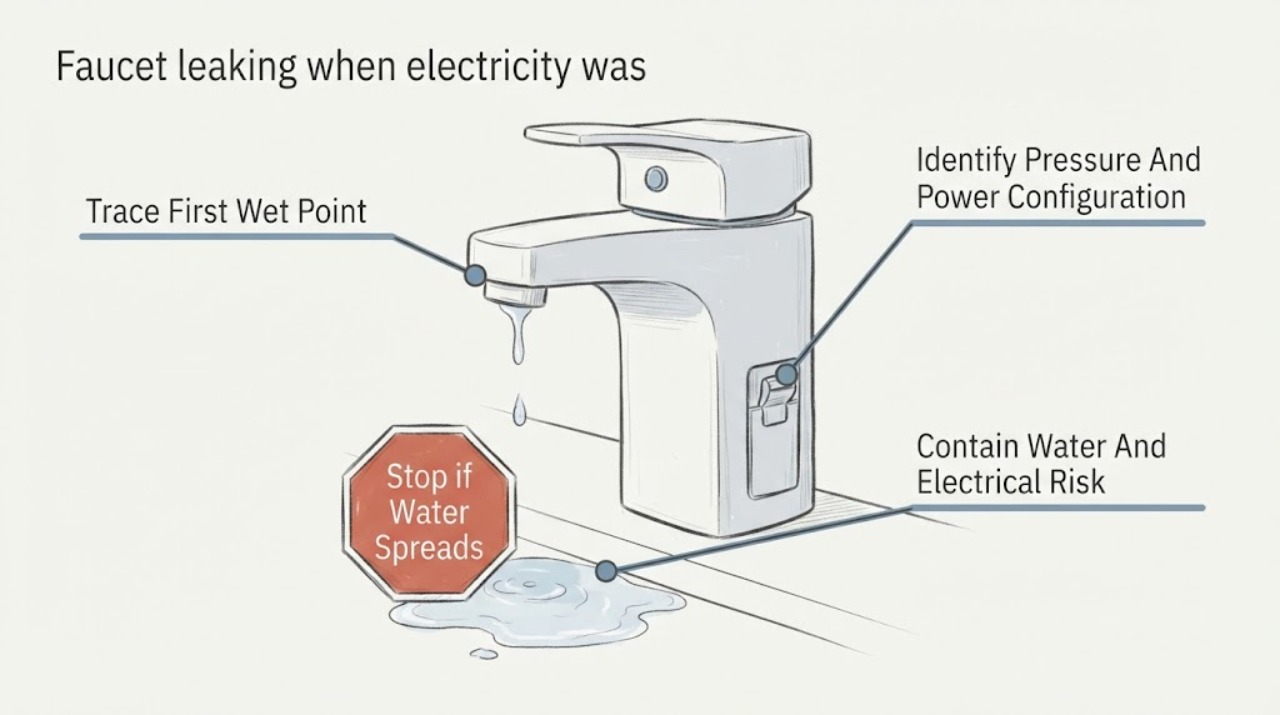
Work through in order
Diagnostic checks
Use only checks that match the exact appliance or system and its official guide.
-
Check 1
Stop using the faucet and inspect from a dry position; close the hot and cold fixture shutoffs if they turn normally and are safely reachable, without forcing a corroded valve or entering standing water.
Expected result: Record whether flow stops, slows, or continues, and whether water is near an outlet, adapter, control box, battery holder, appliance cord, cabinet floor, wall, or other electrical equipment.
Next step: If the fixture valves do not stop the flow, use the home's main shutoff only from a dry, safe position and arrange plumbing service; if electrical equipment is wet or damaged, leave it alone and arrange electrical service after the water hazard is controlled.
Stop if: Stop immediately for flooding, standing water near electricity, a stuck or leaking shutoff, damaged tubing, exposed wiring, burning odor, sparks, or any need to touch wet electrical equipment.
Why this matters
Why: A stopped, small leak can be traced after isolation. Continued flow, flooding, a failed shutoff, or water near electrical equipment is a containment and service issue rather than a safe seal test.
-
Check 2
Without opening anything, identify whether the faucet is manual, battery-powered touch or hands-free, powered by an adapter or control box, or connected to a special filtered or smart path; separately note whether the home uses city or gravity pressure, a well pump, or a booster.
Expected result: Compare the leak timing with the event: it begins as the pump or booster restarts, begins only when a touch or sensor function is enabled, or continues even with the handle closed and the electronic function unused.
Next step: Keep the water isolated and follow the matching pressure or faucet branch; do not assume that the returning household power caused a failed plumbing seal.
Stop if: Do not repeatedly cycle a pump, booster, breaker, adapter, or faucet to reproduce the leak, and do not remove covers or inspect live wiring.
Why this matters
Why: A pump or booster can simply restore water pressure to a manual faucet. A sensor-only event points toward an electronic valve or control path. A continuous leak independent of electricity points toward a water-path seal, valve, hose, connection, or body fault.
-
Check 3
After the water is isolated and visible surfaces are dry, place separate dry towels at the spout outlet, handle or stem, faucet base or deck, visible supply connections, and electronic valve or control area; do not wrap or seal over a wet spot.
Expected result: When a brief normal flow is safe and cannot reach electricity, note which location becomes wet first: spout, handle, rotating base, deck, supply connection, hose, valve box, or cabinet surface.
Next step: Shut the water off again, photograph the first wet point, and use that evidence for the exact model manual or plumber instead of choosing a generic seal from the drip location alone.
Stop if: Do not perform the flow observation if water is spreading rapidly, can reach an outlet or control box, is hot enough to burn, or requires reaching into standing water.
Why this matters
Why: The first wet point is more diagnostic than the largest puddle. Spout or handle moisture can indicate an internal valve seal; base or deck moisture can indicate a body or mounting seal; a hose or valve-box wet point can indicate a connection or electronic valve water-path issue.
-
Check 4
With the water isolated, record the handle position and electronic status; only after the area is dry and the model instructions allow it, compare handle-closed behavior with a single normal manual or sensor activation, without opening the control box or touching wiring.
Expected result: The faucet stays dry with the handle closed, leaks only after touch or sensor activation, drips continuously with the handle closed, or fails to shut off after activation.
Next step: Leave the water isolated and give the exact behavior and model to a plumber or manufacturer-authorized service path; use only a documented model-specific bypass or reset if the manual explicitly permits it.
Stop if: Do not repeat activation, bypass a safety function, disconnect a solenoid, open a control cover, or continue if the faucet sprays, clicks without stopping, heats wiring, or leaks near electricity.
Why this matters
Why: A sensor-only leak supports an electronic solenoid, valve-box, or control-path diagnosis. A continuous handle-closed drip supports an internal water-valve seal or cartridge path. Failure to shut off after activation can leave an electronic valve or manual override partly open; it is not proof of a compatible replacement part.
-
Check 5
From above the counter and from a dry cabinet position, inspect only visible faucet-base, supply-hose, shutoff, and valve-box surfaces; do not loosen a fitting, disconnect a hose, or touch a wet electronic component.
Expected result: Classify the first wet point as a supply connection, hose, faucet body, valve box or solenoid water connection, base or deck, or still unknown, and note whether it happens only when the faucet runs or persists with water isolated until pressure decays.
Next step: Keep the fixture shut off, protect the cabinet and floor, and call a plumber for any wet connection, valve box, body, concealed path, corrosion, or unknown source; involve an electrician if the adapter, outlet, or wiring is wet or damaged.
Stop if: Do not force nuts, apply unapproved sealant, disconnect supply lines, enter standing water, or use electrical tools in the cabinet.
Why this matters
Why: A supply, hose, body, or valve-box leak is a plumbing isolation and repair issue. A dry water path with a power-restoration-only event keeps the electronic trigger in scope, but the seal or valve still requires model-specific assessment.
-
Check 6
Record the faucet maker, model marking, handle count, sensor or touch features, power arrangement, water source, first wet point, and off-versus-electronic behavior before selecting a part or service path.
Expected result: The proposed repair is supported by the exact manual and a dry, isolated workspace, or the source remains unknown, the leak recurs, the shutoff fails, or electrical and water risks overlap.
Next step: Use plumbing service for the water path and leak source; use electrical service for a wet or damaged adapter, outlet, circuit, or wiring. Leave the faucet isolated until the responsible professional confirms safe operation.
Stop if: Stop all further testing for uncontrolled water, cabinet or wall damage, unusual water color or odor, contaminated special water paths, concealed access, a failed shutoff, or any electrical hazard.
Why this matters
Why: A cartridge, O-ring, mounting seal, solenoid, valve box, or supply seal is conditional on the model and observed interface. A power-restoration correlation alone does not establish which component failed.
Use your observations
Decision map
Find the observation that best matches what you see, then follow the next safe action.
-
PATH 01Safety boundary
What you see
The leak begins as a well pump or booster restarts and continues with a manual faucet regardless of touch or sensor use.
Do this next
Keep the faucet isolated, trace the first wet point after pressure decays, and call a plumber for the fixture or water-supply assessment.
Why this path and its safety boundary
Why it matters: Electricity likely restored water pressure rather than electronically opening the faucet; an upstream pressure event may have exposed a weak seal, hose, connection, or valve.
Safety stop: Do not repeatedly cycle the pump or booster, and stop for uncontrolled flow, flooding, or a failed shutoff.
-
PATH 02Safety boundary
What you see
The leak appears only when the touch, hands-free, or sensor function is enabled after power returns, while a manual handle-closed check stays dry.
Do this next
Close the water shutoffs, keep the control area dry, and provide the model and timing to a plumber or authorized service provider; do not open or bypass the electronics as a generic test.
Why this path and its safety boundary
Why it matters: An electronic valve, solenoid, valve box, sensor, or control path is plausible, but the model determines the safe repair and whether the fixture uses batteries or an adapter.
Safety stop: Stop for wet wiring, a hot adapter, sparking, smoke, an outlet problem, or a valve that will not stop water.
-
PATH 03Safety boundary
What you see
Water drips or seeps with the handle closed and the electronic function unused, or it continues as pressure remains in the line.
Do this next
Keep hot and cold supplies closed, document the first wet point, identify the exact model, and call a plumber if the source is not an ordinary, model-directed repair.
Why this path and its safety boundary
Why it matters: An internal cartridge or valve seal, spout or handle seal, body, hose, supply connection, or mounting interface is more likely than a power-triggered control fault.
Safety stop: Do not select a universal seal, disconnect a hose, or disassemble a pressurized fixture.
-
PATH 04Safety boundary
What you see
The first wet point is a visible supply connection, hose, faucet body, electronic valve box, or the cabinet rather than the spout or handle.
Do this next
Close the fixture or main shutoff safely, keep the cabinet dry, and call a plumber. If the wet area includes an adapter, outlet, or wiring, do not touch it and arrange electrical assessment after water is controlled.
Why this path and its safety boundary
Why it matters: This is a water-path or connection leak that can damage the cabinet; an electronic valve-box leak may require replacement or model-specific service rather than a seal guessed from appearance.
Safety stop: Do not tighten corroded fittings, disconnect supply lines, reach into standing water, or operate electrical equipment in the wet cabinet.
-
PATH 05Safety boundary
What you see
The source cannot be found safely, water has unusual color or odor, the shutoff does not work, or water and electricity cannot be separated.
Do this next
Leave the fixture unused, isolate water only from a safe dry position, and call a qualified plumber; use electrical service for the electrical hazard.
Why this path and its safety boundary
Why it matters: The situation exceeds a generic faucet-seal check and may involve property damage, drinking-water concerns, or electrical injury risk.
Safety stop: Do not restore power, run water, open walls or covers, or continue testing an unsafe or contaminated fixture.
Helpful context
Understand the symptom
Electricity may be the trigger, not the leak location
When a leak appears at power restoration, separate the event from the plumbing cause. A well pump or booster can restore pressure to every fixture; a powered touchless control can reopen an electronic valve; and a battery-powered touch faucet may be unaffected by household power. A manual city- or gravity-supplied faucet normally remains pressurized regardless of electricity. The first wet point and the off-versus-sensor behavior are more useful than assuming that the control box is the failed part.
Keep water and electricity apart
Use only dry, ordinary-access controls. Close the fixture shutoffs when they turn normally and are safely reachable; if water continues, use the main shutoff only when it can be reached without entering water. Keep the cabinet, outlet, adapter, batteries, and control box dry. Never open an energized control box, probe wiring, or restore power repeatedly to make a leak happen.
Model-specific electronic parts need model-specific instructions
Touch, hands-free, and smart faucets differ: some use batteries, while others use a power supply, circuit board, sensor, solenoid, or manual override. A leak at an electronic valve may need a valve-box or solenoid assessment, but the exact model determines the safe isolation and repair method. Record the maker and model marking and use its manual before considering any seal, valve, or control part.
Safety boundary
Stop conditions
- Close the fixture shutoffs, or the main shutoff when safely accessible, for uncontrolled flow, flooding, or a shutoff that will not stop the leak.
- Do not work on a wet electrical area, enter standing water, touch exposed wiring, or use electrical tools near cabinet water.
- Do not repeatedly restore power or cycle a pump, booster, sensor, or faucet to reproduce a leak.
- Do not open an electronic control box, disconnect a solenoid, bypass an interlock, or disassemble a pressurized faucet as a user test.
- Do not choose a washer, O-ring, cartridge, solenoid, valve box, or other part from appearance or leak timing alone; confirm the exact model and manufacturer procedure first.
- Stop for unusual water color or odor, special filtered water-path concerns, cabinet or wall damage, hot-water burn risk, smoke, sparks, a hot adapter, or any uncertainty about drinking-water safety.
Only after diagnosis
Potential parts
- faucet cartridge or water-valve seal
Consider this category only when a continuous handle-closed drip and the exact faucet model support an internal water-valve diagnosis.
Confirm the exact model, valve design, dimensions, sealing surfaces, and manufacturer procedure; similar-looking seals are not automatically interchangeable. - electronic solenoid or valve-box assembly
Consider this category only when a model-specific diagnostic path links a sensor-only leak or valve-box wet point to the electronic water valve.
Confirm whether the fixture uses batteries or an adapter and the exact model assembly; do not open, bypass, or replace an electronic valve in a wet or energized area. - supply connection or hose seal
Consider this category only after the first wet point is confirmed at a visible supply interface and the exact connection type is known.
Confirm the faucet, hose, thread or compression interface, material, and installation requirements; a seal does not repair a cracked hose, body, or shutoff.
When checks do not resolve it
Need a professional?
Call a qualified plumber when the leak is uncontrolled, reaches the cabinet or wall, comes from a supply connection, hose, faucet body, or valve box, persists with the handle closed, recurs after a safe model-directed check, involves a stuck shutoff or concealed access, or has an unknown first wet point. Call an electrician for wet or damaged wiring, an outlet, an adapter, or another electrical supply. Keep the fixture isolated when practical and provide the event timing, water-source type, power arrangement, first wet point, model marking, and off-versus-electronic result.
Safety scope: This article supports water isolation, drying, identification, and non-contact or ordinary-access leak tracing only. Do not work on a pressurized fixture, disconnect supply lines or solenoids, open an electronic cover, probe wiring, force fittings, or use electrical tools in a wet area.
Common questions
FAQ
Why would a faucet leak when electricity comes back on?
Electricity may restart a well pump or booster and restore pressure, or it may activate a powered touchless control. A battery-powered touch faucet can behave differently, and a manual faucet normally does not depend on household electricity. Isolate water safely and trace the first wet point before blaming the electrical control.
Should I turn off the breaker if the faucet is leaking?
Only isolate power from a dry, safe position when the leak involves an adapter, outlet, control box, or wiring and doing so does not require touching wet equipment. Close the water shutoffs first when safely possible. Never enter standing water, touch wet electrical equipment, or restore power to reproduce the leak.
What if the faucet leaks only when touch or sensor mode is on?
Keep the water isolated and treat an electronic solenoid, valve box, sensor, or control path as a possibility. The exact model determines the safe procedure. Do not open the control box or bypass electronics; provide the model and the sensor-only timing to a plumber or authorized service provider.
What if the leak continues with the handle closed?
A continuous handle-closed drip points more toward an internal valve seal or cartridge, body, hose, supply connection, or mounting interface than a power trigger. Close the hot and cold supplies, document the first wet point, and call a plumber if the source is not an exact model-directed repair.
Can I replace a faucet seal or solenoid by appearance?
No. Seals, cartridges, hoses, and electronic valve assemblies vary by model and interface. Confirm the exact faucet model and its manufacturer instructions, and keep water and electrical risks isolated before any repair decision.
Read the exact guide
Official sources
- My Touch2O® faucet handle or spout does not respond to touch.Delta Faucet · Official Delta touch-faucet troubleshooting used to distinguish electronic operation from a generic manual faucet; it is not a repair procedure for an unspecified model.
- Fixture leaks from the end of the spoutMoen Solutions · Official Moen guidance used only as a manufacturer example; the mechanism and repair part may differ on an unspecified faucet.
- Fix a Leak WeekU.S. Environmental Protection Agency · EPA WaterSense household leak guidance used for visual leak tracing and water isolation; it does not identify an electronic faucet model or part.
- Touchless Kitchen FaucetKohler Co. · Official Kohler troubleshooting guide used for the safety boundary around a powered valve box; it does not authorize opening or repairing an unspecified faucet.
- Find Parts and Identify Your ProductDelta Faucet · Official Delta parts guidance used as a brand-specific example that leak location and exact model matter; it does not establish compatibility with an unspecified faucet.
- Touchless Kitchen FaucetKohler Co. · Official Kohler installation and operation guide used only to explain why powered touchless faucets differ from battery or manual designs; it is not a generic procedure.
- What if there is a power outage?Delta Faucet · Official Delta guidance used as a manufacturer example only; unspecified faucets may use a different power and valve arrangement.
- Home MaintenanceU.S. Environmental Protection Agency · EPA WaterSense home-maintenance guidance used for visible inspection under a sink; it does not authorize concealed plumbing or electrical work.
Community feedback
Share a repair observation
Share a plain-text repair observation. Accepted observations are published automatically; this page may take a moment to update.