
On this page
Start here
Quick answer
Quickly closing the hot side of a kitchen faucet can produce a short water-hammer bang without causing a leak, so first separate sound from actual wetness. If water remains at the spout, handle, base, or a supply connection, close the local water valve under the sink from a dry position; use the main valve if the local valves fail. Do not put a hand into hot water. A leak that appears at the base, inside the cabinet, or behind the wall needs plumbing attention, especially if the cabinet or electrical equipment is wet. If there is only a brief bang and no moisture, close the hot handle more slowly and have a plumber assess persistent hammering rather than treating the sound alone as a faucet leak.
Before you begin
Safety first
- Keep the affected supply isolated and avoid hot water contact. If water is near electrical equipment, do not operate it; use the main water shut-off only from a dry, safe position and request urgent service. Do not perform concealed plumbing or pressure-control work.
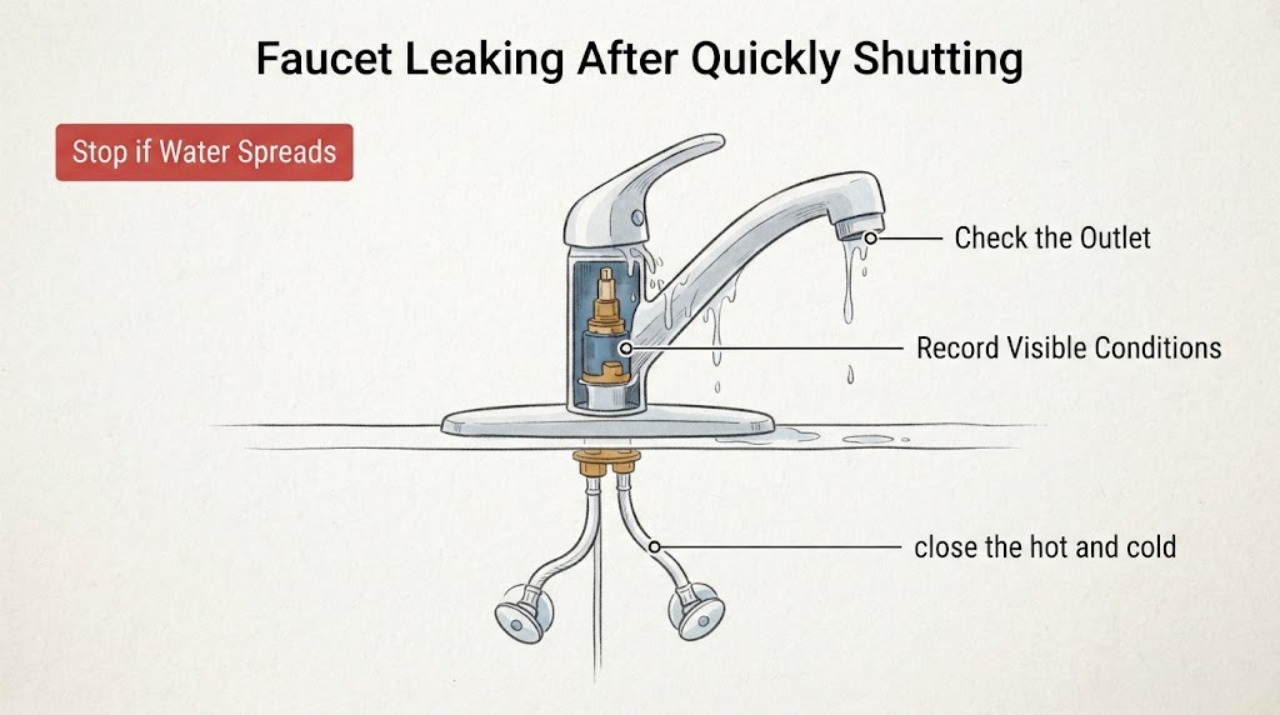
Work through in order
Diagnostic checks
Use only checks that match the exact appliance or system and its official guide.
-
Check 1
Wait for the faucet and sink area to be safe to approach, then look without touching the water for a continuing drip, spray, or wet trail. Check the spout outlet, hot-side handle or stem area, faucet base, both supply connections under the sink, and the wall or counter cutout.
Expected result: No moisture after the sound stops supports water hammer rather than a confirmed leak. A continuing drip at the outlet, handle, base, or a connection identifies a different first wet point.
Next step: If there is no wetness, do not disassemble the faucet; observe whether the bang repeats. If there is wetness, close the local water valves from a dry position before inspecting further.
Why this matters
Why: Portland's municipal guidance separates the handle, stem, and faucet as distinct leak locations, while EPA leak guidance recommends checking faucet outlets and hot and cold connections.
-
Check 2
Do not repeat the fast closure just to reproduce the symptom. Instead, record whether the sound occurs when the hot lever is moved quickly, when it is closed slowly, or when another faucet or appliance valve closes; note whether the sound comes from the faucet, cabinet, or wall.
Expected result: A brief bang with no wetness that is reduced by slower closure is consistent with a pressure-shock symptom. A sound that persists, vibrates the wall, or accompanies a wet connection is not safely explained by water hammer alone.
Next step: Use slower ordinary handle movement only as a low-risk observation. If the sound is severe, persistent, or paired with moisture, leave water isolated and arrange a plumber to assess supports, valves, pressure, and the faucet.
Why this matters
Why: Official plumbing guidance describes sudden valve closure as a cause of water hammer and notes that vibration can be transmitted through pipe supports and building surfaces.
-
Check 3
If a leak is visible, close the hot and cold fixture valves under the sink if they are clearly identified and reachable without contact with hot water or a wet electrical area. Open the faucet briefly only from a dry position to release residual pressure; if a valve will not close, use the main water shut-off.
Expected result: If the drip stops after the fixture valves close, the faucet and its immediate connections are isolated. If water continues, the wrong valve may have been closed, the valve may not seal, or the leak may be upstream.
Next step: Keep the valves closed and do not reopen them repeatedly. Arrange service when isolation fails, the cabinet is wet, or the source is a supply connection or wall-side line.
Why this matters
Why: Portland advises using the local supply valves and the master supply when local isolation is unavailable; prompt isolation limits water damage.
-
Check 4
With water isolated and the surface dry, inspect the cabinet using a flashlight from outside the wet area. Look for the first damp point at the hot supply connection, cold supply connection, faucet mounting area, hose or tube, and the wall penetration; do not tighten a fitting that is cracked, corroded, moving in the wall, or connected to a rigid line.
Expected result: Moisture at a supply connection differs from moisture at the faucet base or a wall penetration. Staining, swelling, soft material, or dampness that extends behind the cabinet indicates hidden water damage rather than a simple outlet drip.
Next step: Document the first wet point and leave the water isolated. Have a plumber handle a wall-side connection, concealed line, corroded fitting, or any repair requiring force or access behind the wall.
Why this matters
Why: EPA WaterSense identifies faucet outlets and hot and cold connection valves as leak inspection points, while hidden moisture needs prompt attention to limit building damage.
-
Check 5
After the area is dry and only after a clearly accessible external repair or professional instruction, restore the isolated supply slowly while watching the original wet point. Do not use the quick hot-water closure as a stress test.
Expected result: No returning moisture during a brief normal use supports the repair. Any drip, spray, cabinet moisture, wall dampness, or renewed vibration means the issue remains.
Next step: Close the valves again if any moisture returns and call a plumber. If the faucet is dry but hammering continues, request an assessment of the valve, pressure, and pipe support rather than replacing a part based only on sound.
Why this matters
Why: A faucet repair should be checked for leaks after water is restored, but a hidden or pressure-sensitive leak should not be repeatedly recreated by rapid handle movement.
-
Check 6
Check the water-damage boundary without opening finishes: look for cabinet swelling, wall staining, mildew-like odor, damp flooring, or water near an outlet or appliance. If a leak has been active, note its duration, whether it follows hot-water use, and whether the water meter moves when all fixtures are off.
Expected result: A dry cabinet with no ongoing meter movement supports a limited visible event. Persistent meter movement, hidden staining, or damp wall material indicates an ongoing or concealed leak even if the faucet appears dry.
Next step: Keep the affected supply isolated and arrange plumbing and drying assessment for hidden moisture. Never energize wet electrical equipment or continue using a faucet that is leaking into the wall or cabinet.
Why this matters
Why: EPA WaterSense recommends prompt attention to leaks and describes a no-use meter check as a way to identify continuing water flow.
Use your observations
Decision map
Find the observation that best matches what you see, then follow the next safe action.
-
PATH 01Next step
What you see
There is a short bang or vibration when the hot handle closes quickly, but no drip, spray, or moisture is found.
Do this next
Avoid abrupt handle movement and have a plumber assess persistent or forceful hammering, pressure, valves, and pipe supports; do not replace a faucet solely because of the sound.
Why this path and its safety boundary
Why it matters: Water hammer is more likely than a faucet leak.
-
PATH 02Next step
What you see
Water continues at the spout, hot-side handle, or valve-stem area after the handle is closed.
Do this next
Isolate the fixture supply, avoid hot-water contact, and use the exact faucet instructions or a plumber for the repair. Do not force a seized handle or packing nut.
Why this path and its safety boundary
Why it matters: An exposed faucet seal, cartridge, stem, or packing area may be leaking.
-
PATH 03Next step
What you see
Water is at the faucet base, hot or cold supply connection, cabinet floor, or wall penetration.
Do this next
Close the local valves or main supply from a dry position, protect the area from further water, and arrange plumbing service. Do not keep the line pressurized to locate a hidden source.
Why this path and its safety boundary
Why it matters: The leak may be at a connection, mounting seal, flexible tube, or concealed supply line rather than the outlet.
-
PATH 04Next step
What you see
The sound occurs only with a fast closure and the wall or cabinet vibrates, but there is no water.
Do this next
Use normal slower handle movement and schedule a plumber if the vibration is persistent, loud, or worsening; pipe supports and pressure controls are not a casual faucet adjustment.
Why this path and its safety boundary
Why it matters: Pressure shock or pipe movement may be transmitting noise through the building.
-
PATH 05Next step
What you see
Water reaches electrical equipment, the wall is swelling or soft, the local valve will not isolate flow, or a hidden leak is suspected.
Do this next
Avoid the wet area and electrical controls, close the main water valve from a dry position if safe, and request urgent plumbing and drying help. Do not reopen the supply to test.
Why this path and its safety boundary
Why it matters: This is an urgent water-damage or electrical-exposure condition.
Helpful context
Understand the symptom
A bang is not automatically a leak
Water hammer is a pressure shock caused by a sudden interruption of moving water. It may sound like a bang or vibration in the pipe and can fade without leaving any water. A real faucet leak is identified by continuing droplets, a wet fixture surface, moisture in the cabinet, or dampness at a connection. The fact that the hot handle was closed quickly is a useful timing clue, not proof that the cartridge or supply pipe has failed.
Hot-water and cabinet safety
Hot water can scald. Do not touch or taste a suspected leak to identify it, and do not reach into a wet cabinet near powered equipment. Keep a towel on the floor only after the area is safe to approach. Shut off water from a dry position and avoid opening the wall, removing the faucet body, or altering a pressurized line as an ordinary check.
Safety boundary
Stop conditions
- Stop if hot water may contact skin; do not identify a leak by touching it, and allow the area to cool before any visual work.
- Stop if water reaches an outlet, appliance, powered equipment, or wiring; do not operate a switch or handle a wet electrical connection.
- Stop and close the main water supply from a dry position if the local valves do not isolate the leak, flow is rapid, or water is entering a cabinet, wall, floor, or ceiling.
- Do not repeat a rapid hot-water closure to reproduce a suspected pressure shock, and do not keep a hidden leak pressurized for diagnosis.
- Do not open the wall, remove the faucet or supply line, force a seized valve, or alter pressure-control equipment as an ordinary-user check.
Only after diagnosis
Potential parts
- faucet cartridge, valve stem, or packing seal
Consider this category only when the first wet point is the exposed handle or stem area and the exact faucet instructions or diagnosis identify the seal assembly.
Confirm faucet type and exact model before selecting a part; the quick-shut condition alone does not establish fit. - faucet base gasket
Consider this category only when moisture begins at the faucet base and the countertop or mounting area is otherwise sound.
Confirm the faucet configuration and mounting surface; a base leak can also be downstream water from a supply connection. - flexible water supply connector or shut-off valve
Consider this category only after the first wet point is confirmed at an accessible supply connection and the water is isolated.
Connection type, length, thread, and local requirements vary; concealed or corroded connections belong to a plumber.
When checks do not resolve it
Need a professional?
Call a qualified plumber for a continuing spout, handle, base, or supply leak; moisture inside the cabinet or wall; a valve that will not isolate flow; a leak after freezing or pressure shock; or persistent banging and vibration. Provide the first wet point, whether the hot side was used, and whether the sound occurs with slow closure.
Safety scope: Keep the affected supply isolated and avoid hot water contact. If water is near electrical equipment, do not operate it; use the main water shut-off only from a dry, safe position and request urgent service. Do not perform concealed plumbing or pressure-control work.
Common questions
FAQ
Can quickly shutting off hot water make a kitchen faucet leak?
It can reveal or stress an existing weak seal or connection, but a quick closure more directly causes a brief pressure-shock sound. Confirm actual moisture and locate the first wet point instead of assuming the sound is a leak.
Why does the faucet bang when I close the hot handle quickly?
A sudden interruption of moving water can create water hammer, which sounds like a bang or vibration in the pipe. Slower ordinary handle movement may reduce it; persistent or severe noise merits a plumbing assessment.
Where should I look if water appears under the kitchen faucet?
After isolating the water from a dry position, look for the first wet point at the hot and cold supply connections, faucet base, handle or stem, and wall or counter penetration. Hidden or returning moisture should be handled by a plumber.
Read the exact guide
Official sources
- WaterSense Labeled Homes Technical Sheet: Free of Water LeaksU.S. Environmental Protection Agency WaterSense · General visual leak-location guidance; it does not replace diagnosis of concealed plumbing or electrical exposure.
- Quieting in the HomeU.S. Environmental Protection Agency · General technical explanation of plumbing noise; a leak still requires visual isolation and plumbing diagnosis.
- Home MaintenanceU.S. Environmental Protection Agency WaterSense · General home leak guidance; hidden wall moisture requires local plumbing and drying assessment.
- Operation and Maintenance Part 1Utah Division of Drinking Water · General water-system training guidance; household diagnosis and repairs may need a qualified plumber.
- How to fix a faucet leakCity of Portland Water Bureau · General faucet guidance for accessible fixture leaks; hidden wall plumbing and hot-water hazards require professional judgment.
Community feedback
Share a repair observation
Share a plain-text repair observation. Accepted observations are published automatically; this page may take a moment to update.