
On this page
Start here
Quick answer
Stop flushing as soon as the bowl level rises. Close the accessible toilet supply valve only if it operates normally, protect the floor, and use a toilet flange plunger with enough water to cover its cup. A bowl that clears and holds its normal level points toward a temporary trapway blockage; a bowl that rises again, a clog that will not release, or backup at other fixtures points farther down the drain and needs qualified plumbing help. Glacier Bay flush parts and adjustments are model-specific, so a weak flush should not be diagnosed as a clog from the brand name alone.
Before you begin
Safety first
- Owner checks are limited to stopping flushes, safe external observation, normal operation of an accessible supply valve, careful use of a toilet flange plunger, visible model identification, and documentation. A qualified professional should handle failed isolation, deep augering or snaking, toilet removal, concealed drain work, foreign-object extraction, cracked porcelain, contaminated water, and model-specific internal tank repairs.
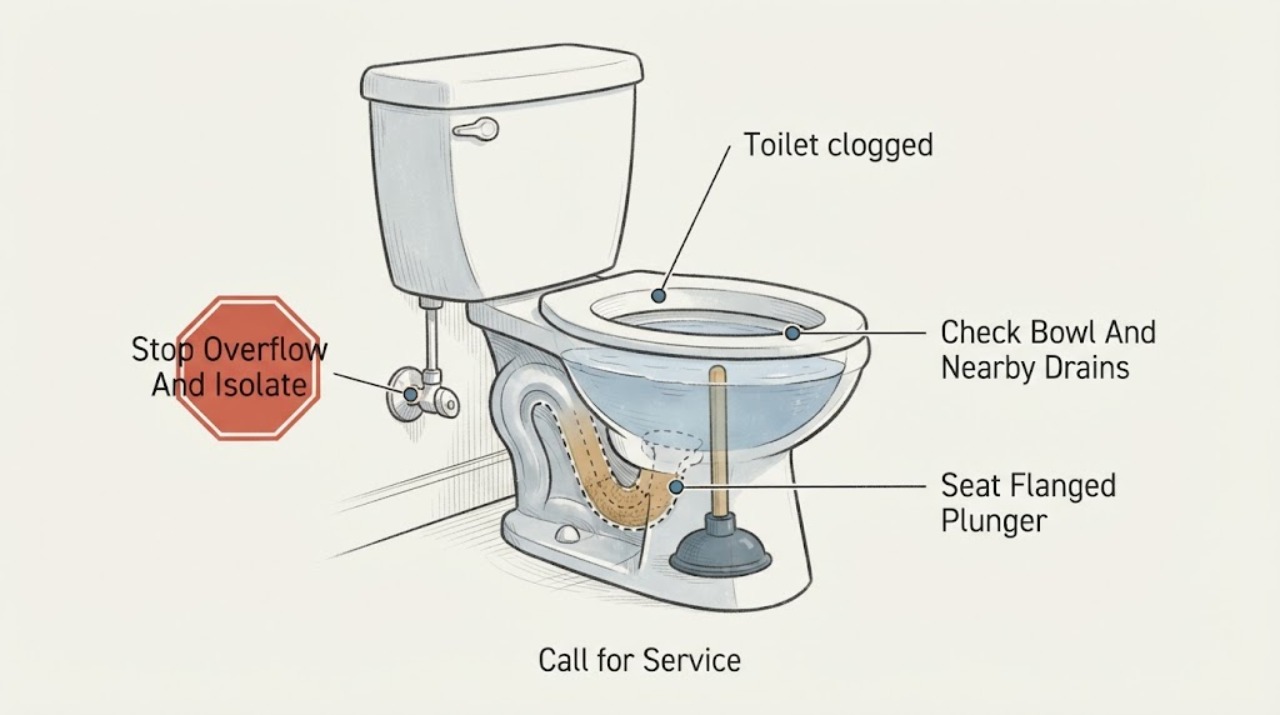
Work through in order
Diagnostic checks
Use only checks that match the exact appliance or system and its official guide.
-
Check 1
Stop flushing immediately. Watch the bowl without touching the water; if its level is rising, close the accessible toilet supply valve by hand only if it turns normally, and place towels around the base. If the level is near the rim, do not add water or insert a tool until enough water has been safely removed to prevent spillover.
Expected result: Record whether the level is rising, stable, slowly falling, or already at the rim, and whether the supply valve closes without force.
Next step: Keep the toilet out of use. If the valve will not close, the flow is fast, sewage is spilling, or water is near electrical equipment, isolate the broader supply only when safe and call a plumber urgently. Otherwise continue only after the bowl is below the spill point.
Stop if: Stop for an overflowing bowl, contaminated water, a seized or broken valve, a spray, active flooding, or any need to reach through water.
Why this matters
Why: A rising or stable high level means another flush can overflow and there is not yet a safe test condition. A valve that will not close is an isolation problem, not evidence that the toilet needs a new flush part.
-
Check 2
With flushing stopped, observe the bowl and briefly check whether a nearby sink or tub is draining normally without running enough water to make the toilet rise. Do not pour a bucket into a full or unstable bowl and do not use another fixture to force a test.
Expected result: The bowl drains down and nearby fixtures are normal; the bowl stays high; or another fixture also gurgles, backs up, or drains slowly.
Next step: For a toilet-only symptom, prepare a toilet flange plunger. For multiple-fixture backup, stop using connected fixtures and arrange plumbing service rather than trying to push the obstruction deeper.
Stop if: Stop if any other fixture backs up with sewage, the bowl level rises during the check, or the source of contaminated water is uncertain.
Why this matters
Why: A normal nearby drain with a toilet-only rise keeps a toilet trapway blockage more likely. A high bowl plus other fixture symptoms makes a shared branch or main drain obstruction more likely and increases overflow risk.
-
Check 3
Put on gloves and use a clean toilet flange plunger, not a flat sink cup. Keep enough water to cover the cup, lower the flange into the outlet, and pump with controlled strokes while maintaining the seal; stop if the seal cannot be made without splashing or if porcelain is damaged.
Expected result: The bowl level drops, the plunger loses its seal, the water only swirls, or the level rises toward the rim.
Next step: If the level drops, let it settle and continue to the controlled retest. If a seal cannot be maintained, the clog does not respond after several careful cycles, or the level rises, stop and arrange qualified service; do not escalate to improvised tools.
Stop if: Stop for a rising bowl, splash or sewage exposure, cracked or unstable porcelain, a persistent failed seal, or any need to use force beyond controlled hand pumping.
Why this matters
Why: A drop in level after a sealed pumping cycle is consistent with a loosening trapway blockage. A lost seal gives little diagnostic information; a rising level means the blockage remains and another attempt could overflow.
-
Check 4
After the bowl has returned to a safe level and the plunger is removed, restore the supply only if the valve operates normally. Perform one controlled flush while watching the bowl from the side; keep your hand ready to close the supply valve and do not repeat the flush if the level rises.
Expected result: The bowl drains with a normal pull and returns to its usual level; it drains slowly; or it rises again.
Next step: If normal, monitor without flushing non-toilet material. If slow or rising, keep the toilet out of use and call a plumber for an auger or drain-line diagnosis; do not repeatedly flush to prove the result.
Stop if: Stop immediately for a rising bowl, overflow, a flush that never completes, a failed supply stop, or water escaping at the base.
Why this matters
Why: One normal flush after clearing supports a released temporary blockage. A slow or repeat rise means the path is still restricted, a foreign object may be present, or the obstruction may be farther down the line.
-
Check 5
If the bowl drains but the toilet still has a weak or incomplete flush, record the Glacier Bay model and inspect only visible tank controls with the supply isolated if needed: tank water line, refill tube position, flush button or rod movement, and visible flush-valve seal condition. Do not remove a valve or seal unless the exact model instructions and safe access support it.
Expected result: The water line is not at its marked level, a refill tube or dual-flush rod is obstructed, the flush valve seal shows debris or damage, or all visible controls appear normal.
Next step: Use the exact Glacier Bay model instructions for a clearly identified visible adjustment or debris check. If a seal, flush valve, button, or tank part is damaged, the model is unknown, or the weak flush persists, stop and arrange qualified service or manufacturer support.
Stop if: Stop for a cracked tank, a leaking or stuck valve, water near electrical equipment, an unknown model, or any need to reach inside a pressurized or inaccessible assembly.
Why this matters
Why: A weak flush with a draining bowl can reflect refill or flush-valve performance rather than a trapway clog. Glacier Bay's support instructions are model-specific; a damaged seal or mismatched button cannot be inferred from the brand alone.
-
Check 6
Document the bowl behavior, whether plunging changed it, nearby fixture symptoms, any foreign object concern, the Glacier Bay model or visible markings, and whether the supply valve closes. Keep the toilet and connected fixtures out of use until the cause is resolved.
Expected result: The clog cleared and stays clear, the symptom recurs, multiple fixtures are affected, or the blockage remains after safe plunging.
Next step: Give the record and photos to a qualified plumber or Glacier Bay support route. Do not remove the toilet, snake an unknown line, open a wall, or use chemicals as a homeowner escalation.
Stop if: Stop owner troubleshooting when clearing requires toilet removal, deep snaking, drain-line access, chemical exposure, force against porcelain, or any unsafe water isolation.
Why this matters
Why: A stable one-time result can be monitored, while recurrence, multiple-fixture backup, or failure of a proper plunger points toward a deeper obstruction, foreign object, vent or drain issue, or a non-clog flush problem.
Use your observations
Decision map
Find the observation that best matches what you see, then follow the next safe action.
-
PATH 01Next step
What you see
The bowl rises immediately on a flush attempt or stays high, while nearby fixtures drain normally.
Do this next
Keep the supply isolated and use a toilet flange plunger only while the bowl is below the spill point. If it does not clear after careful attempts, call a plumber for a toilet auger or diagnosis.
Why this path and its safety boundary
Why it matters: A blockage in the toilet trapway is more likely than a building-wide drain obstruction.
-
PATH 02Next step
What you see
The toilet remains high and a sink, tub, or another fixture also gurgles, drains slowly, or backs up.
Do this next
Stop using connected fixtures and arrange qualified plumbing service. Do not push a cable through an unknown line or use chemical drain opener.
Why this path and its safety boundary
Why it matters: A shared branch or main drain obstruction is more likely, and flushing or running water elsewhere can worsen the backup.
-
PATH 03Next step
What you see
A flange plunger lowers the bowl, but the toilet rises again, drains slowly, or clogs again soon after.
Do this next
Keep the toilet out of use and call a plumber for an appropriate auger or drain-line evaluation. Do not keep repeating flushes or add chemicals.
Why this path and its safety boundary
Why it matters: The obstruction may be lodged deeper, only partly displaced, or caused by a foreign object or recurring pipe restriction.
-
PATH 04Next step
What you see
The bowl drains and holds its level, but the flush is weak or fails to move contents normally.
Do this next
Record the model and follow the matching Glacier Bay support instructions for visible checks. Arrange service for a damaged valve, seal, button, tank, or persistent weak flush; do not select a universal part.
Why this path and its safety boundary
Why it matters: A Glacier Bay tank water-line, refill, button or rod, flush-valve seal, jet, or model-specific adjustment issue is more likely than a simple trapway clog.
-
PATH 05Next step
What you see
A foreign object may be lodged, the supply valve is seized, porcelain is cracked, sewage is exposed, or water cannot be isolated safely.
Do this next
Stop testing, keep people and pets away from contaminated water, isolate water only if safe, and call a qualified plumber. Do not use improvised metal tools or remove the toilet as a first response.
Why this path and its safety boundary
Why it matters: The situation exceeds safe owner clearing and may cause contamination, water damage, or porcelain or valve damage.
Helpful context
Understand the symptom
Control the water before diagnosing the clog
Do not keep flushing a rising bowl. If the supply stop is accessible and works normally, close it; protect the floor and leave some bowl water for a plunger seal, but remove enough if the level is close to the rim. Do not reach through contaminated water or operate a valve that is seized, damaged, or spraying.
A trapway clog behaves differently from a drain-line backup
If the bowl rises immediately when the toilet is flushed, a blockage in the trapway is likely. If the toilet clears only briefly, other bathroom fixtures also back up, or water moves slowly farther down the system, the obstruction may be in the connected sanitary line. Avoid repeated flush tests while the level is unstable.
Glacier Bay flush mechanisms vary by model
Glacier Bay support material covers single-flush and dual-flush toilets with different button or rod arrangements, tank water lines, refill paths, and flush-valve seals. If the bowl drains but the flush remains weak or the symptom returns, record the model and inspect only visible, accessible controls; do not assume a replacement valve, seal, or button fits every Glacier Bay toilet.
Use only low-risk clearing methods
A flanged toilet plunger is intended to seal the toilet outlet and create alternating pressure. An auger can be appropriate for a stubborn trapway blockage, but repeated failed attempts, a suspected foreign object, a porcelain risk, or a blockage beyond the toilet is a professional boundary. Do not use a coat hanger, boiling water, bleach, or chemical drain opener as a substitute.
Safety boundary
Stop conditions
- Do not keep flushing a rising or unstable bowl; stop before overflow and isolate water only with an accessible valve that operates normally.
- Stop for sewage exposure, active flooding, water near electrical equipment, a cracked or unstable toilet, a seized valve, or a source that cannot be safely isolated.
- Do not use bleach, boiling water, chemical drain opener, a coat hanger, or another improvised tool in place of a toilet flange plunger or qualified service.
- Do not remove the toilet, open a wall, deep-snake a drain, or disassemble a Glacier Bay flush valve or tank part as a first homeowner escalation.
- Call a qualified plumber when careful flange plunging fails, the clog recurs, another fixture backs up, a foreign object is suspected, or clearing requires force or inaccessible plumbing.
Only after diagnosis
Potential parts
- toilet flange plunger
Consider this only for a toilet-only blockage with a bowl below the spill point and an intact outlet that can accept a safe seal.
Use a toilet-specific flanged design; stop if the seal cannot be made safely or the porcelain is damaged. - toilet auger
Consider this only after a careful flange-plunger attempt fails and a qualified person confirms the obstruction is in the toilet trapway rather than a shared drain.
Use a toilet-rated tool appropriate for the fixture and stop rather than forcing it; professional handling is preferred for unknown objects, porcelain risk, or deeper lines. - Glacier Bay flush valve or dual-flush seal
Consider this only when the bowl drains but a model-specific inspection identifies debris, a damaged seal, or a failed flush-valve component rather than a trapway blockage.
Confirm the exact Glacier Bay model and single- or dual-flush configuration before ordering; do not assume a universal valve, seal, button, or rod fits. - Glacier Bay fill valve or refill tube
Consider this only when a weak post-clog flush is traced to an incorrect tank water level, obstructed refill path, or failed fill component.
Use the exact model instructions and verify fitment and water-line requirements; persistent or inaccessible tank work belongs with qualified service.
When checks do not resolve it
Need a professional?
Call a qualified plumber when the bowl will not clear after careful use of a toilet flange plunger, the clog returns, another fixture backs up, a foreign object may be lodged, the obstruction appears beyond the trapway, or a toilet auger, drain snake, toilet removal, or concealed-line work is needed. Call urgently for an overflow, sewage contamination, active flooding, a failed supply valve, cracked porcelain, or water near electrical equipment. For a bowl that drains but has a persistent weak flush, use the exact Glacier Bay model information and arrange qualified repair when the visible model-specific checks do not resolve it.
Safety scope: Owner checks are limited to stopping flushes, safe external observation, normal operation of an accessible supply valve, careful use of a toilet flange plunger, visible model identification, and documentation. A qualified professional should handle failed isolation, deep augering or snaking, toilet removal, concealed drain work, foreign-object extraction, cracked porcelain, contaminated water, and model-specific internal tank repairs.
Common questions
FAQ
What should I do first when my Glacier Bay toilet is clogged?
Stop flushing. If the bowl is rising, close the accessible supply valve only if it operates normally, protect the floor, and wait for a safe level before using a toilet flange plunger.
Can I keep flushing to clear a Glacier Bay toilet clog?
No. Repeated flushing can turn a partial blockage into an overflow. Control the water first and use a toilet-specific plunger only when the bowl is below the spill point.
Why does the toilet bowl rise immediately when I flush?
A blockage in the toilet trapway is a common possibility, especially when nearby fixtures drain normally. If other fixtures also back up, a shared drain obstruction is more likely.
What type of plunger works for a Glacier Bay toilet?
Use a clean toilet flange plunger whose flange enters the outlet and forms a seal. A flat sink cup may not seal the toilet trapway.
How many times should I plunge a clogged toilet?
Use controlled pumping while maintaining a seal, then stop if the bowl rises, the seal cannot be maintained, there is splashing, or careful attempts do not change the level. Arrange service rather than forcing the tool.
What if plunging clears the clog but it comes back?
A recurring or slow drain can indicate a deeper obstruction, foreign object, or line restriction. Keep the toilet out of use and have a plumber evaluate the trapway and connected drain.
Why is my Glacier Bay toilet weak after the bowl drains?
A weak flush can involve the tank water line, refill path, dual-flush button or rod, flush valve, seal, or jet rather than a simple clog. Record the exact model and use its matching support instructions.
Should I use boiling water, bleach, or chemical drain opener?
No. These can damage the fixture, seal, plumbing, or user. Use a toilet flange plunger and qualified service for a stubborn blockage; do not substitute an improvised metal tool.
When does a clogged toilet need a plumber?
Call when careful flange plunging fails, the clog recurs, another fixture backs up, a foreign object is suspected, the obstruction is beyond the trapway, or the next step requires an auger, deep snake, toilet removal, or concealed access.
Is a clogged Glacier Bay toilet an emergency?
Treat overflow, sewage contamination, active flooding, a failed supply valve, cracked porcelain, or water near electrical equipment as urgent. Stop testing and obtain qualified help.
Read the exact guide
Official sources
- How to Unclog a ToiletAmerican Standard · American Standard manufacturer guidance used for stopping continuous flushing, protecting the floor, using a toilet plunger, and controlled retesting; the page is not Glacier Bay-specific.
- What should I do if the water continuously runs or ghost flushes for my Single Flush Glacier Bay Made in Mexico Toilets 340-995 or 686-826?Globe Union Industrial Corp. · Globe Union manufacturer support for identified Glacier Bay single-flush models; used to distinguish tank water-level, fill-valve, debris, and flapper or flush-valve checks from a trapway clog.
- Troubleshooting: Poor Or No Flush — KOHLER Pressure Assist ToiletsKohler Co. · Kohler manufacturer troubleshooting flow used as general toilet diagnostic evidence for separating a rising bowl blockage from a water-draining path and escalating unresolved blockage; it is not Glacier Bay-specific.
- How to Unclog a ToiletOatey Company · Oatey plumbing manufacturer guidance used for trapway-versus-sanitary-line clues, flanged plunger selection, safe plunging sequence, auger boundary, and avoidance of improvised tools.
- What should I do if my Glacier Bay Made-in-Mexico Dual Flush Toilet 215-583 is having a flushing performance issueGlobe Union Industrial Corp. · Globe Union manufacturer support for one identified Glacier Bay dual-flush model; used to establish model-specific button, refill, water-line, and flush-valve checks, not universal fitment.
- Troubleshooting GuideGlobe Union Industrial Corp. · Globe Union's official troubleshooting index used to confirm separate Glacier Bay toilet topics for flush performance, tank refill, low bowl water, and flush-valve issues.
Community feedback
Share a repair observation
Share a plain-text repair observation. Accepted observations are published automatically; this page may take a moment to update.