
On this page
Start here
Quick answer
If a Kohler toilet is clogged, stop flushing while the bowl is high and close the nearby supply stop if water is still entering. A single slow or non-draining bowl often points to a bowl or trapway blockage, so a toilet plunger is the appropriate first low-risk check; use a toilet auger only when the exact model instructions and your access make that safe. If the clog returns, the trapway does not clear, several fixtures gurgle or back up, or the toilet is a pressure-assisted model with poor flush rather than a simple blockage, stop testing and call a qualified plumber. Do not use chemical drain cleaner, force tools against the vitreous china, or open a pressure-assisted reservoir as an ordinary-user repair.
Before you begin
Safety first
- This article is limited to overflow prevention, ordinary-access observation, a controlled toilet-plunger check, and an auger only when the exact model instructions and safe access support it. A professional must handle persistent blockages, shared drains and vents, toilet removal, damaged ceramic, supply or base leaks, and pressure-assisted internal service.
Work through in order
Diagnostic checks
Use only checks that match the exact appliance or system and its official guide.
-
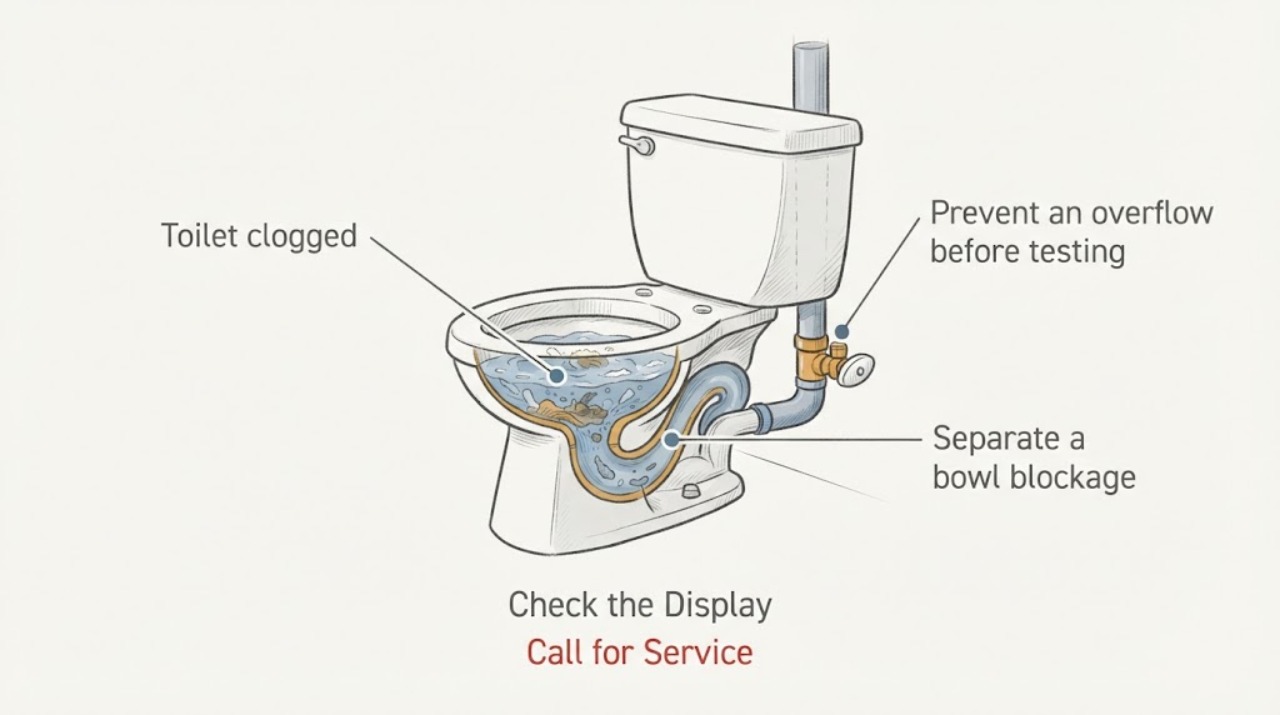
Prevent an overflow before testing
Stop pressing the flush handle. If the bowl is rising or the valve is still admitting water, turn the nearby toilet supply stop clockwise by hand until the inflow stops; keep towels and other items away from contaminated water.
Expected result: Record whether the bowl is high but stable, still rising, overflowing, leaking at the base, or showing clean water entering from the tank or supply.
Next step: Leave the toilet unflushed and proceed only when the bowl is stable and the floor is safe. For overflow, sewage contamination, a base leak, or a supply stop that will not close, arrange prompt plumbing service.
Stop if: Do not continue testing while water is overflowing, spreading across the floor, reaching electrical equipment, or causing a slip or sanitation hazard.
Why this matters
Why: A rising bowl is an overflow-control problem first. Water entering from the tank or a leak at the base can be a separate valve or seal issue, while a stable high bowl is safer to characterize before using a tool.
-
Separate a bowl blockage from a shared drain symptom
Without flushing again, note how the bowl behaved after the last attempt and observe nearby fixtures without adding water: check whether the bowl drains slowly, does not drain, clogs only with one flush, or has a history of recurring clogs. Listen for gurgling or watch for bubbles at the toilet trapway and note whether another drain backs up.
Expected result: Classify the pattern as one isolated slow bowl, a bowl that will not evacuate, repeated clogs, or a toilet symptom accompanied by sounds, bubbles, or backup at another fixture.
Next step: Use the localized blockage path only for an isolated stable bowl. If multiple fixtures are affected or the vent and drain pattern is present, stop using connected fixtures and call a plumber for a drain and vent assessment.
Stop if: Do not run more water through a system that is backing up, bubbling at several fixtures, or threatening another overflow.
Why this matters
Why: An isolated event supports a localized bowl or trapway check. Repetition, bubbles, gurgling, or another affected fixture makes a restricted vent, drain line, or shared waste path more likely than a single piece of debris.
-
Try a controlled toilet-plunger check
For a stable, isolated bowl blockage, place a toilet plunger with its flange centered over the outlet and keep enough water around the cup to form a seal. Use controlled push-and-pull strokes rather than violent force, then pause and observe whether the water level begins to fall.
Expected result: The bowl drains and stays down, drains only slowly, does not change, or rises toward the rim during the attempt.
Next step: If the bowl clears, wait and make one cautious normal-use observation rather than repeated test flushes. If it remains slow or high, stop plunging and use the service or auger branch only when the model and access support it.
Stop if: Stop if the bowl rises, the plunger cannot seal, ceramic cracks or shifts, dirty water splashes, or controlled strokes do not improve drainage.
Why this matters
Why: A clear improvement supports a localized obstruction. Little or no change means the blockage may be deeper or the plunger is not sealing; a rising bowl means the outlet remains restricted and more water should not be added.
-
Inspect only visible bowl and rim areas
With the water level stable and the supply stopped if needed, use a light from outside the bowl to look for a visible object, unusual low water level, or mineral and debris deposits under the rim. Do not reach into the trapway, remove the tank lid hardware, or poke the outlet with a sharp object.
Expected result: The bowl has a visible object, deposits under the rim, no visible cause, or a damaged or cracked ceramic surface.
Next step: Remove only a loose object that is plainly reachable without putting a hand into contaminated water or forcing it; otherwise leave the toilet untouched and arrange service. Follow the exact Kohler care instructions for permitted rim cleaning after the clog is resolved.
Stop if: Do not insert a hand, wire, knife, improvised rod, or chemical cleaner, and do not use the toilet if ceramic is cracked or leaking.
Why this matters
Why: A visible object or rim deposit can explain a localized obstruction or weak flush, but no visible cause does not rule out a deeper trapway or drain blockage. A crack or damaged china is a stop-use condition.
-
Use a toilet auger only within the model's boundary
If the bowl remains blocked after a controlled plunger check, first identify the Kohler model and read its instructions. Use a toilet auger only if the model instructions and the tool's intended use support it, keeping the guide aligned with the trapway and advancing gently; do not force a cable or improvise a long drain tool.
Expected result: The auger meets a removable obstruction and drainage improves, it stops without improvement, or it binds and risks contact with the ceramic.
Next step: Stop after the permitted attempt, preserve any removed object, and have a plumber assess the trapway and drain line when the clog remains, recurs, or the tool could not be used without force.
Stop if: Do not force the auger, remove the toilet, open a pressure-assisted reservoir, or continue if the bowl rises, the tool binds, or the porcelain could be damaged.
Why this matters
Why: Kohler describes an auger or snake as a way to free a clog from the trapway, but a tool that binds, cannot clear the passage, or leaves the problem unchanged may indicate a deeper obstruction or drain issue.
-
Check for a weak-flush cause after the bowl is clear
Once the bowl drains normally, observe a later ordinary flush without repeated cycling. Note whether the supply stop is open, the rim jets appear obstructed, the flush is weak, the bowl rises then falls slowly, or a pressure-assisted model does not perform as usual; do not adjust preset fittings.
Expected result: The flush is strong and normal, or it remains weak with rim deposits, a restricted vent or drain pattern, a closed supply stop, or an unknown pressure-assisted fault.
Next step: Use only model-approved care for visible rim deposits and confirm the supply stop is open. If weak flushing persists, the toilet is pressure-assisted, or vent and drain symptoms remain, provide the model and observations to a plumber or Kohler service channel.
Stop if: Do not adjust preset pressure-assisted fittings, use in-tank chlorine cleansers, or open a pressurized reservoir as a DIY troubleshooting step.
Why this matters
Why: A normal flush after clearing supports a one-time blockage. Persistent weak flushing can involve rim holes, the drain line, venting, supply, or model-specific inlet hardware rather than a remaining bowl clog.
Use your observations
Decision map
Find the observation that best matches what you see, then follow the next safe action.
-
PATH 01Safety boundary
What you see
The bowl is high or rising, the supply is still feeding it, or water is already on the floor.
Do this next
Stop flushing, close the supply stop if it operates normally, keep people away, and call a plumber promptly for overflow, contamination, a base leak, or a valve that will not stop the inflow.
Why this path and its safety boundary
Why it matters: The immediate risk is an overflow or water-damage event, so the clog diagnosis must wait until inflow and access are controlled.
Safety stop: Do not add water, plunge aggressively, or continue if the floor is slippery, contaminated, or near electrical equipment.
-
PATH 02Safety boundary
What you see
The bowl is stable, nearby fixtures are normal, and drainage improves after a controlled toilet-plunger check or model-permitted auger attempt.
Do this next
Avoid repeated test flushes, record what was removed if known, and monitor the next normal use. If the clog returns, move to the recurring-clog branch instead of repeating the same tool cycle.
Why this path and its safety boundary
Why it matters: A localized bowl or trapway obstruction is more likely than a shared vent or drain failure, although recurrence would change that assessment.
Safety stop: Stop if the bowl rises again, leaks, drains slowly, or the same symptom returns.
-
PATH 03Safety boundary
What you see
The bowl remains slow or full after controlled plunging, the auger cannot clear it without force, or no safe model-supported auger procedure is available.
Do this next
Leave the toilet out of service and arrange a qualified plumber to inspect the trapway and drain line; provide the model and the exact tool result.
Why this path and its safety boundary
Why it matters: The obstruction may be lodged deeper in the trapway or drain line, or the fixture may have a condition that a household tool cannot safely distinguish.
Safety stop: Do not force a cable, pour chemical cleaner into the bowl, remove the toilet, or pry against the porcelain.
-
PATH 04Safety boundary
What you see
Clogs recur, the bowl rises quickly and falls slowly, nearby drains gurgle, bubbles appear at the trapway, or another fixture backs up.
Do this next
Stop using the affected group of fixtures and request drain and vent assessment from a qualified plumber.
Why this path and its safety boundary
Why it matters: Kohler associates this pattern with restricted venting or a clogged waste stack or drain path, so a local plunger result does not establish a lasting repair.
Safety stop: Do not keep flushing to force the line clear or access the roof vent, shared drain, or wall piping as an ordinary-user test.
-
PATH 05Safety boundary
What you see
The bowl drains but the flush remains weak, the supply or rim path is restricted, or the Kohler toilet uses a pressure-assisted system with an unresolved fault.
Do this next
Confirm only visible, model-approved checks; then provide the model, flush pattern, supply status, and any rim or vent symptoms to a plumber or Kohler service channel.
Why this path and its safety boundary
Why it matters: The remaining problem may be rim holes, supply, inlet-screen hardware, drain or venting, or pressure-assisted components rather than a simple clog. Kohler warns that some fittings are preset and that the pressurized reservoir requires a service boundary.
Safety stop: Do not adjust preset fittings, lubricate the pressure-assisted system, open the reservoir, or use chlorine in-tank cleansers.
Helpful context
Understand the symptom
A one-time blockage is different from a system problem
A Kohler toilet that rises once after an unusual flush may have a localized blockage in the bowl or trapway. A bowl that rises quickly and drains slowly, clogs repeatedly, makes nearby drains sound unusual, or bubbles through the trapway during flushing deserves a wider drain and vent assessment. Keep the distinction in mind while checking so repeated plunging does not hide a shared plumbing problem.
Kohler models do not all use the same flush hardware
Some Kohler toilets use a pressure-assisted system, while others use a conventional tank arrangement. A pressure-assisted model has a pressurized reservoir and manufacturer-set fittings; its manual warns to turn off the water and flush to release pressure before service and to refer unresolved problems to the installer or plumber. Do not open that reservoir or adjust hidden fittings just because the bowl is slow.
Paper and rim deposits matter when the clog keeps returning
Kohler notes that some toilet papers break down less readily in flowing water and can contribute to recurring clogs. On models where the bowl flush is weak, mineral deposits or debris under the rim can also reduce the flushing action. These are follow-up clues after the bowl is safe and clear; they are not reasons to keep flushing a high bowl or to alter the toilet's internal parts.
Safety boundary
Stop conditions
- Stop flushing when the bowl is high, rising, slow to drain, or another fixture is backing up; close the supply stop if it can be operated normally without force.
- Do not pour chemical drain cleaner into the toilet, mix cleaners, or use a hand, wire, knife, or improvised rod in the trapway.
- Do not force a plunger or auger against the vitreous china, remove the toilet, or open a wall, shared drain, roof vent, or pressure-assisted reservoir as an ordinary-user test.
- Do not adjust preset pressure-assisted fittings, lubricate that system, or use chlorine in-tank cleansers; follow the exact Kohler model instructions instead.
- Stop and call a plumber for overflow, sewage contamination, a base leak, cracked ceramic, recurring clogs, multiple affected fixtures, gurgling or bubbling, or a blockage that remains after a controlled permitted attempt.
Only after diagnosis
Potential parts
- toilet supply stop
Consider this category only if the existing supply stop will not close, leaks, or is damaged during the overflow-control check; it does not clear a trapway blockage.
Confirm the existing connection, pipe arrangement, material, and local plumbing requirements with a plumber before ordering. - toilet fill or flush valve
Consider this category only when the bowl is clear but the model-specific flush or refill hardware is proven faulty, such as water continuing to enter or a weak flush unrelated to the drain path.
Confirm the exact Kohler model and manufacturer fit information; pressure-assisted and conventional systems are not interchangeable by appearance. - toilet tank or bowl seal
Consider this category only if inspection confirms a leak at a tank, bowl, or base connection after the clog is resolved; a seal does not explain an isolated trapway blockage.
Have a plumber identify the leak location and exact model-specific seal before removing the toilet or disturbing a pressure-assisted assembly.
When checks do not resolve it
Need a professional?
Call a qualified plumber when the bowl is overflowing or will not evacuate, the supply stop or base leaks, the clog remains after a controlled toilet-plunger check and any model-permitted auger attempt, the problem recurs, multiple fixtures are affected, gurgling or bubbles suggest venting, or a pressure-assisted Kohler system needs internal service. Keep the toilet out of service until the professional confirms the drain and fixture are safe.
Safety scope: This article is limited to overflow prevention, ordinary-access observation, a controlled toilet-plunger check, and an auger only when the exact model instructions and safe access support it. A professional must handle persistent blockages, shared drains and vents, toilet removal, damaged ceramic, supply or base leaks, and pressure-assisted internal service.
Common questions
FAQ
What should I do first when my Kohler toilet is clogged?
Stop flushing. If the bowl is rising, close the nearby supply stop if it operates normally, keep the floor clear, and wait until the level is stable. For an isolated stable bowl, a controlled toilet-plunger check is the first ordinary tool step; do not use chemical drain cleaner.
When should I use a toilet auger on a Kohler toilet?
Kohler describes an auger or snake as a way to free a clog from the trapway. Use one only when the exact model instructions and safe access support it, and stop if it binds, the bowl rises, the porcelain could be damaged, or the blockage remains.
Why does my Kohler toilet keep clogging after it drains?
Recurring clogs can involve paper that breaks down poorly, rim deposits that weaken the flush, a deeper trapway or drain restriction, or a restricted vent. If nearby drains gurgle, bubble, back up, or the bowl rises quickly and falls slowly, arrange a drain and vent assessment instead of repeating flushes.
Can I open a pressure-assisted Kohler toilet tank to clear a clog?
No. Some Kohler pressure-assisted models contain a pressurized reservoir and use preset fittings. Keep the reservoir closed and use the model manual or qualified service for internal work; a bowl clog is not a reason to improvise pressure-system service.
Why is my Kohler toilet still weak after the clog clears?
A remaining weak flush may involve rim holes, the supply stop, inlet-screen hardware, the drain or vent, or pressure-assisted components rather than a residual bowl clog. Use only visible, model-approved checks and call a plumber when the weak flush persists or the model-specific hardware is uncertain.
Read the exact guide
Official sources
- Poor FlushKohler Assist · Official Kohler troubleshooting guidance for toilet water rising, slow flushes, frequent clogs, sounds from other drains, and trapway bubbles.
- Toilet Water Not Leaving BowlKohler Assist · Official Kohler guidance for a bowl that does not evacuate and for escalation when an auger does not resolve the issue.
- Owner’s ManualKohler Co. · Official Kohler owner manual for Pressure Lite toilet models; used to distinguish pressure-assisted service boundaries and documented poor-flush causes, not to claim every Kohler model has the same hardware.
- Frequent Toilet CloggingKohler Assist · Official Kohler guidance for a recurring-clog pattern where toilet paper choice may affect breakdown in flowing water.
Community feedback
Share a repair observation
Share a plain-text repair observation. Accepted observations are published automatically; this page may take a moment to update.