
On this page
Start here
Quick answer
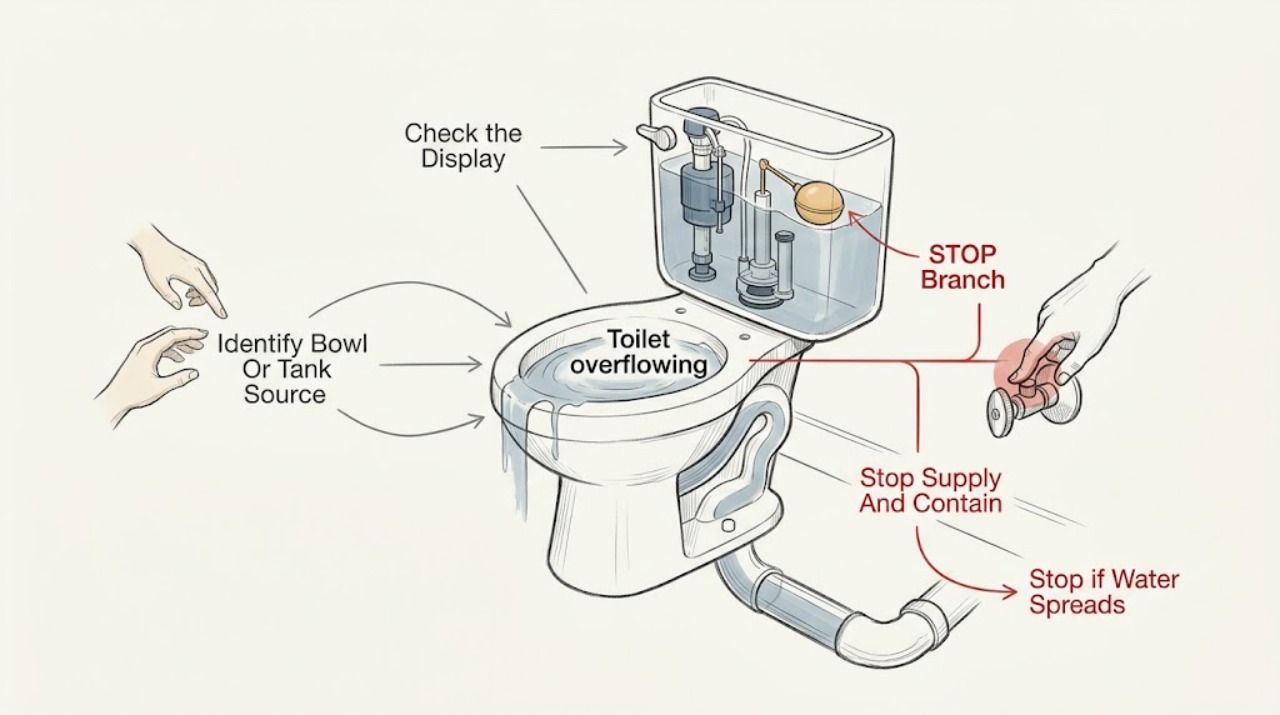
Stop the incoming water before a Kohler toilet reaches the rim: turn the toilet's local supply shut-off clockwise if it operates normally, then do not flush again. If the bowl is high because water is not leaving, a trapway or waste-line clog is likely; use only a toilet plunger or auger after the supply is stopped and the water level is controlled, and stop if the obstruction does not clear. If water keeps entering the bowl or tank, inspect from above for a stuck float, a fill valve that does not shut off, a flush-valve seal or flapper that is leaking, a chain or cable that is holding the flush valve open, or a tank level above the marked waterline. Kohler identifies these as separate troubleshooting paths and says the correct fill-valve part depends on the toilet model. Do not keep testing an overflowing bowl, use drain chemicals, reach into contaminated water without protection, or remove the toilet or open a wall as a first step.
Before you begin
Safety first
- This article supports stopping the supply, containing water, observing the bowl and tank, and a controlled mechanical clearing attempt only after the bowl is below the rim. A plumber handles failed isolation, shared drains, venting, toilet removal, base seals, cracked china, concealed leaks, and model-specific component replacement.
Work through in order
Diagnostic checks
Use only checks that match the exact appliance or system and its official guide.
-
Check 1
Turn the Kohler toilet's local supply shut-off clockwise from a stable, dry position if it turns normally, and keep the bowl lid down or the area isolated without pressing the flush lever again.
Expected result: Confirm whether the incoming stream stops and whether the bowl level stabilizes; note a seized, broken, missing, or leaking shut-off and any water already on the floor.
Next step: Contain the water, protect nearby electrical equipment without touching wet wiring, and continue only with the source check once the level is safely below the rim.
Stop if: Do not force the stop, remove its packing nut, shut an unknown whole-house valve in an emergency without understanding the consequences, or touch energized equipment in standing water.
Why this matters
Why: A stopped supply prevents a fill-valve fault from adding more water, but it does not clear a bowl clog. If the stop cannot isolate the fixture or water continues from elsewhere, the problem needs prompt plumbing service.
-
Check 2
With the water supply isolated, observe whether the bowl had risen because a flush did not drain or whether water was continuously entering the bowl from the tank or refill tube; do not remove the toilet or reach into contaminated water.
Expected result: Classify the pattern as bowl level high with no inflow, water entering from the rim or flush opening during a flush, a tank filling into its overflow tube, a slow ripple from tank to bowl, or water escaping at the base or supply connection.
Next step: Use the matching branch below; photograph the tank components and wet location before moving or disassembling anything.
Stop if: Stop for sewage backing up from another fixture, water at the electrical system, a cracked tank or bowl, an unstable toilet, or contamination that cannot be safely contained.
Why this matters
Why: A high bowl with no evacuation points to the trapway, waste line, or possibly venting. Continuous tank-to-bowl flow points to fill-valve, float, flush-valve seal, chain/cable, or refill-hose behavior. A base or supply leak is a different seal or connection problem and is not repaired by plunging.
-
Check 3
Only after the supply is off and the bowl is below the rim, use a toilet plunger with controlled strokes or a toilet auger/snake appropriate to the fixture; do not use a chemical drain opener or flush to test while the bowl is full.
Expected result: Record whether water begins to move, the obstruction clears and the level falls, the tool meets a hard stop, or the bowl remains slow or backs up into another fixture.
Next step: Keep the supply off until the bowl drains reliably; arrange a plumber if one careful mechanical attempt does not restore drainage or if the obstruction may be a hard object.
Stop if: Do not use caustic chemicals, boiling water, excessive force, a closet auger that can damage the bowl, or repeated flushes while drainage is uncertain.
Why this matters
Why: Improvement after controlled mechanical clearing supports a trapway obstruction. No movement, a hard object, repeated backup, or symptoms across fixtures make a deeper waste-line, vent, foreign-object, or shared-drain problem more likely.
-
Check 4
With the tank lid lifted only if it is stable and the water is controlled, observe the float and fill valve without reaching into the water or removing the valve cap; check whether the float moves freely and whether the valve stops when the float reaches the marked level.
Expected result: Record a stuck or submerged float, debris at the fill-valve head, a valve that continues running, water entering the flush-valve overflow, or a tank level above the marked waterline.
Next step: Keep the supply off, use only the exact Kohler model instructions for a safe fill-valve clean or water-level adjustment, and call a plumber if the float, valve, or tank parts are damaged or unclear.
Stop if: Do not defeat the float, bend parts by force, remove a pressurized valve component, operate a cracked tank, or substitute a fill valve based only on appearance.
Why this matters
Why: Kohler identifies debris at the fill valve, a float that cannot rise, and a water level set too high as causes of continuous running or overflow into the flush-valve overflow. A valve that still runs after model-approved cleaning may require a model-specific replacement.
-
Check 5
From above, inspect whether the trip lever, chain, cable, flapper, canister, or flush-valve seal is holding the flush valve open; do not remove tank hardware while the supply is pressurized or when the model arrangement is unknown.
Expected result: Note a chain or cable with no slack, a lever that binds, a flapper or canister that does not seat, a dirty or damaged seal, or a tank-to-bowl ripple after the supply is briefly restored only when safe.
Next step: Leave the supply off and follow the exact Kohler care or repair guide, or provide the model and photos to a plumber when the seal, valve, cable, or canister cannot be identified.
Stop if: Do not use in-tank chlorine cleaners, overtighten tank hardware, pry a stuck seal, or repeatedly reopen the supply to reproduce an overflow.
Why this matters
Why: A linkage that holds the flush valve open or a worn, dirty, or misaligned seal can let the tank refill continuously into the bowl. This is not the same as a bowl trapway clog; replacing or cleaning a seal requires the exact model procedure.
-
Check 6
After the immediate overflow is contained, observe nearby fixtures and the toilet base from a dry position; do not remove the toilet or open a wall to chase a blocked line.
Expected result: Record whether sinks, tubs, or another toilet also back up, whether the bowl level changes when another fixture runs, whether water leaks at the base or supply connection, and whether the toilet rocks or the floor is damaged.
Next step: Keep the fixture out of service and arrange qualified plumbing assessment, especially if sewage is backing up elsewhere or the base seal or floor may be compromised.
Stop if: Stop for sewage exposure, a cracked or unstable fixture, water entering concealed construction, or any need to pull the toilet, open a wall, or work on a shared drain.
Why this matters
Why: Multiple fixtures backing up suggests a shared waste-line or venting issue rather than a Kohler bowl-only clog. A base leak, rocking toilet, cracked china, or damaged floor indicates a seal or structural/plumbing problem that plunging will not correct.
Use your observations
Decision map
Find the observation that best matches what you see, then follow the next safe action.
-
PATH 01Safety boundary
What you see
The bowl rises during or after a flush, no water is entering from the tank, and the supply is now shut off.
Do this next
Use a controlled toilet plunger or suitable toilet auger only with the bowl below the rim; stop and call a plumber for a hard object, repeated backup, shared-drain symptoms, or no improvement.
Why this path and its safety boundary
Why it matters: A trapway obstruction is the leading safe-to-check possibility; if the trapway is clear or other fixtures back up, the waste line or venting becomes more likely.
Safety stop: Do not add drain chemicals, flush repeatedly, remove the toilet, or force a tool through an uncertain obstruction.
-
PATH 02Safety boundary
What you see
The tank keeps filling and water spills into the flush-valve overflow, or the tank waterline is above its marked level.
Do this next
Keep the supply off and use only the exact Kohler model instructions for the float, waterline, and fill-valve check; replace a valve only after model identification and confirmation.
Why this path and its safety boundary
Why it matters: A high tank setting, stuck or dirty float, fill valve that does not shut off, or supply-pressure/valve issue is more likely than a bowl trapway clog.
Safety stop: Do not force the float, remove a pressurized fill valve, or operate a cracked tank; call a plumber if the valve continues to run or the waterline cannot be controlled.
-
PATH 03Safety boundary
What you see
The bowl shows a continuous ripple or receives water even though no flush is active, while the tank level falls or the fill valve cycles.
Do this next
Leave the supply off, photograph the tank hardware and model marking, and follow the model-specific Kohler procedure or request plumbing service for seal or valve diagnosis.
Why this path and its safety boundary
Why it matters: A leaking flush-valve seal, flapper, canister, trip lever, chain, cable, or refill arrangement is more likely than a blocked bowl drain.
Safety stop: Do not use in-tank chlorine products, pry the seal, over-tighten tank bolts, or keep cycling the supply while water can overflow.
-
PATH 04Safety boundary
What you see
The toilet backs up with a sink, tub, or another toilet, or its level changes when another fixture discharges.
Do this next
Stop using the affected fixtures and request qualified plumbing service to assess the shared line or vent; protect occupants from sewage exposure.
Why this path and its safety boundary
Why it matters: A shared waste-line blockage or restricted vent is more likely than an isolated Kohler trapway problem.
Safety stop: Do not pour chemicals into any fixture, run more water to test the line, or open a cleanout or wall without the appropriate plumbing procedure and protection.
-
PATH 05Safety boundary
What you see
Water appears at the toilet base or supply connection, the toilet rocks, the tank or bowl is cracked, or the floor is becoming wet even after the bowl level is controlled.
Do this next
Keep the supply closed, dry and isolate the area, and arrange prompt plumbing service for a connection, wax or other base seal, fixture, and floor assessment.
Why this path and its safety boundary
Why it matters: A seal, supply connection, damaged fixture, or floor problem is possible; plunging and fill-valve adjustment will not safely correct it.
Safety stop: Do not tighten china hardware by force, rock or lift the toilet, use the fixture with a crack, or open the floor or wall as a DIY test.
-
PATH 06Safety boundary
What you see
The local shut-off is seized, broken, leaking, absent, or does not stop the incoming water.
Do this next
Keep people away from the water, use only a known safe whole-home isolation if necessary, and obtain urgent plumber help to isolate and repair the supply stop.
Why this path and its safety boundary
Why it matters: The immediate water-source problem cannot be controlled at the fixture and increases the risk of a larger overflow or supply leak.
Safety stop: Do not force the valve, remove fittings, or continue flushing while water cannot be isolated.
Helpful context
Understand the symptom
Make the overflow safe before diagnosing it
An overflowing toilet can quickly damage flooring and spread contaminated water. Turn off the local supply stop if it can be operated without force, avoid another flush, and keep children and pets away. If the stop is seized, broken, leaking, or absent, use the home's water isolation only if you know the correct valve, or call a plumber. A bowl that is already near the rim needs containment and source control first; it is not a good time to experiment with a plunger, cleaner, or tank adjustment.
The water level tells you whether to investigate the drain or the tank
If the bowl rises during or after a flush and does not evacuate, Kohler lists a possible trapway clog and recommends a toilet auger or snake; if that path is clear and the problem continues, restricted venting may be involved. If the bowl receives water continuously from the tank, the fill valve, float, flush-valve seal, trip lever, refill arrangement, or tank water level becomes the focused branch. These symptoms can overlap, so stop the supply and observe where water is coming from before replacing a part.
Use model-specific parts and keep chemicals out of the tank
Kohler's support material says fill-valve replacement parts vary by toilet model, and its installation guidance shows model-specific float, flush valve, seal, cable, and waterline arrangements. Record the model before considering a part. Do not add in-tank chlorine tablets or other aggressive cleaners: Kohler warns that chlorine products can damage tank fittings and cause leaks and property damage. Persistent overflow, a blocked waste line, a leaking base, or a toilet that cannot be isolated is plumber work.
Safety boundary
Stop conditions
- Stop flushing and isolate the toilet's water supply before the bowl reaches the rim; contain contaminated water and keep children and pets away.
- Do not use chemical drain openers, boiling water, repeated test flushes, or excessive force in a blocked bowl.
- Do not use in-tank chlorine cleaners; Kohler warns that they can damage tank fittings and cause leakage and property damage.
- Do not force or remove a seized supply stop, float, fill-valve component, tank bolt, flush seal, or other part when its model arrangement is unclear.
- Stop and call a plumber for sewage backup at multiple fixtures, a cracked or rocking toilet, a base leak, water entering concealed construction, electrical contact, or an overflow that cannot be controlled.
Only after diagnosis
Potential parts
- Kohler fill valve
Consider this category only if the float and waterline checks show that the fill valve does not shut off after model-approved cleaning and the exact Kohler model confirms the replacement.
Fill-valve part numbers vary by Kohler toilet model; confirm the tank and valve configuration and follow the exact installation instructions before ordering. - Kohler flush valve seal, flapper, or canister seal
Consider this category only when a tank-to-bowl ripple or continuous refill confirms a worn, dirty, displaced, or damaged flush-valve seal or flapper.
Confirm whether the toilet uses a flapper, canister, cable, or another flush assembly and match the exact model; do not substitute a seal by appearance or overtighten tank hardware. - toilet tank-to-bowl or base seal
Consider this category only if a plumber confirms leakage at the tank-to-bowl joint or the toilet base after the bowl overflow and supply symptoms are separated.
Confirm the exact Kohler toilet configuration and seal type; replacement may require toilet removal and should not be improvised on cracked or rocking china.
When checks do not resolve it
Need a professional?
Arrange qualified plumbing service when the local supply stop cannot isolate the toilet, a controlled plunger or toilet auger does not restore drainage, multiple fixtures back up, the fill valve continues to run, a tank or bowl is cracked, water leaks at the base or wall, the toilet rocks, or contamination and water damage cannot be safely controlled. Provide the Kohler model marking, photos of the tank components and wet areas, and the observation of whether water was entering the bowl or failing to leave it.
Safety scope: This article supports stopping the supply, containing water, observing the bowl and tank, and a controlled mechanical clearing attempt only after the bowl is below the rim. A plumber handles failed isolation, shared drains, venting, toilet removal, base seals, cracked china, concealed leaks, and model-specific component replacement.
Common questions
FAQ
What should I do first when my Kohler toilet is overflowing?
Stop the incoming water at the toilet's local supply shut-off if it operates normally, do not flush again, contain the water, and keep people and pets away. Then determine whether the bowl cannot drain or the tank is continuously adding water.
Why does the toilet overflow when I flush but not when it is idle?
A bowl that rises during a flush and does not evacuate points to a trapway, waste-line, or possibly venting problem. With the supply off and the level below the rim, a controlled toilet plunger or suitable auger may be tried; repeated backup or no improvement needs a plumber.
What if water keeps flowing from the tank into the Kohler bowl?
A fill valve or float may not shut off, the tank level may be too high, or a flush-valve seal, flapper, canister, chain, or cable may be leaking or held open. Keep the supply off and use only the exact Kohler model instructions before considering a part.
Can I use drain cleaner in an overflowing toilet?
No. Do not use chemical drain openers, and do not add in-tank chlorine cleaners. Kohler warns that chlorine products can damage tank fittings and cause leakage; mechanical clearing and model-specific plumbing service are safer paths.
When is a Kohler toilet overflow a plumbing emergency?
Treat it as urgent when the supply cannot be shut off, sewage backs up at multiple fixtures, water reaches electrical equipment or concealed construction, the toilet or tank is cracked or rocking, the base leaks, or contamination and water damage cannot be controlled. Keep the fixture out of service and call a plumber.
How do I know which replacement part fits my Kohler toilet?
Record the exact model or tank marking and identify whether the toilet uses a flapper, canister, cable, particular float, or another assembly. Kohler states that fill-valve part numbers vary by toilet model; do not select a replacement based only on shape or brand.
Read the exact guide
Official sources
- SAN RAPHAEL, RIALTO WATER-GUARD Siphon Action Toilet — TroubleshootingKohler Co. · Official Kohler guide for specified older San Raphael and Rialto models; used for general troubleshooting distinctions, not universal part compatibility.
- Toilet Water Not Leaving BowlKohler Assist · Official Kohler support guidance for toilets and seats; model-specific instructions and a plumber control removal or shared-line work.
- Toilet Constantly Leaking or RunningKohler Assist · Official Kohler troubleshooting for one- and two-piece toilets; exact corrective actions and parts vary by model.
- Installation and Care Guide — Dual Flush Two-Piece ToiletKohler Co. · Official Kohler installation and care guide for the K-3991 family; component names and procedures are model-dependent.
Community feedback
Share a repair observation
Share a plain-text repair observation. Accepted observations are published automatically; this page may take a moment to update.