
On this page
Start here
Quick answer
A flapper normally causes a tank-to-bowl leak or a toilet that keeps refilling; it does not by itself explain a bowl that rises and drains slowly. First stop flushing, turn the toilet's accessible shutoff valve clockwise if water is still entering, and identify whether water is rising in the bowl, spilling from the tank into the overflow tube, or appearing on the floor. A stable bowl with a falling tank level points toward the flapper or its seat; a tank level at the overflow tube points toward the fill valve or float; a rising bowl points toward a drain restriction. Do not add chemical drain cleaner or keep flushing a rising bowl. If the shutoff does not stop water, the tank or bowl is cracked, sewage has reached the floor, or the cause is not clear after safe observations, leave the toilet out of use and call a plumber.
Before you begin
Safety first
- This article supports dry, ordinary-access observation and one manufacturer-authorized low-risk correction only. It does not authorize tank or toilet removal, chemical clearing, work on cracked ceramic, or contact with sewage-contaminated water.
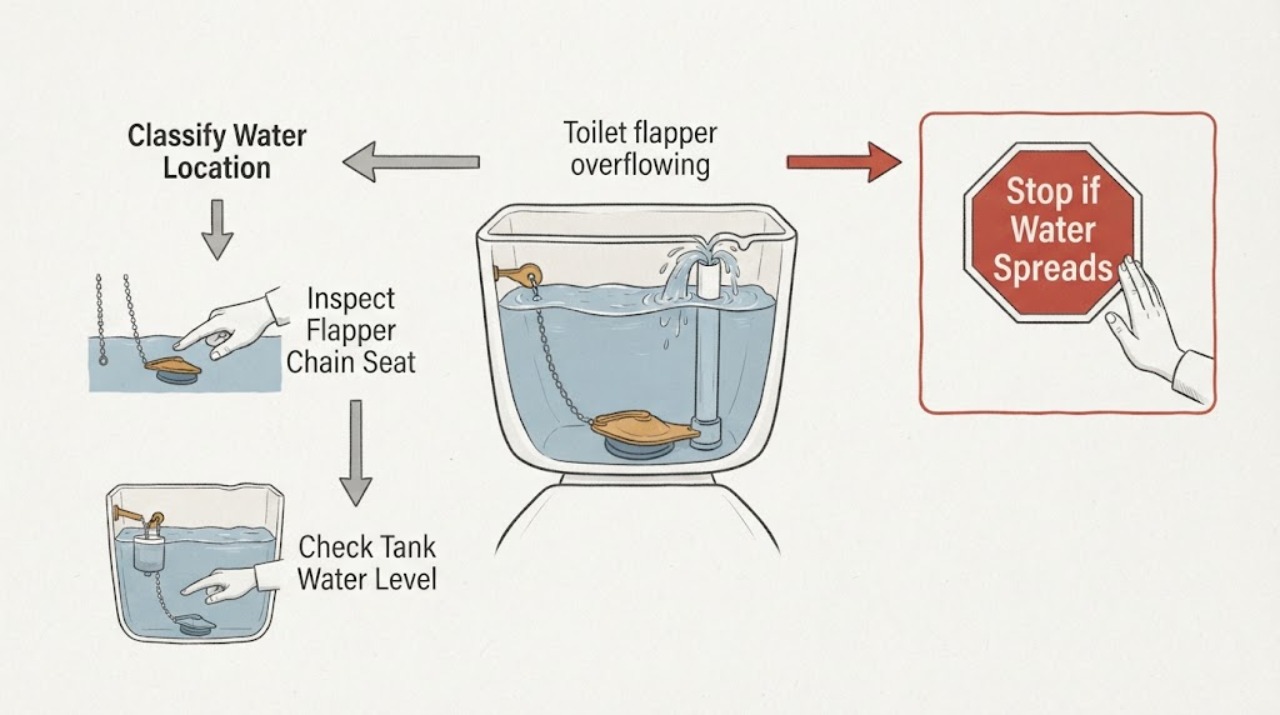
Work through in order
Diagnostic checks
Use only checks that match the exact appliance or system and its official guide.
-
Check 1
Stop pressing the handle and, from a dry accessible position, turn the toilet's local shutoff valve clockwise if water is still entering. Note where the water is moving before removing the tank lid.
Expected result: Record one primary pattern: the bowl is rising or draining slowly; the tank water reaches or enters the overflow tube; the tank refills periodically while the bowl stays at its normal level; or water appears around the supply line, tank, tank-to-bowl joint, or base.
Next step: Follow the matching check below without flushing again; if the shutoff does not stop the inflow, keep people away from the water and arrange urgent plumbing help.
Stop if: Do not reach into bowl water, remove the toilet, or continue testing if the water may be sewage, the floor is unsafe, or the shutoff or tank is damaged.
Why this matters
Why: A rising or slow-draining bowl makes a drain restriction more likely than a flapper fault. Water entering the tank overflow makes fill-valve, float, or tank-level control more likely. Periodic refilling with a stable bowl makes a flapper or flush-valve seat leak more likely. Floor water is a separate plumbing leak until proven otherwise.
-
Check 2
Only if the bowl is stable and the tank water is not actively spilling, lift the tank lid and visually inspect the flapper, its hinge, chain, and the visible flush-valve seat from ordinary standing access.
Expected result: Look for a flapper that is warped, hardened, split, lifted by a chain with no slack, caught under the chain, or unable to sit flat; note scale or debris on the visible seat and whether water is visibly passing into the bowl.
Next step: Photograph the valve arrangement and use the exact toilet instructions to identify a compatible flapper or seat procedure; make no adjustment if the seal, hinge, or valve style is uncertain.
Stop if: Do not force the flapper, scrape a ceramic or plastic seat, use a sharp tool, or handle the tank if it is cracked or unstable.
Why this matters
Why: A damaged or held-open flapper can account for a tank that loses water and repeatedly refills. A clean, seated flapper with continued bowl rippling shifts suspicion toward the flush-valve seat, refill tube/siphoning, or fill valve rather than proving the flapper is good.
-
Check 3
After the tank has had time to refill without another flush, compare the water surface with the overflow tube and watch whether the fill valve stops on its own.
Expected result: Record whether the water stops below the overflow opening, continues into the overflow, or stops only when the local shutoff is closed; also note whether the bowl has a steady ripple while the tank level falls.
Next step: Use only the exact model's fill-valve or tank-level instructions for an authorized adjustment; if the valve still runs, the model is unknown, or the overflow is imminent, leave the water off and call a plumber.
Stop if: Do not bend a float arm, remove a fill-valve cap, or change the refill-tube routing unless the exact manufacturer procedure applies and the parts are intact.
Why this matters
Why: Water that reaches the overflow or a fill valve that never shuts off points to fill-valve debris, float adjustment, or a failed fill valve. A level below the overflow with a falling tank and bowl ripple is more consistent with water escaping past the flapper or flush-valve seal. A shutoff that is needed to stop flow is a service boundary, not a successful repair.
-
Check 4
Without adding water or flushing again, observe the bowl after it has settled and note the result of the last normal flush: whether the bowl rose quickly and fell slowly, stayed high, gurgled, bubbled, or failed to evacuate.
Expected result: Classify the bowl as normal and stable, slowly draining, repeatedly rising, or backed up; note any bubbles or sounds from nearby drains.
Next step: Stop using the toilet and arrange plumbing diagnosis for a backed-up or repeatedly rising bowl. If no chemical product has been used and the water level is safe, a toilet-specific manual clearing method may be considered only when the exact fixture instructions allow it; otherwise do not improvise.
Stop if: Never add chemical drain cleaner, mix cleaners, or plunge a bowl that is already threatening to spill or may contain a prior chemical product.
Why this matters
Why: Rapid rise followed by slow fall, persistent high water, gurgling, bubbles, or failure to evacuate is a drain, trapway, waste-stack, or vent pattern, not evidence that replacing the flapper will clear the blockage. A normal bowl with a continuous tank ripple keeps the tank seal path in focus.
-
Check 5
With the water supply off if necessary, dry only the accessible exterior surfaces and look for fresh water at the supply connection, shutoff, tank bolts, tank-to-bowl seam, and base; do not tighten or dismantle hardware during this check.
Expected result: Identify whether water reappears at one connection, the tank or bowl ceramic, the tank-to-bowl joint, the base, or nowhere outside the bowl and tank.
Next step: Keep the shutoff closed, protect the floor from further spread, and arrange qualified plumbing service for any recurring external leak, cracked ceramic, loose tank hardware, or wet base.
Stop if: Do not overtighten porcelain hardware, lift the toilet, remove the tank, or use the fixture when water is reaching electrical equipment or the floor is contaminated.
Why this matters
Why: A localized external leak is not corrected by a flapper. A crack, a leak at the base, or water that reaches the floor may require removal, a seal replacement, or subfloor inspection; the safest conclusion from this check is where to stop and what to show the plumber.
-
Check 6
After one manufacturer-authorized low-risk correction, restore water only while standing clear and perform at most one controlled observation; do not repeatedly flush to prove the repair.
Expected result: Watch for the tank to stop below the overflow, the bowl to remain stable, the ripple to disappear, and the floor to stay dry; record any return of running, overflow, slow drainage, or leakage.
Next step: Close the shutoff again and call a plumber for recurrence, unresolved overflow, a failed shutoff, a crack, a base leak, or a blockage pattern; provide the recorded observations and photos.
Stop if: Stop immediately if water rises, spills, the tank flexes or cracks, the shutoff cannot control flow, or sewage-contaminated water reaches the room.
Why this matters
Why: A stable tank and bowl after one observation supports the specific correction but does not validate an unknown part or concealed condition. Any recurrence, new leak, or continuing overflow means the cause remains unresolved.
Use your observations
Decision map
Find the observation that best matches what you see, then follow the next safe action.
-
PATH 01Safety boundary
What you see
The bowl remains at its normal level, the tank level falls or periodically triggers refill, and the flapper is warped, held open, or visibly leaking into the bowl.
Do this next
Use the exact toilet model's part and installation guidance for a compatible flapper or have a plumber replace and verify the seal, then make one controlled observation.
Why this path and its safety boundary
Why it matters: The flapper or its visible seat is the leading suspect; this is the EPA-described toilet leak pattern rather than a bowl drain overflow.
Safety stop: Do not assume a generic flapper fits, scrape the seat, or continue using the toilet if the tank or valve is cracked.
-
PATH 02Safety boundary
What you see
The tank water reaches or enters the overflow tube, or the fill valve continues running even though the bowl is not backing up.
Do this next
Keep the local shutoff closed when unattended and follow only the exact model's fill-valve instructions; arrange service if the valve does not stop or the overflow is recurring.
Why this path and its safety boundary
Why it matters: The fill valve, float, refill routing, or tank-level adjustment is more likely than the flapper. Kohler notes that debris at the fill valve and an incorrectly set tank level can keep a toilet running.
Safety stop: Do not keep the tank overflowing, bypass the fill valve, or alter an unknown valve assembly by force.
-
PATH 03Safety boundary
What you see
The bowl rises rapidly during a flush, drains slowly or stays high, gurgles or bubbles, or other drains react when the toilet is flushed.
Do this next
Stop using the toilet and arrange a plumber for the blockage or vent diagnosis; disclose any chemical product already used before anyone attempts clearing.
Why this path and its safety boundary
Why it matters: A trapway, waste stack, or vent restriction is more likely than a flapper problem. Continuing to flush can turn a partial restriction into a floor spill.
Safety stop: Do not add chemicals, mix cleaners, or continue clearing attempts while the bowl may spill or contain contaminated water.
-
PATH 04Safety boundary
What you see
Water appears at the supply connection, tank hardware, tank-to-bowl seam, bowl ceramic, or toilet base rather than only inside the bowl or overflow tube.
Do this next
Leave the shutoff closed, keep the area dry and unused, and arrange plumbing service for the connection, seal, cracked ceramic, or base installation.
Why this path and its safety boundary
Why it matters: This is an external plumbing or porcelain/seal problem, so a flapper replacement would not address the observed leak and floor damage may continue.
Safety stop: Do not overtighten porcelain fasteners, lift the toilet, or use the fixture when contaminated water or electrical contact is possible.
-
PATH 05Safety boundary
What you see
The shutoff cannot stop the inflow, the toilet is cracked or unstable, sewage-contaminated water has reached the room, the floor is unsafe, or one controlled observation leaves overflow unresolved.
Do this next
Keep people and pets clear, isolate the water if it can be done safely, avoid contact with contaminated water, and request urgent qualified plumbing service.
Why this path and its safety boundary
Why it matters: The situation exceeds a safe flapper check and may involve uncontrolled water, sanitation exposure, structural damage, or concealed plumbing.
Safety stop: Stop all flushing, tank disassembly, and improvised clearing or sealing until the hazard is assessed.
Helpful context
Understand the symptom
First separate a tank leak from a bowl overflow
People often call any toilet water problem an overflow, but the location and timing change the diagnosis. Water that rises in the bowl during a flush and then falls slowly is a drain-side symptom. Water that keeps moving from the tank into the flush-valve overflow is a tank-level or fill-valve symptom. A quiet bowl with a tank that repeatedly refills is the pattern in which a flapper leak is most useful to check. Water on the floor is a separate leak path at the supply connection, tank hardware, tank-to-bowl joint, or base.
Use the flapper as a diagnosis, not a guess
The rubber flapper holds tank water until the handle is operated. Age, a warped seal, a chain caught under the flapper, or debris on the flush-valve seat can let water pass into the bowl. A flapper that looks intact does not rule out a worn seat or a fill valve that never shuts off. Match any replacement to the exact toilet's valve style and instructions; a generic part should not be assumed to fit.
Protect the room and stop when the boundary changes
Keep hands, children, and pets away from contaminated bowl water. Do not repeatedly flush a bowl that is rising, and do not use chemical drain cleaner in a toilet. If water has reached the floor, clean-up and drying matter after the plumbing fault is controlled; if the water may contain sewage, a damaged tank is visible, the shutoff is ineffective, or electrical equipment is getting wet, use qualified service rather than opening more of the installation.
Safety boundary
Stop conditions
- Stop flushing when the bowl rises, drains slowly, stays high, or threatens to spill.
- Do not use chemical drain cleaner in the toilet or mix cleaning products; disclose any prior chemical use to the plumber.
- Do not force a flapper, fill valve, porcelain fastener, tank, bowl, or shutoff, and do not remove the toilet or tank without the exact instructions and safe conditions.
- Keep children, pets, and unprotected hands away from bowl water, especially when an overflow may contain sewage.
- Close the local shutoff and seek qualified help for an ineffective shutoff, cracked or unstable ceramic, floor contamination, electrical contact with water, recurring overflow, or an unresolved cause.
Only after diagnosis
Potential parts
- toilet flapper
Consider this part only when a stable bowl, falling tank level, and visual or dye-test evidence support leakage past the flapper or flush-valve seal.
Confirm the exact toilet model, flush-valve style, attachment points, size, and manufacturer's instructions before selection; do not assume a universal part fits. - toilet fill valve
Consider this part only when the tank reaches the overflow tube or the fill valve will not shut off after the exact model's permitted adjustment or cleaning procedure.
Confirm the exact model, inlet and refill arrangement, water-level requirements, and manufacturer's fit information before ordering. - toilet auger
Consider this category only after a plumber or exact fixture guidance identifies a trapway blockage and confirms that no chemical drain product is present.
Use a toilet-specific tool suited to the fixture and stop if the bowl may spill, the obstruction is not reached, or the problem may be in the building drain or vent.
When checks do not resolve it
Need a professional?
Call a plumber when the bowl is rising or backing up, the tank repeatedly spills into the overflow, the local shutoff cannot stop water, the tank or bowl is cracked, water reaches the floor or electrical equipment, sewage contamination is possible, or the symptom returns after one exact-model-authorized correction.
Safety scope: This article supports dry, ordinary-access observation and one manufacturer-authorized low-risk correction only. It does not authorize tank or toilet removal, chemical clearing, work on cracked ceramic, or contact with sewage-contaminated water.
Common questions
FAQ
Can a toilet flapper make the toilet overflow?
A worn or held-open flapper commonly causes the tank to lose water and refill, sometimes sending water into the bowl. A bowl that rises and drains slowly is more consistent with a drain-side restriction, while a tank that spills into its overflow tube points toward the fill valve or water-level control.
What should I do first if the toilet bowl is rising?
Stop flushing and turn the local toilet shutoff clockwise if water is still entering. Keep people and pets away from the water, do not add chemical drain cleaner, and arrange plumbing help if the bowl stays high, threatens to spill, or the shutoff does not work.
How can I tell whether the flapper or fill valve is the problem?
With the bowl stable, watch the tank. A falling tank level with a steady bowl ripple suggests leakage past the flapper or flush-valve seat. Water that reaches the overflow tube or a valve that never stops filling points toward the fill valve, float, or tank-level setting.
Should I replace the flapper immediately?
Not if the bowl is rising, the water is on the floor, or the tank level is overflowing. First classify the water location and inspect only the accessible flapper and chain when conditions are dry and stable. If a replacement is justified, match it to the exact toilet model and valve arrangement.
When does a toilet overflow need a plumber?
Call a plumber for a backed-up or repeatedly rising bowl, a shutoff that cannot stop inflow, recurring tank overflow, a cracked or unstable toilet, a base or tank leak, sewage-contaminated water, water near electrical equipment, or any symptom that returns after one authorized correction.
Read the exact guide
Official sources
- Toilet Water Not Leaving BowlKohler Assist · Kohler troubleshooting guidance for a bowl that does not evacuate; exact fixture and site conditions determine the safe clearing method.
- Fix a Leak WeekU.S. Environmental Protection Agency · EPA WaterSense leak-detection guidance for household toilets; exact manufacturer instructions and fixture condition control any repair.
- Residential ToiletsU.S. Environmental Protection Agency · EPA WaterSense residential-toilet information; it describes common flapper leakage but does not diagnose a specific toilet or guarantee a replacement part fit.
- Home MaintenanceU.S. Environmental Protection Agency · EPA WaterSense home-maintenance guidance for tank-type residential toilets; exact toilet instructions and local plumbing conditions govern a particular fixture.
- Toilet Constantly Leaking or RunningKohler Assist · Kohler troubleshooting for one- and two-piece toilets; it is useful for mechanism and symptom distinctions, while the installed toilet's exact instructions control.
- Poor FlushKohler Assist · Kohler toilet troubleshooting symptom guidance; it does not identify the cause of an unbranded fixture without a site diagnosis.
Community feedback
Share a repair observation
Share a plain-text repair observation. Accepted observations are published automatically; this page may take a moment to update.