
On this page
Start here
Quick answer
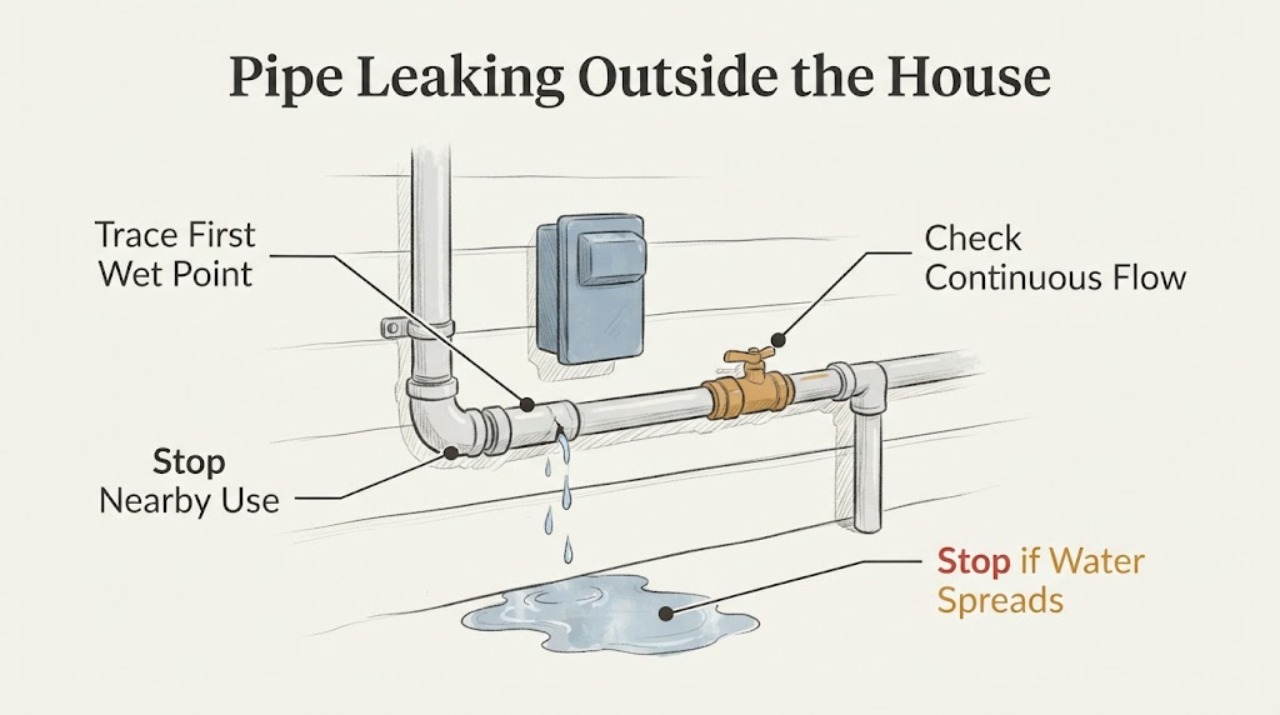
An outdoor pipe leak may be a pressurized water service line, an irrigation or hose-bib connection, a drain that leaks only when a fixture is used, rainwater, groundwater, or a public-utility problem. First stop the nearby fixture or irrigation run and observe the water from a safe, stable, dry position. Note whether it continues with every fixture off, appears only during discharge or watering, follows rain, smells like sewage, or is near the meter or public right-of-way. Close the property shutoff only if it is safely reachable and you know what it controls. Do not dig, loosen a pressurized fitting, enter a saturated area, or work near damaged electrical equipment. A fast flow, wastewater, a sinkhole or undermined surface, freezing damage, or a leak at the utility side needs urgent plumber or utility guidance.
Before you begin
Safety first
- A licensed plumber or utility can trace the line, establish the public-private boundary, coordinate permits and utility locating, and choose repair methods without the user digging or opening a pressurized system.
Work through in order
Diagnostic checks
Use only checks that match the exact appliance or system and its official guide.
-
Check 1
Stop the nearby hose bib, irrigation zone, outdoor appliance, or indoor fixture that could discharge through the suspected pipe. From a safe position, note whether the wet area continues, slows, or stops. Do not step into muddy water or touch a wet electrical device.
Expected result: Water may stop when one fixture or irrigation zone stops, continue with all use off, appear only after a drain is used, or follow rain rather than household use.
Next step: Use the timing branch. If flow is rapid, contaminated, near electricity, or undermining the ground, stop all nearby activity and use urgent service from a safe location.
Why this matters
Why: A use-linked change favors a hose, irrigation, drain, or fixture connection. Continuous flow with all use stopped favors a pressurized supply leak or utility-side event. Rain-linked moisture may be surface runoff or groundwater rather than a pipe.
-
Check 2
Without digging or moving covers, photograph the area and trace visible moisture uphill or upstream from the largest puddle. Check only exposed connections, the hose bib, irrigation box cover, cleanout area, foundation edge, meter area, and nearby downspouts from stable dry ground.
Expected result: The first wet point may be an exposed fitting, a hose-bib stem, an irrigation component, a cleanout or drain edge, a foundation or wall, a downspout discharge, or an area with no visible source.
Next step: Keep the area undisturbed and record the location relative to the house, meter, sidewalk, curb, and property line. Arrange a plumber or utility assessment when the source is not exposed.
Why this matters
Why: The first wet point is more useful than the lowest pooling point. No visible source with saturated soil suggests a buried line, groundwater, or a leak entering from another property or public side; it is not permission to excavate.
-
Check 3
With all water use stopped, look at the water meter or its leak indicator only if it can be reached without entering standing water or opening a hazardous enclosure. Record whether the reading changes after a quiet interval, and note whether the outdoor wet area changes at the same time.
Expected result: The meter may remain still, change while all use is off, or be inaccessible or unclear; the outdoor flow may continue, stop, or fluctuate.
Next step: If the meter changes and the leak is not safely exposed, close the property water shutoff only if you know its location and can operate it from dry ground. Then contact a plumber or the water utility for responsibility and tracing.
Why this matters
Why: A changing meter supports an active leak in the metered property system. A still meter with outdoor moisture points toward a drain, irrigation discharge, rain, groundwater, or a source outside that meter. A meter result cannot establish the repair boundary by itself.
-
Check 4
From a distance, observe the water's clarity, temperature only by visual context rather than touch, odor, and timing. Compare it with the timing of a toilet, sink, shower, washer, irrigation zone, outdoor tap, and recent rain; do not deliberately create a large discharge to repeat the event.
Expected result: Water may be clear and continuous, appear only during a drain discharge, be cloudy or foul-smelling, follow irrigation or rain, or be warm or contaminated.
Next step: Stop using the related fixture or irrigation zone when the water is contaminated, rapid, or damaging. Use a plumber for private piping, a utility for a public-side or water-quality concern, and emergency support for immediate flooding or electrical danger.
Why this matters
Why: Clear continuous flow is more consistent with a supply or service line. A discharge-linked wet point suggests a drain or sewer path. Foul or cloudy water raises contamination concerns. Rain-linked water may be stormwater or groundwater, and irrigation water can originate from a separate branch.
-
Check 5
If the flow appears to be clean pressurized water and the shutoff is clearly labeled and reachable from dry, stable ground, close the property-side shutoff once. Do not force a seized valve, open a meter box with water inside, loosen a fitting, or operate a valve in an active electrical or structural hazard.
Expected result: The flow may slow or stop, continue, or be unchanged because the valve controls a different branch or the source is not the property supply.
Next step: Leave the water isolated if safe and call a plumber or water utility. Tell them the valve location, whether the meter changed, and the exact side of the meter, curb, or property line where water appears.
Why this matters
Why: A change after a safe shutoff supports a property-side pressurized leak. No change can mean the valve is wrong, the valve failed, the source is a drain or irrigation branch, or the line is on the utility side; it is not a reason to turn the valve harder.
-
Check 6
Map the wet area without digging: note its distance from the meter, curb, sidewalk, property line, house, cleanouts, irrigation controls, and neighboring lots. Ask the local water or sewer utility whether there is a known main break, service disruption, public easement, or reporting process.
Expected result: The moisture may be clearly on private property, near or beyond the meter, in a right-of-way, shared by several properties, or aligned with a public main or sewer route.
Next step: Do not promise ownership or excavate based on a general diagram. Provide the utility and plumber with photos, timing, meter behavior, and the map of the affected area.
Why this matters
Why: Repair responsibility is local and may be divided at different points for water and sewer. Shared or public-side lines need utility or authority coordination before work, while private lines need a licensed plumber under local rules.
-
Check 7
Prepare a service handoff with photos, weather and use timing, meter observations, shutoff response if safely attempted, odors or contamination, and any history of freezing, landscaping, irrigation work, or recent construction. If excavation is later proposed, arrange the local before-you-dig locate process first.
Expected result: The plumber or utility may identify a safe exposed repair, request a locate or inspection, find a shared or public boundary, or determine that the moisture is rainwater or groundwater.
Next step: Keep the area isolated until the responsible professional gives a safe plan. Do not backfill, cover, clamp, glue, or pressure-test an unknown buried line yourself.
Why this matters
Why: A well-documented pattern helps distinguish a buried supply leak from a drain, irrigation, stormwater, or utility event. A locate protects underground services but does not replace a professional plan for unstable or contaminated ground.
Use your observations
Decision map
Find the observation that best matches what you see, then follow the next safe action.
-
PATH 01Next step
What you see
The wet area appears only when a hose bib, irrigation zone, outdoor appliance, or indoor fixture is used.
Do this next
Stop that use and inspect only the visible connection or discharge point from dry ground.
-
PATH 02Next step
What you see
All water use is stopped but the meter changes or water continues from the ground.
Do this next
Treat it as an active supply or service-line clue and close a known property shutoff only from dry, safe ground.
-
PATH 03Next step
What you see
Water appears during a fixture discharge, is cloudy or foul-smelling, or there is backup, soft ground, or a repeating hole.
Do this next
Stop using the related fixture and keep people and pets away from the water.
-
PATH 04Next step
What you see
The wet area follows rain, snowmelt, slope runoff, or groundwater and the meter remains still.
Do this next
Document weather, flow direction, and the first wet point without opening soil or redirecting water onto another property.
-
PATH 05Next step
What you see
The wet area is near the meter, curb, sidewalk, right-of-way, easement, public main, or a line shared with another property.
Do this next
Do not assume the owner or repair boundary from appearance. Photograph the location and contact the water or sewer utility before work.
-
PATH 06Next step
What you see
There is no safe exposed source, the meter result is unclear, or the suspected pipe is buried.
Do this next
Leave the ground intact and request professional tracing or inspection.
-
PATH 07Next step
What you see
Flow is rapid or uncontrolled, ground is collapsing or undermined, water is near electrical equipment, freezing damage is expanding, or people could contact sewage or contaminated water.
Do this next
Keep everyone away, stop nearby use, and isolate water or electricity only from a safe dry location if possible.
Helpful context
Understand the symptom
The first question is whether the water is using a pipe
Outdoor wet ground is not automatically a broken pipe. A hose bib, irrigation valve, downspout, condensate line, rain event, rising groundwater, or a drain used by an indoor fixture can put water in the same area. Look for the first wet point and the timing of the water, not just the largest puddle. Do not remove soil to chase a suspected line.
Use the meter as a clue, not as a repair test
When every fixture, appliance, irrigation zone, and outdoor tap is off, a changing water meter can support the conclusion that water is moving through the property system. It cannot tell you whether the leak is above ground, buried, on the customer side, or in a neighboring or public line. Local utility rules control the boundary.
Separate pressurized water from a drain or sewer leak
A pressurized supply leak tends to continue while the property shutoff is open, while a drain leak often appears when a particular sink, shower, appliance, or cleanout is used. Foul odor, cloudy or contaminated water, sewage backup, repeated soft ground, or a rat hole is not a normal DIY pipe repair signal. Keep people and pets away and call plumbing or utility support.
Why outdoor excavation is not the next step
Buried lines may include gas, electric, communications, water, sewer, irrigation, and private services. The local locating service must mark utilities before any digging, and a plumber or utility can select a safe tracing or inspection method. Never assume a shallow hand excavation is harmless.
Safety boundary
Stop conditions
- Stop immediately for rapid flow, a spreading sinkhole, undermined soil, a damaged foundation, an unstable trench, or water entering a building. Keep people and pets away and request urgent professional support.
- Stop immediately for sewage, foul odor, cloudy or contaminated water, overflow, or wastewater contact. Do not handle it bare-handed or use a fixture that may discharge into the affected line.
- Stop immediately if water is near outdoor outlets, pumps, lighting, service equipment, or damaged electrical wiring. Do not enter standing water or touch wet electrical equipment.
- Do not dig, probe soil, drive stakes, operate powered tools, or uncover a suspected buried line before the local utility-locate process. Never assume a shallow line is safe.
- Do not loosen a pressurized fitting, force a seized shutoff, open a wet meter enclosure, pressure-test an unknown line, or apply a clamp, glue, or patch as a substitute for diagnosis.
- Stop if freezing, recent excavation, structural movement, gas odor, or a public or shared line is suspected. Leave the area and use the responsible utility or qualified professional.
Only after diagnosis
Potential parts
- outdoor hose-bib repair assembly
Consider only when a qualified diagnosis identifies an exposed hose-bib leak and the assembly is approved for the exact installation.
Confirm the pipe material, connection, freeze protection, local requirements, and exact fitting with a qualified plumber. - irrigation valve or connector
Consider only after the leak is confirmed in an irrigation branch and the valve or connector is identified as failed.
Irrigation parts depend on pipe size, control voltage, pressure, and system design; confirm fit and isolation before ordering. - buried water service pipe section
Consider only after professional tracing confirms a private buried supply section requires replacement.
Pipe material, diameter, depth, connection method, permits, and utility clearances must be confirmed by the responsible professional.
When checks do not resolve it
Need a professional?
Arrange professional assessment whenever the source is buried, continuous, contaminated, near a public boundary, or not stopped by a safely operated property shutoff. Escalate immediately for rapid flow, structural undermining, electrical contact, or sewage.
Safety scope: A licensed plumber or utility can trace the line, establish the public-private boundary, coordinate permits and utility locating, and choose repair methods without the user digging or opening a pressurized system.
Have this ready
- Provide photos, address and exact outdoor location, distance from the house, meter, curb, sidewalk, and property line, water clarity and odor, weather, fixture or irrigation timing, meter behavior, safe shutoff response, recent freezing or digging, and whether another property is affected.
Common questions
FAQ
How can I tell if an outdoor wet spot is a broken pipe?
Stop nearby fixture and irrigation use, watch whether water continues, and compare the water-meter behavior while all use is off. Trace moisture to the first visible wet point without digging. Rain, groundwater, and drain discharge can look like a supply leak.
Should I dig up the yard to find a leaking pipe?
No. Buried areas can contain gas, electric, communications, water, sewer, and private services. Leave the ground intact and arrange professional tracing; if excavation is proposed, complete the local before-you-dig utility locate process first.
What if the outdoor leak stops when I close the house water valve?
That supports a property-side pressurized-water clue, but it does not identify the exact pipe or repair boundary. Leave the water isolated if safe and give a plumber or utility the valve response, meter location, and photos.
What does a sewage smell or cloudy water outside mean?
Treat it as a possible drain or sewer leak. Stop using the related fixture, keep people and pets away, avoid contact, and arrange prompt plumbing or sewer-utility assessment. Do not attempt a temporary clamp or excavation.
Who is responsible for a pipe leaking near the meter or sidewalk?
The boundary is local and differs for water and sewer lines. A utility may own one section while the property owner owns another, with different rules in a right-of-way or easement. Ask the local utility before authorizing excavation or repair.
Read the exact guide
Official sources
- 21.30.130 Service Maintenance Responsibility.City of Portland · Example local water-service responsibility rules dividing public and property-side service sections
- Home MaintenanceU.S. Environmental Protection Agency WaterSense · Home leak observation, water-meter leak clues, service pressure, and outdoor water-use maintenance
- Troubleshooting water pressure and flowCity of Portland Water Bureau · Official example of comparing indoor and outdoor flow, identifying leaks, and separating property from utility water issues
- Broken Sewer and Drain Lines- Guide to Repairs, Permits and InspectionsCity of Portland · Official example of sewer leak signs, public-private boundaries, permits, licensed work, and buried utility precautions
- 811 Before You Dig. Every Dig. Every Time.Common Ground Alliance · U.S. before-you-dig utility locating and buried-utility marking guidance
Community feedback
Share a repair observation
Share a plain-text repair observation. Accepted observations are published automatically; this page may take a moment to update.