
On this page
Start here
Quick answer
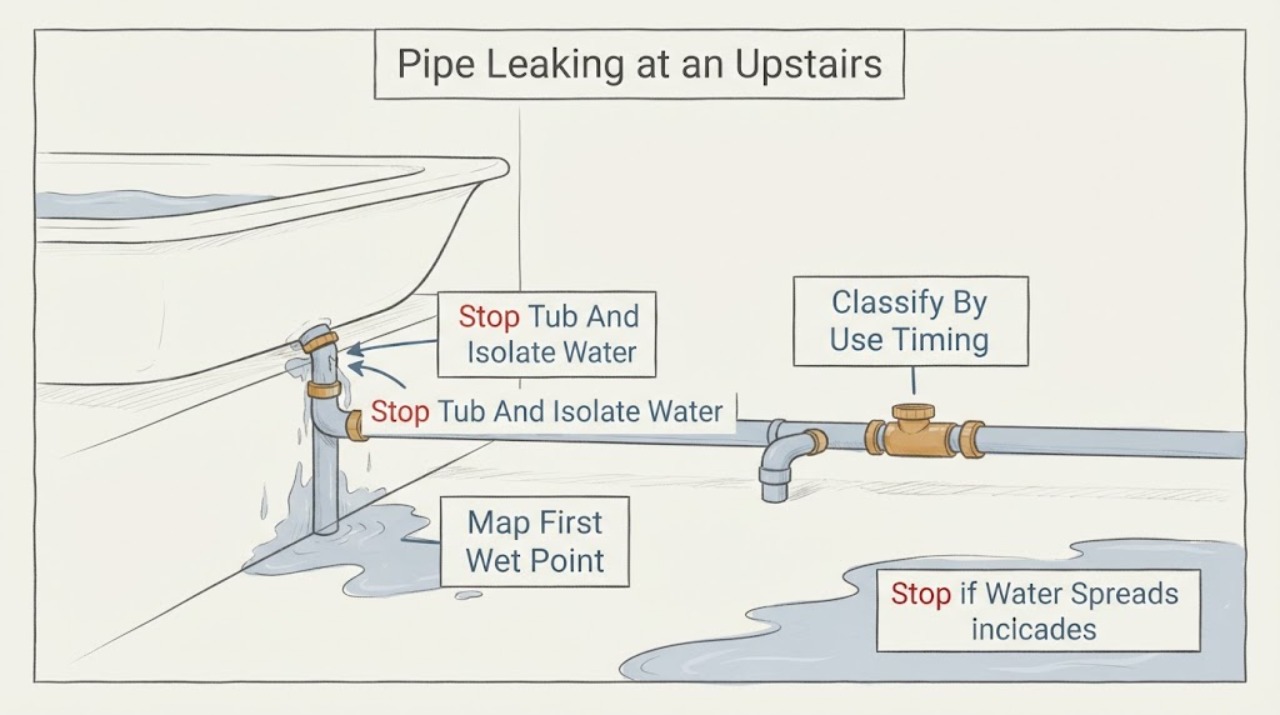
Stop using the upstairs tub first. A leak that appears below the tub can come from the pressurized supply while the faucet or shower is running, the tub waste or overflow only when water drains, the overflow opening when the tub is too full, or the tub enclosure, door, curtain, or seal letting spray reach the floor. Look for the first wet point from safe, accessible surfaces in the bathroom and the room below, and note whether water appears during filling, showering, draining, or when the tub is unused. Do not open the ceiling or wall, remove a tub panel, or run electrical equipment in a wet area. Close the local fixture stops or the home's main water shutoff if the flow continues, and call a plumber when the source is hidden, the ceiling is wet or sagging, or any pipe, drain, overflow, or waterproofing repair is needed. If water is near electrical equipment or standing on the floor, keep away and have an electrician isolate power safely.
Work through in order
Diagnostic checks
Use only checks that match the exact appliance or system and its official guide.
-
Check 1
Stop using the upstairs tub, shower, and tub drain. From a dry, stable location, close an obvious local fixture shutoff or the home's main water shutoff only if it can be reached without crossing standing water or touching wet electrical equipment. Do not move the tub or open walls or ceilings.
Expected result: Water stops when the local or main shutoff is closed; water continues; the shutoff cannot be reached safely; or the leak is only a stain with no active flow.
Next step: If water continues or the valve is inaccessible, leave the area and call a plumber or building maintenance for isolation. If the flow stops, keep the tub out of service and document the rooms and timing for the next check.
Stop if: Stop immediately for standing water, water near outlets or lights, a hot or damaged electrical device, a sagging ceiling, a large or rapidly spreading leak, or any need to enter a wet area or operate equipment while wet.
Why this matters
Why: A continuing flow suggests a pressurized supply or another active source and needs prompt isolation. A stain with no current flow still may conceal wet framing, a drain leak, or previous overflow and should not be tested by normal tub use.
-
Check 2
From safe, accessible, dry surfaces, photograph and map the first wet point in the upstairs bathroom and the room below. Look only at visible tub edges, floor, ceiling, wall finish, and exposed connections; do not remove trim, panels, ceiling material, or wall covering.
Expected result: The upstairs floor or tub edge is wet first; a visible supply connection drips; the lower ceiling becomes wet first; or the wet area cannot be localized.
Next step: Keep the tub isolated and give the plumber the photos, room relationship, and whether the ceiling is soft or changing. If the source cannot be seen without opening construction, stop investigating and request professional leak tracing.
Stop if: Do not pull the tub, remove a ceiling, cut a wall, probe saturated material, stand under a bulging ceiling, or continue if water reaches electrical equipment.
Why this matters
Why: The lower stain may be downstream from a hidden pipe or waste line. A first wet point near a visible supply fitting or tub edge helps prioritize the plumber's inspection, but it does not prove that the exposed fitting is the source.
-
Check 3
Use the existing history of the leak to record whether the first drip occurs when the faucet or shower is turned on, while water is in the tub, only as the tub drains, only when the level reaches the overflow, only during shower spray, or while the tub is unused. Do not repeat a risky use test if the ceiling is wet or the leak is active.
Expected result: The leak begins with water delivery; only with draining; only at overflow level; only with shower splash; or with no tub use at all.
Next step: Tell the plumber the exact timing and whether the lower ceiling responds immediately or later. Keep the suspected component out of use; do not assume new caulk will repair a supply or waste-line leak.
Stop if: Stop for active flooding, sewage-colored or foul water, a rapidly growing ceiling stain, ceiling movement, electrical contact, or any need to run more water to reproduce the leak.
Why this matters
Why: Delivery timing favors a supply, valve, spout, or shower connection. Drain timing favors the waste, trap, or branch line. Overflow timing favors the overflow assembly. Shower-only timing favors the curtain, door, enclosure, caulk, or splash path. A leak while unused suggests a continuously pressurized supply or another plumbing source.
-
Check 4
Compare the timing and visible wetness around the tub's overflow opening, drain flange, tub-to-wall or tub-to-floor joint, curtain or door threshold, and enclosure seams. Make only a dry visual inspection; do not remove the overflow cover, drain, trap, or seal and do not apply sealant over an active leak.
Expected result: The overflow area is wet only at a high tub level; the drain area is wet during emptying; the enclosure or threshold is wet during showering; or a supply fitting or pipe is wet before the tub drains.
Next step: Keep the tub unused and give the plumber the matching observation. A hidden waste, overflow, supply, or waterproofing repair should be opened and tested by a plumber, not covered with caulk or tape as a final fix.
Stop if: Do not use a tool on a drain or overflow, remove a fitting, use chemical drain cleaner, fill a suspect tub, or continue if the lower room shows active or structural water damage.
Why this matters
Why: These observations narrow the service boundary but cannot certify a hidden seal or pipe. A waste-line leak can be in the branch between the tub drain and stack, while enclosure water can travel under finishes before appearing below.
-
Check 5
From outside the affected area, check whether the room below has dripping, a spreading stain, a bulge, cracks, soft plaster or drywall, a ceiling light, outlet, extension cord, or other electrical equipment in or near the wet area. Do not touch wet fixtures or stand in water.
Expected result: The ceiling is dry and stable; it is wet but stable; it is bulging, cracking, soft, or shedding; or water is near electrical equipment or has entered it.
Next step: Keep people away and call a plumber for the water source. If electrical equipment is wet, have an electrician isolate the affected circuit from a safe location; do not restore power until it is inspected. If the ceiling is unstable or water is rapidly entering, leave the room and contact emergency or building assistance.
Stop if: Stop immediately for a bulging, sagging, cracking, or falling ceiling, standing water, sparks, burning odor, exposed wiring, or water contacting a light, outlet, panel, or appliance.
Why this matters
Why: A stable dry stain still requires plumbing diagnosis, but saturated or moving ceiling material can fall. Wet electrical equipment can shock or start a fire even after the tub is stopped.
-
Check 6
When the tub is isolated and no water is being used, observe from a dry location whether the meter or an accessible leak-detection alert indicates ongoing flow and whether the lower wet area changes. Do not remove access covers or enter a ceiling or wall cavity.
Expected result: Flow continues with the tub unused; flow stops when the fixture shutoff is closed; no flow continues; or another nearby bathroom, roof, or supply source could explain the wet area.
Next step: Keep the tub shut off and tell the plumber the result, including any nearby fixtures or apartments that may share the branch. Do not open construction or use pressure tools as a homeowner test.
Stop if: Stop for an active increase in water, sewage or contaminated water, a wet electrical area, structural ceiling change, or any unsafe access to a hidden pipe.
Why this matters
Why: Continued flow while unused favors a pressurized supply leak or another plumbing source; stopping at the tub shutoff supports the tub branch. A dry meter does not clear a drain, overflow, or enclosure leak that occurs only during use.
-
Check 7
Prepare a plumber handoff with the first wet point, upstairs and downstairs locations, leak timing, photos, shutoff status, whether water was clean or contaminated, visible damage, and whether the leak is supply, drain, overflow, or enclosure related. Keep the tub out of service.
Expected result: The plumber has enough information to select a safe access and test plan without a homeowner opening the ceiling, wall, tub surround, drain, or water-damaged electrical area.
Next step: Request a licensed or qualified plumber for the leak and any required access or repair. Also request water-damage or restoration assessment when materials remain wet, and electrical inspection when circuits or equipment were exposed to water.
Stop if: Stop documenting and leave if the ceiling shifts, water accelerates, contaminated water appears, or smoke, sparks, or a burning odor develops.
Why this matters
Why: A timing and location record prevents mistaking the ceiling stain for the source and helps distinguish a fixture-seal repair from concealed supply, waste, or waterproofing work.
Use your observations
Decision map
Find the observation that best matches what you see, then follow the next safe action.
-
PATH 01Next step
What you see
Water appears while the faucet or shower is delivering water, or continues while the tub is unused and stops when the fixture shutoff is closed.
Do this next
Keep the tub isolated and have a plumber inspect the accessible supply, valve, spout, shower connection, and concealed branch. Do not open the wall or loosen a fitting.
-
PATH 02Next step
What you see
The lower ceiling or floor becomes wet only while the tub empties, not while water is delivered or held.
Do this next
Do not run another drain test if damage is present. Have a plumber trace the drain, trap, overflow connection, and branch line; a hidden waste-line repair may require controlled professional access.
-
PATH 03Next step
What you see
Water appears only when the tub level reaches the overflow opening or when water is directed at that area.
Do this next
Keep the water below the overflow and stop using the tub until a plumber evaluates the overflow assembly and seal. Do not remove the cover or rely on caulk over the fitting.
-
PATH 04Next step
What you see
Water appears during showering at the curtain, door threshold, enclosure seam, tub edge, or wall, without drain-timing evidence.
Do this next
Keep the shower out of use, photograph the first wet edge, and have a plumber or qualified bathroom professional inspect the door, curtain, enclosure, caulking, and waterproofing path.
-
PATH 05Next step
What you see
The lower ceiling is bulging, cracking, soft, actively dripping, or near a light, outlet, wiring, or other electrical equipment.
Do this next
Keep people out of the area and do not pierce or touch the ceiling. Have an electrician isolate wet electrical equipment from a safe location and contact plumbing/building emergency assistance for the active leak.
-
PATH 06Next step
What you see
The source cannot be seen, timing is inconsistent, water continues with the tub unused, or another fixture, roof, or shared plumbing route could be involved.
Do this next
Keep the upstairs tub isolated and request professional leak tracing. Do not open walls, ceilings, or a tub surround to search for the pipe.
Helpful context
Understand the symptom
Stop the tub before tracing the leak
Do not use the upstairs tub, shower, or its drain again until you know the area is safe. From a dry location, close an obvious local fixture stop or the home's main water shutoff if water is still flowing and the valve can be reached without crossing standing water. Do not pull a tub, open a ceiling, cut drywall, or remove a wall or access panel just to look for the pipe. Photograph the stain, drip location, wet floor, and visible fittings from a safe position so a plumber can compare the rooms vertically. EPA WaterSense recommends addressing household leaks promptly, and building-water guidance treats active free-standing water and saturated ceiling material as conditions requiring prompt escalation.
Use timing to separate supply, drain, overflow, and spray
The useful observation is not where the stain is—it is when the first water appears. A drip that begins as soon as the faucet or shower is turned on points toward the supply, valve, spout, or shower connection. A leak that appears only while the tub empties points toward the waste or trap path. Water at the ceiling only when the tub level reaches the overflow points toward that opening or its seal. A wet floor or wall edge during showering, with no corresponding drain timing, points toward the curtain, door, enclosure, caulk, or splash path. Do not deliberately flood a suspect tub or continue a test when a ceiling is already wet; let a plumber perform any controlled test when the consequence of another leak is unclear.
Treat the lower ceiling as evidence and a hazard
The room below can reveal a vertical plumbing route, but the stain is not necessarily the source. Check only exposed, dry surfaces for the first drip, its timing, and whether it follows the upstairs tub's use. Do not stand beneath a bulging, cracked, soft, or actively dripping ceiling, and do not pierce it to drain water. Keep people away from wet ceiling lights, outlets, extension cords, and standing water. CDC guidance says not to operate electrical equipment while standing in water and not to restore power to wet equipment until it has been inspected; call an electrician if water has reached wiring or electrical equipment.
Safety boundary
Stop conditions
- Stop and leave the affected area for a bulging, sagging, cracking, soft, or falling ceiling, rapidly spreading water, or active flooding; do not pierce or open the ceiling.
- Do not touch wet outlets, lights, wiring, appliances, or panels, and do not use electrical tools or operate a breaker while standing in water. Have an electrician isolate wet equipment safely.
- Do not open walls or ceilings, remove a tub surround, pull the tub, remove drain or overflow fittings, loosen supply connections, or use chemical drain cleaner to diagnose a concealed leak.
- Keep the upstairs tub and shower out of service when water reaches the floor or lower ceiling. Stop immediately for sewage or contaminated water, smoke, sparks, a burning odor, or any electrical contact.
When checks do not resolve it
Need a professional?
Request a qualified plumber for any concealed supply, waste, overflow, tub connection, enclosure, or waterproofing leak; for water that continues when the tub is unused; or when the first wet point cannot be safely identified. Request an electrician when water has reached electrical equipment, wiring, or a panel, and a restoration professional when building materials remain wet or contaminated.
Have this ready
- Provide the upstairs and downstairs locations, first wet point, exact timing relative to filling, showering, overflow, and draining, whether water was clean or contaminated, shutoff status, photos from safe areas, ceiling condition, and any nearby fixture or shared-plumbing clues.
Common questions
FAQ
Why does water from an upstairs tub show up on the ceiling below?
Water can travel from a supply connection, tub drain or waste branch, overflow, or enclosure and splash path before it appears below. The first wet point and the timing—delivery, showering, overflow, draining, or no use—are more useful than the stain location alone. Keep the tub out of service and have a plumber trace a concealed source.
How can I tell whether an upstairs tub leak is the drain or the water supply?
A leak that starts as soon as the faucet or shower supplies water favors the supply, valve, spout, or shower connection. A leak that appears only while the tub empties favors the drain, trap, or waste branch. Do not repeat a water test when the ceiling is wet or changing; give the plumber the timing you already observed.
What should I do if the leak is only around the tub overflow?
Keep the water below the overflow and stop using the tub until it is inspected. An overflow opening or seal can leak when the tub reaches that level, but the cover and connection should not be removed as a homeowner diagnosis when water is reaching the floor or ceiling below.
Should I open the downstairs ceiling to find the leaking tub pipe?
No. A water-stained ceiling may be downstream from the source, and saturated drywall or plaster can fall. Photograph and report the first visible wet points from a safe position; have a plumber choose any access and keep away from a bulging, cracking, soft, or actively dripping ceiling.
What if water from the tub reaches a ceiling light or outlet?
Do not touch the wet fixture, stand in water, or operate electrical equipment in the wet area. Keep people away and have a qualified electrician isolate and inspect the affected circuit or equipment; do not restore power until it is cleared. Call plumbing or building emergency assistance for the active water source.
Read the exact guide
Official sources
- Leak and Moisture Control Standard ProcedureNew York City Housing Authority · Official NYCHA maintenance procedure; its trained-staff workflow is used here only for the diagnostic distinctions and professional boundary, not as a homeowner instruction to open construction.
- What to Do to Protect Yourself From Electrical HazardsCenters for Disease Control and Prevention · Official CDC household electrical-safety guidance applied to water intrusion near an upstairs-tub leak.
- State Or Lease Building Water Impact ResponseState of Nevada Risk Management · Official building water-impact response guidance; emergency and building-specific procedures may differ by location.
- Home MaintenanceU.S. Environmental Protection Agency WaterSense · Official EPA WaterSense guidance for residential water-using fixtures and plumbing; exact fixture construction varies.
Community feedback
Share a repair observation
Share a plain-text repair observation. Accepted observations are published automatically; this page may take a moment to update.