
On this page
Start here
Quick answer
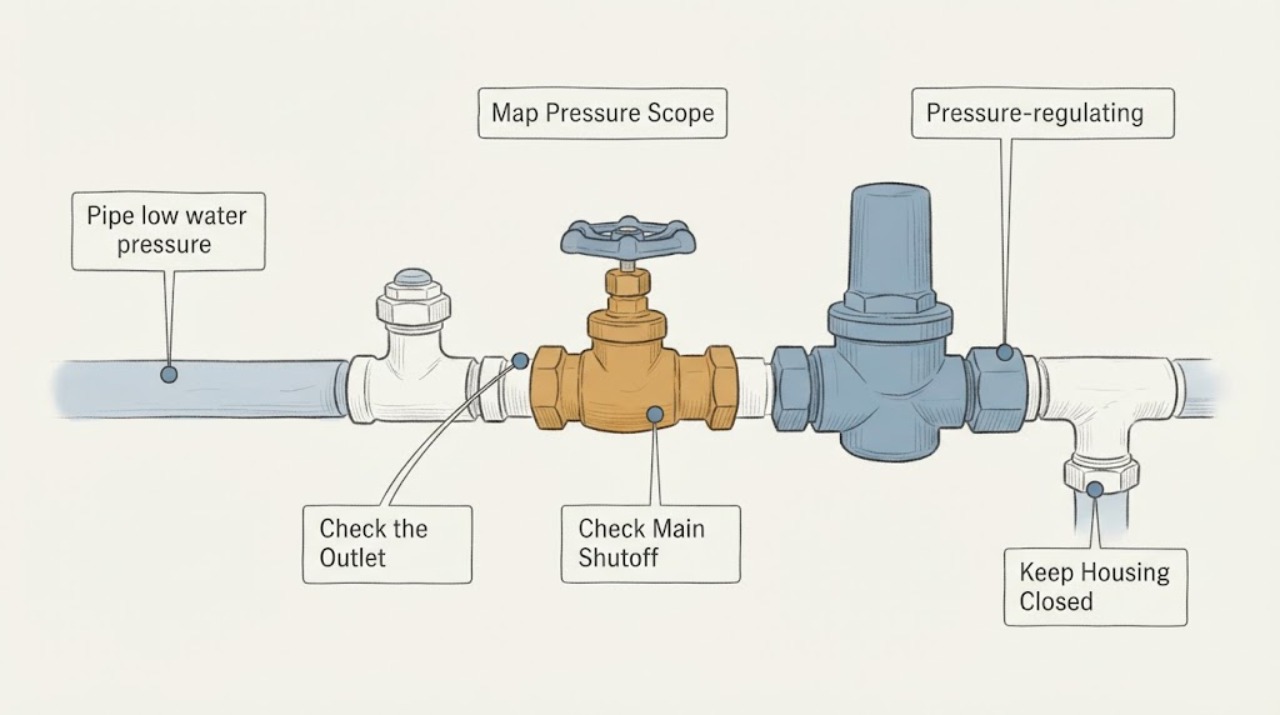
Low water pressure at a pipe or fixture is not enough to identify a failed pipe. First compare several fixtures and record whether the problem affects one outlet, hot water only, cold water only, the whole home, or only multiple fixtures running at once. Check that the visible main shutoff is open, look for leaks or unexplained meter movement, and inspect one affected faucet's accessible aerator only if it can be removed without force. For a system check, turn off water-using fixtures and use a pressure gauge at a hose bibb as EPA describes; its WaterSense guidance treats incoming service pressure around 45–60 psi as the useful operating range, while unusually low pressure can warrant leak investigation and unusually high pressure can warrant professional pressure-regulator work. If a valve is stuck or dripping, a pipe is frozen, water is leaking into a wall or ceiling, pressure is suddenly absent, or diagnosis requires changing a PRV or opening pipe, stop and call a qualified plumber or your water utility. Do not cut pipe, adjust a regulator by guesswork, thaw a pipe with an open flame, or rely on a pressure reading from an unverified gauge.
Before you begin
Safety first
- This article covers symptom mapping, ordinary-access inspection, leak observation, and a safely connected static pressure gauge check. PRV, service-line, well, concealed-pipe, frozen-pipe, and pressurized plumbing repairs require qualified service.
Work through in order
Diagnostic checks
Use only checks that match the exact appliance or system and its official guide.
-
Check 1
Compare the affected outlet with at least two other fixtures, testing one fixture at a time and then observing what happens when a second fixture opens; record hot and cold separately.
Expected result: Classify the symptom as one outlet only, one bathroom or branch, hot water only, cold water only, every fixture, or normal at rest but weak during simultaneous use.
Next step: Use the pattern to choose the local-fixture, whole-home, leak, or supply-pressure branch; do not order or cut replacement pipe before the scope is known.
Stop if: Stop if pressure disappears suddenly, water is escaping, a fixture or pipe is hot, a ceiling or wall is wet, or the comparison requires entering an unsafe access area.
Why this matters
Why: A localized pattern supports a fixture, stop valve, or branch restriction. Whole-home or multi-fixture weakness points toward the main shutoff, pressure-regulating valve, service line, leak, well equipment, or utility supply. A flow-dependent drop suggests pipe resistance or a supply-capacity problem rather than a static pressure problem alone.
-
Check 2
For a problem isolated to one faucet or shower, inspect the accessible aerator or outlet screen and the visible stop valve and connection; remove an aerator only if the fixture instructions allow it and it turns without force.
Expected result: Record a scale- or debris-loaded screen, a partly closed or damaged visible stop valve, a leak, a normal outlet assembly, or a component that cannot be removed safely.
Next step: Clean or restore only the accessible component by the fixture instructions and retest once. If the outlet remains weak, the valve is stiff, or the branch needs wall access, arrange plumbing service.
Stop if: Do not force a corroded valve or aerator, remove concealed fittings, use chemical cleaners in a water line, or continue with a leak at the wall or connection.
Why this matters
Why: A restriction at one outlet can mimic low pipe pressure but does not establish a problem in the supply pipe. A normal screen and open visible valve make the local branch or upstream pressure more plausible; a leak can reduce available flow and cause damage.
-
Check 3
Locate the visible main shutoff before or after the water meter and observe whether it is fully in the open position, using only the ordinary handle movement described by the utility or valve instructions.
Expected result: Record a fully open valve, a partly closed valve, a handle that turns without stopping, a valve that is seized, or dripping around the stem or body.
Next step: If the valve is plainly open and dry, continue to leak and pressure observations. If it is stiff, damaged, or leaking, leave it in the safest stable position and call a licensed plumber or the water utility rather than forcing it.
Stop if: Do not force a seized valve, disassemble the valve, remove the meter, or operate a stem that begins dripping heavily.
Why this matters
Why: A partly closed valve can restrict the whole home's flow. A handle that spins, will not move, or leaks when operated indicates a worn or broken valve and can turn a pressure check into a flooding problem.
-
Check 4
With every faucet, appliance, and irrigation use stopped, inspect the visible supply lines, water heater area, crawlspace or basement access that is safe to enter, and the water meter for unexplained movement according to the utility's instructions.
Expected result: Record a dry system and still meter, a visible drip or puddle, water sounds with no fixture open, or a meter that continues to indicate flow.
Next step: If a leak is visible or the meter indicates unexplained use, stop using the affected line, use the shutoff only if it operates safely, and arrange a plumber; contact the utility when the leak may be on its side of the meter.
Stop if: Do not open walls or ceilings, excavate, tighten buried or pressurized connections, or leave a leak running while continuing pressure tests.
Why this matters
Why: A visible or hidden leak can lower available pressure and cause water damage. Continued meter movement when no water should be flowing supports a leak investigation, but a still meter does not rule out a restricted pipe, intermittent leak, or utility-side issue.
-
Check 5
If there is no leak or electrical or freeze hazard and a hose bibb is safely accessible, turn off all water-using fixtures and systems, attach a suitable pressure gauge as EPA describes, open the bibb fully, and record the static reading without adjusting any regulator.
Expected result: Record a reading around the EPA WaterSense operating range of 45–60 psi, much lower than 45 psi, much higher than 60 psi, a reading that is unstable, or a gauge connection that leaks or cannot seal.
Next step: Photograph or record the gauge, fixture pattern, and valve status for a plumber or utility. Request professional PRV or supply assessment when the result is outside the range or changes sharply during use.
Stop if: Do not adjust a PRV by guesswork, use a leaking or unverified gauge, attach to a damaged hose bibb, or continue if the connection sprays or the pressure behaves erratically.
Why this matters
Why: A low static reading supports a leak, supply, well, shutoff, or regulator issue; a high reading supports pressure-regulator or code review; a normal static reading with weak flow points toward a local restriction, pipe resistance, or a flow-dependent problem. The gauge result alone cannot identify a pipe or authorize a regulator adjustment.
-
Check 6
Compare the pressure pattern by temperature and weather, and inspect only safely visible pipes for frost, condensation, bulging, corrosion, or an external kink; do not apply direct heat or open insulation around a concealed line.
Expected result: Record a cold-weather onset, a hot-water-only problem, frost or a bulge, a dry and intact visible pipe, or a symptom unrelated to temperature.
Next step: Protect the area from freezing and arrange qualified plumbing service for a suspected frozen, damaged, concealed, or water-heater branch pipe; do not use the affected line if a leak is developing.
Stop if: Do not thaw with an open flame, torch, improvised heater, or electrical device near water, and do not cut insulation or wall material to reach the pipe.
Why this matters
Why: Cold-weather onset can support a frozen or restricted line, while hot-only weakness can involve the water-heating branch. A bulge, burst, wet insulation, or hidden pipe condition needs immediate professional handling; a normal visible pipe does not clear concealed plumbing.
Use your observations
Decision map
Find the observation that best matches what you see, then follow the next safe action.
-
PATH 01Safety boundary
What you see
Only one faucet or shower has low flow and its accessible screen or aerator is visibly restricted.
Do this next
Clean or restore the accessible part according to the fixture instructions and retest once; call a plumber if the valve is stiff, the outlet remains weak, or hidden branch access is needed.
Why this path and its safety boundary
Why it matters: The local outlet or stop valve is more likely than a whole-home pipe or supply-pressure problem.
Safety stop: Do not force the fitting, open a wall, or use chemical pipe cleaners.
-
PATH 02Safety boundary
What you see
Multiple fixtures have low pressure, including both hot and cold water, or all outlets are weak.
Do this next
Check the visible main shutoff, look for leak evidence, measure service pressure safely, and share the results with a plumber or water utility.
Why this path and its safety boundary
Why it matters: The issue is upstream of one fixture and may involve the main shutoff, PRV, service line, leak, well equipment, or utility supply.
Safety stop: Do not replace or adjust a PRV, remove a meter, excavate, or cut the service pipe without qualified diagnosis.
-
PATH 03Safety boundary
What you see
Pressure seems acceptable at rest but drops sharply when a second fixture or appliance uses water.
Do this next
Record which fixtures cause the drop and request a professional flow and pipe-resistance assessment rather than installing a larger pipe based on one reading.
Why this path and its safety boundary
Why it matters: Flow-dependent loss can indicate restricted pipe capacity, a partly closed valve, a failing regulator, a supply limitation, or a leak; static pressure alone cannot identify it.
Safety stop: Do not run prolonged tests through a leaking, frozen, noisy, or visibly damaged pipe.
-
PATH 04Safety boundary
What you see
A safely connected gauge shows service pressure much lower than the EPA WaterSense range with all water use stopped.
Do this next
Confirm the gauge connection and compare the result with the fixture pattern, then contact the water utility or plumber for source, leak, and regulator diagnosis.
Why this path and its safety boundary
Why it matters: A leak, supply or well issue, shutoff position, or pressure-regulating device may be limiting the incoming pressure.
Safety stop: Do not alter the regulator, remove the meter, or assume the pipe itself is failed from the gauge reading alone.
-
PATH 05Safety boundary
What you see
A safely connected gauge shows pressure much higher than the EPA WaterSense range.
Do this next
Avoid changing the regulator by guesswork and arrange professional PRV or code review, especially when leaks, banging, or fixture damage are present.
Why this path and its safety boundary
Why it matters: High pressure can damage plumbing, fixtures, and appliances and may indicate a pressure-regulating valve that needs qualified assessment.
Safety stop: Do not continue operating a visibly leaking or damaged system, or install a regulator without considering the system and local plumbing requirements.
-
PATH 06Safety boundary
What you see
The meter moves with no intended use, water sounds continue, or a visible supply-line leak is found.
Do this next
Stop the affected water use, shut off water only if the valve operates safely, protect the area, and call a qualified plumber or water utility as appropriate.
Why this path and its safety boundary
Why it matters: An active or hidden leak can consume available flow and cause structural damage; the low pressure is not safely treated as a pipe-sizing problem.
Safety stop: Do not open walls, tighten buried connections, or leave water flowing while troubleshooting.
-
PATH 07Safety boundary
What you see
Low pressure began during freezing weather or a visible pipe is frosted, bulging, split, corroded, or wet.
Do this next
Stop using the affected line, follow local emergency or utility guidance, and arrange qualified plumbing service to isolate and repair it.
Why this path and its safety boundary
Why it matters: The pipe may be frozen or damaged and can release a larger leak when it thaws; direct heating and wall access can increase risk.
Safety stop: Never use an open flame or torch to thaw a pipe, and do not cut into insulation, wall, ceiling, or pipe.
Helpful context
Understand the symptom
Map where the low pressure appears before blaming a pipe
A single weak faucet can have a restricted aerator, stop valve, or local branch problem, while weak flow at several fixtures points upstream toward the main valve, pressure-regulating valve, service line, leak, or utility supply. Hot-only weakness moves the check toward the water-heating branch and its valves; cold-only weakness can point toward a cold-water branch or inlet restriction. Pressure that looks acceptable with no water running but collapses when another fixture opens needs a flow and pipe-resistance assessment rather than a random pipe replacement.
Use a gauge and leak observations to separate static pressure from flow loss
EPA's homeowner guidance describes attaching a pressure gauge to a hose bibb with all water-using fixtures and systems off, then opening that point fully. The result is a service-pressure observation, not proof that every branch has the same pressure while flowing. Compare the gauge result with the fixture pattern, meter behavior, visible leaks, and whether the reading falls sharply when water is used. A pressure-regulating valve, private well, or utility connection can change the interpretation, so do not adjust it from a number alone.
Treat valves, leaks, frozen lines, and wall access as service boundaries
A main shutoff that will not move or drips at its stem, unexplained meter movement, wet drywall, a frozen or bulging pipe, or a pressure regulator that needs adjustment can cause damage if operated or opened incorrectly. Illinois American Water directs homeowners to a licensed plumber for a worn or broken shutoff valve and unresolved in-home problems. Stop water use at the affected area when safe, protect the space from water damage, and arrange qualified service instead of cutting into pipe or applying heat directly.
Safety boundary
Stop conditions
- Stop for a burst, bulging, frozen, corroded, or actively leaking pipe; water in a wall or ceiling; unexplained meter movement; or sudden loss of pressure. Use the main shutoff only if it operates safely and arrange qualified plumbing or utility service.
- Do not adjust a pressure-regulating valve by guesswork, remove a water meter, cut or solder a pressurized pipe, open walls or ceilings, or replace a service line based only on one gauge reading.
- Do not force a seized or dripping main valve, disconnect a buried or concealed connection, or continue a pressure test through a leaking or unstable system.
- Never thaw a pipe with an open flame, torch, improvised heater, or electrical device near water; do not use chemical pipe cleaners to address low water pressure.
- If the problem affects the whole home, persists after accessible checks, or needs PRV, well, utility, wall, ceiling, or pipe access, stop troubleshooting and call a qualified plumber or water utility.
Only after diagnosis
Potential parts
- water pressure test gauge
Consider this only when a safe hose bibb is accessible and a static pressure observation is needed to distinguish localized flow loss from a whole-home supply condition.
Use a gauge and connection that fit the accessible hose bibb and are rated for the installation; stop for a damaged bibb, leak, or unstable reading. - pressure-regulating valve
Consider this only after a qualified assessment confirms that the installed regulator is missing, failed, incorrectly set, or unsuitable for the measured supply condition.
Confirm the system, flow demand, pipe connection, pressure range, thermal-expansion requirements, and applicable plumbing rules; do not choose or adjust one from a low-pressure symptom alone. - main water shutoff valve
Consider this only when inspection confirms that the main valve is damaged, seized, leaking, or unable to open fully and a qualified plumber identifies it as the restriction.
Confirm the exact pipe material, connection, service location, meter arrangement, and utility responsibilities before any replacement. - local faucet aerator or inlet screen
Consider this only when low flow is isolated to one outlet and the accessible screen is damaged or remains restricted after manufacturer-approved cleaning.
Confirm the exact fixture thread, screen arrangement, and manufacturer fit information; a local screen part does not repair a whole-home pipe-pressure problem.
When checks do not resolve it
Need a professional?
Arrange qualified plumbing service or contact the water utility when low pressure affects several fixtures, the pressure falls during normal use, a safely measured reading is outside the expected range, the main valve or pressure regulator is stiff or leaking, the meter indicates unexplained flow, a pipe may be frozen or damaged, water is entering a wall or ceiling, or diagnosis requires changing a PRV, opening piping, accessing a well or service line, or checking utility-side equipment. Sudden loss of water, active leakage, burst or bulging pipe, and water near electrical equipment require immediate attention.
Safety scope: This article covers symptom mapping, ordinary-access inspection, leak observation, and a safely connected static pressure gauge check. PRV, service-line, well, concealed-pipe, frozen-pipe, and pressurized plumbing repairs require qualified service.
Common questions
FAQ
How can I tell whether low water pressure is from one pipe or the whole house?
Compare several fixtures and test hot and cold separately. One weak outlet supports an aerator, stop valve, or local branch check; weak flow at multiple fixtures points upstream toward the main shutoff, PRV, service line, leak, private supply, or utility.
How do I check household water pressure safely?
If there is no leak or freeze hazard and a hose bibb is safe to use, turn off all water-using fixtures and systems, connect a suitable pressure gauge, open the bibb fully, and record the static reading. Do not use a leaking connection or adjust a regulator from one reading.
What water-pressure range does EPA describe for home fixtures?
EPA WaterSense describes incoming service pressure around 45–60 psi as its useful operating range. A much lower reading can warrant leak or supply investigation, while a much higher reading can warrant professional pressure-regulator review; the range is not a license to alter a valve yourself.
Can a partly closed main shutoff cause low pressure?
Yes, a partly closed main shutoff can restrict flow throughout the home. Observe its position only as the utility or valve instructions describe. If it is seized, spins, or starts leaking, do not force it; call a plumber or water utility.
When should low pipe pressure be treated as an emergency?
Act promptly for a burst, bulging, frozen, or actively leaking pipe, sudden loss of water, water in a wall or ceiling, unexplained meter movement, or water near electrical equipment. Stop using the affected line, use the shutoff only if safe, and arrange qualified plumbing or utility service.
Read the exact guide
Official sources
- Home MaintenanceU.S. Environmental Protection Agency WaterSense · EPA WaterSense homeowner guidance; local plumbing requirements, utility responsibility, and the installed system's instructions control a particular property.
- WaterSense Labeled Homes Technical Sheet: Service Water PressureU.S. Environmental Protection Agency WaterSense · EPA WaterSense technical reference for homes; it is not a substitute for the installed system's engineering, local code, or a plumber's diagnosis.
- Some common water service issues can be caused by in-home plumbing and resolved by the home ownerIllinois American Water · Illinois American Water customer guidance; valve layouts, utility responsibility, local requirements, and conditions differ by property and service territory.
Community feedback
Share a repair observation
Share a plain-text repair observation. Accepted observations are published automatically; this page may take a moment to update.