
On this page
Start here
Quick answer
Low pressure after the water company repaired a pipe burst can be a temporary distribution-system condition, air or sediment released during restoration, a still-active utility restriction, or a private valve, leak, filter, regulator, or pipe problem. First confirm the utility has declared service restored and compare cold and hot flow at several indoor fixtures, an outside hose connection if safe, and nearby properties. Do not enter the work zone, open a meter or curb-stop box, force a valve, or repeatedly operate taps to provoke a response. If the utility authorizes flushing, use a suitable cold-water outlet and follow its instructions; do not use discolored water for drinking or cooking and do not draw suspect sediment into hot-water equipment. Stop for flooding, a ruptured private pipe, uncontrolled flow, water near electricity, gas odor, smoke, or a pressure surge. Use the water utility for a shared or meter-side problem and a qualified plumber for an isolated private-side restriction or leak.
Before you begin
Safety first
- This article supports official-status checks, safe fixture comparison, utility-authorized cold-water flushing, and ordinary-access screen inspection only. It does not authorize work in the street, meter or curb-stop operation, forced valve movement, PRV or pressurized-filter service, excavation, water-heater service, or work around water and electricity.
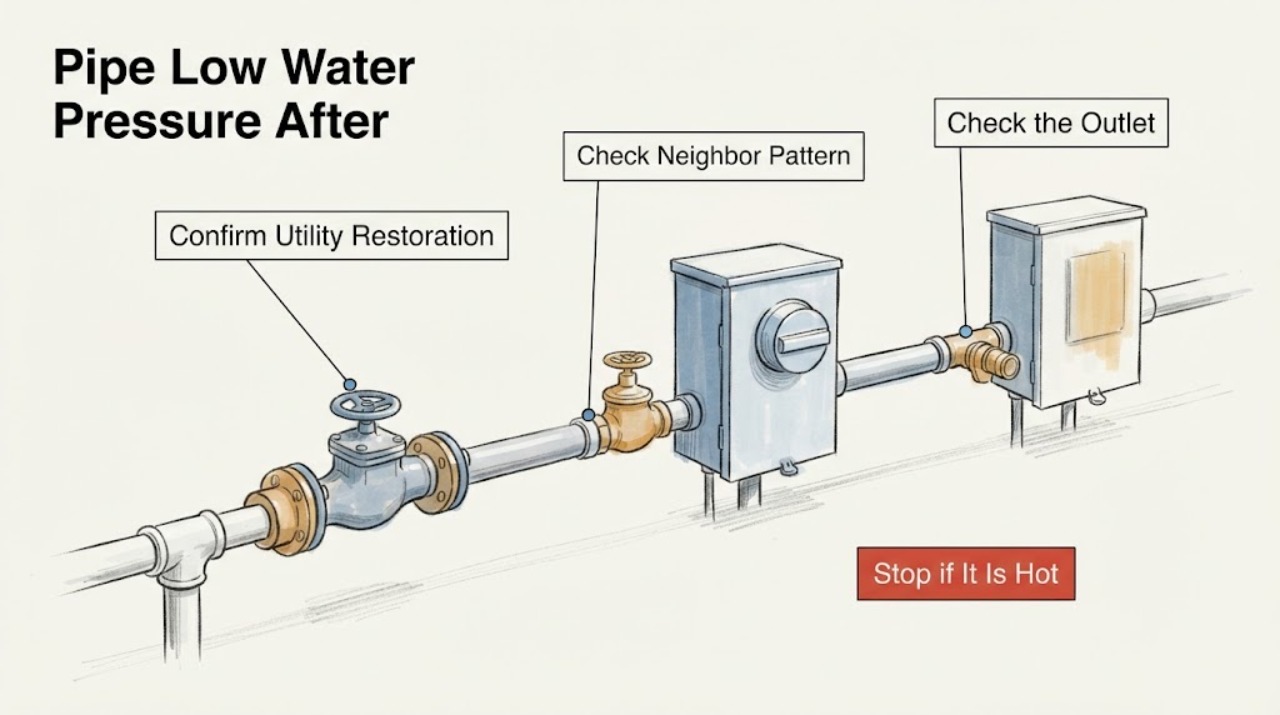
Work through in order
Diagnostic checks
Use only checks that match the exact appliance or system and its official guide.
-
Check 1
Check the water company's official outage or repair notice from a safe location and record whether the burst is repaired, the main has been flushed, service is declared restored, or a boil-water or discolored-water instruction remains active; do not enter the work zone.
Expected result: Record restored, still under repair, delayed restoration, pressure reduced by design, or water-quality instruction active; note whether the notice applies to your address, building, or neighborhood.
Next step: Follow the utility's restoration, water-use, flushing, and reporting instructions; contact the utility for a shared or delayed service issue and do not alter private plumbing to compensate.
Stop if: Do not enter an excavation or crew area, operate a street or meter valve, drink discolored water, or use water contrary to an active health advisory.
Why this matters
Why: A continuing utility restriction can explain low pressure without a private pipe fault. A declared restoration with a remaining isolated symptom makes air, sediment, a valve, leak, or private restriction more relevant, but does not establish which one.
-
Check 2
Ask a nearby neighbor or building manager whether pressure is also low, without entering another property, and compare the report with your own cold-water flow at a low-level and an upper-level fixture if safe.
Expected result: Classify the issue as shared by neighbors or the building, isolated to your property, or unknown because others have not checked; note whether the whole building or only one unit is affected.
Next step: Report a shared or unresolved post-burst pressure problem to the utility or building manager; arrange a plumber for an isolated property after safe external checks.
Stop if: Do not delay response for active flooding, a ruptured pipe, water near electricity, or an unsafe public work area while waiting for neighbor information.
Why this matters
Why: A shared pattern supports an ongoing utility, main, building, or pressure-zone issue. An isolated property keeps attention on the private service line, main valve, PRV, whole-house filter, leak, or internal restriction.
-
Check 3
With fixtures used normally and not left unattended, compare cold and hot flow at several indoor faucets and, only when the area is dry and safe, an outside hose connection; note air sputtering, sediment, discoloration, and whether one branch or all outlets are affected.
Expected result: Record one faucet, some fixtures, all indoor fixtures, indoor and outdoor outlets, cold only, hot only, or air/sediment that diminishes as water runs under an authorized procedure.
Next step: Use this footprint to choose utility versus plumber service and preserve the result; do not create a pressure change by rapidly opening valves or operating extra fixtures.
Stop if: Stop for uncontrolled flow, scalding water, flooding, a pipe movement, a pressure surge, gas odor, or water near powered equipment.
Why this matters
Why: One fixture suggests a screen or local branch. All indoor and outdoor outlets suggests a main valve, service line, PRV/filter, leak, or utility pressure issue. Cold-normal/hot-weak suggests the hot-water branch or heater rather than the repaired main.
-
Check 4
Only after the utility's instructions authorize household flushing, run cold water through a suitable high-capacity outlet such as a tub, utility sink, or outdoor hose connection while watching the discharge and surrounding area; keep filters and hot-water equipment out of the flow unless the utility specifically directs otherwise.
Expected result: Observe rushing air, sputtering, sediment, discoloration, or flow that becomes clear and steadier; record whether the change occurs at the outlet or across the property.
Next step: Stop when the utility's endpoint is reached, replace any removed screen correctly, follow its drinking-water guidance, and report unresolved pressure or water-quality symptoms.
Stop if: Do not flush under an active advisory without following it, use hot water to clear sediment, flush through a refrigerator filter, leave a hose unattended, or continue if flooding, a leak, or pressure surge appears.
Why this matters
Why: Air and disturbed debris can follow a main burst and repair. Improvement supports a temporary restoration effect or screen restriction; persistent low pressure, recurring debris, or water that does not clear needs utility or plumbing assessment rather than stronger flushing.
-
Check 5
If only one faucet remains weak and the surrounding area is dry, inspect its accessible aerator or screen for sediment without forcing the fitting; remove and clean it only when the fixture design permits ordinary access, keeping its small parts in order.
Expected result: Record sand, rust, scale, or other debris; a clean screen; a damaged or missing screen; or a fitting that cannot be removed without force.
Next step: Rinse or replace only the compatible screen according to fixture guidance, compare flow once, and contact a plumber or utility when the restriction remains or sediment continues.
Stop if: Do not probe the pipe, use chemical cleaner, force a pressurized fitting, dismantle a cartridge, or work where escaping water could reach electrical equipment.
Why this matters
Why: A post-burst sediment blockage can limit one outlet even after the main is restored. A clean screen, repeated blockage, or whole-house symptom points to a branch, service line, valve, filter, PRV, leak, or utility issue.
-
Check 6
If the utility reports normal service and all safe outlets remain weak, inspect only visible, dry, user-accessible areas for a partly closed private main valve, a whole-house filter indication, a visibly leaking PRV, wet flooring, or sound of water running when fixtures are off; do not adjust or dismantle anything.
Expected result: Record a valve that is clearly open or partly closed, a filter bypass or blockage indication, a PRV that is leaking or damaged, water movement with fixtures off, or no visible private-side clue.
Next step: If safe, contain a confirmed private leak with the normal accessible shutoff and arrange a plumber; ask the utility to check the meter or service side when the private inspection is inconclusive.
Stop if: Do not open a pressurized filter, adjust a PRV, force the main valve, excavate, enter a flooded space, or touch a wet heater, outlet, panel, pump, or other electrical equipment.
Why this matters
Why: A private restriction or leak may have been exposed or aggravated by the pressure change. A valve or PRV that is stiff, broken, buried, meter-side, or leaking needs a plumber or utility rather than force or adjustment.
-
Check 7
Prepare a handoff record with the burst notice, repair and restoration times, utility instructions, neighbor pattern, hot/cold and indoor/outdoor comparison, flushing result, sediment or discoloration, valve/filter/PRV observations, and any leak or safety sign; do not perform another pressure test by manipulating valves.
Expected result: Confirm that the record distinguishes a shared utility event, one weak faucet, whole-property low flow, a private leak/restriction, hot-only weakness, or unresolved restoration, and states what was left untouched for safety.
Next step: Keep affected fixtures or the private supply isolated as needed and arrange the utility or plumbing service indicated by the pattern; use emergency help for flooding, fire, gas, or immediate electrical danger.
Stop if: Do not restore a leaking or unstable system for convenience, re-enter the repair area, or work around water and electricity together.
Why this matters
Why: A precise sequence helps a utility or plumber separate a distribution pressure issue from low flow caused by sediment or a private component without repeating a potentially damaging operation.
Use your observations
Decision map
Find the observation that best matches what you see, then follow the next safe action.
-
PATH 01Safety boundary
What you see
The water company still lists the burst as under repair, pressure is low for neighbors, or restoration has not been declared complete.
Do this next
Follow official outage and water-quality updates and report the missing or low service through the utility or building manager; keep clear of crews and work zones.
Why this path and its safety boundary
Why it matters: The distribution system or repair work remains the leading explanation; private pipe work cannot restore a utility-side pressure loss.
Safety stop: Do not operate meter valves, enter excavation, or use water contrary to an active advisory.
-
PATH 02Safety boundary
What you see
Neighbors or multiple units have the same low pressure after the burst, or a utility pressure-zone issue is reported.
Do this next
Contact the water utility or building manager and follow its restoration and flushing instructions; do not compensate by changing private valves or regulators.
Why this path and its safety boundary
Why it matters: A utility, building, main, or service restoration issue is more likely than one household fixture.
Safety stop: Stop for flooding, unsafe public work, a ruptured service line, or water near electrical equipment and use the appropriate emergency channel.
-
PATH 03Safety boundary
What you see
Service is restored, flow sputters or carries sediment, and a utility-authorized cold-water flush improves flow or clarity.
Do this next
Complete only the utility-authorized flush, clean accessible screens, and follow its water-use instructions before drinking, cooking, or using hot-water equipment.
Why this path and its safety boundary
Why it matters: Air or debris released by the burst and repair may have temporarily affected household plumbing or screens.
Safety stop: Stop for persistent discoloration, flooding, a leak, pressure surge, or any instruction conflict with a health advisory.
-
PATH 04Safety boundary
What you see
Only one faucet or branch remains weak after restoration and its accessible screen contains sediment.
Do this next
Clean or replace the accessible screen according to the fixture guidance, compare flow once, and arrange plumbing service if restriction or sediment returns.
Why this path and its safety boundary
Why it matters: A localized post-repair blockage is plausible and does not establish a failed water main or private service pipe.
Safety stop: Do not probe pipework, force the fitting, use chemical cleaners, or continue if the fixture leaks.
-
PATH 05Safety boundary
What you see
The utility reports normal pressure and neighbors are normal, but indoor and outdoor outlets at the property remain weak.
Do this next
Leave adjustments and pressurized housings alone and arrange qualified plumber diagnosis; ask the utility to check its meter/service side if ownership is unclear.
Why this path and its safety boundary
Why it matters: A private main valve, service line, PRV, whole-house filter, leak, or corroded pipe is more likely than a single screen.
Safety stop: Do not force a valve, adjust a regulator, open a filter housing, excavate, or enter a flooded or electrically unsafe area.
-
PATH 06Safety boundary
What you see
Cold flow is normal but hot flow is low, or the water-heater area has a leak, gas odor, abnormal flame, smoke, steam, or electrical damage.
Do this next
Stop using the affected hot-water equipment and arrange qualified plumbing, gas, or electrical service as appropriate; follow the utility's water-quality guidance.
Why this path and its safety boundary
Why it matters: The hot-water branch or heater may be involved; this is not a reason to open or relight the heater after a burst.
Safety stop: Do not relight, drain, open, adjust, or bypass the heater when gas, flame, smoke, scalding water, steam, leakage, or electrical risk is present.
Helpful context
Understand the symptom
A burst in the water main can change pressure without proving your pipe failed
When a utility isolates a burst, customers may temporarily lose pressure or service. Repressurization and repair work can also move air and sediment through the service connection and household plumbing. A low-volume faucet can be low flow rather than low static pressure. Treat the exact sequence—utility repair, restoration notice, pressure return, and remaining symptom—as evidence, and keep the public main, the private service line, and a fixture restriction as separate possibilities.
Confirm restoration before flushing or using affected water
The responsible water company controls whether a burst is repaired, the line is flushed, and any water-quality or boil-water instruction is lifted. Until its guidance says otherwise, do not drink or cook with discolored water. If flushing is authorized, start with an appropriate cold-water outlet and protect refrigerator filters, water heaters, boilers, and appliances from sediment according to the utility's instructions. Do not enter a street excavation, operate a utility valve, or improvise a high-pressure flush.
The distribution pattern chooses the next service call
Low pressure at neighboring properties or throughout a building points back to the water company's repair or distribution system. Normal neighbors with weak flow at every fixture shifts attention to the property's main valve, PRV, filter, service line, or leak. One weak faucet after a burst is more consistent with a blocked screen or local restriction. Cold flow that is normal while hot flow is weak points to the hot-water branch or heater, which should not be opened while hot, leaking, gas-affected, or electrically unsafe.
Safety boundary
Stop conditions
- Stop for flooding, a ruptured or bulging pipe, uncontrolled flow, a pressure surge, water near electrical equipment, or any unsafe area; isolate water only from a safe reachable control and arrange emergency help when needed.
- Do not enter an excavation or water-main work zone, open a meter or curb-stop box, operate a utility valve, dig, or interfere with repair crews.
- Do not force the main valve, use tools on a stiff stem, adjust a pressure-reducing valve, open a pressurized filter, or dismantle a pipe or service connection.
- Do not drink or cook with discolored or advisory-affected water, flush through a refrigerator filter, or draw disturbed sediment into hot-water equipment unless the responsible utility specifically authorizes the procedure.
- Stop around a water heater for gas odor, abnormal flame, smoke, steam, scalding water, leakage, or electrical damage; do not relight or service it in that condition.
- Do not enter standing water to reach a valve or touch wet outlets, appliances, panels, pumps, or wiring; leave whole-house low pressure or unresolved post-burst symptoms for the utility or a qualified plumber.
When checks do not resolve it
Need a professional?
Contact the water utility or building manager when the burst is still under repair, neighbors share low pressure, restoration is delayed, a water-quality advisory is active, or the meter/main side may be responsible. Arrange qualified plumbing service for an isolated property with persistent low pressure after utility restoration, a leaking or damaged private valve, PRV, filter, service line, repeated sediment, or a suspected leak. Use emergency help for flooding, a ruptured pipe, gas odor, smoke, fire, or water contacting electricity.
Safety scope: This article supports official-status checks, safe fixture comparison, utility-authorized cold-water flushing, and ordinary-access screen inspection only. It does not authorize work in the street, meter or curb-stop operation, forced valve movement, PRV or pressurized-filter service, excavation, water-heater service, or work around water and electricity.
Common questions
FAQ
Can a water-main burst cause low pressure after the repair?
Yes. Isolating a burst can cause low or no pressure, and restoration can temporarily leave air, sediment, or a delayed utility response. Confirm the utility's status and compare neighbors, hot/cold, and indoor/outdoor fixtures before deciding whether the issue is utility-side or private.
Should I flush my pipes after a water-main break?
Only follow the responsible utility's post-repair instructions. When flushing is authorized, use a suitable cold-water outlet, watch for air and sediment, protect filters and hot-water equipment, and do not drink or cook with discolored or advisory-affected water.
Why is only one faucet weak after the burst?
Sediment released during the repair can lodge in one faucet screen or local branch. If the screen is designed for ordinary access, inspect and clean it without force; a clean screen, recurring sediment, leaks, or weak flow throughout the property needs plumber or utility assessment.
When is low pressure a plumber problem instead of a utility problem?
Use the utility when neighbors or multiple units share the symptom, restoration is delayed, a main break is still active, or the meter-side service may be involved. Use a qualified plumber for an isolated property with normal neighbors and persistent low flow after official restoration, especially with a leak, private valve, PRV, filter, or service-line concern.
Read the exact guide
Official sources
- Main BreaksPhiladelphia Water Department · Municipal water-main guidance; follow the responsible local utility for a different service area.
- Troubleshooting water pressure and flowCity of Portland Water Bureau · Municipal residential pressure-and-flow guidance; local water conditions and qualified plumbing practice control.
- Water Shut OffsNew York City Department of Environmental Protection · Municipal shutoff guidance; local utility notices and health instructions control a different service area.
- Overnight Water Main Break Isolated, Service Being RestoredCity of Richmond Department of Public Utilities · A municipal incident example used to explain the distribution footprint of a main break; it does not predict restoration timing for another location.
- Property Owners and ContractorsCity of Fresno Public Utilities, Water Division · Municipal water-division guidance; local ownership and valve design control a particular property.
- Water Pressure HelpEast Valley Water District · Water-district troubleshooting guidance; private responsibility and regulator practice vary by property and jurisdiction.
Community feedback
Share a repair observation
Share a plain-text repair observation. Accepted observations are published automatically; this page may take a moment to update.