
On this page
Start here
Quick answer
Low water pressure after the main valve was shut off is often a valve-position, trapped-air, sediment, restriction, leak, or water-service issue; do not assume the pipe itself has failed. From a dry, safe position, confirm that the main shutoff valve is intended to be open and has not been left partly closed, but do not force a stiff valve or use tools on it. Compare several cold and hot faucets, an outside hose connection if safe, and the neighbors' water to separate one-fixture flow from a whole-property or utility problem. If sediment entered during the shutoff, clean only accessible faucet screens and flush through a suitable cold-water outlet according to local or utility guidance, while keeping hot-water equipment protected. Stop for an active leak, flooding, a valve that will not operate, water near electrical equipment, a leaking or gas-smelling water heater, or pressure that surges; arrange qualified plumbing service or contact the water utility for a neighborhood or meter-side issue.
Before you begin
Safety first
- This article supports dry external observation, safe comparison of fixtures, and cleaning of an ordinarily accessible screen or utility-authorized cold-water flush only. It does not authorize forced valve operation, meter or curb-stop work, PRV adjustment, pressurized disassembly, concealed-pipe work, water-heater service, or work around water and electricity.
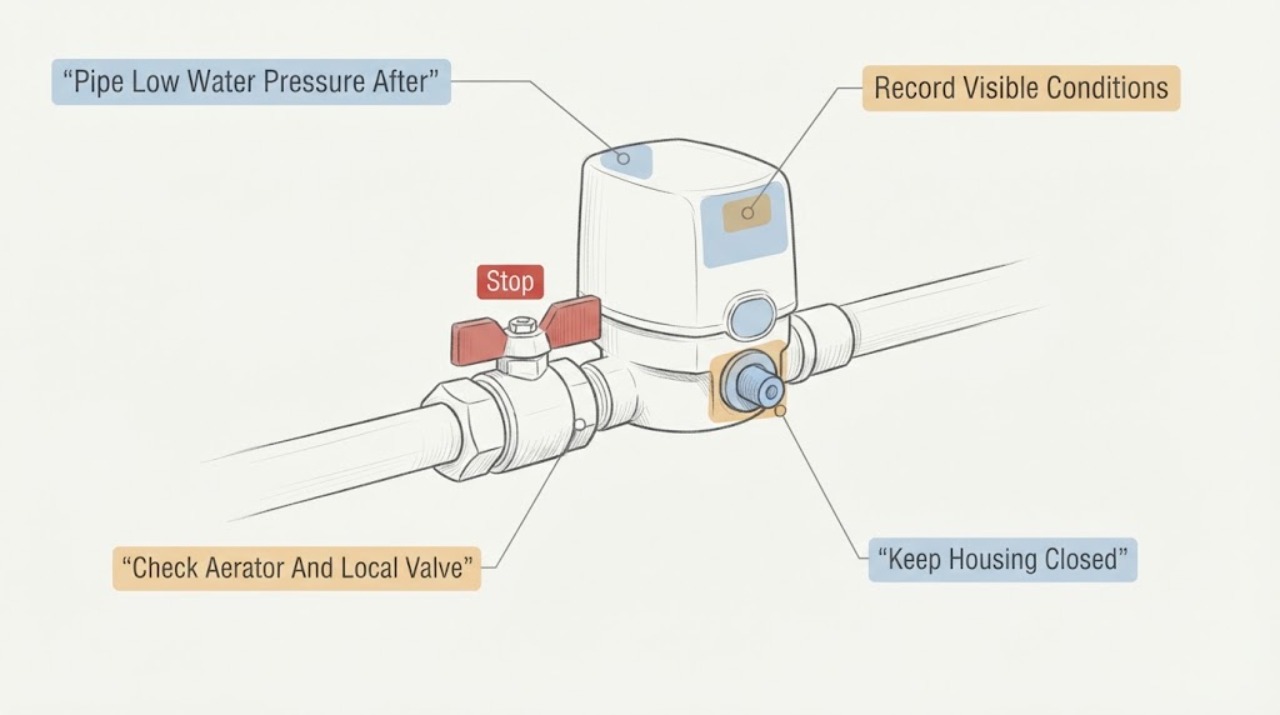
Work through in order
Diagnostic checks
Use only checks that match the exact appliance or system and its official guide.
-
Check 1
From a dry, unobstructed position, record when the main water valve was shut off, why it was shut off, when service was restored, and whether the accessible main valve handle appears open; make only the normal hand movement specified by the valve or utility guidance and do not force it.
Expected result: Record fully open, apparently partly closed, closed, stiff, damaged, leaking, or unknown; note whether the valve is the house main, an irrigation valve, a meter-side curb stop, or a building-controlled valve.
Next step: If the valve is normally operable and safe, leave it in the documented open position and compare fixtures; if its identity or condition is uncertain, stop handling it and arrange the appropriate water-service or plumbing assessment.
Stop if: Do not force the stem, use pliers or a wrench, dismantle a curb stop or pressure regulator, dig around the service, or continue if the valve leaks, sprays, is inaccessible, or may be utility-controlled.
Why this matters
Why: A valve left partly closed after work can restrict the whole property. A stiff, broken, leaking, buried, meter-side, or building-controlled valve is not a DIY adjustment target and may require the utility, property manager, or plumber.
-
Check 2
With outlets operated normally and without leaving a fixture unattended, compare cold and hot flow at more than one indoor faucet, then compare an outside hose connection only if the area is dry and safe; note any rushing air, sputtering, or sudden pressure change.
Expected result: Classify the loss as one fixture, several indoor fixtures, all indoor and outdoor fixtures, cold only, hot only, or a temporary air/sputter that improves as service settles.
Next step: Use the footprint to choose the next safe check and include the comparison in a plumber or utility report; do not add loads, rapidly cycle valves, or continue if pressure surges or water escapes.
Stop if: Stop for uncontrolled flow, an active leak, flooding, scalding hot water, water near electrical equipment, a gas odor, or any need to open a water heater or concealed pipe.
Why this matters
Why: One fixture suggests a screen or local branch restriction. All outlets, including outside, suggest a main valve, PRV, whole-house filter, leak, service-line, or utility issue. Cold normal but hot weak points toward hot-water equipment or its branch rather than the main pipe.
-
Check 3
If only one faucet has low flow and the area is dry, inspect the faucet screen or aerator and the visible local stop valves without forcing a fitting; remove and clean the screen only if it is designed for ordinary access, keeping its parts in order.
Expected result: Record a screen blocked with sand, scale, rust, or other sediment; a local valve partly closed; a clean screen; a damaged fitting; or an assembly that cannot be removed without force.
Next step: Rinse or clean only the accessible screen as appropriate, restore it correctly, and compare flow once; if the blockage returns, the faucet is damaged, or flow remains low, arrange plumbing service and preserve a sediment sample or photo if safe.
Stop if: Do not use excessive force, probe deep into a pipe, remove a cartridge, loosen a pressurized connection, mix chemical cleaners, or work where a leak could reach electrical equipment.
Why this matters
Why: A localized blockage or partly closed local valve can restrict flow after service work without proving a whole-house pressure loss. A clean screen, damaged fitting, or forced-access requirement shifts the issue to the branch or fixture and needs a more specific assessment.
-
Check 4
If the utility or building has confirmed that service is restored and the water is safe for flushing, use one suitable cold-water outlet such as a tub spout, utility sink, or outdoor hose connection to run a controlled flush; remove a screen only when the outlet and screen are meant for ordinary access.
Expected result: Observe rushing air, sputtering, visible sediment, discoloration, or flow that becomes steadier; note whether the issue clears at that outlet or remains across the home.
Next step: Follow the local utility's flushing and drinking-water instructions, replace cleaned screens correctly, and contact the utility or plumber if flow remains low or water remains discolored; protect hot-water equipment until cold water is clear when utility guidance requires it.
Stop if: Do not flush through a suspected contaminated or unsafe supply, use hot water to clear sediment, run water into electrical equipment, leave a hose unattended, or continue if flooding, pipe movement, a leak, or pressure surge appears.
Why this matters
Why: Air and disturbed sediment can follow shutoff or nearby repairs and can restrict screens. Persistent low flow after a controlled flush, repeated sediment, or water that does not clear according to utility guidance is not permission to increase pressure or open the pipe.
-
Check 5
For low flow at all indoor and outdoor outlets, inspect only visible, dry, user-accessible areas for a whole-house filter bypass position, a pressure-reducing valve, unusual running-water sound, or visible leak; do not adjust the regulator or open a filter housing under pressure.
Expected result: Record a failed or bypassed filter indication, a regulator that is visibly damaged or leaking, water movement when fixtures are off, wet soil or flooring, or no visible restriction.
Next step: Shut water only if needed to contain a confirmed leak and it is safe to reach the valve; otherwise leave the system undisturbed and arrange a plumber. Ask the utility to check the meter or service side when the private-side checks do not explain the loss.
Stop if: Do not open pressurized housings, adjust a PRV, excavate, enter a flooded space, touch wet electrical equipment, or approach a water heater with a gas smell, flame, smoke, or electrical damage.
Why this matters
Why: A whole-house filter, PRV, leak, corroded service pipe, or valve can reduce flow after the main was operated. A hidden leak or failed regulator cannot be cleared by forcing the main valve or changing an adjustment screw.
-
Check 6
Ask a nearby neighbor or building manager, without entering another person's property, whether the same low pressure or no-water event occurred and whether street, meter, or water-main work was announced; check only public notices or the utility's official service-status channel.
Expected result: Record the symptom as isolated to the property, shared by the building, shared by neighbors, or associated with a recent main repair, shutoff notice, open hydrant, or service interruption.
Next step: Contact the water utility or building manager for a service-side check when the pattern is shared or restoration is delayed; contact a qualified plumber for an isolated private-side problem.
Stop if: Do not open a street or meter box, operate a utility valve, dig, enter a work zone, or delay emergency action for an active leak or flooding while waiting for a status update.
Why this matters
Why: A shared pattern or recent water-main work makes a utility or building-side cause more likely, while an isolated property with normal neighbors keeps attention on the house valve, service line, PRV, filter, leak, or private pipe.
-
Check 7
Prepare a service record with the shutoff and reopening times, main valve identity and observed position, affected fixtures, hot/cold and indoor/outdoor comparison, sediment or discoloration, visible leaks, neighbor status, and any safe-distance photos; do not perform another pressure test by manipulating valves.
Expected result: Confirm that the record distinguishes one fixture, the whole property, hot only, a shared utility event, a suspected leak, or a valve/PRV/filter condition, and states what was not touched because it was unsafe.
Next step: Keep affected fixtures or the main supply isolated as needed for safety and arrange plumber or utility service; use emergency services for flooding, gas, fire, or immediate electrical danger.
Stop if: Do not restore a leaking or unstable system for convenience, force the main valve, dismantle pipework, or work around water and electricity together.
Why this matters
Why: A precise sequence lets a plumber or utility separate low flow from low pressure and determine whether the fault is after the meter, at the service, or in the distribution system without repeating a potentially damaging operation.
Use your observations
Decision map
Find the observation that best matches what you see, then follow the next safe action.
-
PATH 01Safety boundary
What you see
The house main valve was used for the work, appears partly open, and low flow affects the property broadly without a leak or hazard.
Do this next
Only if the valve is clearly the homeowner's, dry, intact, and normally operable, leave it in the manufacturer's or utility's fully open position without force; otherwise call a plumber or utility.
Why this path and its safety boundary
Why it matters: A partially reopened main valve is a plausible restriction after a shutoff, but an old or damaged valve can fail internally when operated.
Safety stop: Do not use tools, force a stuck stem, dismantle the valve, or continue if it leaks, sprays, is meter-side, or may be utility-controlled.
-
PATH 02Safety boundary
What you see
Only one faucet or branch has low flow and its accessible screen shows sediment or scale after service was shut off.
Do this next
Clean and replace only the accessible screen as appropriate, compare flow once, and arrange plumbing service if sediment returns or the branch remains weak.
Why this path and its safety boundary
Why it matters: A local screen or branch restriction is more likely than a whole-house pressure failure.
Safety stop: Do not probe pipes, force fittings, use chemical drain products, or continue if the fixture leaks or water can reach electrical equipment.
-
PATH 03Safety boundary
What you see
Flow sputters or carries visible sediment immediately after the main or nearby water service was restored and then becomes steadier at a safe cold-water outlet.
Do this next
Follow the utility's controlled flushing and drinking-water guidance, clean accessible screens, and protect hot-water equipment until the water is suitable under that guidance.
Why this path and its safety boundary
Why it matters: Trapped air or disturbed sediment may be affecting the outlet or screens temporarily; this is not evidence that a pressure regulator should be adjusted.
Safety stop: Stop for persistent discoloration, flooding, a leak, pipe movement, pressure surge, or water near electrical equipment.
-
PATH 04Safety boundary
What you see
Indoor and outdoor outlets are all weak, neighbors have normal service, and there is no confirmed utility outage.
Do this next
Leave adjustments and pressurized housings alone and arrange qualified plumber diagnosis; include the valve position, fixture comparison, leak observations, and service history.
Why this path and its safety boundary
Why it matters: The restriction may be private-side: main valve, PRV, whole-house filter, service line, corrosion, or a leak.
Safety stop: Do not adjust the PRV, open the filter housing under pressure, excavate, or enter a flooded or electrically unsafe area.
-
PATH 05Safety boundary
What you see
Cold flow is normal but hot flow is weak, or the water heater area shows leaking, unusual noise, gas odor, smoke, or electrical damage.
Do this next
Stop using the affected hot-water equipment and arrange qualified plumbing or appropriate gas/electrical service; provide the shutoff history and hot/cold comparison.
Why this path and its safety boundary
Why it matters: The hot-water branch or water heater may be restricting flow or failing; the main pipe is not established as the cause.
Safety stop: Do not open, relight, adjust, drain, or bypass water-heater components when there is gas odor, flame abnormality, smoke, hot water/steam, leaking water, or electrical risk.
-
PATH 06Safety boundary
What you see
Neighbors or the building share the low pressure, a shutoff notice is active, or recent water-main work is known.
Do this next
Contact the water utility or building manager through its official channel, follow its restoration and flushing guidance, and avoid changing private valves beyond safe visual confirmation.
Why this path and its safety boundary
Why it matters: The cause may be a distribution or building-side service interruption, temporary pressure change, air, or sediment from repair work.
Safety stop: Do not enter a work zone, open a meter box, operate a utility valve, or delay emergency response for flooding, a ruptured pipe, or electrical contact with water.
Helpful context
Understand the symptom
Keep the main valve and the condition separate from the diagnosis
The assigned condition is low pressure after the main valve was shut off, and the wording may describe a main value/valve that was closed during work. A valve left partly open can restrict the whole property, but a low-flow complaint can also come from a clogged screen, a pressure-reducing valve, a whole-house filter, corroded pipe, a leak, trapped air, or a water-service event. A faucet that delivers less volume is not automatically proof that static pressure in the pipe is low. Record what was shut off, when it was reopened, and whether the symptom affects hot, cold, indoor, and outdoor outlets.
Restore flow without forcing a valve or protecting sediment in hot equipment
After water service is restored, air and disturbed sediment can briefly change flow or collect at faucet screens. Use a suitable, accessible cold-water outlet for a controlled flush and remove only screens that can be handled without force, keeping small parts in order. Do not force the main valve, dismantle a curb stop or pressure regulator, flush questionable water through hot-water equipment, or work around wet electrical equipment. If the valve feels broken, the water is discolored beyond the utility's guidance, or flow does not recover, preserve the sequence for a plumber or utility.
Use the footprint of the pressure loss to choose the handoff
One faucet or one branch suggests a screen, local valve, cartridge, or branch restriction. Low flow at every indoor and outdoor outlet points toward the main valve, PRV, whole-house filter, service line, leak, or utility supply. Normal cold flow with weak hot flow moves attention toward the water heater or hot-water branch, where scalding, gas, and electrical hazards make internal work a service task. If neighbors are also affected, or the street has recent water work, contact the water utility or building manager rather than altering private plumbing.
Safety boundary
Stop conditions
- Stop for an active leak, flooding, a ruptured or bulging pipe, uncontrolled flow, or pressure surge; isolate water only from a safe reachable valve and arrange emergency plumbing help when needed.
- Do not force the main valve, use pliers or a wrench on a stiff stem, open a meter or curb-stop box, adjust a pressure regulator, or dismantle a pressurized filter or pipe.
- Stop and keep away from water near outlets, appliances, wiring, panels, pumps, or other electrical equipment; do not enter standing water to reach a valve.
- For a water heater, stop for gas odor, abnormal flame, smoke, electrical damage, scalding water, steam, or a leak; do not relight, open, drain, or repair it without the appropriate qualified professional.
- Do not flush questionable water through hot-water equipment, mix chemical cleaners, or use high pressure, heat, or improvised tools to clear a pipe.
- Leave whole-house low pressure, repeated sediment, a damaged valve/PRV, unexplained pressure loss, or a suspected service-line leak for a qualified plumber or water utility.
When checks do not resolve it
Need a professional?
Arrange qualified plumbing service for low pressure that remains after the main valve is safely confirmed open, an old/stiff/leaking valve, a failed or leaking pressure-reducing valve or whole-house filter, repeated sediment, a suspected service-line leak, or any unexplained whole-house restriction. Contact the water utility or building manager when neighbors are affected, a shutoff notice or water-main work is involved, or the meter/service side may be responsible. Use emergency help for flooding, a ruptured pipe, gas odor, fire, or water contacting electricity.
Safety scope: This article supports dry external observation, safe comparison of fixtures, and cleaning of an ordinarily accessible screen or utility-authorized cold-water flush only. It does not authorize forced valve operation, meter or curb-stop work, PRV adjustment, pressurized disassembly, concealed-pipe work, water-heater service, or work around water and electricity.
Common questions
FAQ
Why is water pressure still low after the main valve was turned back on?
The main valve may be partly open or damaged, but low flow can also come from air or sediment after restoration, a faucet screen, PRV, whole-house filter, leak, hot-water branch, or utility event. Compare several hot and cold fixtures and indoor/outdoor outlets before choosing a plumber or utility handoff.
Should I force the main water valve fully open?
No. Confirm its identity and observe its position only from safe access. Do not use pliers or a wrench on a stiff stem, operate a utility-controlled curb stop, or dismantle the valve. A valve that is stuck, leaking, damaged, or not clearly yours needs qualified plumbing or water-service help.
Can shutoff work clog faucet aerators?
Yes. Disturbed sediment can collect at an accessible faucet screen after water service is interrupted or repaired. If only one fixture is weak and the screen can be removed without force, clean and replace it correctly; persistent or whole-house low flow needs plumbing or utility assessment.
When should low pressure go to the water utility instead of a plumber?
Contact the utility or building manager when neighbors share the symptom, a shutoff notice or main work is active, restoration is delayed, or the meter-side service may be involved. An isolated property with a safe, fully open private valve and normal neighbors is more likely to need a qualified plumber.
Read the exact guide
Official sources
- Troubleshooting water pressure and flowCity of Portland Water Bureau · Municipal residential water-pressure guidance; local water conditions and qualified plumbing practice control.
- Property Owners and ContractorsCity of Fresno Public Utilities, Water Division · Municipal water-division guidance for property owners; local valve design and utility instructions control a particular installation.
- Main BreaksPhiladelphia Water Department · Municipal water-main guidance; use the local utility's instructions for a different distribution system.
- Water Shut OffsNew York City Department of Environmental Protection · Municipal shutoff and restoration guidance; follow the responsible local utility's instructions for a different service area.
- Water Pressure HelpEast Valley Water District · Water-district troubleshooting guidance; pressure-regulator work and private plumbing responsibility vary by property and jurisdiction.
Community feedback
Share a repair observation
Share a plain-text repair observation. Accepted observations are published automatically; this page may take a moment to update.